Form 8960: Filing the 3.8% Net Investment Income Tax
Form 8960 is where the net investment income tax stops being a paragraph in the statute and becomes a number on a return. Section 1411 creates the tax at 3.8 percent. Form 8960 measures it, line by line, and carries the result onto Schedule 2 of Form 1040. This guide is the filing operation: who must attach the form, how its 21 lines are built, and how the tax interacts with estimated payments. The tax itself is covered in our companion guide, Section 1411 Net Investment Income Tax Playbook. The wage-side surtax is our IRS Form 8959 Additional Medicare Tax playbook.
Who Must File
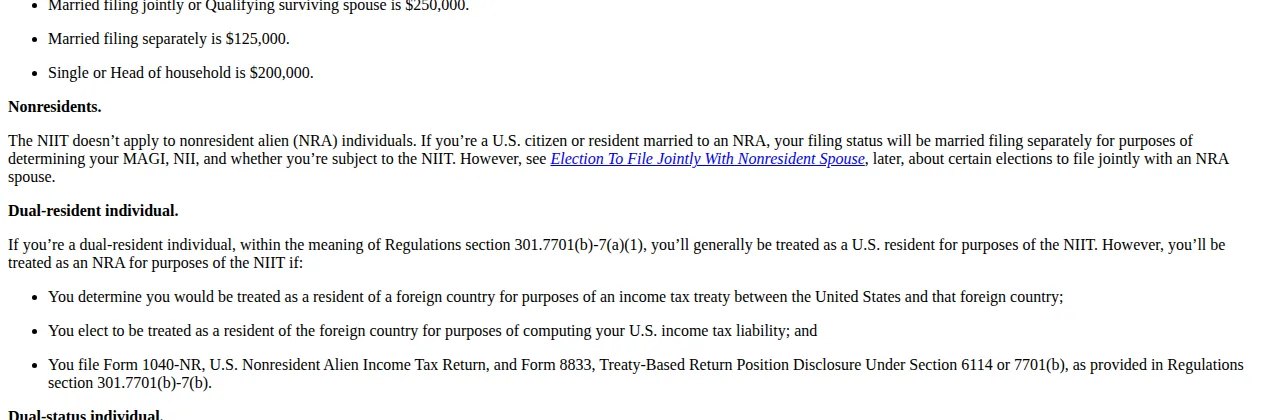
The instructions state the filing rule in one sentence: attach Form 8960 if your modified adjusted gross income, MAGI, is greater than the applicable threshold amount. It is a MAGI test, not an investment-income test. A filer with no investment income but MAGI above the threshold still attaches the form, and the computation produces zero tax.
The thresholds are written into section 1411(b) as fixed dollar figures, not indexed for inflation, so the filing population grows every year as nominal incomes rise.
| Filing status | Threshold amount | Authority |
|---|---|---|
| Married filing jointly | $250,000 | 26 U.S.C. § 1411(b)(1) |
| Qualifying surviving spouse | $250,000 | 26 U.S.C. § 1411(b)(1) |
| Married filing separately | $125,000 | 26 U.S.C. § 1411(b)(2) |
| Single | $200,000 | 26 U.S.C. § 1411(b)(3) |
| Head of household | $200,000 | 26 U.S.C. § 1411(b)(3) |
Estates and trusts use a different threshold, the dollar amount at which the highest tax bracket begins under section 1(e), which moves with inflation. For 2025 it is $15,650, per IRS Topic No. 559.
The Computation in One Paragraph
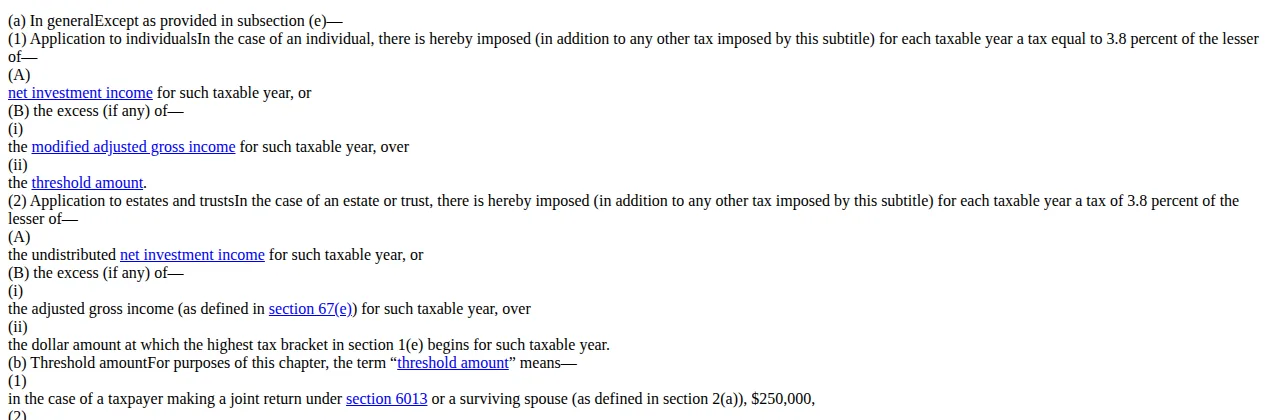
The whole form reduces to one formula, and every line exists to feed it. Net investment income is built in Parts I and II. MAGI is entered on line 13. The tax is 3.8 percent of the smaller of net investment income or the amount by which MAGI exceeds the threshold:
The lesser-of rule is why the form asks for two quantities and discards the larger one: a taxpayer with $500,000 of investment income and MAGI only $10,000 over the threshold pays 3.8 percent on $10,000.
Worked Examples
Example 1, single filer. MAGI is $260,000 and net investment income is $40,000. The threshold is $200,000, so the MAGI excess is $60,000. The lesser of the two is $40,000, and the tax is $1,520. On the form: lines 13 through 17 read $260,000, $200,000, $60,000, $40,000, and $1,520.
Example 2, married filing jointly. MAGI is $400,000 and net investment income is $90,000. The threshold is $250,000, so the MAGI excess is $150,000. The lesser of $90,000 and $150,000 is $90,000, and the tax is $3,420.
Example 3, married filing separately. MAGI is $150,000 and net investment income is $60,000. The threshold is $125,000, so the MAGI excess is $25,000. The lesser of the two is $25,000, and the tax is $950.
Example 4, the MAGI add-back. A single filer has adjusted gross income of $230,000 and excluded $40,000 of foreign earned income under section 911, with $8,000 of deductions disallowed under section 911(d)(6). MAGI is $230,000 plus the $32,000 excess: $262,000.
The instructions add a trust example: two beneficiary contracts hold $16,000 of interest and $21,000 of dividends. The $15,650 threshold is multiplied by two contracts, giving $31,300 on line 19b, an excess of $5,700, and tax of $216.60.
Part I: Investment Income, Lines 1 to 8
Part I totals gross investment income before any deduction. Lines 1, 2, and 3 are taxable interest, ordinary dividends, and annuities, taken from the corresponding lines of the return. Tax-exempt interest does not appear: it is excluded income, listed in the instructions alongside wages, unemployment compensation, and Social Security benefits.
Line 4 is where rental and passthrough income enters. Line 4a covers rental real estate, royalties, partnerships, S corporations, trusts, and trades or businesses, and the instructions state that it includes total income reported on Schedules C, E, and F of Form 1040 that is potentially subject to the tax. Line 4b removes net income or loss derived in the ordinary course of a trade or business that is not a section 1411 trade or business, and line 4c combines the two. Income from a business in which the taxpayer materially participates is not net investment income. The Section 469 passive activity rules explain the material participation tests, and our Schedule E rental income guide covers the most common line 4a item.
Line 5 is net gain or loss from the disposition of property. Line 5a is the net gain or loss. Line 5b removes the portion not subject to the tax, including gain on property held in a trade or business that is not a section 1411 trade or business. Line 5c is the adjustment from the disposition of a partnership interest or S corporation stock, counted only to the extent of the net gain that would be taken into account if all the entity property were sold at fair market value immediately before the disposition.
Line 6 is adjustments for certain controlled foreign corporations and passive foreign investment companies. Line 7 is other modifications, including deduction recoveries under the tax benefit rule of section 111; a recovery of a deduction taken in a tax year beginning before 2013 is never included. Line 8 is total investment income: lines 1, 2, 3, 4c, 5d, 6, and 7 combined.
Part II: Allocable Deductions, Lines 9 to 11
Part II is short and frequently underclaimed, which means taxpayers overpay. Line 9a is investment interest expense. Line 9b is state, local, and foreign income tax properly allocable to investment income. Line 9c is miscellaneous investment expenses, and line 9d adds the three. Line 10 is additional modifications, including the trader worksheet keyed off Schedule SE line 3. Line 11 is total deductions and modifications: line 9d plus line 10.
One feature deserves attention: the state income tax on line 9b is allocated to investment income independently of the regular income tax rules, and the instructions state that its deductibility for this tax is independent of the alternative minimum tax. Only deductions properly allocable to investment income reduce the tax.
Part III: Tax Computation, Lines 12 to 21
Line 12 is net investment income: Part I line 8 minus Part II line 11. If the result is zero or less, enter zero. Individuals complete lines 13 through 17; estates and trusts complete lines 18a through 21.
Line 13 is MAGI. For most filers it is simply adjusted gross income from Form 1040 or 1040-SR. Expatriates and owners of foreign entities use the Line 13 worksheet and the adjustments under Regulations section 1.1411-10(e)(1).
Line 14 is the threshold from the table above, based on filing status. Line 15 subtracts line 14 from line 13; if zero or less, enter zero. Line 16 is the smaller of line 12 or line 15, and line 17 multiplies line 16 by 3.8 percent. That is the tax for an individual.
For estates and trusts, line 18a is net investment income, line 18b is deductions for distributions and charitable deductions, and line 18c is undistributed net investment income. Line 19a is adjusted gross income under section 67(e), line 19b is the highest bracket threshold, $15,650 for 2025, line 19c is the excess, line 20 is the smaller of the two, and line 21 multiplies line 20 by 3.8 percent.
Where the Tax Lands
Line 17 does not stay on Form 8960. The instructions direct Form 1040 and 1040-SR filers to include it on Schedule 2 (Form 1040), line 12, from where it flows into total other taxes and then into total tax. Form 1040-NR filers use the corresponding line of their residency statement, and for estates and trusts line 21 goes onto Form 1041. Nothing is withheld from interest, dividends, or capital gains to cover it.
Estimated Tax: Paying During the Year
The net investment income tax must be included when figuring estimated tax. The Form 1040-ES worksheet carries a line for other taxes, and its instructions direct the net investment income tax onto that line, alongside the additional Medicare tax. IRS Topic No. 559 states that taxpayers may need to increase withholding or estimated taxes because of the additional liability. Take the projected line 17 amount for the year and divide it by four.
A couple filing jointly that projects $3,420 for the year, as in Example 2, adds $855 to each quarterly payment. A single filer projecting $1,520, as in Example 1, adds $380 per quarter. The estimated tax voucher guide, IRS Form 1040-ES estimated tax voucher playbook, covers the voucher mechanics and due dates.
An underpayment of estimated tax can draw a penalty under section 6654, computed on the shortfall for each quarter; no rate is quoted here because the penalty is interest-based and varies by quarter. The safe harbors are the usual ones: at least 90 percent of the current year tax, or 100 percent of the prior year tax, 110 percent for higher-income taxpayers. Withholding is treated as paid evenly through the year even when it is not, so a taxpayer with wage income can sometimes cover a shortfall by increasing withholding late in the year.
Founder & CEO Insight — Enow A. Jovial
MAGI, Foreign Income, and the Joint-Return Elections
Line 13 is where the filing operation most often goes wrong for internationally mobile taxpayers. MAGI is adjusted gross income increased by the excess of amounts excluded under section 911(a)(1) over deductions disallowed under section 911(d)(6). The Line 13 worksheet walks through it in four lines: AGI, the foreign earned income exclusion from Form 2555 line 42 less the allocable deductions from Form 2555 line 44, and the sum.
Foreign entity owners face further adjustments under Regulations section 1.1411-10(e)(1), and the instructions flag digital asset income as potentially subject to the tax.
Three elections sit at the top of Part I as checkboxes. The section 6013(g) election applies where a nonresident alien is married to a United States citizen or resident at the end of the tax year. The section 6013(h) election applies where at least one spouse was a nonresident alien at the beginning of the year but is a citizen or resident, married to a citizen or resident, at the end. Either election can be applied for net investment income tax purposes, so the couple uses combined income and the $250,000 joint threshold instead of $125,000. The election must be made for the first tax year in which the United States taxpayer is subject to the tax. The Regulations section 1.1411-10(g) election is the third checkbox, for controlled foreign corporations and qualified electing funds.
Common Errors
| Error | What happens | Authority |
|---|---|---|
| Using AGI instead of MAGI on line 13 | Foreign earned income exclusion stays out, tax understated | Form 8960 instructions, Line 13 |
| Entering the wrong threshold on line 14 | Married filing separately at $200,000 instead of $125,000 | 26 U.S.C. § 1411(b)(2) |
| Netting active business income on line 5 instead of line 4b | Disposition gain misclassified, NII overstated | 26 U.S.C. § 1411(c)(2); Reg. § 1.1411-4 |
| Leaving line 9 blank | Allocable deductions unclaimed, tax overstated | Form 8960 instructions, Part II |
| Omitting NIIT from estimated tax | Underpayment surfaces at filing, section 6654 penalty | Form 1040-ES instructions |
The threshold error is the most expensive single keystroke on the form: entering $200,000 on line 14 instead of $125,000 understates the MAGI excess by $75,000, up to $2,850 of tax that never appears on line 17.
A second class of error is documentary: the instructions require records kept for the entire life of the investment to show how basis was calculated. Have a CPA review the first filing: the return carries the filer's SSN or EIN, FICA wages and SECA earnings stay outside net investment income, and S-Corp, C-Corp, and LLC income is tested line by line.
Filing Checklist
- Confirm the gate: compute MAGI first. At or below the threshold, stop.
- Assemble the inputs: Forms 1099-INT, 1099-DIV, 1099-B, Schedules C, E, and F, and every K-1.
- Complete Part I: lines 1 to 3 from the 1099s, line 4 from Schedules C, E, and F, line 5 from dispositions, lines 6 and 7 for foreign entities and recoveries.
- Complete Part II: investment interest, allocable state and foreign tax, other allocable deductions, line 10.
- Complete Part III: line 12 net investment income, line 13 MAGI, line 14 threshold, line 16 lesser of the two, line 17 tax at 3.8 percent.
- Route the answer: line 17 onto Schedule 2, line 12.
- Pay during the year: add projected tax to the Form 1040-ES other taxes line, divided by four, or increase withholding.
- Keep the file: retain the worksheets, K-1s, and basis records.
Form 8960 rewards a filer who treats it as an accounting system. The statute supplies the rate and the thresholds, the form supplies the sequence, and the instructions supply the definitions. Run the estimated tax projection with our Self-Employed Tax Estimator before the first voucher is due.