Form 8959: Filing the 0.9% Additional Medicare Tax
Form 8959 is where the Additional Medicare Tax stops being a statute paragraph and becomes a number on a return. The rate is 0.9 percent, but only above a filing-status threshold, the withholding trigger uses a different number, and self-employment income is tested against a threshold wages have already partly consumed. This guide covers who must attach the form, how its 24 lines are built, and how the tax is paid. The companion surtax is in our Section 1411 Net Investment Income Tax Playbook, filed via our IRS Form 8960 Playbook.
The tax is a surtax on earned income for years beginning after December 31, 2012, on top of ordinary Medicare tax. An employee pays 1.45 percent on all wages, then 0.9 percent more above the threshold, for 2.35 percent on that slice. A self-employed person pays the 2.9 percent SECA rate, then 0.9 percent more, for 3.8 percent there. The employer pays its 1.45 percent and nothing on the extra 0.9 percent; there is no employer match, per IRS Topic No. 560. Form 8959 attaches to Form 1040, 1040-SR, 1040-NR, or 1040-SS; the total lands on Schedule 2.
Founder & CEO Insight — Enow A. Jovial
The Thresholds
Every computation starts by picking the threshold from the filing status. The instructions print the table on the form itself, noting the amounts are not indexed for inflation. As nominal pay rises, more filers cross thresholds set in 2010 and never adjusted.
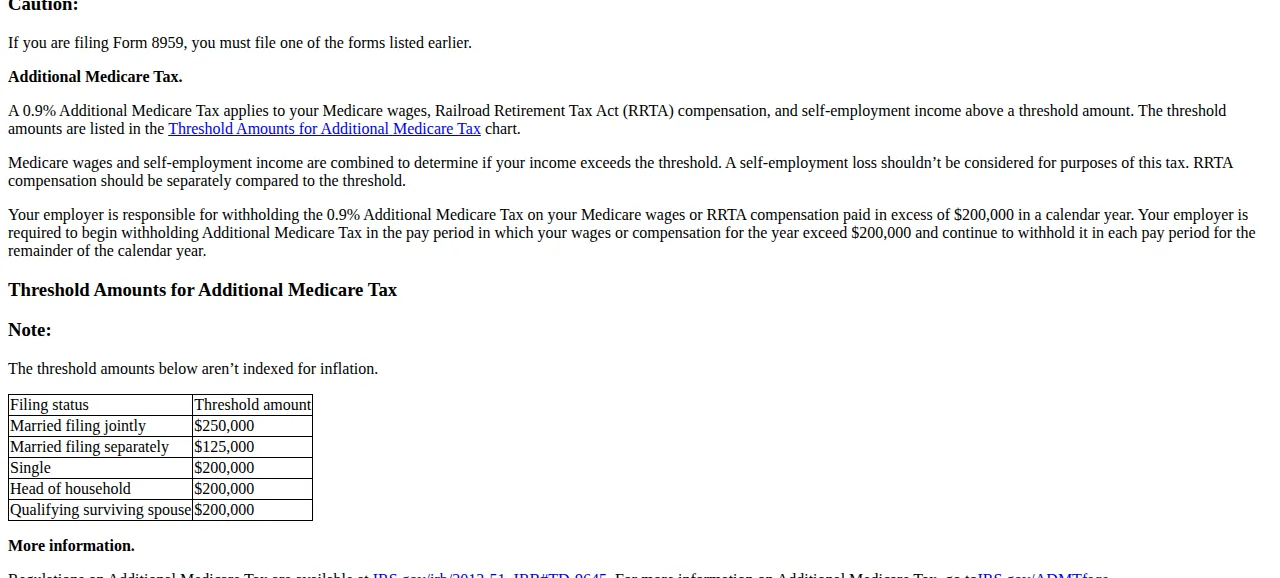
| Filing status | Threshold | Authority |
|---|---|---|
| Married filing jointly | $250,000 | 26 U.S.C. 3101(b)(2)(A) |
| Married filing separately | $125,000 | 26 U.S.C. 3101(b)(2)(B) |
| Single | $200,000 | 26 U.S.C. 3101(b)(2)(C) |
| Head of household | $200,000 | 26 U.S.C. 3101(b)(2)(C) |
| Qualifying surviving spouse | $200,000 | 26 U.S.C. 3101(b)(2)(C) |
The separate figure is half the joint figure: one $250,000 threshold split in half, not two $200,000 thresholds. That catches couples who file separately for student-loan or state-tax reasons and assume each spouse keeps a full threshold. Single and head of household filers share the $200,000 figure.
What Counts
Three kinds of income feed the tax, each tested in its own part. Part I covers Medicare wages: W-2 box 5, plus unreported tips from Form 4137 line 6, plus wages from Form 8919 line 6. Box 5 is the number that matters, not box 1, which is reduced by pre-tax 401(k) contributions while box 5 generally is not. Unreported tips still count, with a 50 percent penalty on the taxes due on them. Part II covers self-employment income: Schedule SE, Part I, line 6, with a loss entered as zero, since a loss cannot shelter wages or offset a spouse's income. Part III covers Railroad Retirement Tax Act compensation: W-2 box 14, plus tips, with employee representatives using Form CT-2 line 2. RRTA compensation is compared separately: $150,000 of RRTA pay plus $150,000 of wages owes nothing on either track.
Two parallel statutes run the form. Section 3101(b)(2) imposes 0.9 percent on wages above $250,000 joint, half that amount separate, and $200,000 in any other case. Section 1401(b)(2) imposes the same 0.9 percent on self-employment income above the same thresholds, with one difference, the coordination rule in section 1401(b)(2)(B): the self-employment threshold is reduced, but not below zero, by the wages taken into account on the wage tax. Wages are tested first and consume the threshold.
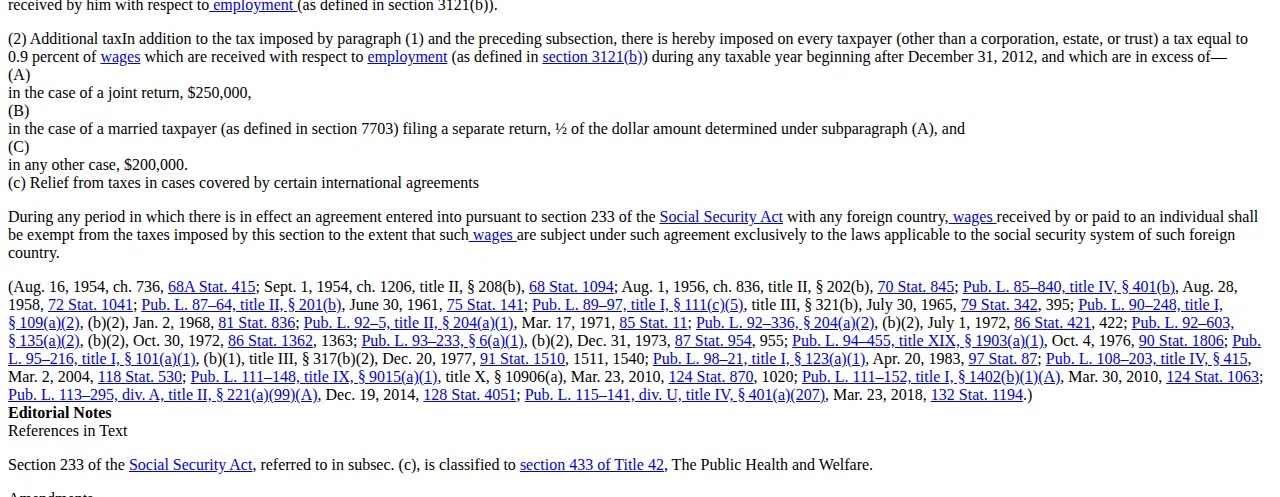
Line 10 carries line 4 wages into Part II, line 11 subtracts them from the threshold, and line 12 subtracts the reduced threshold from self-employment income. A filer with wages alone never touches Part II. FICA and SECA share one threshold here.
Worked Example 1: Single Filer, $260,000 Wages
A single filer earns $260,000 of Medicare wages, shown in box 5 of a single W-2, against a $200,000 threshold. The excess is the wage total minus the threshold.
The filer owes $540, which the employer should already have withheld once wages crossed $200,000. Part V reconciles the $540 withheld against the $540 owed. Total employee-side Medicare tax is 1.45 percent on $260,000, or $3,770, plus $540, for $4,310.
Worked Example 2: Married Couple, Two Paychecks
A married couple files jointly: spouse A earns $180,000, spouse B earns $110,000. Neither crosses $200,000 alone, so neither employer withholds anything. But the form tests combined wages of $290,000 against the joint threshold of $250,000.
The couple owes $360, withheld by no employer: withholding is per-employee and per-employer, while the tax is per-return. The fix is planned during the year: one spouse files a new Form W-4 requesting additional income tax withholding, or the couple pays estimated tax. Additional W-4 withholding is income tax withholding, not Additional Medicare Tax withholding, and cannot be designated for the surtax; it still counts against total tax on the return.
Worked Example 3: Self-Employed Filer
A self-employed consultant, single, reports $300,000 of self-employment income on Schedule SE, Part I, line 6, and has no wages. The threshold is $200,000 and no wages reduce it.
The filer owes $900, on top of regular SECA Medicare tax of 2.9 percent on $300,000, or $8,700. The combined SECA rate on the $100,000 slice is 3.8 percent. Nothing was withheld, so the $900 must be covered by estimated tax payments. Our Self-Employed Tax Estimator Tool models the quarterly set-aside, including the 15.3 percent combined SECA rate and the extra 0.9 percent.
Now add wages: the consultant also earns $220,000 of Medicare wages, still single, with $150,000 of self-employment income. Wages are tested first: the excess over $200,000 is $20,000, and the tax on wages is $180. Then the threshold for self-employment income is reduced by the full $220,000 of wages, driving it to zero.
Every dollar of self-employment income is taxed because wages consumed the threshold. Testing the two incomes independently understates the bill by $1,350: the wage test gives $180, and the self-employment test against a fresh $200,000 threshold gives zero.
Part by Part: The 24 Lines
Part I (lines 1-7) builds the wage tax: line 1 is W-2 box 5 wages, line 2 is Form 4137 tips, line 3 is Form 8919 wages, line 4 is the sum, line 5 is the threshold, line 6 is the excess, line 7 is 0.9 percent of line 6. Part II (lines 8-13) builds the self-employment tax: line 8 is Schedule SE line 6, line 9 is the threshold, line 10 is the line 4 wage total, line 11 is the reduced threshold, line 12 is the excess, line 13 is 0.9 percent of line 12. Part III (lines 14-17) builds the RRTA tax alone. Part IV is line 18, the sum, carried to Schedule 2, line 11. Part V (lines 19-24) reconciles withholding: line 19 is Medicare tax withheld from W-2 box 6, line 23 is Additional Medicare Tax withheld from W-2 box 14, line 24 goes to Form 1040 line 25c.
| Part | Lines | What it computes | Authority |
|---|---|---|---|
| Part I, Medicare wages | 1-7 | 0.9 percent of wages over the threshold | Form 8959 instructions (2025), Part I |
| Part II, self-employment income | 8-13 | 0.9 percent of SE income over the reduced threshold | 26 U.S.C. 1401(b)(2)(B); Form 8959 instructions (2025), Part II |
| Part III, RRTA compensation | 14-17 | 0.9 percent of RRTA compensation over the threshold, tested separately | Form 8959 instructions (2025), Part III |
| Part IV, total tax | 18 | Sum of lines 7, 13, and 17, to Schedule 2 line 11 | Form 8959 instructions (2025), Part IV |
| Part V, withholding reconciliation | 19-24 | Additional Medicare Tax withheld, to Form 1040 line 25c | Form 8959 instructions (2025), Part V |
Two routing details matter. Line 18 goes to Schedule 2, line 11, the other-taxes schedule, not to the wages line; a return that puts the surtax on the wrong schedule can show the right total while mislabeling it. Line 24 goes to Form 1040 line 25c, so over-withholding comes back in the ordinary refund. The form is Attachment Sequence No. 71 for 2025, and the SSN on it must match the return, with the first SSN on a joint return in the SSN field.
The Withholding Trap
An employer must withhold 0.9 percent on wages above $200,000 in a calendar year, without regard to filing status, beginning in the pay period wages cross $200,000 and continuing for the rest of the year. For a single filer the numbers coincide. For a joint couple, the employer withholds above $200,000 per employee while the tax applies only above $250,000 combined, so a spouse earning $220,000 has $180 withheld the couple does not owe, recoverable only on the return. For a separate couple, withholding still starts at $200,000 while the tax applies above $125,000, so the couple can be under-withheld. Payroll may not adjust for filing status, a spouse's income, or self-employment income.
Paying During the Year
A filer expecting tax beyond withholding has two tools with the same limit. A new Form W-4 can request additional income tax withholding, and estimated tax payments can be made, but neither can be designated for this tax specifically; both apply against all taxes on the return. What matters is that total payments cover total liability. The safe harbor is worth memorizing: in general, no estimated tax is required if the return will show a refund or a balance due of less than $1,000. Above that line, Form 1040-ES and Publication 505 carry the worksheet, and Form 2210 measures the penalty for waiting. Run that worksheet in January; the penalty is computed quarter by quarter.
Common Errors
First, box 1 wages instead of box 5 Medicare wages on line 1. Second, testing RRTA compensation together with wages, which overstates the tax for railroad households. Third, measuring self-employment income against a fresh threshold instead of the wage-reduced one. Fourth, treating a self-employment loss as an offset against wages; a loss is not considered. Fifth, assuming an employer match exists; the employer pays its share of regular Medicare tax and nothing on the additional 0.9 percent. Sixth, owner pay classification: an S-Corp distribution is not Medicare wages, a C-Corp salary is, and an LLC taxed as a sole proprietorship reports through Schedule SE into Part II. Our S-Corp Reasonable Compensation Guide covers owner pay classification. A CPA will ask for the EIN on the W-2, the SSN on the Form 8959, and the Schedule SE behind line 8. Seventh, the QBI deduction reduces taxable income, not net earnings, so it does not reduce the Schedule SE figure on line 8.
Execution Checklist
- Collect every W-2: pull box 5 wages, box 6 Medicare tax withheld, and box 14 RRTA compensation and Additional Medicare Tax withheld.
- Pick the threshold: $250,000 joint, $125,000 separate, $200,000 single, head of household, qualifying surviving spouse.
- Build Part I: add lines 1-3 into line 4, subtract the line 5 threshold, and multiply the excess by 0.009 for line 7.
- Build Part II with the coordination rule: enter Schedule SE line 6 on line 8, carry line 4 wages to line 10, reduce the threshold on line 11, multiply the line 12 excess by 0.009 for line 13.
- Build Part III separately: test RRTA compensation on its own track, lines 14-17, never combining it with Parts I or II.
- Total on line 18: add lines 7, 13, and 17, and carry the total to Schedule 2, line 11.
- Reconcile withholding in Part V: total box 6 on line 19, total box 14 Additional Medicare Tax withheld on line 23, and carry line 24 to Form 1040 line 25c.
- Cover any shortfall before April: request additional withholding on Form W-4 or make estimated tax payments, and check the $1,000 safe harbor and Form 2210 exposure.
- Attach and file: attach Form 8959 to Form 1040, 1040-SR, 1040-NR, or 1040-SS, confirm the SSN matches the return, and keep the W-2s and Schedule SE.
Verdict
Form 8959 rewards filers who read the routing first. The rate is 0.9 percent and the math is one multiplication per part, but the filing turns on three distinctions: the threshold belongs to the return, wages consume the threshold before self-employment income, and RRTA compensation is tested alone. Run the checklist, reconcile Part V, pay the shortfall during the year.