What the voucher actually is
Form 1040-ES is not a tax return and not a tax bill. It is the operating paperwork for estimated tax: a worksheet that figures how much you owe in advance, and four dated payment vouchers that carry each installment to the IRS. Estimated tax is the pay-as-you-go rule for income nothing is withheld from — self-employment earnings, gig work, interest, dividends, rents, taxable Social Security benefits. You can pay the same amounts online and never touch a voucher, but the worksheet is the same either way, and the due dates do not move because you paid electronically. The 2026 Form 1040-ES is the current edition (February 12, 2026); the 2026 Form 2210 was not yet published on November 8, 2026, so the penalty mechanics rest on § 6654 and the 2025 Form 2210 worksheet.
The four dates are the whole game
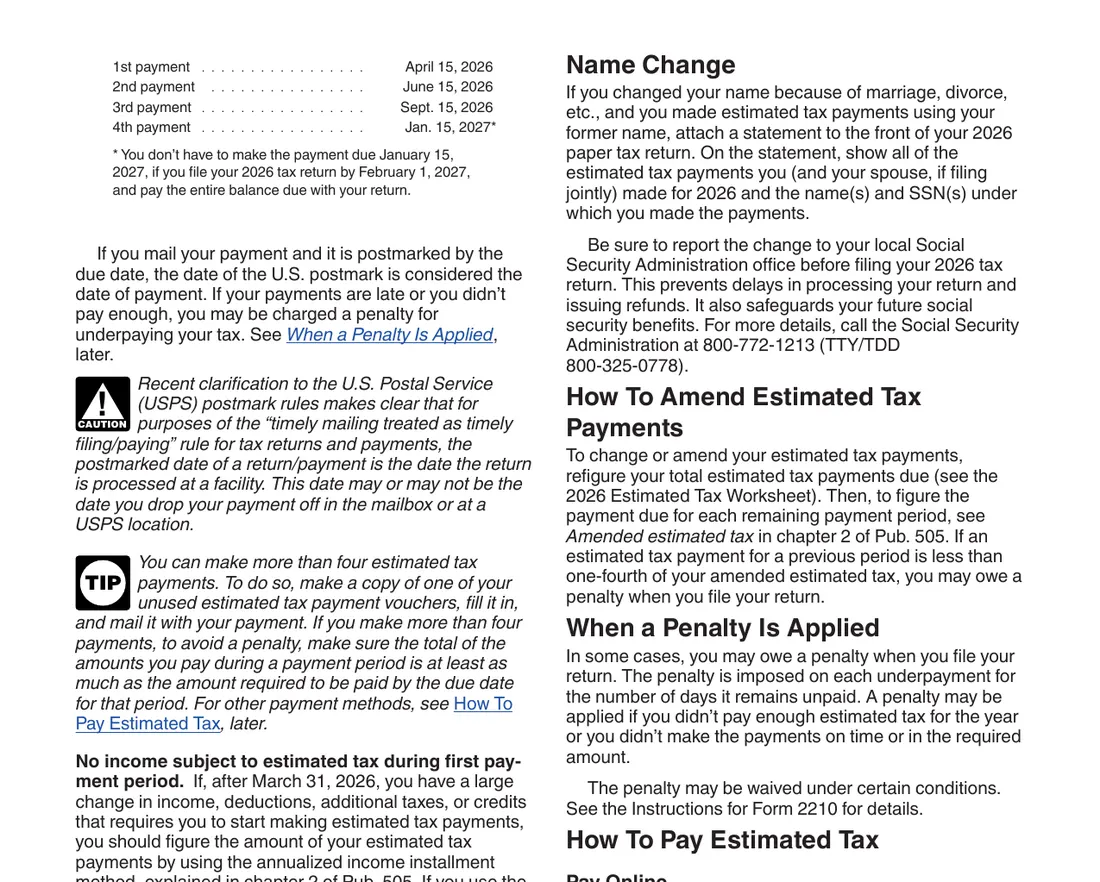
Section 6654(c)(2) writes the calendar in four lines: 1st, April 15; 2nd, June 15; 3rd, September 15; 4th, January 15 of the following taxable year. For 2026: Wednesday, April 15; Monday, June 15; Tuesday, September 15, 2026; and Friday, January 15, 2027. The periods are uneven — three and a half months, two, three, four — which is why seasonal earners get into trouble.
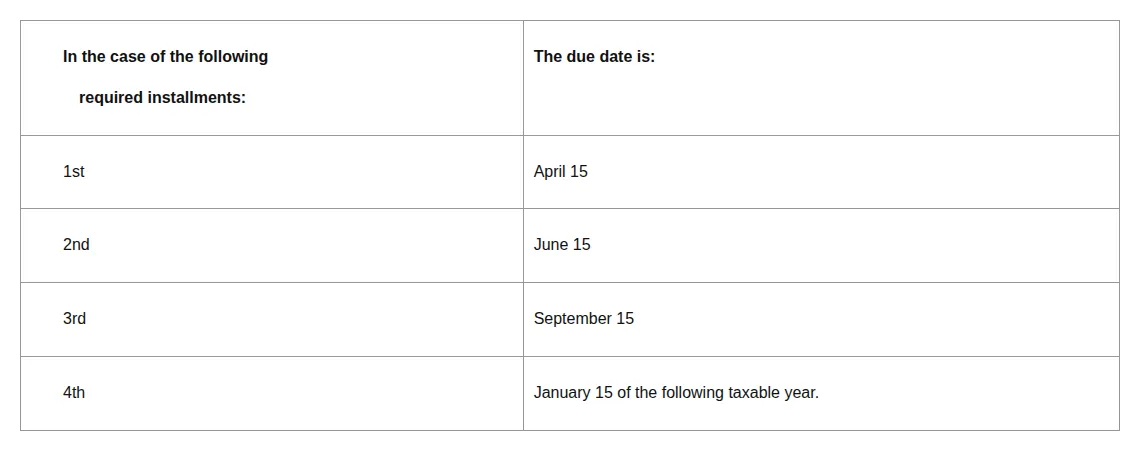
Three rules sit on top of the dates. A due date on a Saturday, Sunday, or legal holiday moves to the next business day. A mailed payment counts on its U.S. postmark date — but the form warns the postmark date is the date the payment is processed at a facility, which "may or may not be the date you drop your payment off in the mailbox or at a USPS location." And you do not have to make the January 15 payment if you file by February 1, 2027 and pay the entire balance due with it; section 6654(h) bars any penalty on the fourth installment if you file on or before January 31, 2027 and pay in full.
Who has to pay, and the two exits
The form's General Rule has two prongs, and both must hold: you expect to owe at least $1,000 in tax for 2026 after subtracting withholding and refundable credits, and you expect withholding plus refundable credits to be less than the smaller of 90 percent of the tax on your 2026 return or 100 percent of the tax on your 2025 return. Section 6654(e)(1) adds a complete exit: if the tax shown on the return, reduced by the withholding credit under section 31, is less than $1,000, no addition to tax applies at all. The other exit is the no-liability prior year: no estimated tax is due for 2026 if you were a U.S. citizen or resident alien for all of 2025 with no tax liability for the full 12-month 2025 tax year. Nonresident aliens use Form 1040-ES (NR) and pay in three installments under section 6654(j). If you also earn wages, ask the employer to withhold more on Form W-4. Our quarterly estimated tax payments guide covers the general decision; this playbook covers the voucher.
The required annual payment: the lesser-of test
Section 6654(d)(1) defines the computation. Each required installment is 25 percent of the required annual payment, and the required annual payment is the lesser of 90 percent of the current-year tax or 100 percent of the prior-year tax. The prior-year leg does not apply if the prior year was not a 12-month year or no return was filed for it. The form's worksheet runs the same test at lines 12a through 12c.
Worked example: a consultant expects $24,000 of total tax for 2026 and paid $18,000 on her 2025 return. Ninety percent of $24,000 is $21,600; 100 percent of $18,000 is $18,000. The required annual payment is the lesser, $18,000, and each installment is $4,500. She may still owe $6,000 when she files, but she owes no underpayment penalty. The worksheet subtracts expected withholding at line 13 — if $6,000 will be withheld, the installments fall to $3,000 each.
The 110-percent rule for higher-income taxpayers
If adjusted gross income on the prior-year return exceeded $150,000 — $75,000 for a married individual filing separately — the prior-year leg rises from 100 percent to 110 percent. Worked example: prior-year AGI $210,000, prior-year tax $30,000, expected 2026 tax $36,000. The 110-percent leg is $33,000; the 90-percent leg is $32,400; the required annual payment is the lesser, $32,400, and each installment is $8,100. It does not apply to farmers and fishermen at all.
Filling in the voucher, field by field
There is one voucher per due date, and the due date is printed in the upper-right corner — a January voucher sent in April is a misapplied payment, not a timely one. Complete it only if you are paying by check or money order; online payments need no voucher. Print your name, address, and Social Security number — an Individual Taxpayer Identification Number goes wherever the SSN is requested, and once you are issued an SSN, stop using the ITIN. On a joint voucher, enter both spouses' names and SSNs in the same order as on the joint return. Enter in the box only the amount you are sending with this check, not any 2025 overpayment credited to 2026.
Make the check payable to "United States Treasury" — not to the IRS — and write "2026 Form 1040-ES" and your SSN on it.
Mail to a different address than Form 1040: western and southern states, P.O. Box 1300, Charlotte, NC 28201-1300; eastern and midwestern states, P.O. Box 931100, Louisville, KY 40293-1100; foreign-country filers, APO and FPO addresses, Form 2555 filers, and dual-status aliens, P.O. Box 1303, Charlotte, NC 28201-1303. Only the U.S. Postal Service can deliver to a P.O. box. Never mail a return to a voucher address, and never send an estimated payment without a voucher.
Voucher versus online: the decision
The form nudges the reader away from paper: "Before submitting a payment through the mail using the estimated tax payment voucher, please consider alternative methods." Our editorial analysis found the comparison turns on four things — proof, timing, fees, and whether the route still accepts new users.
| Route | Proof |
|---|---|
| Voucher + check | Postmark date; no confirmation number |
| IRS Direct Pay | Confirmation number; change or cancel in 2 days |
| IRS Online Account | Payment history visible in the account |
| EFTPS (existing users) | Immediate acknowledgment; 15 months of history |
| Debit/credit card | Processor confirmation |
Two facts decide most cases. Direct Pay is free, needs no sign-in, and a single payment cannot exceed $10 million — above that, use EFTPS or a same-day wire. And EFTPS no longer accepts new individual enrollments: "No new enrollments for individual taxpayers. Individual taxpayers can no longer create new EFTPS accounts." Current users can still use it for now. The card fee is the one figure the form will not pin down: a fee "is charged by these service providers," so no percentage is printed here.
The section 6654 penalty, worked to the dollar
Section 6654(a) charges the underpayment rate under section 6621 on the amount of the underpayment, for the period of the underpayment — the required installment minus what was paid by its due date, running from the due date to the earlier of April 15 of the following year or the date the shortfall is paid. Form 2210's worksheet turns that into arithmetic: for each rate period, multiply the underpayment by days, divide by 365, multiply by that quarter's rate, then add. The rate is the federal short-term rate plus three points; the 2026 rates were 7, 6, 7, and 7 percent by quarter.
Worked example: the consultant from the safe-harbor example owes a $4,500 first installment due April 15, 2026, pays nothing, and pays in full on September 15, 2026 — 153 days, two rate periods:
| Rate period | Days unpaid | Rate | Penalty | Authority |
|---|---|---|---|---|
| Q2: Apr 16–Jun 30 | 76 | 6% | $4,500 × 76/365 × 0.06 = $56.22 | § 6654(b)(2) |
| Q3: Jul 1–Sep 15 | 77 | 7% | $4,500 × 77/365 × 0.07 = $66.45 | § 6654(b)(2) |
Total penalty: $56.22 plus $66.45 is $122.67. The worksheet counts days, not months, and splits at the July 1 rate change. Payments credit the earliest unpaid installment first under section 6654(b)(3). Form 2210 Part I stops the inquiry if current-year tax or total tax minus withholding is under $1,000. If no Part II box applies, the IRS figures the penalty; claim the annualized method, a partial waiver, or actual withholding dates, and you must file Form 2210. Waiver is narrow: casualty or disaster under section 6654(e)(3)(A), or retirement after age 62 or disability with reasonable cause under section 6654(e)(3)(B).
Schedule AI: when income arrives unevenly
The flat 25-percent installment assumes income arrives evenly, and for a seasonal business it does not. Section 6654(d)(2) lets a filer replace each flat installment with the annualized income installment when it is lower, then recaptures the reduction in the next installment, so the yearly total is unchanged. Schedule AI runs four columns ending March 31, May 31, August 31, and December 31: annualize the income so far (×4, ×2.4, ×1.5, ×1), subtract the standard deduction, figure the tax, apply 22.5, 45, 67.5, and 90 percent.
Worked example: a single filer, standard deduction $16,100 for 2026, income landing in the fourth quarter.
| Period | AGI to date | Annualized income | Tax on annualized income | Installment |
|---|---|---|---|---|
| Jan–Mar | $24,000 | $96,000 | $12,290 | $2,765.25 |
| Jan–May | $42,000 | $100,800 | $13,346 | $3,240.45 |
| Jan–Aug | $68,000 | $102,000 | $13,610 | $3,181.05 |
| Full year | $160,000 | $160,000 | $27,134 | $15,233.85 |
Total paid: $24,420.60 — exactly 90 percent of the $27,134 full-year tax. The flat installments would have been $6,105.15 each, and the first three would each have drawn a penalty. File Form 2210 including Schedule AI even if no penalty is owed. Self-employed filers should start from Schedule C; see our IRS Form 1040 Schedule C playbook.
Farmers and fishermen: one installment, two exits
If at least two-thirds of gross income for 2025 or 2026 is from farming or fishing, section 6654(i) replaces the four installments with one: a single required installment due January 15 of the following year, equal to the required annual payment computed with 66 2/3 percent substituted for 90 percent and without the 110-percent rule. Two exits: pay in full by January 15, 2027, or file the 2026 Form 1040 or 1040-SR by March 1, 2027 and pay the total tax due with it, in which case no 2026 estimated payments are required to avoid a penalty. The test is measured on gross income from all sources.
Identifiers, scope, and who this is for
The voucher carries the identifiers the IRS uses to match money to a person: your SSN, or your ITIN if you have no SSN, printed on the voucher and written on the check with "2026 Form 1040-ES." A single-member LLC files under the owner's SSN; an S-Corp shareholder pays on pass-through income under the shareholder's SSN; a C-Corp pays corporate estimated tax on Form 1120-W. FICA and SECA taxes ride along in the estimate: self-employment tax is figured on the worksheet at line 9 and is due on the same four dates. Pay by ACH through Direct Pay or EFTPS where the route is open to you, and keep the confirmation number. This playbook is for individuals with income no one withholds from: the self-employed, gig workers, landlords, investors, retirees drawing taxable distributions. It is not for corporations or employers remitting payroll tax deposits. If you cannot pay, use an installment agreement under section 6159 instead. Before quoting any figure, run it through the tax estimator.
The 2026 filing sequence
- [x] Step 1: Figure the 2026 tax. Expected AGI, minus deductions ($16,100 single, $32,200 married filing jointly, $24,150 head of household), minus credits, plus self-employment tax — line 11c.
- [x] Step 2: Take the lesser of 90 percent of line 11c or 100 percent of 2025 tax — line 12c. If 2025 AGI exceeded $150,000, use 110 percent; if farming or fishing is two-thirds of gross income, use 66 2/3 percent.
- [x] Step 3: Subtract expected withholding. Line 13 withholding comes off line 12c; divide the remainder by four.
- [x] Step 4: Pay the first installment by April 15, 2026. Direct Pay or Online Account for most filers; EFTPS only if already enrolled; voucher and check to the Charlotte or Louisville P.O. box, by USPS only.
- [x] Step 5: Repeat June 15, September 15, and January 15, 2027 — or file by February 1, 2027 and skip January. If income arrives unevenly, use Schedule AI and file Form 2210.
- [x] Step 6: Reconcile. Claim every estimated payment on Form 1040 line 33, attach Form 2210 if Schedule AI, a waiver, or actual withholding dates apply, and keep every confirmation number and voucher copy.
Founder & CEO Insight — Enow A. Jovial