The Net Investment Income Tax Playbook: Section 1411, the 3.8% Surtax, and Form 8960
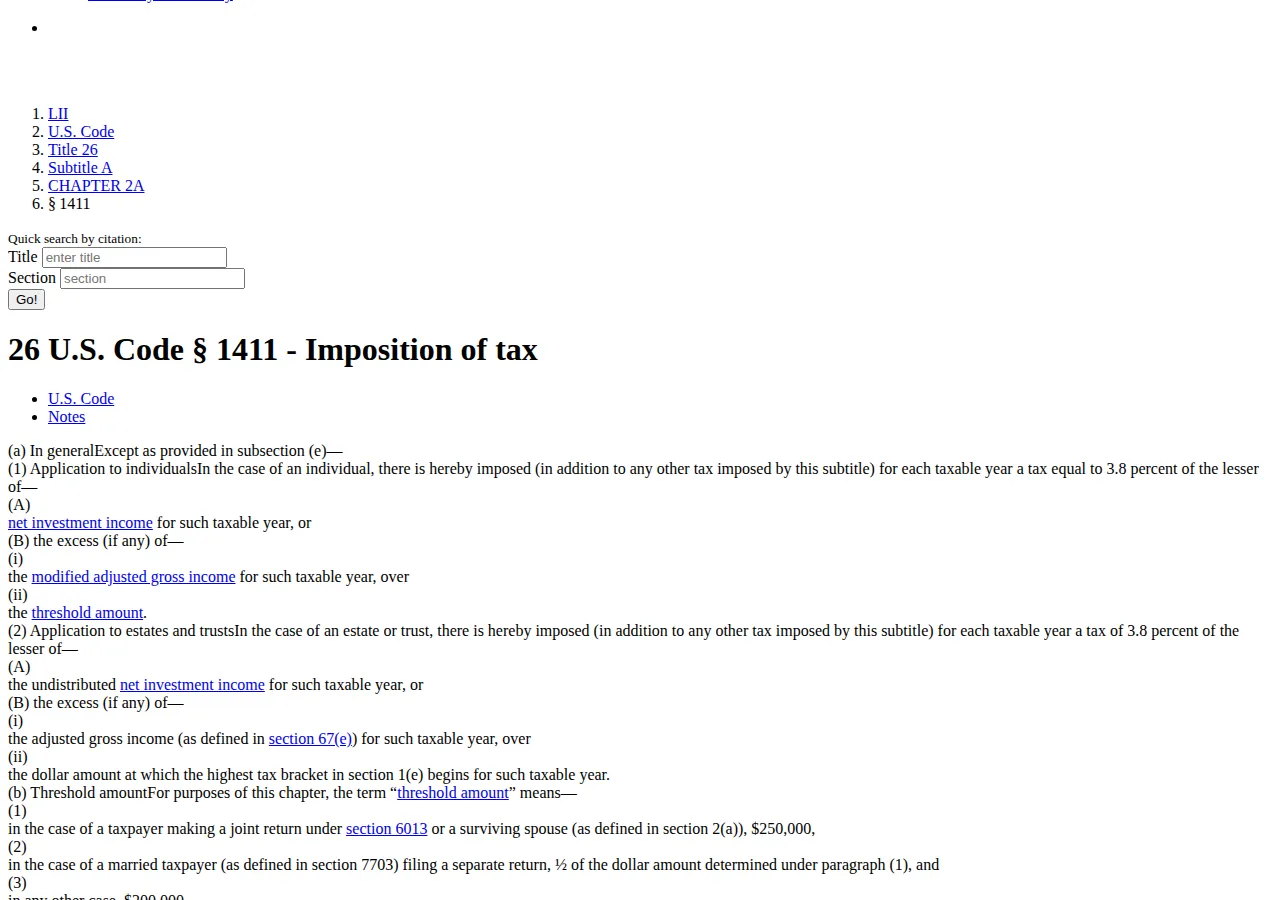
The net investment income tax is the quietest surtax in the code. It arrives once a year, on Form 8960, as 3.8% of the smaller of two numbers. Congress added it in section 1411, effective January 1, 2013; the thresholds have never moved.
The formula: the lesser of two numbers
Section 1411(a)(1) imposes 3.8% on the lesser of net investment income for the year or the excess of MAGI over the threshold amount. Section 1411(b) states the thresholds: $250,000 for a joint return or a surviving spouse, $125,000 for a married taxpayer filing separately, and $200,000 in any other case — single and head of household filers.
The lesser-of structure is the planning game: MAGI $10,000 over the threshold with $1,000,000 of investment income means 3.8% on $10,000, or $380.
Modified adjusted gross income: the measuring stick
Section 1411(d) defines it as adjusted gross income increased by the foreign earned income excluded under section 911(a)(1), less the deductions or exclusions disallowed under section 911(d)(6). Topic 559 says the same in one line: for a taxpayer who has not excluded any foreign earned income, MAGI is generally the same as regular adjusted gross income.
The standard deduction does not enter the calculation: the threshold test runs on MAGI, before deductions.
What counts as net investment income
Section 1411(c)(1) defines net investment income as three buckets of gross income less the deductions properly allocable to them: interest, dividends, annuities, royalties, and rents outside a non-1411 trade or business; other gross income from a section 1411 trade or business; and net gain from disposing of property other than property held in one. A section 1411 trade or business is a passive activity under section 469, or a business of trading in financial instruments or commodities.
Topic 559 gives the working list: interest, dividends, annuities, royalties, and rents; income from a passive activity or a trading business; net gains from the disposition of stocks, bonds, mutual funds, and real estate; and net gains from the sale of an active partnership or S-Corp interest. Capital losses offset capital gains first — only net gain enters the base — and the deductions properly allocable to the income reduce it.
What does not count
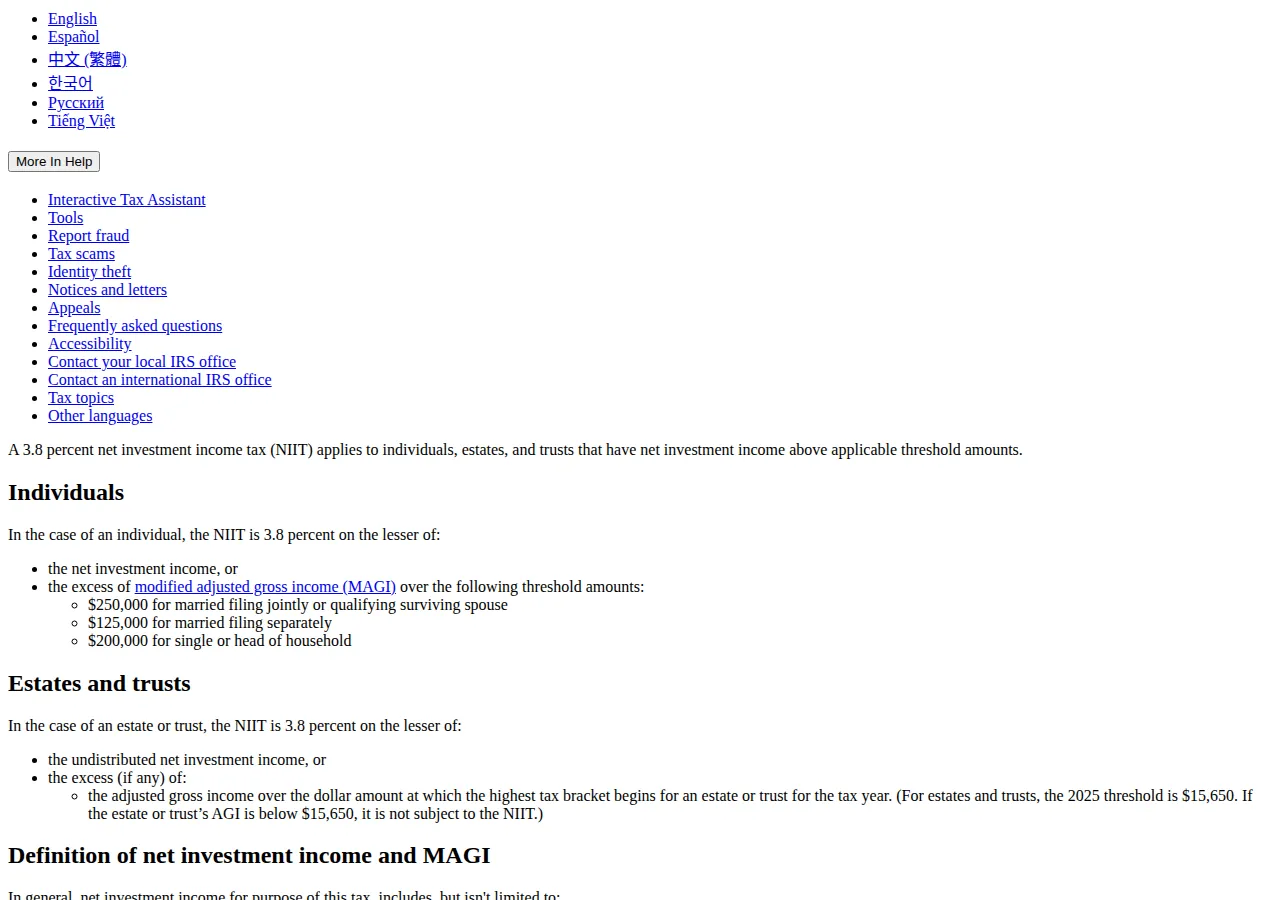
The IRS lists the exclusions: wages, unemployment compensation, operating income from a nonpassive business, Social Security benefits, alimony, tax-exempt interest, self-employment income, Alaska Permanent Fund dividends, and distributions from qualified plans — sections 401(a), 403(a), 403(b), 408, 408A, and 457(b). Section 1411(c)(5) writes the qualified-plan exclusion into the statute, and section 1411(c)(6) excludes self-employment income taxed under section 1401(b).
Municipal bond interest is outside the base entirely. Distributions from a 401(k), a traditional IRA, or a Roth IRA are excluded, so a retiree living on them can have a large cash flow and zero net investment income. Wages are excluded even when they push MAGI over the threshold: a surgeon earning $400,000 of wages and holding no investments pays none.
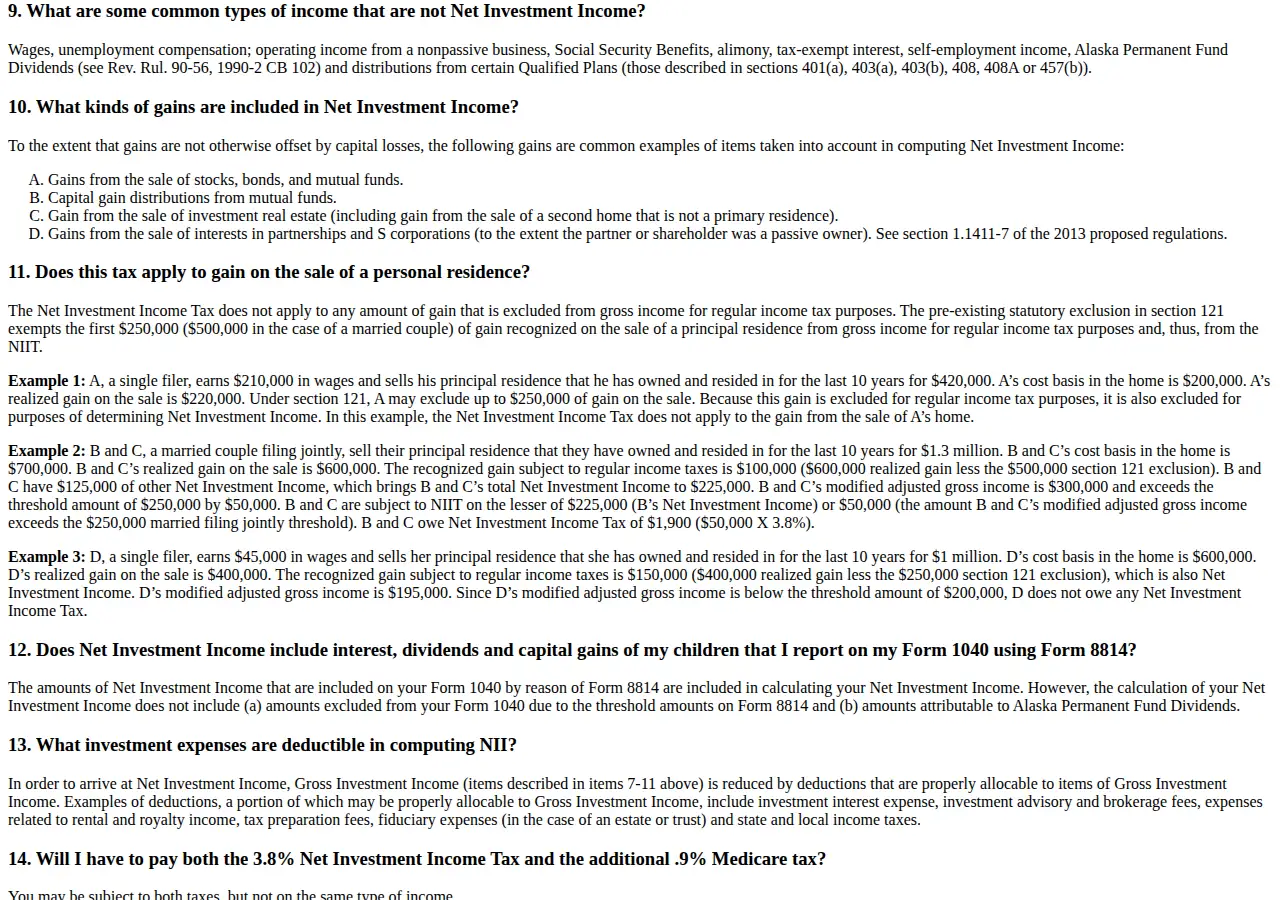
The home-sale exclusion works the same way: the tax does not apply to gain excluded from gross income, and section 121 shelters the first $250,000 of gain for a single filer and $500,000 for a married couple. Only the gain above the exclusion can be net investment income. Our Schedule D playbook works the gain computation, and our Schedule E playbook covers the rental side.
Worked examples, recomputed
Example A is the MAGI-excess cap. A single filer has $180,000 of wages and $90,000 from a passive partnership interest: MAGI $270,000, $70,000 over the $200,000 threshold, against $90,000 of net investment income. The tax falls on the lesser amount, $70,000:
Example B is the home sale. A married couple filing jointly sells a principal residence for $1,300,000 with a cost basis of $700,000: realized gain $600,000, the section 121 exclusion shelters $500,000, leaving $100,000 of recognized gain. With $125,000 of other net investment income, total NII is $225,000. MAGI is $300,000, $50,000 over the $250,000 threshold. The tax falls on the lesser amount, $50,000:
The 2026 capital gains interaction
The net investment income tax sits on top of the capital gains rates, and the two systems use different measuring sticks: the capital gains brackets run on taxable income, this tax on MAGI. Rev. Proc. 2025-32, section 4.03, sets the 2026 lines: the 0% rate applies to taxable income up to $49,450 single, $98,900 joint, $66,200 head of household, and $49,450 married filing separately; the 15% rate runs up to $545,500 single, $613,700 joint, $579,600 head of household, and $306,850 married filing separately, with 20% above.
A gain taxed at 15% that also falls inside the base bears 18.8% combined; at 20%, 23.8%:
The practical point is timing: a gain realized in a year when MAGI is already over the threshold pays the surtax on the slice inside the MAGI excess.
What the surtax changes: consequences and trade-offs
The surtax changes timing, not just the bill, because the threshold is fixed while incomes move. A household that realizes two years of gains in one year pushes MAGI over the line and therefore pays 3.8% on the excess slice; the same sales split across December and January can keep part below the line. Spreading a sale controls the MAGI excess, but it requires holding the asset longer — and that trade-off cuts both ways, because a market fall while waiting costs more than the 3.8% saved.
The other boundary is between the payroll taxes and this one: wages are subject to FICA, not the NIIT; self-employment income is taxed under SECA (section 1401(b)), not the NIIT — because the surtax reaches investment income only. The same line governs entities: operating income from an S-Corp or an LLC taxed as a partnership is outside net investment income when the owner materially participates, and inside it when passive, while a C-Corp dividend is always in the base. The same dollar can therefore be exempt or surtaxed depending on entity form and participation — so the choice of entity, the hours log, and a CPA's review before any large sale decide it.
Rental real estate and the section 469 line
Section 1411(c)(1) includes rents in net investment income unless derived in the ordinary course of a non-1411 trade or business, and section 1411(c)(2) counts any passive activity under section 469 as a section 1411 trade or business. Publication 925 states the rule plainly: generally, rental activities are passive activities even if you materially participated in them.
Publication 925 lists seven ways to meet material participation — the usual one is more than 500 hours in the activity during the year. But for rental real estate, passing it is not enough: the activity is passive by statute even when the owner materially participates.
The way out is the real estate professional rule in section 469(c)(7): the taxpayer qualifies only if more than half of the personal services performed in all trades or businesses during the year were in real property trades or businesses in which the taxpayer materially participated, with more than 750 hours in those businesses. If both conditions hold and the taxpayer materially participates in the rental activity, it is not passive — and its income is not net investment income. The tests are personal: on a joint return, the spouse's hours do not count toward qualifying, though a spouse's participation counts toward material participation.
Sale of a business interest
Selling an interest in a partnership or S-Corp is the second classification fight. Section 1411(c)(4) gives the rule: gain counts only to the extent of the net gain that would result if all property of the entity were sold for fair market value immediately before the disposition. The seller looks through the entity to its assets — only gain attributable to property that would itself produce net investment income counts.
Topic 559 states the practical result: generally, net gains from the sale of an active partnership or S-Corp ownership interest are included. A passive owner's gain is in the base; an active owner's gain is in the base only to the extent the entity's property would produce investment income. The same look-through applies to a loss, done asset by asset.
Form 8960: the computation, line by line
Attach Form 8960 if MAGI is greater than the applicable threshold amount.
Part I totals investment income on lines 1–8 — interest, dividends, annuities, royalties, rents, passive business income, and net gains. Part II totals the properly allocable deductions on lines 9–11, and line 12 is net investment income: Part I minus Part II. Part III is the tax computation for individuals: line 13 MAGI, line 14 the threshold, line 15 the excess of MAGI over the threshold, line 16 the smaller of line 12 or line 15, and line 17 line 16 times 3.8%. The result goes to Schedule 2 (Form 1040), line 12. Our Schedule 2 additional taxes playbook shows where the number lands on the return.
Estates and trusts complete lines 18a–21: undistributed net investment income on line 18c, adjusted gross income against the top-bracket threshold — $16,000 in 2026 — on lines 19a through 19c, the smaller amount on line 20, the 3.8% tax on line 21.
Estimated tax: pay it during the year
The net investment income tax is subject to the estimated tax provisions: adjust withholding or estimated payments to account for it. No withholding applies to the tax itself, but the taxpayer may ask the employer to withhold extra income tax, treated as paid evenly across the four quarters.
Section 6654 sets the safe harbors: the required annual payment is the lesser of 90% of the current-year tax or 100% of the prior-year tax — 110% if prior-year AGI exceeded $150,000 ($75,000 married filing separately). No addition to tax applies if the tax shown, less withholding, is under $1,000. The four installments fall on April 15, June 15, September 15, and January 15, each 25% of the required annual payment. The tax estimator will run the quarterly amount before the first due date.
The common failure is the lump-sum year: a household sells a rental property in October and owes the surtax on estimates based on the prior year. Re-run the estimate that quarter and pay the difference by the next due date.
The decision table
| Situation | Net investment income? | Authority |
|---|---|---|
| Interest, dividends, capital gains | Yes | § 1411(c)(1); Topic 559 |
| Rental income, real estate professional | No | § 469(c)(7); Pub. 925 |
| Wages, unemployment, Social Security | No | Topic 559 |
| Active business operating income | No | § 1411(c)(2); Topic 559 |
| Tax-exempt municipal bond interest | No | Topic 559 |
| Qualified plan distributions | No | § 1411(c)(5); Topic 559 |
| Self-employment income under § 1401(b) | No | § 1411(c)(6) |
| Gain on home sale, within § 121 exclusion | No | § 121; IRS NIIT Q&A 11 |
| Gain on home sale, above § 121 exclusion | Yes, on the taxable part | § 1411(c)(1); IRS NIIT Q&A 11 |
| Active business interest sale, operating-asset gain | No, to that extent | § 1411(c)(4); Topic 559 |
Who pays it, and who never does
Individuals, estates, and trusts with net investment income and MAGI over the threshold pay it. It is never paid by a nonresident alien, never on wages alone, and never by a household whose MAGI is at or below the threshold, however large its investment income.
Founder & CEO Insight — Enow A. Jovial
Execution checklist
- Compute MAGI: adjusted gross income plus the foreign earned income exclusion, if any.
- Compare MAGI with the threshold for the filing status.
- If MAGI is at or below the threshold, stop: no Form 8960, no surtax.
- List every item of investment income, less the deductions properly allocable.
- Strip out the exclusions: wages, active business income, tax-exempt interest, qualified-plan distributions, self-employment income, section 121 excluded gain.
- Test rental income against section 469: passive by default; nonpassive only for a qualifying real estate professional.
- For a business-interest sale, apply the section 1411(c)(4) look-through to the entity's assets.
- Take the smaller of net investment income or the MAGI excess, multiply by 3.8%, complete Form 8960.
- Re-run the estimated tax for the year of any large sale.
- File the workpapers with the return so the number can be rebuilt next year.