IRS Form 1040 Schedule E Rental Income Playbook
Schedule E is where rental real estate lives on a federal tax return. One wrong line can turn a deductible loss into a suspended loss unused for years, and one missed depreciation schedule can turn a profitable sale into a surprise tax bill. This playbook walks the form line by line, then through depreciation, the section 469 limits, and the sale. It is not Schedule C; see the companion guide to Schedule C self-employed profit and loss.
> [!FOUNDER]
> "A rental property is a business with a balance sheet, not a hobby with a mailbox. If you cannot state your basis, your depreciation, and your suspended losses from memory, you do not own an investment yet. You own a surprise." — Enow A. Jovial, Founder & Chief Executive Officer
What Schedule E Part I reports
Part I covers income or loss from rental real estate and royalties. Each property gets its own column, A, B, or C: no blending; the passive-activity rules operate property by property.
Line 3 is where rents go. The 2025 Instructions put rental income from real estate on line 3, including personal property leased with it and income for renting a room or other space. Noncash rent counts at fair market value, and advance rent counts in the year received.
Line 4 is royalties, not rents: oil, gas, or mineral properties, copyrights, patents, name, image, and likeness rights. Lines 5 through 19 are expenses, with depreciation on line 18 and other expenses on line 19; line 20 totals them. Only ordinary and necessary expenses belong here.
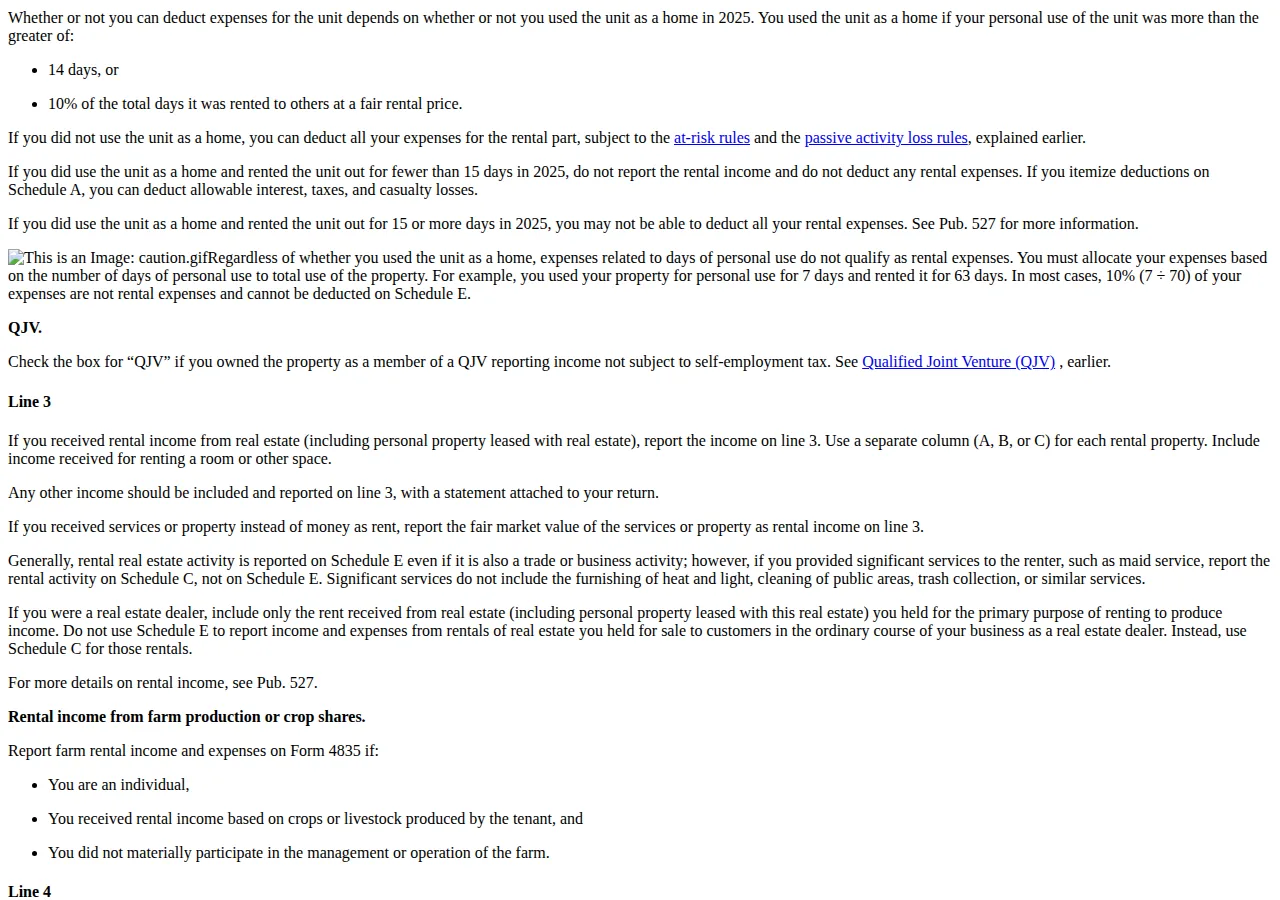
!Schedule E instructions showing line 3 for rents and line 4 for royalties
> [!KEY TAKEAWAY]
> Schedule E is a per-property ledger: rents line 3, royalties line 4, expenses lines 5-19, total line 20, depreciation line 18; section 469 decides how much loss the taxpayer may use.
The line-by-line operation
Line 21 is income or loss: line 3 minus line 20, and the entry point for the at-risk rules. A taxpayer with amounts for which they are not at risk uses Form 6198 to determine the deductible loss, entering it on line 21 with Form 6198 noted beside it. Line 22 is where the passive-activity rules bite: a taxpayer with a rental real estate loss from a passive activity may need Form 8582 to determine the loss, if any, to enter on line 22. The difference is the suspended loss, carried forward until passive income absorbs it or the entire interest is disposed of.
A worked return
A single-family rental purchased for 200,000 dollars: land 40,000 dollars, building basis 160,000 dollars. It rents for 2,000 dollars a month, 24,000 dollars a year. Cash expenses total 12,200 dollars: interest 6,400, property tax 2,100, insurance 900, repairs 1,200, advertising 250, management 1,350. Full-year depreciation is 160,000 dollars divided by 27.5 years, or 5,818 dollars.
$ ext{Net rental income} = ext{Gross rents} - ext{Cash expenses} - ext{Depreciation} $
$ ext{Net rental income} = 24,000 - 12,200 - 5,818 = 5,982 $
Paper income is 5,982 dollars against an 11,800-dollar cash surplus: depreciation shelters cash but reduces basis and raises gain on sale.
> [!TIP]
> Keep a one-page depreciation ledger per property — basis, placed-in-service date, cumulative depreciation — rebuilt before filing, not after an audit notice.
Depreciation: the 27.5-year rule
Residential rental property is depreciated under MACRS, general depreciation system, straight-line over 27.5 years. Land is never depreciable, so the price must be split between land and building in the year placed in service.
Publication 527's example: a house bought for 185,000 dollars, placed in service February 8, building cost 160,000 dollars, land 25,000 dollars. Table 2-2d gives 3.182 percent for February of Year 1, so first-year depreciation is 5,091 dollars: 160,000 × 0.03182.
The passive-activity rules: section 469
Rental real estate is passive by statute: in most cases all rental real estate activities are passive, except those of certain real estate professionals. A passive loss cannot offset wages or portfolio income; it offsets passive income or carries forward.
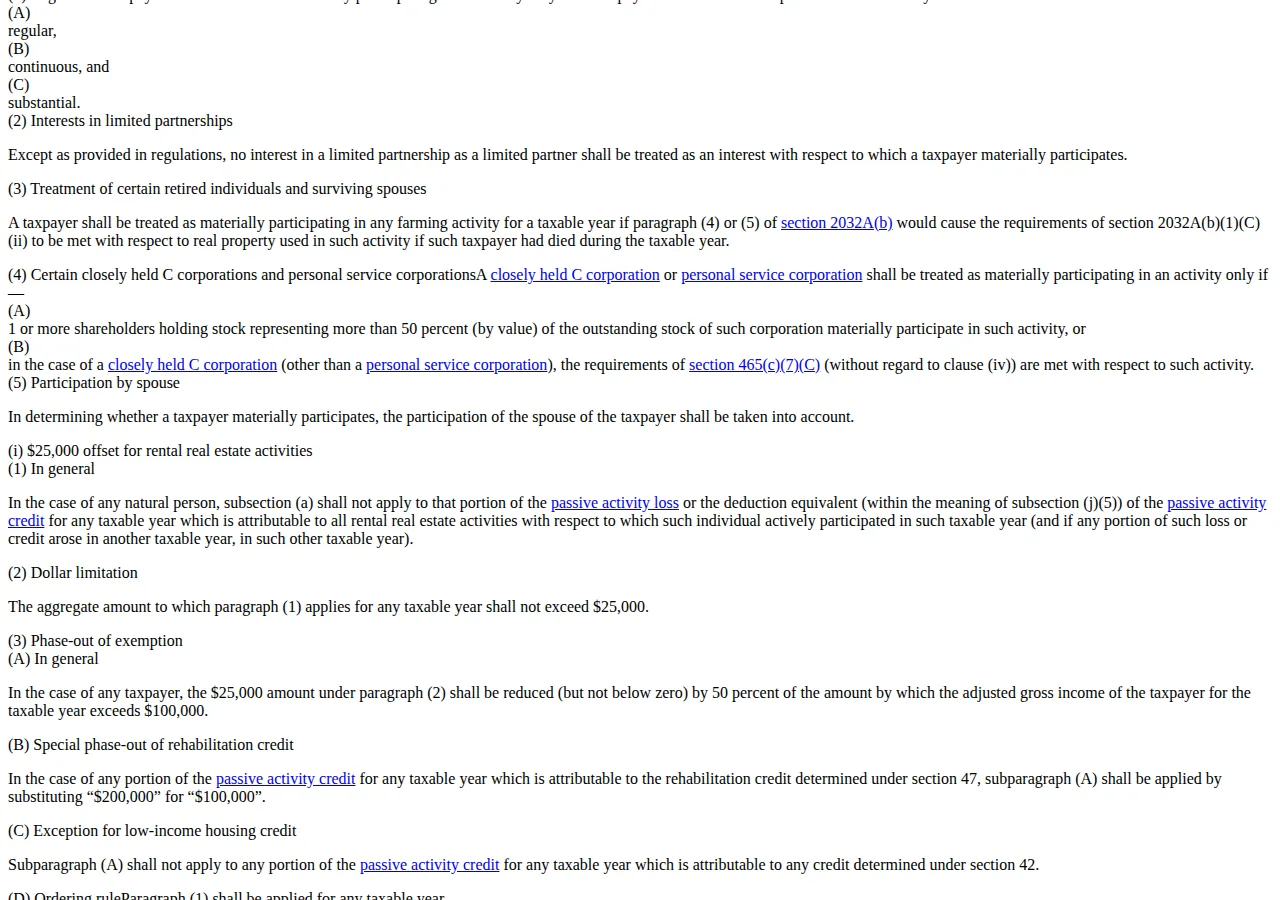
!26 U.S.C. section 469 text showing the 25,000 dollar offset and phaseout rule
| Situation | Treatment | Authority |
|---|---|---|
| Active participation, MAGI 100,000 dollars or less | Up to 25,000 deductible | 26 U.S.C. § 469(i); Pub. 527 |
| MAGI 100,000 to 150,000 dollars | Phases out 50 cents per dollar over 100,000; zero at 150,000 | 26 U.S.C. § 469(i)(3)(A) |
| Married filing separately | Capped at 12,500 dollars | 26 U.S.C. § 469(i)(5) |
| Real estate professional, both prongs met | Nonpassive if material participation shown | 26 U.S.C. § 469(c)(7) |
| Average customer use 7 days or less, or 30 days or less with significant personal services | Not a rental activity | Pub. 925 |
| Personal use above greater of 14 days or 10 percent of rental days | Dwelling used as a home; loss limited | Pub. 527 |
| Entire interest sold in a fully taxable sale | Suspended losses generally allowed in full | Pub. 925 |
Active participation is a lower bar than material participation, and the distinction decides who gets the 25,000-dollar allowance. It means owning at least 10 percent and making management decisions, or arranging for others to provide services, in a significant and bona fide sense. Material participation is the higher standard; Publication 925 lists more than 500 hours as its first test.
> [!WARNING]
> A suspended loss is not a lost loss, but it is not a deduction either. Confirm the allowance before counting on a loss, and track suspended losses on Form 8582 every year.
The 25,000-dollar allowance and its phaseout
Section 469(i) lets a natural person who actively participates deduct up to 25,000 dollars of passive rental losses against nonpassive income each year, phased out by 50 percent of the amount by which adjusted gross income exceeds 100,000 dollars. The test uses modified adjusted gross income (MAGI).
$ ext{Allowance} = 25,000 - 0.5 imes max(0, ext{MAGI} - 100,000) $
At MAGI of 120,000 dollars the allowance is 15,000 dollars; at 135,000 it is 7,500 dollars; at 150,000 it is zero. With an 18,000-dollar loss at MAGI 120,000 dollars, the taxpayer deducts 15,000 dollars and suspends 3,000 dollars; at MAGI 150,000 dollars the whole 18,000 dollars is suspended.
The real estate professional exception
Section 469(c)(7) is the only full escape from passive treatment, and its two prongs are conjunctive: the taxpayer must perform more than one-half of the personal services in trades or businesses during the year in real property trades or businesses in which the taxpayer materially participates, and more than 750 hours of services in those businesses.
Passing the test does not make every rental nonpassive: the taxpayer must still materially participate in each rental activity, or elect to treat all interests as a single activity. The election groups hours across properties, but a later sale of one property is then a sale of part of an activity, delaying the release of suspended losses. The election, once made, is binding, so have a CPA review it before filing.
Short-term rentals and the 7-day rule
Not every property with guests is a rental activity under section 469; two Publication 925 exceptions decide most short-term rental cases. If the average period of customer use is 7 days or less, the activity is not a rental activity. The average period divides total rental days by the number of rentals during the tax year. If the average period is 30 days or less and the taxpayer provides significant personal services, it is also not a rental activity.
The consequence cuts both ways: a short-term rental that escapes rental-activity status can be a nonpassive business, so losses may offset other income, but net income may face self-employment tax, the SECA levy that parallels FICA for employees. Reporting on Schedule E without testing the 7-day and 30-day rules risks the wrong schedule and the wrong loss limits. See also Form 1099-K payment-app reporting.
Personal use: the 14-day and 10-percent test
A dwelling unit used as a home faces expense-allocation rules that can deny part of a loss. Publication 527 applies the test as the greater of 14 days or 10 percent of the total days the unit is rented to others at a fair rental price. Its cottage example: 14 days of personal use in May plus a 2-day July weekend, against 83 rental days, totals 16 days of personal use. Because 16 exceeds both 14 days and 8 days (10 percent of 83), the cottage was used as a home, so a net loss may not be fully deductible.
The sale: recapture meets the section 121 exclusion
Return to the worked property, total basis 200,000 dollars. After five full years, depreciation taken is 5 × 5,818 dollars, or 29,090 dollars. Adjusted basis is 200,000 minus 29,090, or 170,910 dollars. A sale for 310,000 dollars produces total gain of 310,000 minus 170,910, or 139,090 dollars.
Of that gain, 29,090 dollars is unrecaptured section 1250 gain, equal to the depreciation taken and taxed at a maximum 25 percent rate under Topic No. 409; the remaining 110,000 dollars is capital gain. Tax basis, not GAAP book value, drives this math. If the property was once the taxpayer's principal residence, section 121 may exclude part of the gain, but not the depreciation part. Section 121(a) excludes gain where the property was owned and used as the principal residence for 2 years or more in the 5-year period ending on the sale date, up to 250,000 dollars for a single filer and 500,000 dollars for certain joint returns. Section 121(d)(6) removes the depreciation portion, for periods after May 6, 1997, from the exclusion.
So the 110,000 dollars is excludable up to the 250,000-dollar cap, but the 29,090 dollars of depreciation gain is not excludable at all. Suspended losses are generally allowed in full in the year the taxpayer disposes of the entire interest in a fully taxable transaction to an unrelated person.
Who should NOT use this playbook
This playbook covers an individual owner reporting residential rental real estate in Schedule E Part I — not the following operators. A dealer buying and selling property as inventory reports on Schedule C or as an entity, not on Schedule E as a passive rental. A partnership, an LLC taxed as a partnership, or an S-Corp shareholder reports K-1 results in Parts II and III under entity basis rules; a C-Corp holding rentals files Form 1120, not Schedule E. A taxpayer who cannot produce receipts, a depreciation ledger, and a use log should not file a rental loss until those records exist: the loss will not survive examination without them.
Execution checklist
1. Confirm Schedule E Part I, one column per property, rents on line 3, royalties on line 4.
2. Reconcile gross rents to deposits, leases, 1099s.
3. Verify the land/building split and the building basis.
4. Recompute depreciation for the year and confirm the cumulative total agrees with prior returns.
5. Separate repairs from improvements; capitalize each improvement to its own schedule.
6. Total expense lines 5 through 19 on line 20, confirm line 21 income or loss, and apply Form 6198 if needed.
7. Complete Form 8582, determine the line 22 loss after the limits and phaseout, and record any suspended loss.
8. Log personal-use and rental days; confirm the 14-day and 10-percent thresholds.
9. For a short-term rental, compute average customer use and test the 7-day and 30-day exceptions.
10. If claiming professional status, confirm both prongs, the 750-hour test, and the grouping election, in writing.
11. Before a sale, compute adjusted basis, total gain, unrecaptured section 1250 gain, and the section 121 exclusion. If the rental sits in an LLC, keep the LLC's EIN and accounts separate from personal ones.
Before filing, check the phaseout and sale math with the tax estimator and the ROI calculator.