The withholding tax your partnership owes before the foreign partner files anything
A US partnership with a foreign partner does not wait for that partner to file a return. The partnership itself withholds tax on the foreign partner's share of effectively connected income, pays it in quarterly installments, reports it on Form 8804, and hands each foreign partner a Form 8805. Get the rate, the installments, or the deadline wrong and the partnership — not the partner — owes the shortfall, plus interest. Our IRS Form 8233 treaty exemption playbook covers the exemption the individual claims at the payment level; this guide covers the withholding the partnership applies when no exemption stops it. Our IRS Form 8843 exempt individuals playbook covers the exempt days, and our IRS Form 1040-NR nonresident return playbook covers the return where the withheld tax is credited.
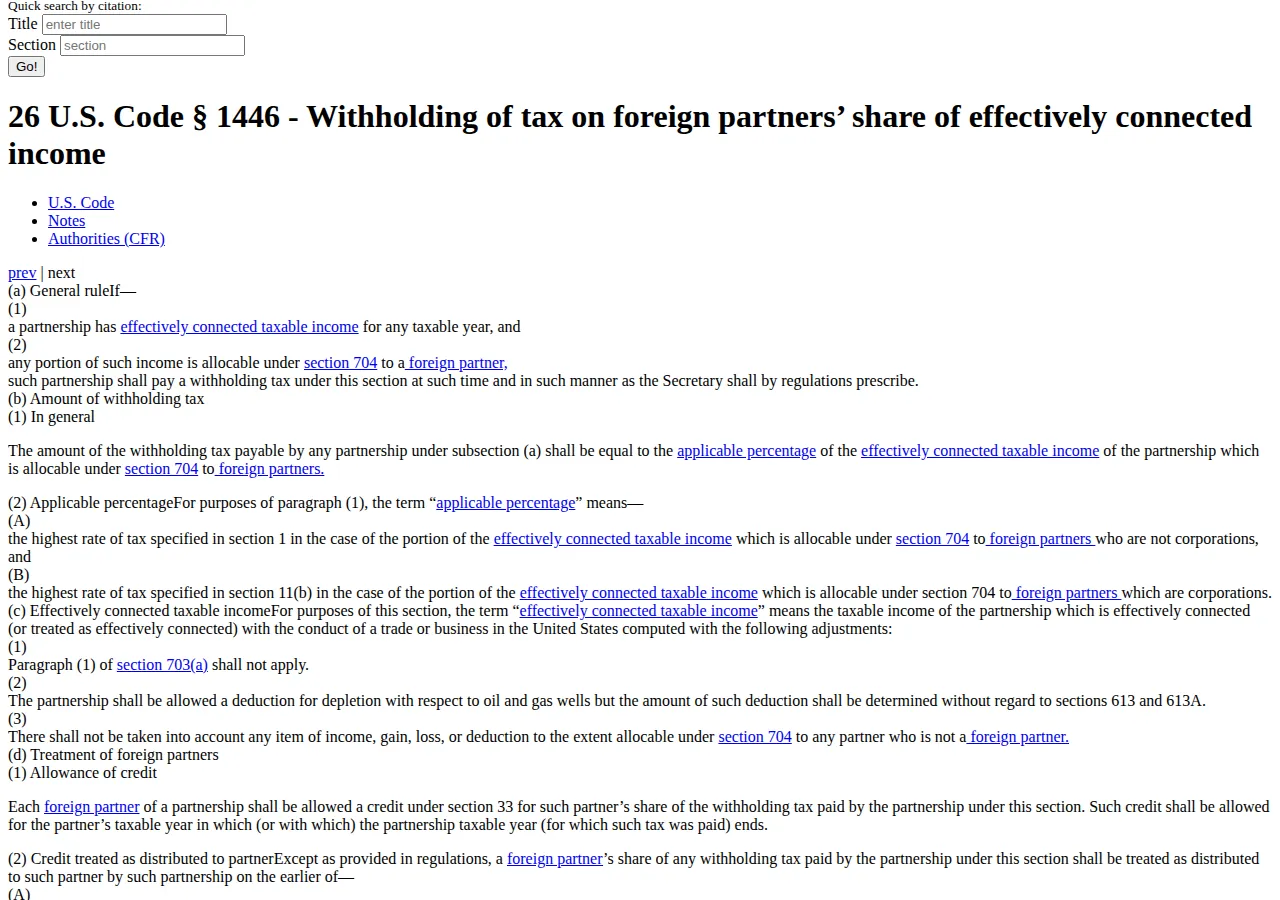
Section 1446 of the Internal Revenue Code is the charging provision. Section 1446(a) says that if a partnership has effectively connected taxable income for a taxable year and any portion of it is allocable under section 704 to a foreign partner, the partnership shall pay a withholding tax. The obligation sits on the partnership, and it arises whether or not the partner ever files. The forms are the machinery: Form 8804 is the annual return that reports the total section 1446 liability for the partnership's tax year, Form 8805 is the per-partner information statement, and Form 8813 is the voucher that carries each quarterly installment payment. The January 2026 instructions for Forms 8804, 8805, and 8813 are the operating manual for the deadlines and rates that follow.
The statute: section 1446, paragraph by paragraph
Section 1446(b) sets the amount. The withholding tax equals the applicable percentage of the effectively connected taxable income allocable under section 704 to foreign partners. The applicable percentage is the highest rate of tax specified in section 1 for the portion allocable to foreign partners who are not corporations, and the highest rate specified in section 11(b) for the portion allocable to foreign partners that are corporations. In the January 2026 instructions the IRS states the percentages plainly: 37 percent for non-corporate foreign partners, 21 percent for corporate foreign partners. The top rate applies to the whole allocable slice.
Section 1446(c) defines effectively connected taxable income, or ECTI. It is the taxable income of the partnership that is effectively connected, or treated as effectively connected, with the conduct of a trade or business in the United States, computed with three adjustments: section 703(a)(1) does not apply, the partnership may deduct depletion for oil and gas wells without regard to sections 613 and 613A, and no item of income, gain, loss, or deduction is taken into account to the extent it is allocable under section 704 to a partner who is not a foreign partner. The last adjustment matters operationally: the base is the foreign partners' slice only, proved from the section 704 allocations and the K-1s.
Section 1446(d) gives the foreign partner the credit. Each foreign partner is allowed a credit under section 33 for the partner's share of the withholding tax paid by the partnership, allowed for the partner's taxable year in which, or with which, the partnership taxable year ends. The partner's share of the withholding tax is treated as distributed to the partner, which means the credit arrives on the partner's return even though the cash never passed through the partner's hands. Over-withholding is recovered on Form 1040-NR; under-withholding still leaves the partnership liable for the failure.
Worked example: three partners, one partnership, three different answers
Take a Delaware LLC taxed as a partnership with $2,000,000 of effectively connected taxable income for the year. The operating agreement allocates 40 percent to Aisha, a nonresident alien individual living in London; 25 percent to Meridian GmbH, a German corporation; and 35 percent to a US citizen. The base is the foreign partners' slices only: Aisha's $800,000 plus Meridian's $500,000, or $1,300,000 of the $2,000,000 total. The US partner's $700,000 never enters the computation.
- Aisha, non-corporate: $800,000 × 37% = $296,000
- Meridian, corporate: $500,000 × 21% = $105,000
- Total section 1446 withholding for the year: $296,000 + $105,000 = $401,000
Form 8813 carries four installments, each on or before the 15th day of the 4th, 6th, 9th, and 12th months — April 15, June 15, September 15, and December 15 for a calendar-year partnership. Equal installments are the safe default: $100,250 each on the combined $401,000. A partnership that waits until March to pay the whole $401,000 has missed four deadlines and owes interest on each late installment.
If Meridian's allocation were 25 percent of a $4,000,000 ECTI, its slice is $1,000,000 and the withholding is $210,000 at 21 percent; as an individual the same slice would draw $370,000 at 37 percent. The $160,000 difference is why the partnership must classify each foreign partner correctly — individual or corporation — before it computes anything. The CPA who prepares the return works from the EIN on file, reconciles GAAP book income to ECTI, and confirms each partner's status from the W-8BEN, W-8BEN-E, or W-8ECI on file; a QBI deduction does not reduce ECTI, and FDAP income such as portfolio dividends is not ECTI at all.
The filing sequence: 8813, 8804, 8805, and the partner's return
The calendar runs in four steps:
- Pay installments with Form 8813 — during the year, on the 15th day of the 4th, 6th, 9th, and 12th months.
- File Form 8804 and furnish Form 8805 — on or before the 15th day of the 3rd month after year-end: March 15 for a calendar-year partnership, the 15th day of the 6th month if the books are kept outside the United States and Puerto Rico, with the box at the top of Form 8804 checked.
- File Forms 8804 and 8805 separately from Form 1065 — the withholding return is not an attachment to the partnership return.
- Each foreign partner attaches the Form 8805 to Form 1040-NR — and claims the section 33 credit.
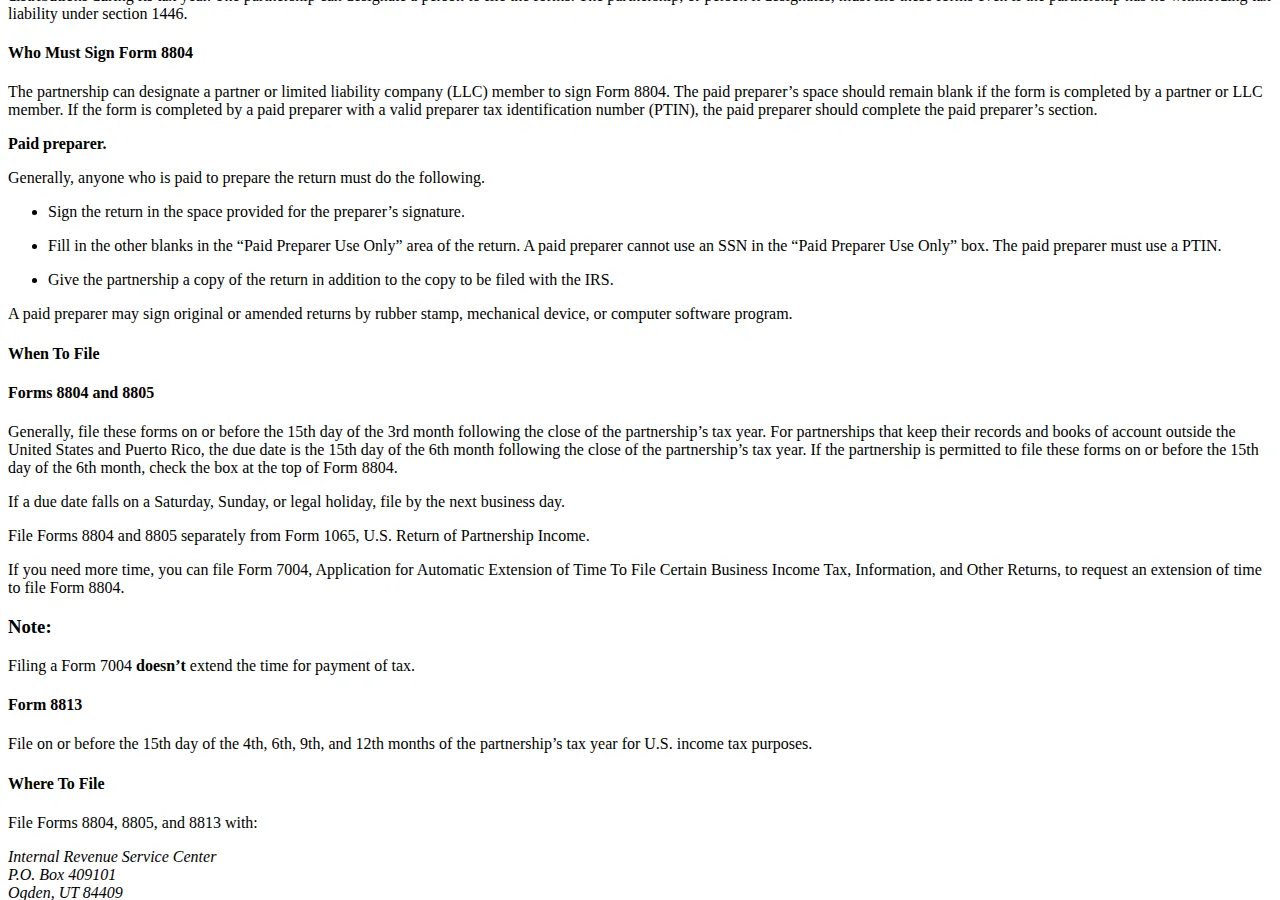
If the partnership needs more time to file Form 8804, it files Form 7004 for an automatic extension. The instructions carry the warning in bold: filing Form 7004 does not extend the time for payment of tax. An extension that arrives with no payment still accrues interest. A due date that falls on a Saturday, Sunday, or legal holiday moves to the next business day.
Form 8805 is the document the foreign partner actually sees. One Form 8805 goes to each foreign partner, showing the partner's share of ECTI, the withholding tax paid on that share, and the identifying information the partner needs for Form 1040-NR: the partnership's EIN, the partner's TIN — an SSN or an ITIN from Form W-7 — and the tax year. A section 6722 penalty applies for each failure to furnish a correct Form 8805 when due. Filing Form 8804 on time but never furnishing the 8805s is still a failure, because the partner cannot claim the credit without the statement.
Section 1446(f): the 10 percent withholding when a foreign partner sells out
A separate rule applies when a foreign partner disposes of the interest itself. Under section 1446(f)(1), if any portion of the gain would be treated under section 864(c)(8) as effectively connected with a US trade or business, the transferee — the buyer — must withhold 10 percent of the amount realized. The base is the amount realized, not the gain: a $1,500,000 sale draws $150,000 of withholding even if the seller's actual gain is far smaller.
The exception is the nonforeign affidavit. Under section 1446(f)(2), no withholding is required if the transferor furnishes an affidavit, under penalty of perjury, stating the transferor's US taxpayer identification number and that the transferor is not a foreign person. The exception fails if the transferee knows the affidavit is false, if an agent gives notice under section 1445(d) that it is false, or if the transferee fails to furnish a copy the Secretary requires. A buyer who closes without the affidavit and without withholding has bought the seller's liability with the interest.
| Rule | Base | Rate | Who withholds | Form |
|---|---|---|---|---|
| Section 1446(a) annual withholding | ECTI allocable to foreign partners | 37% individual / 21% corporate | The partnership | 8804 / 8805 / 8813 |
| Section 1446(f) disposition withholding | Amount realized on the disposition | 10% | The transferee (buyer) | 8288-A / 8288 |
| Section 1441 FDAP withholding | US-source fixed or determinable income | 30% unless treaty reduces it | The withholding agent | 1042 / 1042-S |
| Section 1445 FIRPTA withholding | Amount realized on a US real property interest | 15% | The transferee (buyer) | 8288-A / 8288 |
Section 1446 taxes a foreign partner's operating income; section 1441 taxes passive FDAP income at 30 percent unless a treaty reduces it; section 1445 taxes a US real property interest sale at 15 percent of the amount realized. A buyer of a partner's interest lives under section 1446(f), not section 1445 — unless the partnership's assets are US real property, in which case both regimes can reach the same disposition and the ordering rules decide which applies first.
Where partnerships get it wrong
Treating the withholding as the partner's problem. It is the partnership's liability from the moment ECTI is allocable. The agreement should state who bears the withholding, whether the partnership may reduce distributions by the withheld amount, and what happens when the withholding exceeds the partner's cash distributions — section 1446(d) treats the partner's share as distributed, so a partner who received no cash can still owe tax on the deemed distribution.
Withholding on the wrong base. The base is ECTI, not gross receipts and not book income. A partnership with $2,000,000 of gross receipts and $2,000,000 of ECTI after deductions withholds on the $2,000,000, but a partnership with the same receipts and $400,000 of ECTI withholds on $400,000. A foreign partner may also certify deductions and losses to the partnership to reduce the ECTI allocable to them, lowering the withholding in the year the certificate is given instead of waiting for a refund on Form 1040-NR.
Applying treaty rates to section 1446. A treaty can reduce the FDAP rate under section 1441, and a Form 8233 exemption can stop withholding on personal-services income, but the section 1446 percentages are statutory — 37 percent and 21 percent — and the instructions allow preferential rates for particular income types only in the circumstances the regulations describe. A publicly traded partnership cannot consider preferential rates at all; it withholds at the full percentage and reports on Form 1042. The treaty claim belongs on the partner's return, as a credit or refund, not in the withholding computation.
Founder & CEO Insight — Enow A. Jovial
The decision framework: who this is for, and who should stop here
This guide is for a US partnership — an LLC taxed as a partnership, a limited partnership, or a general partnership — with at least one foreign partner and effectively connected income, and for the buyer of a foreign partner's interest. It is also for the CPA who prepares Form 1065 for such a partnership. It is not for a foreign investor who holds only portfolio stock or receives only FDAP income: that investor lives under section 1441 and Form 1042-S. It is not a substitute for the treaty analysis that decides whether the partner is foreign in the first place — that starts with the substantial presence test and the treaty tie-breaker, covered in our Form 8843 playbook and our Form 8833 treaty position playbook.
Execution checklist
- [x] Classify every partner — foreign or domestic, individual or corporation, from the W-8BEN, W-8BEN-E, or W-8ECI on file; confirm the TIN.
- [x] Compute ECTI and allocate it under section 704 — the foreign partners' slices only, from the K-1 allocations and the books.
- [x] Apply the applicable percentages — 37 percent for non-corporate foreign partners, 21 percent for corporate foreign partners.
- [x] Pay four installments with Form 8813 — 15th day of the 4th, 6th, 9th, and 12th months of the partnership's tax year.
- [x] File Form 8804 and furnish Form 8805 — on or before the 15th day of the 3rd month after year-end, March 15 for a calendar-year partnership, separately from Form 1065.
- [x] Give each foreign partner the Form 8805 — with the ECTI share, the withholding paid, and the TINs, so the section 33 credit lands on Form 1040-NR.
- [x] On a disposition, get the nonforeign affidavit or withhold 10 percent — the buyer withholds on the amount realized under section 1446(f), and a false affidavit known to the buyer does not protect them.