Form 8843 is a one-page statement that decides whether an F-1 student, a J-1 teacher, or a visiting researcher is taxed as a nonresident alien or as a US resident. The form itself computes no tax. It proves that days spent in the United States should not count toward the substantial presence test in 26 U.S.C. § 7701(b)(3) — and if the form is not filed, those days count. A student who spends four years on an F-1 visa and never files Form 8843 can wake up a resident alien for tax purposes, taxed on worldwide income.
The substantial presence test, with the math exposed
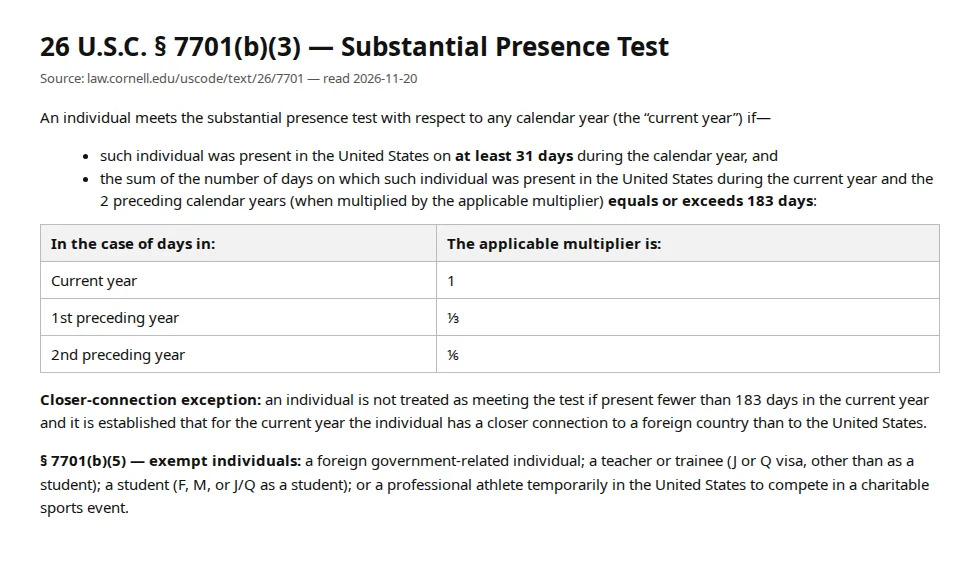
Section 7701(b)(3) makes an alien individual a resident alien for a calendar year if two conditions are both met: presence in the United States on at least 31 days during the year, and a weighted sum of days of presence over the current year and the two preceding years of at least 183 days. The weights are 1 for the current year, one-third for the first preceding year, and one-sixth for the second:
Days spent as an exempt individual are removed from the count before the formula runs, and so are days spent unable to leave because of a medical condition, days commuting from Canada or Mexico, days in transit under 24 hours, days as crew of a foreign vessel, and days under a NATO visa as a member of a force or civilian component. Form 8843 claims the first two exclusions; the others need no form.
Four worked examples that show where the line falls
Example 1 — the clean student. An F-1 student is present 200 days in 2024, 210 days in 2025, and 220 days in 2026, all as an exempt student. Every day is excluded, so the weighted count is 0 + 0 + 0 = 0. The test is not met and the student is a nonresident alien for 2026.
Example 2 — the teacher's 2-of-6 cliff. A J-1 teacher is exempt in 2024 (150 days present) and 2025 (180 days present), then is present 190 days in 2026. Line 8 asks whether the filer was exempt as a teacher, trainee, or student for any part of 2 of the preceding 6 calendar years. The answer is yes, and the teacher cannot exclude any 2026 days unless the Exception in the instructions is met. If it fails, the weighted count is 190 — at least 183, and 190 is at least 31 — so the teacher is a resident alien for 2026.
Example 3 — the 31-day floor. An individual is present 30 days in 2026, 365 days in 2025, and 365 days in 2024, with no exclusions. The weighted count is 30 + 365 ÷ 3 + 365 ÷ 6 = 212.50, well over 183 — but current-year presence is 30 days, one short of the 31-day floor, so the test is not met. One day of presence is the difference between resident and nonresident status.
Example 4 — the student's sixth year. An F-1 student is exempt for five calendar years, 2024 through 2028, then is present 200 days in 2029 with no showing that they do not intend to reside permanently in the United States. The sixth year is not excludable. The weighted count for 2029 is 200 + 70 + 33.33 = 303.33 — the student is a resident alien for 2029, and 2029 is a dual-status year with the residency starting date on the first day the student was present that year.
The closer-connection exception in § 7701(b)(3)(B) only matters when the weighted count reaches 183, and the claim is made on Form 8840 under Treasury Regulation § 301.7701(b)-2.
Who is an exempt individual — § 7701(b)(5)
| Category | Visa | Rule |
|---|---|---|
| Foreign government-related individual | A or G (except A-3 and G-5) | Diplomatic or consular status, full-time employee of an international organization, or immediate family of either; A-3 and G-5 holders count every day |
| Teacher or trainee | J or Q, other than as a student | Substantially complies with the visa; not exempt if exempt as a teacher, trainee, or student for any part of 2 of the preceding 6 calendar years, unless the Exception applies |
| Student | F, M, or J/Q as a student | Substantially complies with the visa; not exempt after the 5th calendar year as an exempt individual unless the filer establishes no intent to reside permanently in the United States |
| Professional athlete | Any, temporarily present | Competing in a charitable sports event: organized for a 501(c)(3) organization, all net proceeds contributed to it, volunteers doing substantially all the work |
The Exception that saves a teacher or trainee past the 2-of-6 limit has four conditions, all of which must hold: exempt as a teacher, trainee, or student for any part of 3 or fewer of the 6 prior calendar years; a foreign employer paid all compensation during the current year; present as a teacher or trainee in any of the 6 prior years; and a foreign employer paid all compensation during each of those prior years. A foreign employer includes an office of an American entity in a foreign country or a US territory, and the filer must attach information verifying the foreign payment.
For students past the 5-year limit, the IRS weighs whether the filer kept a closer connection to a foreign country than to the United States, and whether the filer took steps to change status to lawful permanent resident. Line 13 asks directly whether the filer applied for lawful permanent resident status.
Who must file — and who must not
An alien individual, other than a foreign government-related individual, must file Form 8843 to explain the basis of the claim that days can be excluded because the filer was an exempt individual or was unable to leave because of a medical condition. A foreign government-related individual present under an A or G visa — other than A-3 or G-5 — is not required to file Form 8843 at all. An individual present under an A-3 or G-5 visa must count every day of presence. The medical-condition exclusion has its own boundaries: days are excluded only if the condition arose while the filer was in the United States, the filer intended to leave on a particular day, and a physician certifies on line 18 that the filer was unable to leave on that date and that the condition was not preexisting. No days are excluded if the filer entered for medical treatment, if the condition existed before arrival and the filer knew about it, or if the filer stayed beyond a reasonable period after becoming able to leave.
Form 8843 line by line
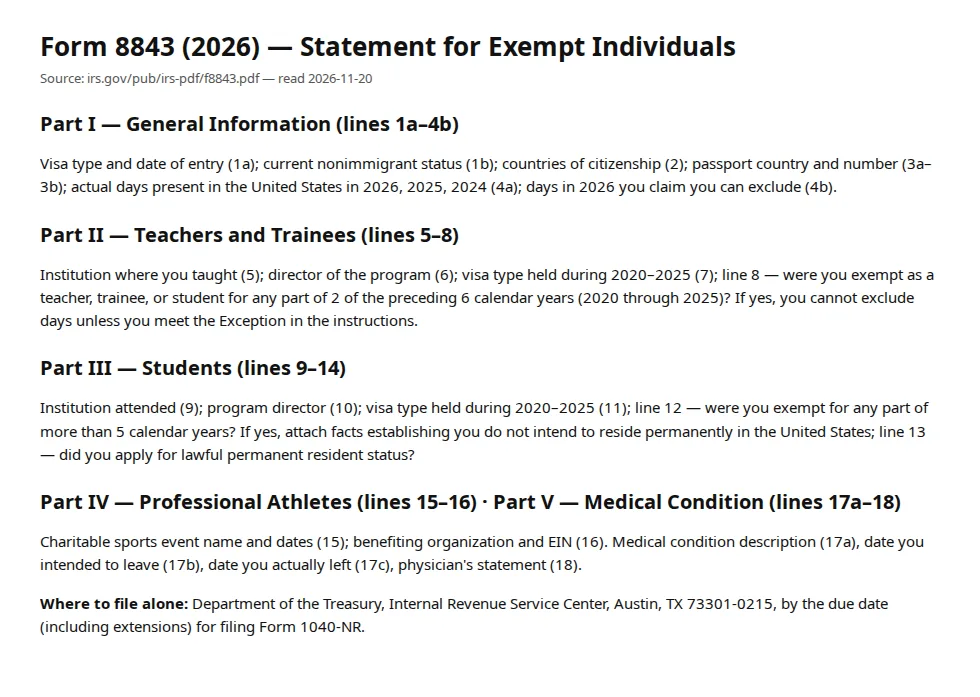
Part I — General Information, lines 1a–4b. Visa type and date of most recent entry (1a), from the electronic arrival and departure record at the CBP I-94 website; current nonimmigrant status as of the last day of the tax year, with the date and previous status if it changed (1b); countries of citizenship (2); passport-issuing country and number (3a–3b); actual days present in 2026, 2025, and 2024 (4a); and the days in 2026 claimed as excludable (4b). If the form is attached to Form 1040-NR, lines 1a through 4a may be skipped when the same information appears on Schedule OI — enter "Information provided on Form 1040-NR" on line 1a.
Part II — Teachers and Trainees, lines 5–8. The institution where the filer taught (5); for trainees, the director of the program (6); the visa type held during each of 2020 through 2025 (7), with an attached statement if it changed; and line 8, the 2-of-6 question. A Q-visa holder completes Part I and only lines 6 through 8.
Part III — Students, lines 9–14. The institution attended (9); the program director (10); the visa type held during 2020 through 2025 (11); line 12, the more-than-5-calendar-years question, which requires an attached statement establishing no intent to reside permanently in the United States; line 13, whether the filer applied for lawful permanent resident status; and line 14, the explanation if yes. A Q-visa holder completes Part I and only lines 10 through 14.
Part IV — Professional Athletes, lines 15–16. The charitable sports event and dates of competition (15), and the name and employer identification number (EIN) of the benefiting organization (16), with an attached statement verifying that all net proceeds were contributed to it.
Part V — Individuals With a Medical Condition, lines 17a–18. A description of the condition (17a); the date the filer intended to leave (17b); the date the filer actually left (17c); and the physician's statement on line 18, signed and dated, with name, address, and telephone number.
Deadlines, where to file, and the late-filing penalty
If a 2026 Form 1040-NR is being filed, attach Form 8843 to it and mail the return by its due date, including extensions. If no 2026 return has to be filed, mail Form 8843 alone to the Department of the Treasury, Internal Revenue Service Center, Austin, TX 73301-0215, by the 1040-NR due date: April 15, 2027 if wages were withheld, June 15, 2027 if they were not.
Dual-status consequences of failing to file
When the exclusion fails and the weighted count reaches 183, the year becomes a dual-status year if the filer was a nonresident for part of it and a resident for the rest — the most common dual-status years are the years of arrival and departure. Publication 519, chapter 6, applies different rules to each part of the year: the resident part is taxed on worldwide income, the nonresident part on US-source income. Nonresident aliens cannot claim the standard deduction — the exception is a narrow treaty rule for certain students and business apprentices from India under Article 21(2) — cannot file a joint return, and cannot claim a dependent unless that person is a citizen or national of the United States.
The identification numbers matter here too. A nonresident alien without a Social Security number (SSN) files with an Individual Taxpayer Identification Number (ITIN); the employer's EIN goes on line 16, and a CPA who prepares the return will ask which of the filer's income is effectively connected income (ECI) and which is fixed, determinable, annual, or periodic income (FDAP), because the two are taxed on different schedules. A single-member LLC owned by a nonresident is disregarded for US tax purposes, while a C-Corp or an S-Corp election changes who owes what.
The residency starting date is the first day during the calendar year on which the individual is present in the United States, once the substantial presence test is met. Section 7701(b)(4) also offers a first-year election for an individual who will meet the test in the following year; take it to a CPA before electing.
Founder & CEO Insight — Enow A. Jovial
Execution checklist
- [x] Step 1: Pull the I-94 record — download the arrival and departure record from the CBP I-94 website and count actual days present in 2026, 2025, and 2024.
- [x] Step 2: Run the weighted formula — apply the 1, one-third, and one-sixth multipliers, check the 31-day floor first, and write the result down.
- [x] Step 3: Check the year limits — teachers and trainees count exempt years in the preceding six; students count exempt calendar years against the five-year limit.
- [x] Step 4: Complete only the parts that apply — Part I plus Part II for teachers and trainees, Part I plus Part III for students, Part I plus Part IV for athletes, Part I plus Part V for a medical condition.
- [x] Step 5: Attach the form to Form 1040-NR — or mail it alone to the IRS Center in Austin, Texas, by April 15, 2027 if wages were withheld, or June 15, 2027 if they were not.
- [x] Step 6: Keep the proof — retain the I-94 record, the visa pages, the institution letters, and any physician statement.
- [x] Step 7: Diary next year's count — re-run the formula every January, because the year the exemption expires is the year the status flips.
For the wider picture, our IRS Form 1040-NR nonresident alien tax return playbook covers the return this form attaches to, our IRS Form W-9 vs W-8BEN contractor onboarding playbook covers the withholding certificate, and our IRS Form 8854 expatriation tax playbook covers the exit side of the same residency rules. Estimate the exposure with our tax estimator.