A tax treaty can cut a U.S. tax bill by tens of thousands of dollars — and create a second filing duty most taxpayers never hear about until the penalty notice arrives. When a treaty changes what the Code would otherwise charge, IRC § 6114 requires the taxpayer to say so on Form 8833. Silence costs $1,000 for an individual and $10,000 for a C corporation, per failure, under IRC § 6712.
1. What IRC § 6114 actually requires
Section 6114(a) states the rule in one sentence: a taxpayer who takes the position that a U.S. treaty overrules or otherwise modifies an internal revenue law shall disclose it as the Secretary prescribes — on the return, on an attached statement, or, if no return is required, in the prescribed form. Section 6114(b) gives the Secretary waiver authority — the legal source of every exception in the regulations.
The trigger is the position, not the outcome: a position with no saving this year can still be reportable. The regulation's own Example 1 turns on an NOL carryover — a treaty position that changes a carryover is reportable even when this year's saving is zero. The form warns on its face: "Attach a separate Form 8833 for each treaty-based return position taken. Failure to disclose a treaty-based return position may result in a penalty of $1,000 ($10,000 in the case of a C corporation) (see section 6712)."
2. The comparison test: is your position treaty-based?
Treas. Reg. § 301.6114-1(a)(2) gives the test, and it is arithmetic, not instinct. Compare (A) the tax liability — including credits, carrybacks and carryovers for the current year and any affected year — as reported, with (B) the liability that would be reported if the treaty provision did not exist. Any difference, or potential difference, makes the position treaty-based and reportable. A position counts as treaty-based unless the no-reporting conclusion has a substantial probability of successful defense if challenged.
Worked example: a nonresident alien receives $120,000 of U.S.-source royalties, taxed at 30 percent under IRC § 871(a). Suppose the treaty caps the U.S. tax on royalties at 10 percent:
Because the figures differ, the royalty position is treaty-based. The 10 percent rate is an assumption showing the arithmetic; the real rate comes from the royalty article of the treaty in force.
3. The eight positions that always require reporting
Regulation § 301.6114-1(b) lists eight positions for which reporting is specifically required. The regulation's definition reaches any treaty provision that overrules or modifies the Code — income tax treaties, estate and gift tax treaties, and friendship, commerce and navigation treaties alike.
| # | Treaty position | Authority |
|---|---|---|
| 1 | A nondiscrimination provision precludes an otherwise applicable Code provision (other than § 897(i)) | § 301.6114-1(b)(1) |
| 2 | A treaty reduces or modifies tax on gain or loss from a U.S. real property interest disposition | § 301.6114-1(b)(2) |
| 3 | A treaty exempts a foreign corporation from, or reduces, branch profits tax (§ 884(a)) or excess interest tax (§ 884(f)(1)(B)) | § 301.6114-1(b)(3) |
| 4 | A treaty exempts or reduces tax on U.S.-source interest or dividends paid by a foreign corporation, or FDAP income from a U.S. person, in the related-party and $500,000 cases | § 301.6114-1(b)(4) |
| 5 | Effectively connected income is not attributable to a U.S. permanent establishment or fixed base, or treaty rules allow expenses the Code denies | § 301.6114-1(b)(5) |
| 6 | A treaty alters the source of any item of income or deduction | § 301.6114-1(b)(6) |
| 7 | A treaty grants a credit for a specific foreign tax the Code would not allow | § 301.6114-1(b)(7) |
| 8 | The residency of an individual is determined under a treaty and apart from the Code | § 301.6114-1(b)(8) |
Line 5 exists for this list: if the position is one for which reporting is specifically required under § 301.6114-1(b), check "Yes," enter the subsection — for example, (b)(3) — and complete line 6.
4. When you do not file: the waivers
Regulation § 301.6114-1(c) waives reporting for a defined set of positions:
- Reduced withholding on FDAP for individuals and governments. A treaty reduction in the withholding rate on dividends, interest, rents or royalties is waived when the beneficial owner is an individual or a State — so a nonresident alien individual receiving treaty-reduced withholding on a portfolio dividend ordinarily files no Form 8833, the withholding agent's Form 1042-S already reporting the payment.
- Personal services, pensions and students. A treaty reduction of tax on dependent personal services, pensions, annuities, Social Security and other public pensions, and income of artistes, athletes, students, trainees or teachers is waived.
- Resourcing for the foreign tax credit. A treaty provision resourcing income solely to apply the foreign tax credit limitation is waived, as is a Social Security Totalization Agreement or Diplomatic or Consular Agreement reducing or modifying tax; the credit itself is claimed on Form 1116.
- The individual de minimis threshold. Reporting is waived for an individual if reportable payments or income in the year total $10,000 or less — $100,000 for positions reportable only by reason of (b)(8), treaty-determined residency.
- Partnerships, trusts and withholding agents. A partnership, trust or estate that discloses a position excuses its partners or beneficiaries from disclosing the same position, and a withholding agent is exempt from reporting a position taken by the person for whom it withholds. Form 1042-S waivers in (c)(6)–(c)(8) cover the same ground for the payee, subject to a $500,000 aggregate cap for non-individuals.
The de minimis rule is a calculation: $8,500 is waived; $12,000 is not:
5. The penalty math: what silence costs
Section 6712(a) imposes $1,000 — $10,000 for a C corporation — on each failure to meet § 6114, and each undisclosed position is a separate failure. An S-Corp pays the $1,000 figure, not $10,000 — the statute names C corporations only. Section 6712(b) lets the Secretary waive all or part of the penalty on reasonable cause and good faith; § 6712(c) adds that the penalty is in addition to any other penalty imposed by law.
A C-Corp takes three treaty positions — branch profits tax, real property interest gain, and source alteration — and discloses none:
Compliance is cheap: Form 8833 carries no separate IRS filing fee, and the IRS estimates the burden at 6 hours 25 minutes — 3 hours 7 minutes of recordkeeping, 1 hour 35 minutes of learning, and 1 hour 43 minutes of preparing and sending. Against a $30,000 corporate exposure the arithmetic of disclosure is one-sided. Price the treaty-side tax first with our Tax Estimator, so the comparison test runs on real numbers. Reasonable cause under § 6712(b) is a facts-and-circumstances test: written advice from a CPA, contemporaneous workpapers showing the comparison test, and a filed Form 8833 for the other positions on the same return all weigh in the taxpayer's favour; a bare claim of ignorance does not.
Founder & CEO Insight — Enow A. Jovial
>
6. Completing Form 8833 line by line
Form 8833 (Rev. December 2022, OMB No. 1545-1354) runs to two pages of form and three pages of instructions. The header carries two checkboxes, checked singly or together: disclosure under § 6114, or disclosure by a dual-resident taxpayer under Reg. § 301.7701(b)-7. It also asks for name, taxpayer identifying number — SSN or ITIN for an individual, EIN for all others — and a reference ID number for a foreign corporation.
Line 1 — the treaty position relied on. Enter the treaty country and article — for example, "United States–United Kingdom Income Tax Treaty, Article 12 (Royalties)."
Line 2 — the Code provisions overruled or modified. List every IRC section displaced — § 871(a) for royalties, § 884(a) for branch profits. Omitting one leaves that part undisclosed.
Line 3 — the payor. Name, identifying number if available, and U.S. address of the FDAP payor.
Line 4 — the limitation on benefits article. Name the specific LOB test the taxpayer meets; the IRS summarizes the tests treaty-by-treaty in Table 4 of its Tax Treaty Tables. If a competent-authority determination is pending under Rev. Proc. 2015-40, say so on line 6 — the IRS treats a pending determination as a live position, not a settled one.
Line 5 — specifically required reporting. Answer "Yes" or "No"; if "Yes," enter the subsection and complete line 6 in full.
Line 6 — the explanation. This is the line the examination turns on. Explain the position, summarize the facts, list the nature and amount — or a reasonable estimate — of each item claimed, and show why the taxpayer meets the LOB test named on line 4. Same-type payments from the same payor may be treated as one item; estimates must be labelled as such, with their basis stated.
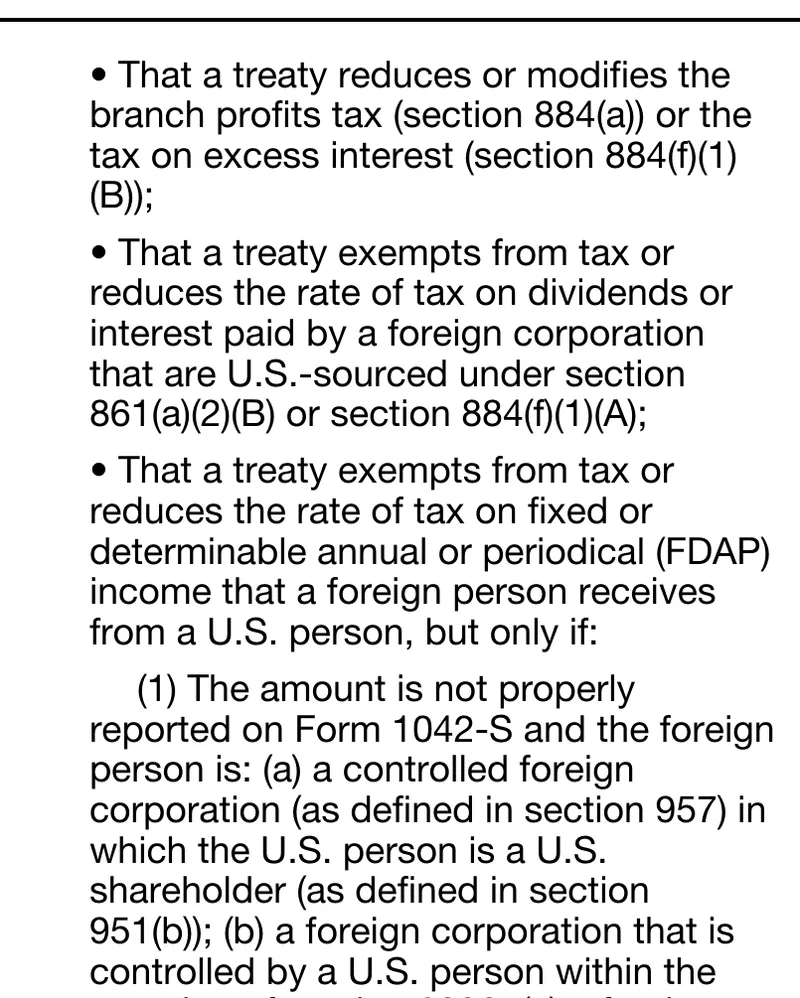
The instructions to Form 8833 (Rev. December 2022) list the positions for which reporting is specifically required under Reg. § 301.6114-1(b).
7. Filing mechanics: where the form goes, and the dual-resident trap
Attach Form 8833 to the tax return — Form 1040-NR or Form 1120-F for most claimants — for the year the position is taken. A separate form is required annually for each position. If no return would otherwise be required, the taxpayer must still file one: under Reg. § 301.6114-1(a)(1)(ii) it need contain only name, address, and taxpayer identifying number, signed under penalties of perjury, with the disclosure attached, and the taxable year is deemed the calendar year unless the taxpayer has established a different one.
An alien individual resident of both the United States and another country under each country's laws, who determines under the treaty's tie-breaker that they are a resident of the foreign country, must file Form 1040-NR with Form 8833 attached and compute the tax as a nonresident alien for that part of the year. Publication 519 (2025) states this directly.
The trap inside the trap is the long-term resident. A dual-resident taxpayer who is also a long-term resident — a lawful permanent resident in at least 8 of the last 15 tax years — and who elects foreign treaty residence is deemed to have expatriated under § 877A, must file Form 8854, and may owe expatriation tax. A green-card holder of eight or more years must price that consequence before claiming the tie-breaker.
Two related forms are often confused with Form 8833: Form 8802 certifies U.S. residence for claiming treaty benefits abroad, and Form 1116 claims the foreign tax credit. Neither discloses a treaty position on a U.S. return. Our Form 8802 residency certification playbook covers the certification, and our Form 1116 foreign tax credit playbook covers the credit. Filing one never satisfies the others.
8. The filing sequence, start to finish
- Identify every treaty position on the return. Walk each item of income, deduction and credit; run the § 301.6114-1(a)(2) comparison for each, in writing.
- Test each position against the (b) list. If it matches one of the eight, mark it for line 5 "Yes" and note the subsection.
- Test each position against the (c) waivers. Check payee type, payment type, Form 1042-S reporting, and the $10,000 threshold — $100,000 for (b)(8) positions. Keep the fitting waiver and citation in the workpapers.
- Pull the treaty text and the LOB analysis. Confirm the article, the paragraph, the LOB test met, and that the treaty is in force.
- Complete one Form 8833 per surviving position. Lines 1 through 6, with amounts or reasonable estimates, and the LOB test on line 4.
- Attach each form to the correct return. Form 1040-NR for a nonresident alien or dual-resident taxpayer, Form 1120-F for a foreign corporation, or a disclosure-only return.
- File, then keep the file. Retain the treaty article, the comparison, the LOB analysis, and the filed forms. If a position is discovered after filing, amend and attach the missing Form 8833.
9. Execution checklist
- [x] Every treaty position run through the § 301.6114-1(a)(2) comparison
- [x] Each position checked against the eight (b) positions
- [x] Each position checked against the (c) waivers, including the $10,000 / $100,000 thresholds
- [x] One Form 8833 per surviving position, lines 1–6 filled, LOB test named
- [x] Treaty country and article cited on line 1; overruled Code sections listed on line 2
- [x] Forms attached to the correct return
- [x] Long-term resident status checked before any tie-breaker claim — Form 8854 and § 877A priced in advance
- [x] Treaty article, comparison memo and LOB analysis retained