IRS Form 1040-NR: The Nonresident Alien Tax Return Playbook
The return itself, not the paperwork around it
Form 1040-NR is the income tax return for a person who is neither a U.S. citizen nor a U.S. resident for tax purposes, and who still owes the United States tax. It is where the two halves of nonresident taxation meet: income connected with a U.S. trade or business, taxed at graduated rates, and U.S.-source income that is not connected, taxed at a flat 30 percent. The W-8BEN, the residency determination, and Form 8833 all feed it.
Who must file
The IRS page on taxation of nonresident aliens names five filers. A nonresident alien engaged or considered to be engaged in a trade or business in the United States during the year must file. A nonresident alien who is not engaged in a trade or business but has U.S. income on which the tax was not satisfied by withholding at source must file. A representative or agent of such a person must file, as must a fiduciary for a nonresident alien estate or trust.
A nonresident alien student, teacher, or trainee temporarily present on an F, J, M, or Q visa is considered engaged in a trade or business in the United States, and must file Form 1040-NR if they have income subject to tax, such as wages, tips, scholarship and fellowship grants, or dividends.
A nonresident alien must also file to claim a refund of overwithheld tax, or the benefit of any deductions or credits. Our Form 8833 tie-breaker playbook covers the residency determination, and our W-9 vs W-8BEN playbook covers the withholding certificate.
The residency gate: the 183-day test
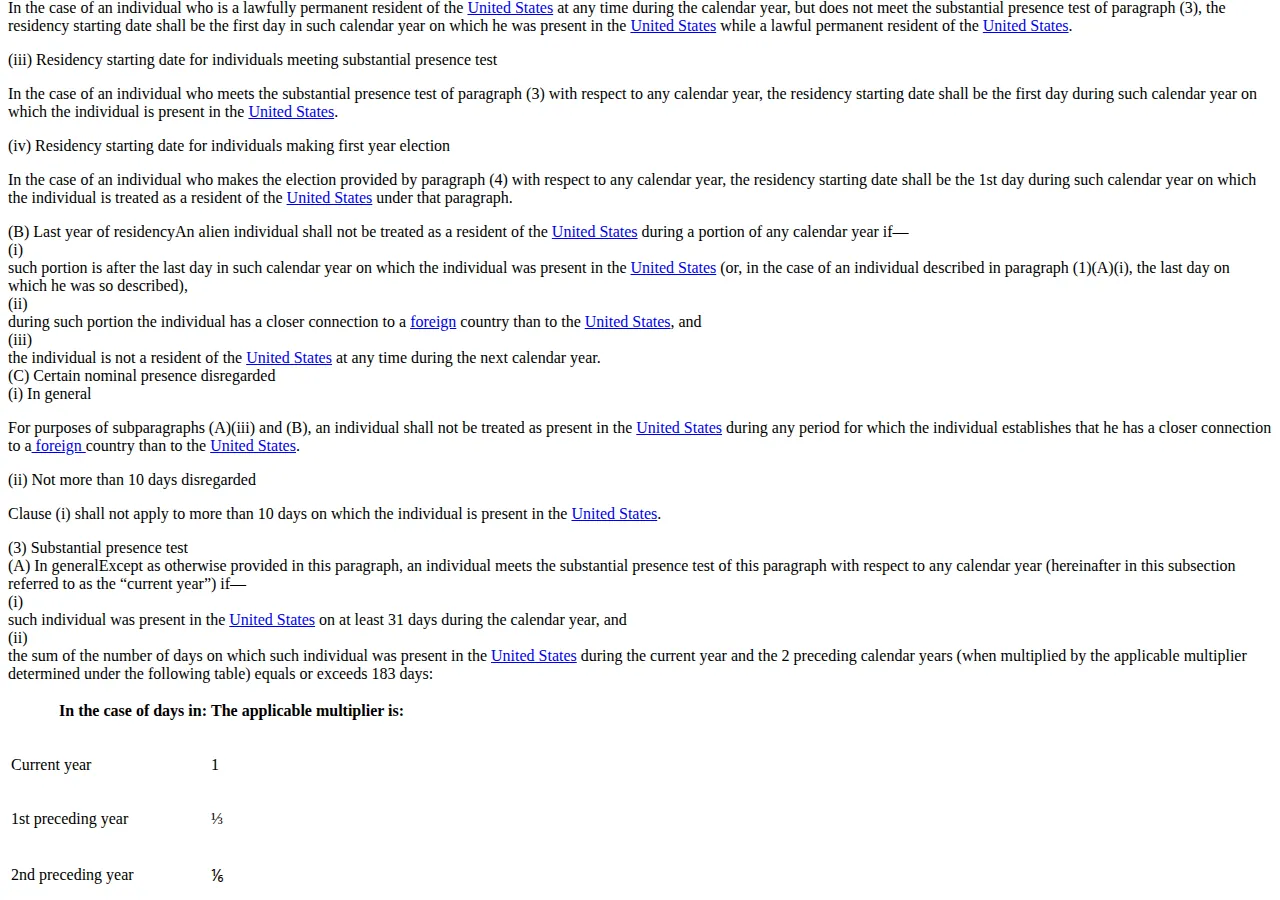
Residency for tax purposes is a statute, not a feeling and not an immigration status. Section 7701(b)(1)(A) treats an alien as a resident if the person holds a green card, meets the substantial presence test, or makes the first-year election. A green card holder is a resident from the first day of presence as a permanent resident. Everyone else runs the day count.
Section 7701(b)(3) sets the test in two parts. The person must be present in the United States on at least 31 days during the current year, and the weighted sum of days across the current year and the two preceding calendar years must equal or exceed 183 days. The weights are fixed: current year days at full weight, the first preceding year at one-third, the second preceding year at one-sixth.
Worked example — a consultant present 120 days in 2025, 180 in 2024, 120 in 2023. The 31-day floor is met, and the weighted sum is:
At 200 weighted days the consultant meets the test for 2025 and files as a resident; at 60 days in 2025 the sum falls to 140.
Section 7701(b)(3)(B) excuses a person present fewer than 183 days in the current year who has a tax home in a foreign country and a closer connection to that country than to the United States. That exception is unavailable to anyone with a pending application for adjustment of status. Section 7701(b)(3)(D) excludes days on which the person is an exempt individual, and days on which a medical condition that arose while present in the United States made it impossible to leave.
Exempt individuals: the F, J, and Q clock
Section 7701(b)(5) names the exempt individuals: a teacher or trainee holds a J or Q visa; a student holds an F, M, J, or Q visa.
The exemption is time-limited by section 7701(b)(5)(E), and the limits are the trap. A teacher or trainee stops being exempt for a year if, for any two calendar years during the preceding six, the person was exempt as a teacher, trainee, or student. A student stops being exempt after the fifth calendar year of exemption, unless the student establishes to the satisfaction of the Secretary that the student does not intend to reside permanently in the United States and still meets the student requirements.
ECI vs FDAP: the two lanes of the return
The IRS divides a nonresident alien's taxable income into two categories, and the return is built around the split. Effectively connected income is income connected with a trade or business in the United States. It is taxed at graduated rates on page one of Form 1040-NR, after allowable deductions. FDAP income — fixed, determinable, annual, or periodical income from U.S. sources — is taxed at a flat 30 percent, or a lower treaty rate if the filer qualifies, with no deductions allowed against it. It is reported on Schedule NEC (Form 1040-NR).
Section 871 is the statute behind both lanes. Section 871(a)(1) imposes the 30 percent tax on FDAP items received from U.S. sources: interest, dividends, rents, salaries, wages, and other fixed or determinable annual or periodical income, to the extent not effectively connected. Section 871(b)(1) taxes ECI at the graduated rates of sections 1 and 55. Section 871(a)(2) adds a charge that surprises traders: a nonresident alien present in the United States for 183 days or more during the year pays 30 percent on net U.S.-source capital gains, with no capital loss carryover. Section 871(h) exempts portfolio interest, and section 871(c) treats F, J, M, and Q nonimmigrants as engaged in a U.S. trade or business.
| Income type | Tax treatment | Where it is reported | Deductions allowed | Authority |
|---|---|---|---|---|
| Wages and business income effectively connected | Graduated rates, sections 1 and 55 | Page one of Form 1040-NR | Yes, if properly allocated to ECI | Section 871(b) |
| U.S.-source dividends, interest, rents, royalties | Flat 30 percent, or lower treaty rate | Schedule NEC (Form 1040-NR) | No | Section 871(a)(1) |
| Net U.S.-source capital gains, 183 days or more present | Flat 30 percent on net gain | Schedule NEC (Form 1040-NR) | No, and no capital loss carryover | Section 871(a)(2) |
| U.S. real property income with section 871(d) election | Graduated rates as ECI | Page one of Form 1040-NR | Yes, with a timely true and accurate return | Section 871(d) |
| Portfolio interest on qualifying obligations | Exempt from the 30 percent tax | Not taxed; reported as required by the payer | Not applicable | Section 871(h) |
Misclassify rental income as FDAP and the filer pays 30 percent of gross rent with no deductions. Elect under section 871(d) because the same rent is then taxed on net income at graduated rates, with deductions — but the election stays in effect for all later years and can be revoked only with the consent of the Secretary, and a new election cannot be made before the fifth taxable year after a revocation without consent. Run the numbers on the tax estimator before choosing a lane, and keep the worksheet with the return. Schedule OI is mandatory for every filer; Schedules A, NEC, and P carry itemized deductions, the FDAP tax, and partnership transfers.
Treaty positions and elections
A treaty can cut the 30 percent FDAP rate, and the return is where the cut is claimed. The filer reports the treaty-reduced rate on Schedule NEC, attaches Form 8833 to disclose a treaty-based return position, and keeps the treaty article citation on the worksheet. The residency article decides which country taxes worldwide income; the rate articles set the withholding rate on each class of FDAP income.
Beside the treaty sit two elections. The section 871(d) election treats U.S. real property income as effectively connected. The section 6013(g) election lets a nonresident alien married to a U.S. citizen or resident elect to be treated as a resident, which opens joint filing — but the price is worldwide income on a joint return, and the election, once made, stays in effect until revoked or terminated.
Worked example — FDAP at 30 percent against a treaty rate
A nonresident alien receives 50,000 dollars of U.S. dividends in 2025, with no U.S. trade or business and no treaty claim:
If a treaty sets a 15 percent rate for dividends, and the filer discloses the position on Form 8833, the same income costs half as much:
The clock: April 15, June 15, and the 16-month rule
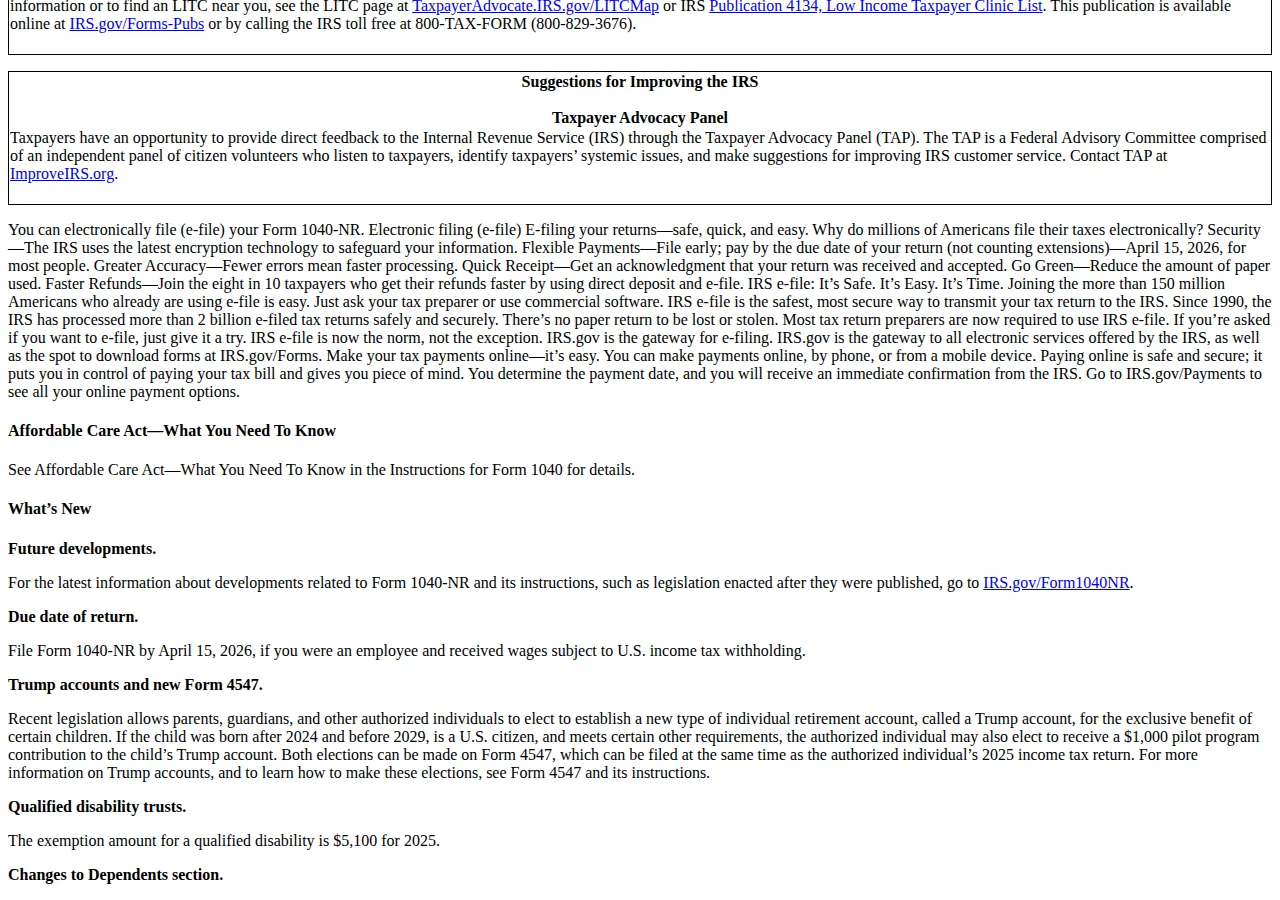
The 2025 instructions state the due date in one line per filer type. File Form 1040-NR by April 15, 2026, if you were an employee and received wages subject to U.S. income tax withholding. If you did not receive wages as an employee subject to withholding, file by the 15th day of the 6th month after the tax year ends — June 15, 2026, for a calendar-year filer.
To get the benefit of any allowable deductions or credits, a nonresident alien must timely file a true and accurate return, and a return is timely for this purpose if filed within 16 months of the due date. The IRS may deny deductions and credits on returns filed more than 16 months after the due date.
Dual-status returns: two halves, one year
A dual-status individual is a person who changes tax status during the year — from nonresident to resident, or from resident to nonresident. Residency is determined under both the Code and tax treaties, and the return is split. Worldwide income for the resident part of the year goes on Form 1040. U.S.-source income for the nonresident part goes on Form 1040-NR.
The first-year choice treats a person who meets the test in the following year as a resident for part of the current year.
The boundary: section 877A and the exit tax
Form 1040-NR is also the last return for a person who leaves the system. A long-term resident who gives up the green card, and a citizen who renounces, faces sections 877 and 877A. Section 877A(a)(1) treats all property of a covered expatriate as sold for fair market value on the day before the expatriation date. Section 877A(a)(3) cuts the gain by an exclusion amount: 890,000 dollars for 2025, 910,000 dollars for 2026 under Rev. Proc. 2025-32.
Any one of three tests makes a person a covered expatriate. The average annual net income tax for the five years before expatriation exceeds the inflation-adjusted threshold — 206,000 dollars for 2025, 211,000 dollars for 2026. Net worth is 2,000,000 dollars or more on the expatriation date, a figure fixed in the statute and never adjusted. Or the person fails to certify on Form 8854 that all federal tax obligations for the five preceding years were met.
Worked example — the mark-to-market charge. A covered expatriate holds assets with net unrealized gain of 1,400,000 dollars in 2025:
The 510,000 dollars is taxed as if the property had actually been sold.
Founder & CEO Insight — Enow A. Jovial
The execution checklist
- Step 1 — Run the residency test first. Count presence days for the current year and the two preceding years, apply the 1, 1/3, 1/6 weights, and check the 31-day floor, the exempt years, and the closer-connection exception.
- Step 2 — Classify every U.S.-source dollar. Wages, business income, and 871(d) rents go in the ECI lane. Dividends, interest, other rents, royalties, and FDAP items go on Schedule NEC.
- Step 3 — Pull the W-8BEN and withholding statements. Match the tax withheld on each 1042-S and W-2 against the treaty rate, and flag overwithholding for a refund.
- Step 4 — Attach Form 8833. Cite the treaty article for each reduced rate, and disclose every treaty-based position on the same return that claims it.
- Step 5 — Complete Schedule OI and the schedules that fit. Schedule A (Form 1040-NR) only for deductions connected with effectively connected income; Schedule P for partnership transfers.
- Step 6 — Test the standard deduction rule. No standard deduction unless the filer is an India treaty student or business apprentice under Article 21(2); dual-status filers never take it.
- Step 7 — Calendar the due date. April 15, 2026 for employees with wages subject to withholding; June 15, 2026 for everyone else; Form 4868 by the regular due date.
- Step 8 — File within 16 months of the due date. After that line, deductions and credits can be denied even on a complete return.
- Step 9 — Handle the departure paperwork. A departing alien needs a sailing or departure permit by filing Form 1040-C or Form 2063 before leaving, and must still file the annual return.
- Step 10 — Test the section 877A boundary before giving up status. Run the three covered-expatriate tests, price the gain against the 890,000-dollar 2025 exclusion, and file Form 8854 with the final return.