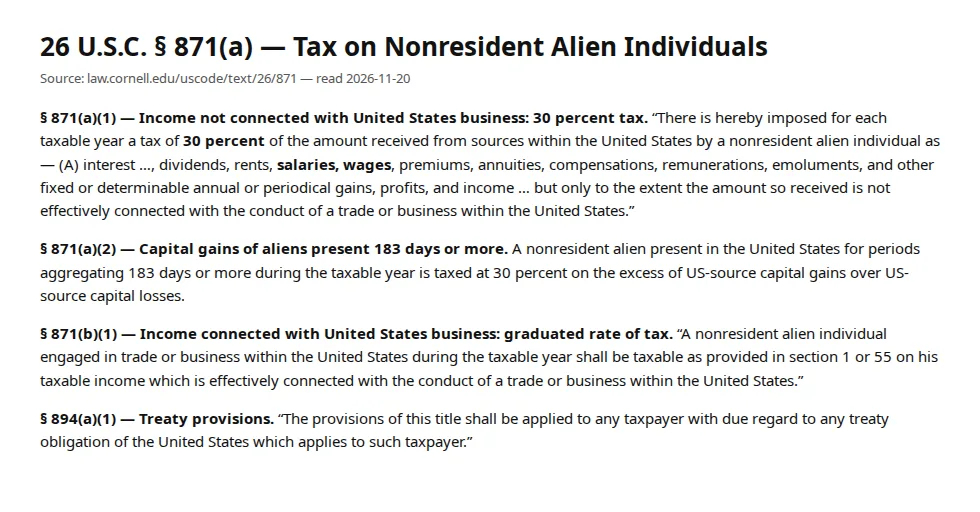
A nonresident alien who earns compensation for personal services in the United States starts from a 30 percent withholding rate. That is the default in 26 U.S.C. § 871(a)(1): US-source salaries, wages, and other FDAP income are taxed at 30 percent when the income is not effectively connected with a US trade or business. A tax treaty can cut that rate to zero — 26 U.S.C. § 894(a)(1) requires the Code to be applied with due regard to treaty obligations — but the treaty does not apply itself. Form 8233 is the instrument that tells the withholding agent to stop withholding. Without it, the employer withholds 30 percent, recoverable only as a Form 1040-NR refund after the year ends.
The default rule, with the math exposed
Section 871(a)(1) imposes the 30 percent tax on US-source income not effectively connected with a US trade or business. Section 871(b)(1) taxes effectively connected income at graduated rates under section 1 or 55 instead. Section 894(a)(1) then layers the treaty on top: a treaty article that exempts personal-services income overrides the 30 percent rate for a resident of the treaty country who meets the article's conditions.
The arithmetic is the reason the form matters. A J-1 visiting professor earns $48,000 for one semester of teaching at a US university. Without Form 8233, the university withholds 30 percent:
\\text{Withholding Without Form 8233} = \\$48,000 \\times 30\\% = \\$14,400
With a valid Form 8233 claiming a full treaty exemption, the withholding is zero, and the $14,400 stays in the professor's pay:
\\text{Withholding With Form 8233} = \\$48,000 \\times 0\\% = \\$0
\\text{Cash Recovered by Filing} = \\$14,400 - \\$0 = \\$14,400
Run your own pay through our tax estimator before the first payroll run.
Who Form 8233 is for — and who must use something else
Form 8233 covers compensation for personal services only, and the boundary is the first thing to get right: for income not earned from personal services, the payee files Form W-8BEN; for income earned from personal services, the payee files Form 8233. The table below is the decision the filer makes before touching either form.
| Income type | Correct form | Why |
|---|---|---|
| Independent personal services — consulting, lectures, professional fees as a contractor | Form 8233 | Treaty exemption on independent-services compensation, claimed under Treas. Reg. § 1.1441-4(b) |
| Dependent personal services — wages as an employee, including compensatory scholarship income | Form 8233 | Treaty exemption on wages, with the treaty article and the Appendix A or B statement |
| Noncompensatory scholarship or fellowship income alone | Form W-8BEN | Not personal-services compensation; 30 percent, or 14 percent for F, J, M, or Q visas, unless a treaty exempts it |
| Dividends, interest, rents, royalties, other FDAP income | Form W-8BEN | Fixed or determinable annual or periodical income; Form 8233 cannot claim it |
| Compensation with no treaty claim | Form W-4 | Ordinary withholding; for a nonresident alien, the W-4 follows Notice 1392 |
Three groups should not file Form 8233 at all. First, a US citizen or resident alien — the form is for nonresident alien individuals only, and a nonresident alien married to a US citizen who elects resident treatment for a joint return is still treated as a nonresident alien for withholding purposes. Second, an athlete or entertainer: most treaties have a special artistes-and-sportsmen article that takes precedence, and the exemption usually turns on a dollar threshold unknown until year-end — the IRS generally cannot accept Form 8233 for them, and they face 30 percent withholding without a Central Withholding Agreement. Third, anyone whose income is not covered by a treaty article.
The treaty table that decides your number
The filer must know the terms of the treaty before completing the form — the Instructions say so directly. IRS Publication 901 (Rev. September 2024) is the quick-reference guide, and its student and trainee entries show how different the numbers are:
| Treaty country | Personal-services exemption for students, trainees, apprentices |
|---|---|
| China | Up to $5,000 for each tax year |
| Cyprus | Up to $2,000 a year, for up to five tax years |
| Egypt | Up to $3,000 a year, for up to five tax years |
| Czech Republic, Estonia, France | Up to $5,000 for each tax year |
| Commonwealth of Independent States | Stipends and allowances of less than $10,000 a year, for a maximum of five years |
Teachers and researchers have their own articles: a resident of China teaching or researching at a US university is exempt on that income.
For independent personal services the pattern is a day-count test plus a fixed-base test. A resident of Australia is exempt if present no more than 183 days during the tax year and without a fixed base regularly available in the United States; income attributable to a fixed base is taxable. Under the Canada, India, and Portugal treaties, an independent contractor with no fixed base may still be taxable if the stay exceeds a specified period — generally 90 or 183 days — and often cannot claim the exemption at payment time because the stay length is not yet known.
Form 8233 line by line
Part I — Identification of Beneficial Owner, lines 1–10. Line 2 requires a US taxpayer identification number — an SSN in most cases, or an ITIN from Form W-7; if the number is pending, attach a copy of the completed Form W-7 or SS-5. An expired ITIN must be renewed first: ITINs expire at the end of the third consecutive tax year without a filed return. Line 3 takes the treaty country's tax identification number. Line 4 is the permanent residence address in the treaty country — not a post office box or a mailing address — although a student or researcher who was a resident of the treaty country at entry may give a US address and still qualify. Line 6 records the visa type — F-1, J-1, M-1 — and spouses and dependents on F-2, J-2, H-4, or O-3 visas are usually not eligible for the same benefits as the primary holder. Line 8 is the date of entry from the CBP I-94 record. Line 10 requires the Appendix A statement for students or the Appendix B statement for teachers and researchers, printed at the end of Publication 519.
Part II — Claim for Tax Treaty Withholding Exemption, lines 11–14. Line 11a describes the services — "consulting contract to design software" or "give three lectures at XYZ University" for independent services; "part-time library assistant" for dependent services. Line 11b is the total compensation expected from this withholding agent during the tax year, estimated if unknown. Lines 12a and 12b name the treaty and the article — for example, "U.S.–Germany tax treaty, Article 14, paragraph 2" — and line 12c states "All" if every dollar is exempt, or the exact exempt amount if only part is. Line 14 gives the facts justifying the exemption; incomplete lines 11 through 14 are a common error that delays acceptance.
Part IV — Withholding Agent Acceptance and Certification. The agent reviews the form and, if satisfied the exemption is warranted, completes and signs the certification. The dated duties after acceptance follow in the next section.
The withholding agent's side: the 10-day wait and the 5-day clock
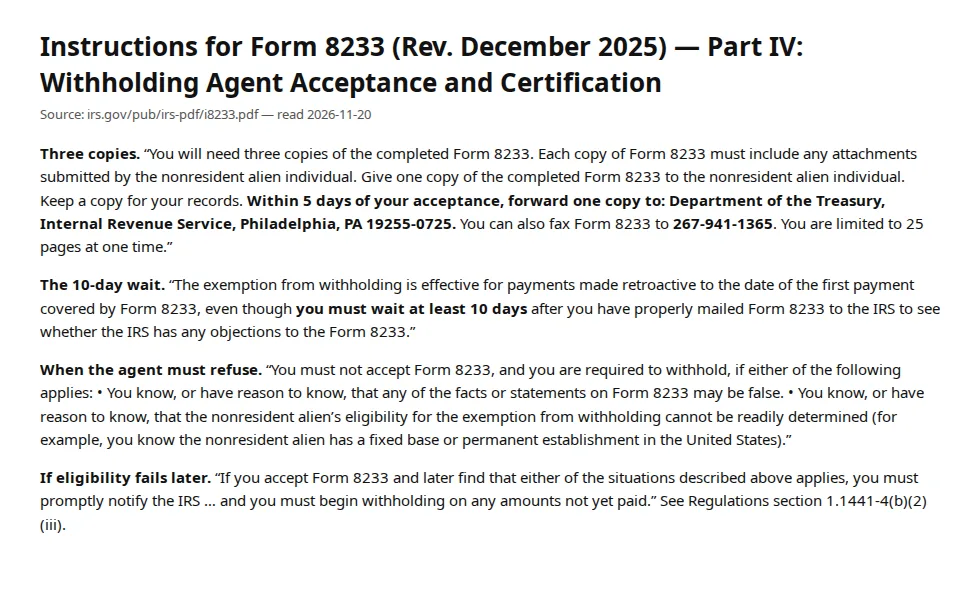
The withholding agent is any person, US or foreign, that has control, receipt, or custody of an amount subject to withholding, or that can disburse it — in practice, the university payroll office. Part IV of the Instructions sets out the agent's obligations in four dated steps: three copies of the completed form, each including attachments; one copy to the nonresident alien, one kept; within 5 days of acceptance, one copy forwarded to the Department of the Treasury, Internal Revenue Service, Philadelphia, PA 19255-0725, or faxed to 267-941-1365, limited to 25 pages at one time; and a wait of at least 10 days after properly mailing the form to the IRS to see whether the IRS objects. The exemption is effective retroactively to the first payment covered, so the waiting period costs the payee nothing.
The agent must not accept the form, and must withhold, in two situations: it knows or has reason to know that any fact or statement may be false, or that eligibility cannot be readily determined — the Instructions give the example of a nonresident alien known to have a fixed base in the United States. If the agent accepts and later discovers either situation, it must promptly notify the IRS at the Philadelphia address and begin withholding on unpaid amounts. If the IRS notifies the agent that eligibility is in doubt, or that the form is incorrect, withholding must begin immediately. The examples are in Treasury Regulation § 1.1441-4(b)(2)(iii).
The companion form: Form 8833 and the $1,000 penalty
Form 8233 stops withholding. Form 8833 discloses the treaty position on the tax return, and the two are often confused. The IRS "Claiming tax treaty benefits" page requires Form 8833 when the treaty position overrides or modifies a provision of the Code and the tax is or might be reduced — with a $1,000 penalty for each failure to file it when required. But the exceptions matter more for Form 8233 filers: no Form 8833 is required for a treaty exemption on dependent personal services, pensions, annuities, social security, or student, trainee, or teacher income — which covers the ordinary Form 8233 wage exemption. Form 8833 is required for a US real property interest gain, a source change, a foreign tax credit the Code would not allow, or a treaty-based residence determination over $100,000. Our IRS Form 8833 treaty-based return position disclosure playbook covers the disclosure side, our IRS Form 1040-NR nonresident alien tax return playbook covers the return the exemption feeds into, and the IRS Form 8843 exempt individuals playbook covers the statement that keeps exempt days out of the substantial presence test.
Founder & CEO Insight — Enow A. Jovial
Failure modes: the six ways Form 8233 dies
1. No treaty, no claim. No income tax treaty with the country, or no article covering the income — the form is rejected.
2. The fixed base. An independent contractor with an office or fixed base available in the United States loses the exemption on that income.
3. The day-count cliff. Under the Canada, India, and Portugal treaties, a contractor who stays past the specified period — generally 90 or 183 days — becomes taxable on US-performed services, and the exemption cannot be claimed at payment time.
4. The wrong form for the income. Noncompensatory scholarship income or FDAP income filed on Form 8233 instead of Form W-8BEN is a rejected claim — Form 8233 is for personal-services compensation only.
5. The expired ITIN. An ITIN unused on a return for three consecutive tax years expires, and a Form 8233 carrying one is not a valid claim until the ITIN is renewed.
6. The agent who knows too much. If the agent knows or has reason to know the facts are false or eligibility cannot be determined, it must refuse the form and withhold.
The filing sequence
- Confirm the treaty and article in Publication 901, and that the treaty is still in force.
- Complete Form 8233 with the TIN and the Appendix A or B statement.
- Give the form to the withholding agent before the first payment.
- Calendar the 5-day forwarding deadline and the 10-day objection window.
Execution checklist
- [x] Confirm the treaty is in force and the income is personal-services compensation — check Publication 901; Hungary terminated January 1, 2024, Russia suspended August 16, 2024.
- [x] Get the TIN right — SSN, or ITIN from Form W-7; attach the W-7 or SS-5 copy if pending.
- [x] Attach the Appendix A or B statement — students, trainees, teachers, and researchers must attach the Publication 519 statement.
- [x] Complete lines 11 through 14 in detail — the service, the total compensation, the treaty and article, "All" or the exact amount, and the justifying facts.
- [x] File one form per tax year, per agent, per income type — a professor lecturing at three institutions files three forms.
- [x] Give the form to the agent before the first payment — late filing means withholding that only a 1040-NR refund recovers.
- [x] Calendar the agent's deadlines — 5 days to forward the copy to Philadelphia, and a 10-day wait for an IRS objection; keep the accepted copy, because the treaty claim must be re-made every tax year.
- [x] Decide whether Form 8833 is also required — usually not for a dependent personal-services exemption; required for real-property gains, source changes, foreign tax credits, and residence over $100,000.