IRS Forms 1099-INT vs 1099-DIV: The Payer's Interest and Dividend Reporting Playbook
The payer's form, not the recipient's schedule
Every January, two people look at the same dollars and see two different forms: the recipient sees a statement to copy onto a tax return, the payer an information return to file with the IRS, on a deadline, under a penalty ladder. This playbook is written for the payer: the bank, brokerage, corporation, fund administrator, or business that paid the interest or dividend. The recipient side is covered in our Schedule B interest and dividends playbook.
A recipient reports interest or dividends over $1,500 on Schedule B; a payer files at $10, and a missed form costs a per-return penalty across every payee.

Who must file, and who is exempt
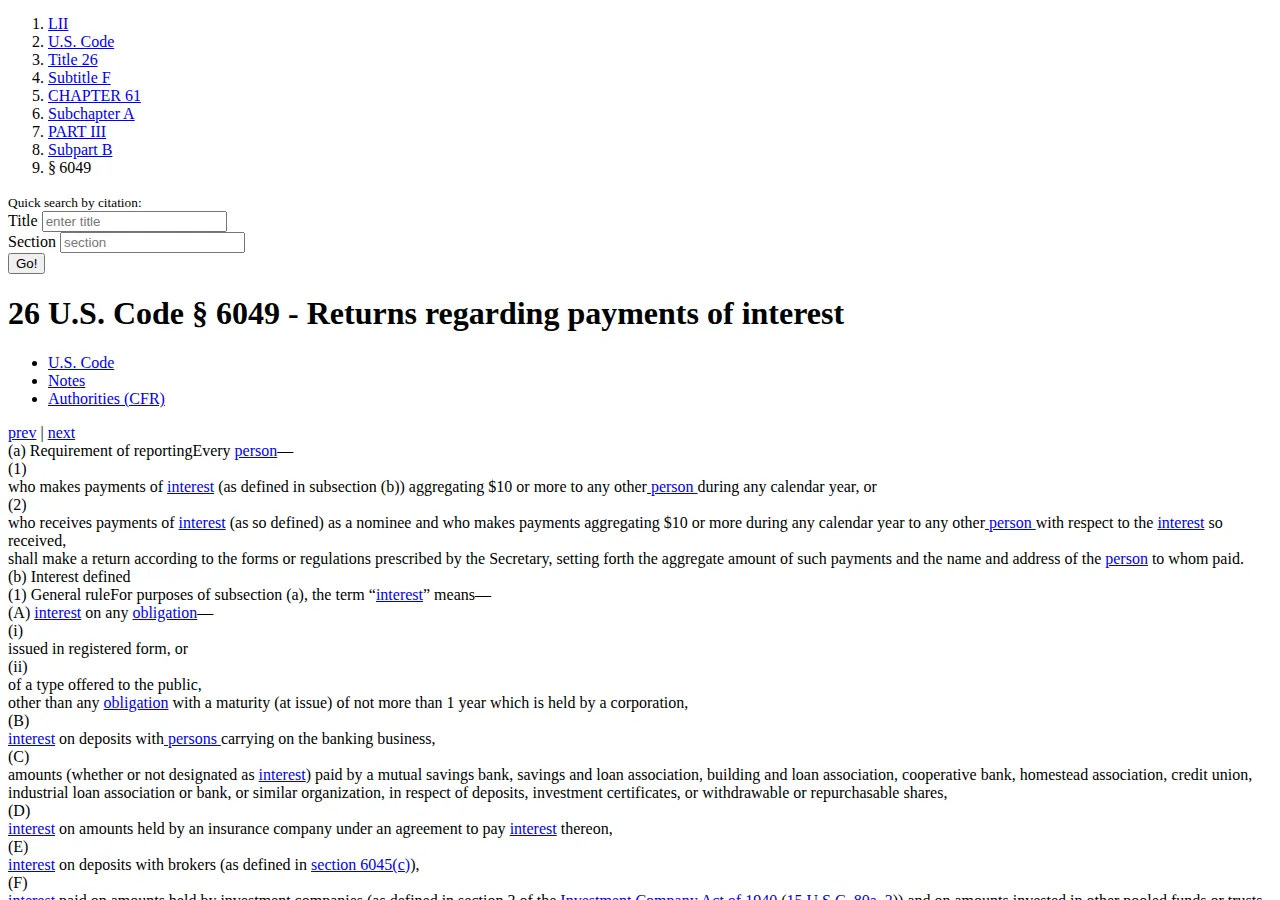
Section 6049(a) requires every person who makes interest payments aggregating $10 or more in a calendar year, or who receives interest as a nominee and pays $10 or more onward, to file a return showing the aggregate amount and the name and address of the person paid. Person here covers banks, brokerages, corporations, any business paying interest in its trade or business, and the nominee who passes interest along. Form 1099-DIV carries the parallel duty for dividends: a corporation, a fund, or a REIT paying distributions of $10 or more files it for each shareholder.
The exempt-recipient list is where payers most often over-file. The Instructions for Form 1099-INT list them: corporations, tax-exempt organizations, IRAs, HSAs, U.S. agencies, states, U.S. territories, registered dealers, nominees, custodians, brokers, and swap dealers. Regulations section 1.6049-4 carries the full list. Test in two steps per payee: first, is this payee exempt; second, if not exempt, did the aggregate cross $10. A $40,000 interest payment to a C-Corp is not reportable; the same payment to an individual or a partnership is reportable, because partnerships are not on the exempt list.
An individual furnishes a Social Security Number (SSN), a nonresident an Individual Taxpayer Identification Number (ITIN), and a business an Employer Identification Number (EIN), all collected on Form W-9, which the CPA needs before the first payment, not in January. An LLC taxed as a sole proprietorship reports under its owner's SSN unless it has elected corporate treatment; an S-Corp and a C-Corp are both corporations for the exempt-recipient test, so interest paid to either is generally exempt, while a partnership is not.
Worked example — the $10 aggregate test
The threshold is an aggregate, per payee, per calendar year: three payments of $4 to the same depositor total $12, and the form is due; one payment of $9 is not. The test runs on boxes 1, 3, or 8 for 1099-INT, and on dividends and distributions of $10 or more for 1099-DIV. Two exceptions change the line. First, interest paid in the course of your trade or business uses a $600 threshold for Box 1 interest, so a business that pays $400 of trade-or-business interest files nothing, while a bank paying $400 of deposit interest files a form. Second, backup withholding has no threshold: if you withheld federal income tax under those rules, you file regardless of the amount.
Take a depositor with two accounts: savings earns $6 in 2025, money market earns $5. Neither crosses $10 alone, but the depositor is one person, so the aggregate is $11 and the form is due with $11 in Box 1. The aggregation query therefore runs at the taxpayer identification number, never at the account number.
Founder & CEO Insight — Enow A. Jovial
The boxes, side by side
Form 1099-INT has seventeen boxes, Form 1099-DIV thirteen; most payers use five. On the INT: Box 1 taxable interest, Box 2 the early withdrawal penalty, Box 3 Savings Bond and Treasury interest, Box 4 federal income tax withheld, Box 6 foreign tax paid, Box 8 tax-exempt interest, and Box 9 specified private activity bond interest. On the DIV: Box 1a total ordinary dividends, Box 1b the qualified portion, Box 2a capital gain distributions, Box 3 nondividend distributions, Box 4 federal income tax withheld, Box 5 section 199A dividends, and Box 7 foreign tax paid.
| Form | Box | Contents | Authority |
|---|---|---|---|
| 1099-INT | 1 | Taxable interest, $10 or more | § 6049 |
| 1099-INT | 3 | Savings-bond and Treasury interest | INT instructions |
| 1099-INT | 4 | Federal income tax withheld | § 3406 |
| 1099-INT | 8 | Tax-exempt interest, $10 or more | INT instructions |
| 1099-DIV | 1a | Total ordinary dividends | DIV instructions |
| 1099-DIV | 1b | Qualified dividends | § 1(h)(11) |
| 1099-DIV | 2a | Total capital gain distributions | DIV instructions |
| 1099-DIV | 3 | Nondividend distributions, return of capital | DIV instructions |
Box 1 versus Box 8: a municipal bond paying $900 produces $900 in Box 8 and nothing in Box 1, while a corporate bond paying $900 produces $900 in Box 1. Box 3: a corporation distributing $1,000 when its earnings and profits support only $600 reports $600 in Box 1a and $400 in Box 3, and the shareholder reduces basis by $400.
1099-INT versus 1099-DIV: the decision table
The two forms are distinguished by the character of the payment, not by the payer; a bank can file both.
| Payment | Form | Box | Authority |
|---|---|---|---|
| Bank deposit interest | 1099-INT | 1 | § 6049(a) |
| Corporate bond interest | 1099-INT | 1 | § 6049(b)(1) |
| Treasury and savings-bond interest | 1099-INT | 3 | INT instructions |
| Stock dividend | 1099-DIV | 1a, 1b | DIV instructions |
| Fund capital gain distribution | 1099-DIV | 2a | DIV instructions |
| Return of capital | 1099-DIV | 3 | DIV instructions |
Interest on a convertible bond is interest, reported on 1099-INT, until conversion, after which the same issuer's payments become dividends on 1099-DIV. A money market fund distribution is a dividend on 1099-DIV, not interest. The rule is the same every time: look at the instrument and the character of the payment.
Qualified dividends: the holding period and the rate
Box 1b is where the payer's accuracy directly changes the recipient's tax bill: qualified dividends are taxed at the capital gain rates of 0, 15, or 20 percent under 26 U.S.C. section 1(h), instead of at ordinary rates. The payer reports the qualified amount and the recipient's return applies the rate; qualification turns on the holding period in section 1(h)(11). For common stock, the recipient must hold the stock for more than 60 days during the 121-day period beginning 60 days before the ex-dividend date; for preferred stock, more than 90 days during the 181-day period beginning 90 days before the ex-dividend date.
Take $10,000 of qualified dividends at an assumed 24 percent marginal ordinary rate: at ordinary rates the tax would be $2,400, at the 15 percent capital gain rate $1,500. The $900 difference exists only because Box 1b was completed correctly. Check your real marginal rate with the Self-Employed Tax & Quarterly Estimator before you file. The 24 percent rate is an assumed marginal bracket, stated so the math can be reproduced.
Backup withholding at 24 percent
Backup withholding under 26 U.S.C. section 3406 applies to both forms at the same rate: 24 percent of the payment. Four triggers: the payee fails to furnish a TIN in the required manner; furnishes an incorrect number and the IRS notifies the payer; the IRS notifies the payer the payee is subject to backup withholding; or the payee fails to certify exemption. When any trigger applies, the payer withholds 24 percent and reports it in Box 4 of either form. There is no $10 threshold for backup withholding: a $4 interest payment with a missing TIN still requires withholding and still requires the form.
A bank pays $4,800 of interest to a depositor who never furnished a TIN: it withholds $1,152, pays the depositor $3,648, reports $4,800 in Box 1 and $1,152 in Box 4, and remits the $1,152 on Form 945. Paying the full $4,800 without withholding when the trigger applied leaves the payer liable for the amount that should have been withheld.
The fix is a gate, not a chase: no W-9, no payment — block the first payment until the W-9 is on file and the number passes IRS TIN matching.
The 2026 deadlines
For 2025 payments, the General Instructions set three dates: the recipient copy is due February 2, 2026, because January 31 falls on a Saturday; the IRS paper filing is due March 2, 2026, because February 28 is also a Saturday; electronic filing is due March 31, 2026, and paper filers attach Form 1096.
| Obligation | Due date for 2025 payments | Authority |
|---|---|---|
| Furnish copy to recipient | February 2, 2026 | General Instructions, Part M |
| File with IRS on paper | March 2, 2026 | General Instructions, Part D |
| File with IRS electronically | March 31, 2026 | General Instructions, Part D |
If you must file 10 or more information returns during the year, you must e-file; the count is aggregate across all return types, so four Forms 1098 and six Forms 1099 make ten. Filing on paper when e-filing was required costs $340 per return: a payer with 40 returns who files on paper has spent $13,600 to avoid a one-time registration.
The penalty ladder, worked per return
Sections 6721 and 6722 are two penalties for two failures, and a late payer can owe both: section 6721 for failing to file a correct return with the IRS by the due date, section 6722 for failing to furnish a correct payee statement. The ladder is $60 per return filed within 30 days after the due date, $130 if filed more than 30 days late but by August 1, and $340 after August 1 or not filed; annual maximums are $683,000, $2,049,000, and $4,098,500. A small business, gross receipts of $5 million or less for the three most recent tax years, faces lower maximums of $239,000, $683,000, and $1,366,000. Intentional disregard costs at least $680 per return or per payee statement, with no maximum.
The same 40 returns cost $2,400, $5,200, or $13,600 depending only on the calendar; intentional disregard is at least $27,200 with no ceiling. The de minimis safe harbor excuses dollar errors of $100 or less.
The execution checklist
- Pull the payee file in October; every payee needs a name, address, and TIN on a Form W-9.
- Run TIN matching and correct every mismatch before the first payment of the new year.
- Test the aggregate per taxpayer identification number, not per account; flag every payee at $10 or more.
- Apply the exempt-recipient test before the threshold test, and keep the list of who was removed and why.
- Separate Box 1 from Box 8 on every 1099-INT and Box 1a from Box 1b on every 1099-DIV, and confirm the qualified-dividend flag per lot.
- Apply backup withholding at 24 percent where the trigger is active, report it in Box 4, and remit on Form 945.
- Furnish recipient copies by February 2, 2026; truncate the TIN where permitted and keep proof of delivery.
- File by March 2, 2026 on paper with Form 1096 or by March 31, 2026 electronically; count all returns against the 10-return e-filing mandate.
- Reconcile to the general ledger before filing: Box 1 interest must tie to the interest accounts, Box 1a dividends to the distributions account.
- Keep the workpapers: W-9s, TIN matching results, aggregate test, exempt-recipient list, and reconciliation are the reasonable-cause record.
Cross-border payments and the forms you do not file
The $10 line stops at the U.S. border. U.S. bank deposit interest of at least $10 paid to certain nonresident alien individuals goes on Form 1042-S, not 1099-INT: the distinction is the payee's status, not the payment's size. The same boundary runs through 1099-DIV: Boxes 2e and 2f exist for section 897 gains, the FATCA checkbox for the chapter 4 regime, and a fund passing foreign tax through reports it in Box 7.
Who should not use this playbook
This guide is for payers; recipients wondering where the numbers go should read the Schedule B playbook instead. If you pay nonemployee compensation, the form is 1099-NEC: the threshold is $2,000 for 2026 payments, due February 2, 2026 to both the IRS and the contractor, with no later electronic date. Our 1099-NEC contractor reporting playbook works that form; the worker classification playbook decides whether the worker is a contractor at all. If your payments run through a payment app or marketplace, the form is 1099-K; our 1099-K payment app reporting threshold playbook covers the restored $20,000 and 200-transaction threshold. If you are a broker reporting sales of securities, the form is 1099-B.