Most founders ask the wrong question first. They ask which form to file — 1099-NEC, 1099-MISC, or W-2 — as if the form were the decision. It is not. The form is the receipt for a decision the statute already made. Classification comes first; a form filed for the wrong classification does not fix it. The IRS says so directly: filing a 1099 does not make a worker a contractor, and a worker paid on a 1099 can still be determined to be an employee through a Form SS-8.
The statute: two definitions and one question
Section 3121(d) defines "employee" for Social Security purposes: a corporate officer; anyone who, under the usual common-law rules, has the status of an employee; and four categories of statutory employees. Section 3401(c) defines "employee" for income tax withholding: an officer of a corporation, and an officer, employee, or elected official of the United States, a State, or any political subdivision.
!Section 3121 employee definition
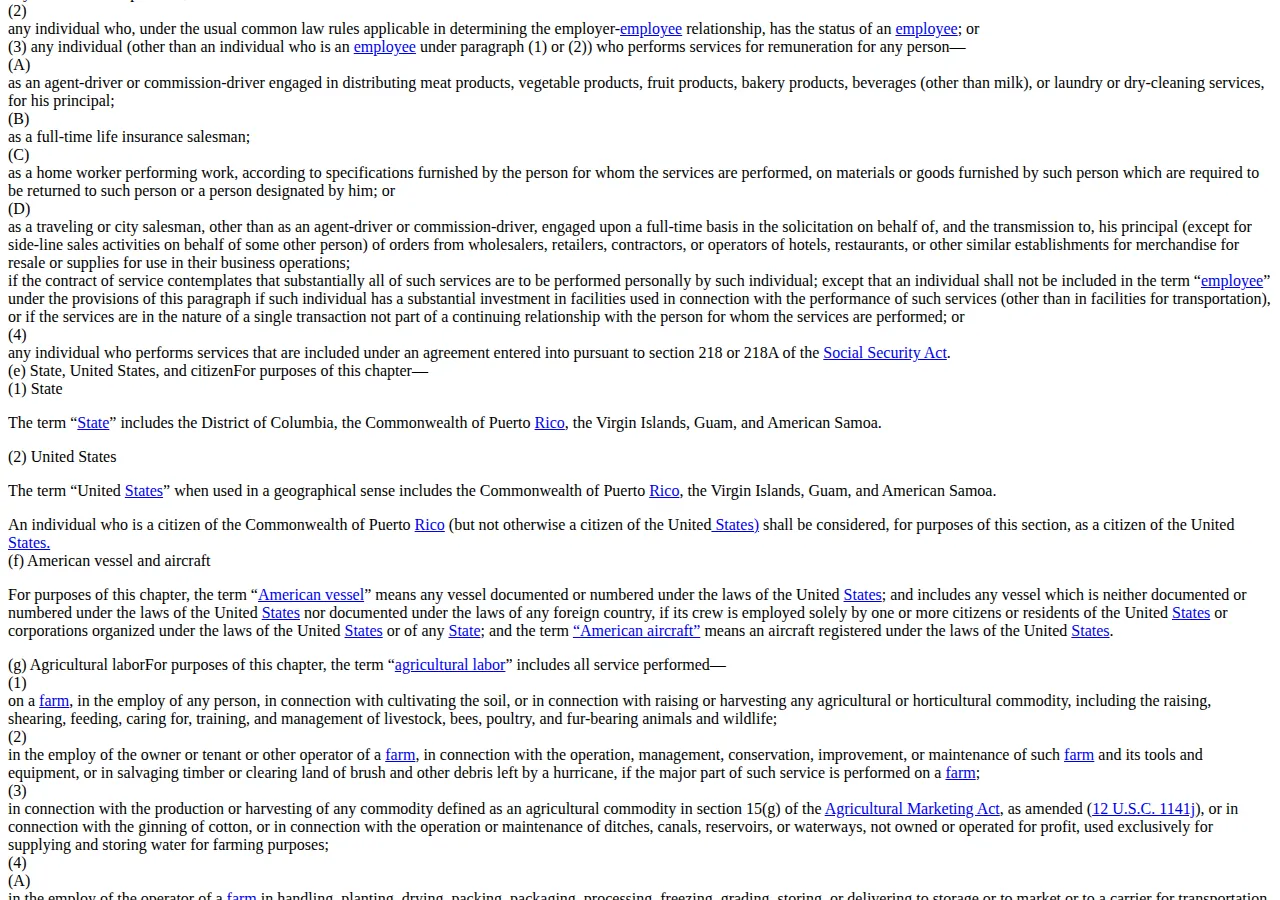
The common-law definition asks one question: does the business have the right to control what will be done and how it will be done? Publication 15-A (2026) states the rule plainly: anyone who performs services for you is generally your employee if you have the right to control what will be done and how it will be done, even when you give the employee freedom of action. The reverse is the contractor test: an individual is an independent contractor if you have the right to control or direct only the result of the work.
The IRS organizes the evidence into three categories. Behavioral control: instructions about when, where, and how to work, and training in the business's own methods. Financial control: unreimbursed expenses, the worker's investment, whether the worker can realize a profit or loss, and how the business pays — a regular wage points to employment, a flat fee points to contracting. Type of relationship: the written contract, employee-type benefits, permanency, and whether the services are a key aspect of the business. No single factor decides anything. Document each factor used: it is defended later against an examiner who was not in the room.
> [!KEY TAKEAWAY]
> Classification is a question of control, not of labels, invoices, or the form filed. If the business holds the right to direct when, where, and how the work is done, the worker is an employee, whatever the contract calls them. If the business controls only the result, the worker is a contractor.
The 20 factors, from Revenue Ruling 87-41
The IRS published the 20-factor test in Revenue Ruling 87-41, 1987-1 C.B. 296: twenty yes-or-no observations, and the pattern across all twenty is the answer.
| Factor | Points to employee when... |
| :--- | :--- |
| Instructions | Follows instructions |
| Training | Business trains worker |
| Integration | Integrated into operations |
| Personal service | Performed personally |
| Assistants | Business hires assistants |
| Continuing relationship | Continuing |
| Set hours | Business sets the hours |
| Full time required | Full time required |
| Employer's premises | On business premises |
| Order or sequence | Order dictated |
| Reports | Regular reports required |
| Payment by time | Paid by time |
| Expenses paid | Expenses paid |
| Tools and materials | Tools provided |
| Investment | No significant investment |
| Profit or loss | Cannot profit or lose |
| One firm only | One client only |
| Not offered to public | Not offered publicly |
| Right to discharge | Discharge at will |
| Right to terminate | Cannot terminate without liability |
Three factors decide most disputes: integration (factor 3), profit or loss (factor 16), and one firm only (factor 17).
Score a worker on all twenty before you pay them: fifteen or more pointing one way settles it for our file. The IRS says no magic number of factors decides it — this line is our operational rule, not the IRS's.
The decision table: which form, and when
Once the classification is decided, the form follows mechanically. Note the 2026 change: for payments made in 2026, the 1099 reporting threshold rose from $600 to $2,000. The IRS instructions state it plainly: before 2026, $600; for 2026, $2,000; after 2026, the inflation-adjusted threshold in Publication 1099.
| Route | Who it covers | 2026 threshold | Due date | Authority |
| :--- | :--- | :--- | :--- | :--- |
| Form W-2 | Employees | All wages | January 31 to employee, SSA | § 3401(c); § 3121(d) |
| Form 1099-NEC, box 1a | Nonemployee compensation | $2,000 for payments made in 2026 | January 31 to payee, IRS | Instructions (12/2026); § 6041A(a)(1) |
| Form 1099-MISC, boxes 1 and 3 | Rents, prizes, other income, medical payments | $2,000 for payments made in 2026 | Feb 28 paper, Mar 31 electronic | IRS Instructions (12/2026) |
| Form 1099-MISC, box 2 | Royalties | $10 | Feb 28 paper, Mar 31 electronic | IRS Instructions (12/2026) |
| Form 1099-MISC, box 10 | Gross proceeds paid to an attorney | $600 | Feb 28 paper, Mar 31 electronic | 26 U.S.C. § 6045(f) |
| Form SS-8 | Worker whose status is unclear | No threshold | Any time; at least six months | IRS, Independent contractor or employee? |
Three traps hide in that table. First, the change applies to payments made in 2026, not to forms filed in 2026: the 1099s sent in January 2026 covered 2025 payments and still used $600. Second, backup withholding overrides the threshold: without a valid taxpayer identification number, file a 1099-NEC regardless of amount and withhold 24 percent of each payment. Third, a misclassified worker can attach Form 8919 to their own return for uncollected Social Security and Medicare tax.
Filing mechanics: the 1099-NEC contractor reporting playbook, the W-2 employee wage reporting playbook, and the W-9 vs W-8BEN contractor onboarding playbook.
Section 530 relief: the safe harbor with three locks
The Revenue Act of 1978, section 530, is the most misunderstood provision in this area: founders treat it as a defense of the classification. It is not — it is relief from employment tax liability even when the classification was wrong. The IRS states plainly that relief does not determine a worker to be an independent contractor. The worker can still be determined to be an employee through an SS-8 determination.
The safe harbor has three locks, and all three must hold. First, a reasonable basis for not treating the worker as an employee: a prior audit, a court decision, a published ruling, or a long-standing industry practice. Second, all required federal information returns filed consistent with that treatment; the 1099-NEC instructions make this concrete: to qualify for relief under section 530, employers must file Form 1099-NEC. Third, no worker in a substantially similar position was treated as an employee after 1977. Fail the first lock and the relief will not apply.
> [!WARNING]
> Section 530 relief is unavailable to a business that never filed the 1099s. The second requirement — filing all required federal information returns consistent with the contractor treatment — is the lock most founders lose without knowing it. No 1099 on file means no section 530 defense, whatever the contract said.
The misclassification math: what the wrong call costs
The cost of a wrong classification is not a fine. It is the tax that should have been paid, plus interest, plus penalties, for every year the statute of limitations still reaches. For 2026, the Social Security wage base is $184,500. The employee pays 6.2 percent for Social Security up to that base and 1.45 percent for Medicare on all wages; the employer matches both, so the combined FICA rate is 15.3 percent. Federal unemployment tax is 6.0 percent on the first $7,000 of wages, effectively 0.6 percent ($42 per employee per year) when state unemployment tax is paid on time.
Section 3509 caps the damage when the misclassification was not intentional. If the employer filed the required information returns, the liability is 1.5 percent of wages for income tax withholding plus 20 percent of the employee share of Social Security tax. Fail the reporting requirements and the rates double to 3 percent and 40 percent; intentional disregard removes section 3509 entirely.
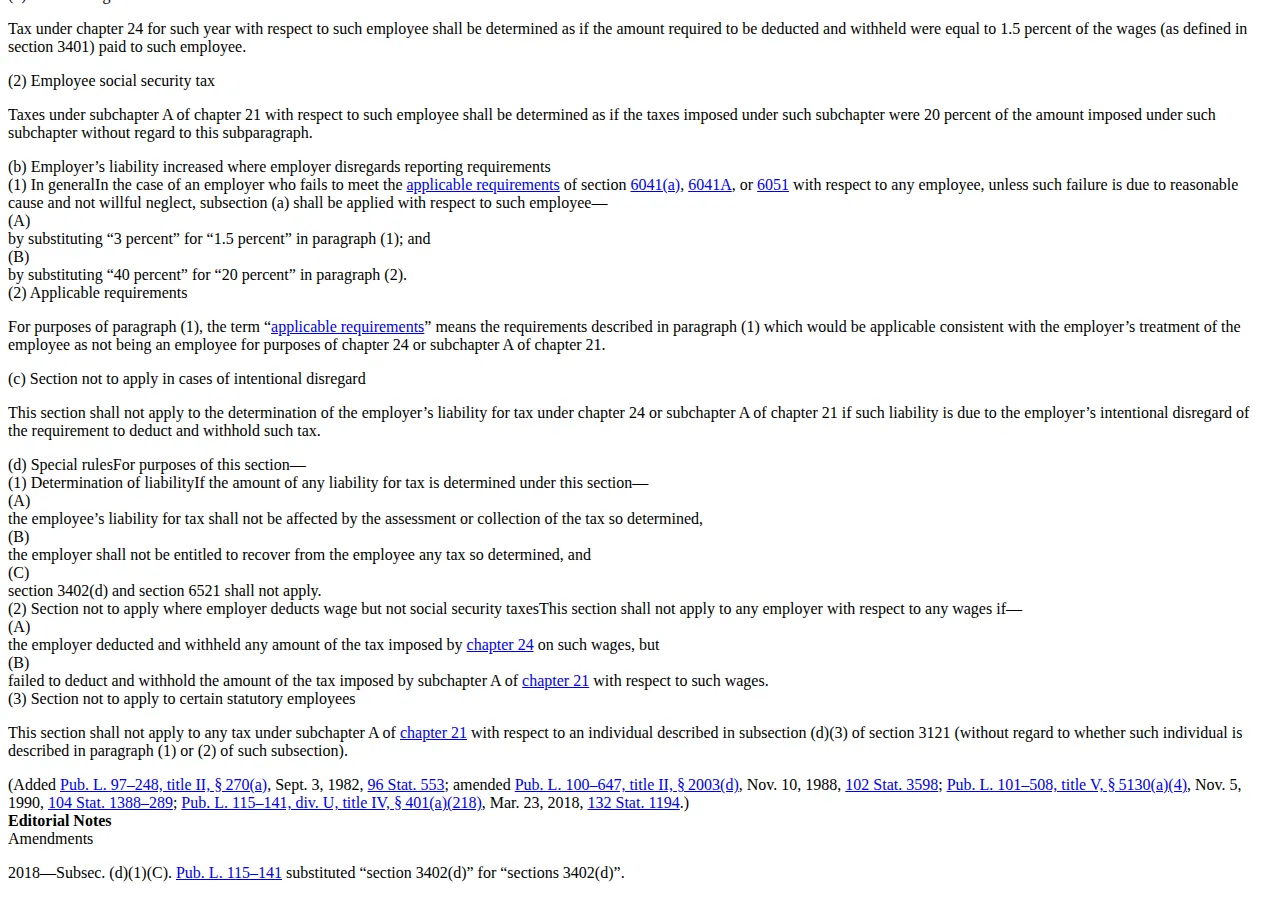
One worker, $60,000, 1099s filed, no intentional disregard:
$
\text{Withholding liability} = 1.5\% \times \$60{,}000 = \$900
$
$
\text{Employee FICA} = 7.65\% \times \$60{,}000 = \$4{,}590
$
$
\text{Employee share} = 20\% \times \$4{,}590 = \$918
$
$
\text{Section 3509 total} = \$900 + \$918 = \$1{,}818
$
Full FICA alone would be $9,180, before any income tax withholding. Without the 1099, the doubled rates give $3,636 — and section 530 relief is lost too.
Five workers, $50,000 each, $250,000 of payroll a year, misclassified for three years, with no section 3509 relief:
$
\text{Employer FICA} \times 3 = 7.65\% \times \$250{,}000 \times 3 = \$57{,}375
$
$
\text{Employee FICA} \times 3 = 7.65\% \times \$250{,}000 \times 3 = \$57{,}375
$
$
\text{FUTA} \times 3 = 0.6\% \times \$7{,}000 \times 5 \times 3 = \$630
$
$
\text{Back taxes} = \$57{,}375 + \$57{,}375 + \$630 = \$115{,}380
$
That $115,380 is before income tax withholding, interest, and penalties. Price the same comparison for a real payroll with the ROI calculator.
The penalties stack on top. Section 6672 imposes a penalty equal to 100 percent of the tax evaded, or not collected, or not accounted for and paid over, on any responsible person who willfully fails to collect and pay it over. Section 6651 adds 5 percent per month, up to 25 percent, for failure to file, and 0.5 percent per month, up to 25 percent, for failure to pay; section 6656 adds 2 to 15 percent for late deposits.
The voluntary fix: VCSP
A business that discovers the problem itself has one clean exit: the Voluntary Classification Settlement Program lets an employer reclassify workers as employees for future tax periods by filing Form 8952. The terms, from the IRS program page: pay 10 percent of the employment tax liability for the most recent tax year, at the reduced section 3509 rates; no interest or penalties on that amount; and no employment tax audit for those workers for prior years.
Run the five-worker example through the VCSP: one year's section 3509 liability on $250,000 of payroll is $3,750 (1.5 percent) plus $3,825 (20 percent of the $19,125 employee FICA), for $7,575. Ten percent of that is $757.50, against $115,380 in back employment taxes alone in an audit without section 3509 relief. The conditions: consistent nonemployee treatment, all required Forms 1099 filed for the previous three years, no employment tax audit underway, and Form 8952 filed at least 120 days before reclassification. A business that never filed the 1099s cannot use the program.
The state layer: California's ABC test
Federal classification does not end the inquiry. California applies the ABC test under Labor Code sections 2775 to 2787, from Dynamex Operations West v. Superior Court (2018), codified by AB 5. The test presumes all workers are employees, and the hiring entity must prove all three prongs: the worker is free from the hiring entity's control and direction, in contract and in fact; the worker performs work outside the usual course of the hiring entity's business; and the worker is customarily engaged in an independently established trade, occupation, or business of the same nature.
Prong B defeats most California arrangements. A clothing manufacturer hiring work-at-home seamstresses to make dresses it sells, or a bakery hiring cake decorators, fails prong B, because the work is the business. A retail store hiring an outside plumber passes, because plumbing is outside the store's usual course. The California Department of Industrial Relations gives both examples. Some licensed professions fall under the older Borello test instead.
> [!TIP]
> Run the classification twice: once under the federal common-law rules and once under the strictest state test that touches the worker. A remote worker in California is judged by California law even when the business sits in Texas.
Who should NOT use contractor treatment
Contractor treatment is wrong for the core team: a worker whose services are a key aspect of the regular business, who works full time for one client for years, whose hours the business sets, is an employee. It is also wrong for any worker whose classification you cannot defend on paper, and wrong as a way to avoid benefits, overtime, or workers' compensation. The classification decision is not a cost-saving device.
The seven-step classification workflow
1. List every worker by role, not by label — what each person actually does.
2. Score the 20 factors — run the Revenue Ruling 87-41 sheet for each role, and keep it in the file.
3. Check the statutory employee categories — if the worker fits section 3121(d)(3), a W-2 follows.
4. Apply the state test — run the ABC test for every state where the worker performs services.
5. Test section 530 before you rely on it — confirm the reasonable basis, the 1099s, and no similar worker treated as an employee after 1977.
6. File the SS-8 when the score is close — a determination takes at least six months.
7. File the form that matches the decision, on time — W-2 by January 31, 1099-NEC by January 31, 1099-MISC by February 28 paper or March 31 electronic.
The classification checklist
> [!FOUNDER]
> The most expensive sentence in a small business is "we will just 1099 them." It sounds like a decision, but it is a postponement, and the IRS charges interest on postponements. Classify the worker before the first payment, write down the factors, and file the form that matches.
> — Enow A. Jovial, Founder & Chief Executive Officer
Our editorial analysis found the classification decision is the one tax choice a founder makes every time they pay someone, and the one most often made by habit instead of by statute. Read section 3121(d) once, score the twenty factors honestly, and let the form follow the facts.