IRS Form 1040 Schedule B: The Interest and Ordinary Dividends Playbook
A taxpayer with $1,240 of bank interest, $310 of Treasury bill interest, and $95 of savings bond interest has $1,645 of taxable interest — $145 over a line the IRS draws in the sand. Crossing it changes the return: Schedule B becomes mandatory, and Part III starts asking questions about foreign accounts.
Schedule B (Form 1040) turns a pile of 1099 forms into a filed return. Part I lists every payer of taxable interest and produces the number for Form 1040, line 2b. Part II lists every payer of ordinary dividends and produces the number for line 3b. Part III asks about foreign accounts and trusts — the FBAR, Form 8938, and Form 3520.
Who this is for — and who should stop here
This guide is for a U.S. individual filer who received interest or dividends in 2025: a sole proprietor on Schedule C, a single-member LLC taxed as a sole proprietor filing under the owner's SSN or the LLC's EIN, a multi-member LLC or partnership, an S-Corp filing Form 1120-S, or a C-Corp filing Form 1120. An S-Corp owner takes a salary subject to FICA; a sole proprietor pays SECA tax on net earnings. It does not cover the net investment income tax on Form 8960 — not a substitute for a CPA review on an examined return, a willful FBAR violation, or a foreign-trust distribution.
> [!FOUNDER]
> "Interest and dividends look like the easy part of a return — the numbers arrive pre-printed on a 1099. The $1,500 line, the qualified-dividend test, and the foreign-account questions are where a filer proves the return is complete."
> — Enow A. Jovial, Founder & Chief Executive Officer
The $1,500 trigger: when Schedule B becomes mandatory
The Instructions for Schedule B list eight situations that require the schedule. The first is the one most filers meet: "You had over $1,500 of taxable interest or ordinary dividends." The other seven are in the table below.
The threshold is "over $1,500," measured on taxable interest or ordinary dividends — each on its own line, not combined. The form makes the test twice: a note under Part I says "If line 4 is over $1,500, you must complete Part III," and a matching note under Part II says the same for line 6.
| Trigger | Authority |
| :--- | :--- |
| Over $1,500 taxable interest (line 4) or ordinary dividends (line 6) | Sch. B instr. (2025) |
| Seller-financed mortgage interest ($50 penalty if buyer name, address, SSN omitted) | Sch. B instr., Line 1 |
| Below-1099 interest/OID/premium; EE/I exclusion; nominee income | Sch. B instr., Lines 1, 3 |
| Foreign account or trust | Schedule B, Part III |
> [!KEY TAKEAWAY]
> The $1,500 test runs separately on interest and on dividends. Two sub-threshold totals do not add up to a Schedule B obligation — but either one crossing the line pulls in the whole schedule.
Part I: interest — what counts, what does not, and the line flow
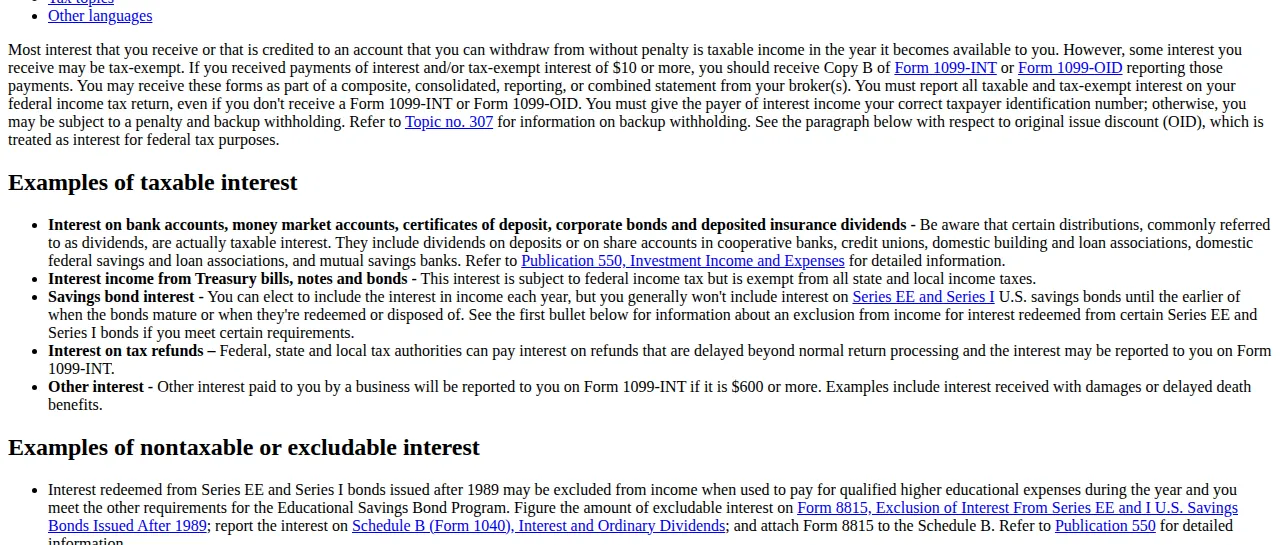
Part I, line 1, takes "all of your taxable interest," listing each payer and amount: bank and money market accounts, certificates of deposit, and corporate bonds; Treasury bills, notes, and bonds — federal tax applies, but that interest "is exempt from all state and local income taxes"; Series EE and I savings bonds; and original issue discount, treated as interest. The label does not control the character: "dividends" paid on deposits at cooperative banks, credit unions, and mutual savings banks "are actually taxable interest" and belong on Part I, not Part II. Tax-exempt municipal-bond interest goes on Form 1040, line 2a, never on Schedule B line 1; EE/I education exclusions come off on line 3 via Form 8815.
The reporting machinery is 26 U.S.C. § 6049, which requires any person who "makes payments of interest aggregating $10 or more" to another person during a calendar year to file an information return — the statute behind Form 1099-INT, with the same $10 floor for Form 1099-OID. Those are payer thresholds, not taxpayer thresholds. IRS Topic No. 403: "You must report all taxable and tax-exempt interest on your federal income tax return, even if you don't receive a Form 1099-INT or Form 1099-OID."
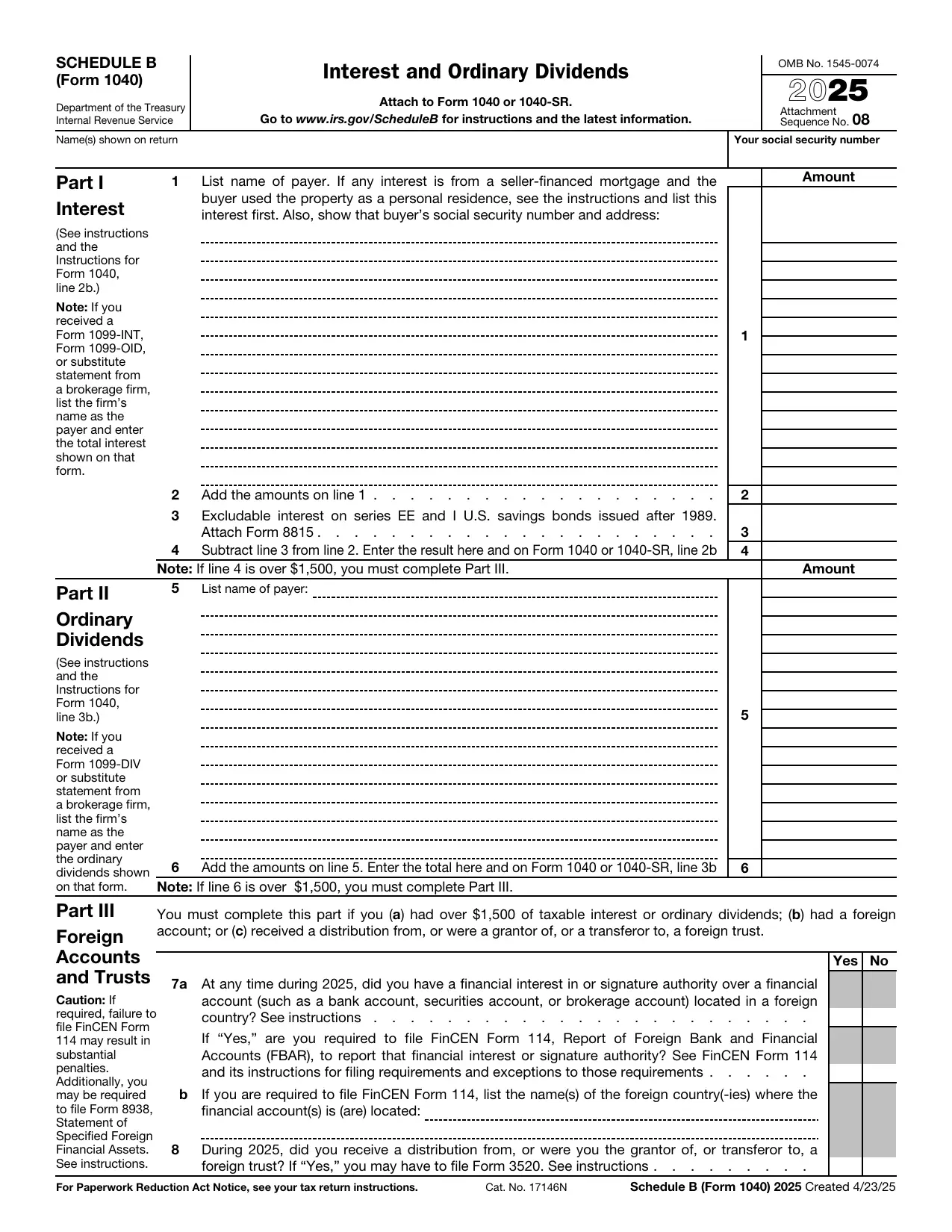
Line 1 lists the payers, line 2 adds them, line 3 subtracts the Form 8815 exclusion, and line 4 is the result, entered on Form 1040, line 2b:
$
\text{Line 2} = 1{,}240 + 310 + 95 = \$1{,}645
$
$
\text{Line 4} = \text{Line 2} - \text{Line 3} = 1{,}645 - 0 = \$1{,}645 \; \rightarrow \; \text{Form 1040, line 2b}
$
Because line 4 is over $1,500, Part III must be completed.
Part II: ordinary dividends and the qualified-dividend rate test
Part II is shorter and more valuable. Line 5 lists every payer of ordinary dividends — the amount in box 1a of each Form 1099-DIV — and line 6 adds them and carries the total to Form 1040, line 3b. A Form 1099-DIV should arrive from each payer for distributions of at least $10; dividends reported on a Schedule K-1 must still be reported even though no 1099-DIV exists.
Every taxable dividend is an ordinary dividend first. A qualified dividend is a subset: an ordinary dividend that also qualifies under 26 U.S.C. § 1(h)(11) to be taxed at the capital-gain rates. IRS Topic No. 404: "qualified dividends are those ordinary dividends that qualify to be taxed at lower capital gain rates," and the payer "is required to correctly identify" the qualified portion on Form 1099-DIV. Box 1b carries that number to Form 1040, line 3a; box 1a goes to line 3b.
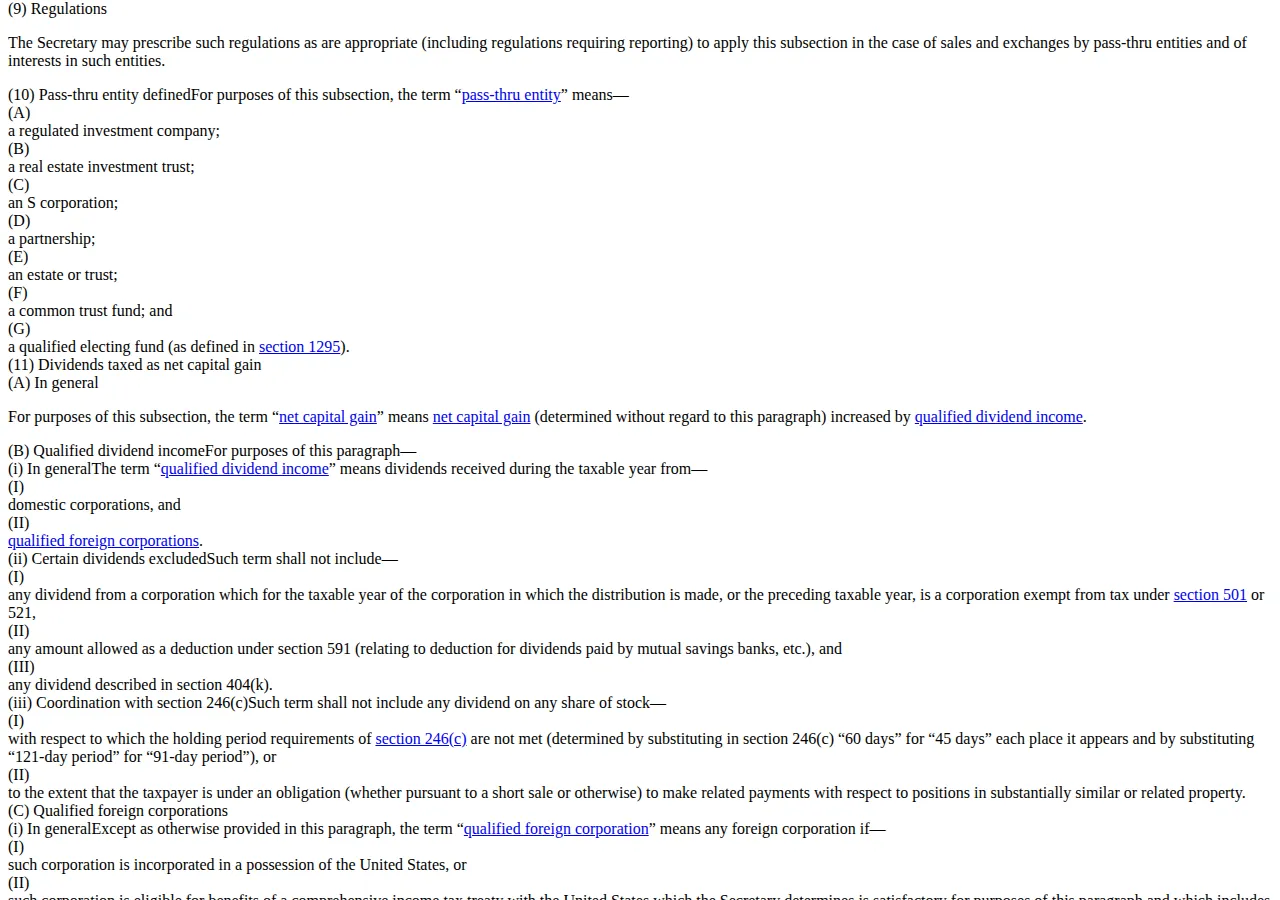
Section 1(h)(11)(B) defines qualified dividend income as dividends from domestic corporations and from qualified foreign corporations — a U.S. possession corporation, a treaty-eligible corporation, or one whose stock is readily tradable on an established U.S. securities market. Excluded: dividends from a corporation exempt from tax under section 501 or 521; section 591 amounts; and section 404(k) dividends. Passive foreign investment companies are excluded too — a PFIC dividend is never qualified — and amounts elected as investment income under section 163(d)(4)(B).
The holding-period test is where filers lose the rate. Section 1(h)(11)(B)(iii) denies qualified treatment to any dividend on stock "with respect to which the holding period requirements of section 246(c) are not met," substituting "60 days" for "45 days" and a "121-day period" for the "91-day period." Hold the stock more than 60 days during the 121-day window around the ex-dividend date, or the dividend is taxed as ordinary income.
| Dividend type | Qualified? | Where it lands | Authority |
| :--- | :--- | :--- | :--- |
| Domestic corporation, held > 60 days | Yes — 0/15/20% rates | 1040, line 3a | § 1(h)(11)(B) |
| Qualified foreign corporation (treaty or U.S.-traded) | Yes — 0/15/20% rates | 1040, line 3a | § 1(h)(11)(C) |
| PFIC or § 501/§ 521 exempt-corporation dividend | No | 1040, line 3b | § 1(h)(11) |
| Held 60 days or fewer; § 163(d)(4)(B) election | No | 1040, line 3b | § 1(h)(11) |
| Return of capital (no earnings and profits) | Not a dividend — reduces basis | Schedule D | Topic 404 |
| Capital gain distribution from a fund or REIT | Long-term capital gain | Schedule D | Topic 404 |
Section 1(h)(1) taxes adjusted net capital gain — which includes qualified dividend income — at 0 percent up to the first threshold, 15 percent up to the second, and 20 percent above it. Worked example — take $10,000 of dividends, all qualified, taxed at 15 percent, against the same $10,000 taxed as ordinary income at an assumed 22 percent marginal rate:
$
\text{Qualified tax} = 10{,}000 \times 0.15 = \$1{,}500
$
$
\text{Ordinary tax} = 10{,}000 \times 0.22 = \$2{,}200
$
$
\text{Rate-test saving} = 2{,}200 - 1{,}500 = \$700
$
The 15 percent rate is the statute's; the 22 percent rate is an assumed marginal bracket. Every dollar that fails the qualified test is repriced from the capital-gain rate to the filer's ordinary rate. Capital gain distributions from a mutual fund or REIT never touch Schedule B — they "are always reported as long-term capital gains" and flow to Schedule D. See the IRS Form 1040 Schedule D capital gains playbook and the tax-loss harvesting and wash-sale playbook.
> [!WARNING]
> A dividend labeled qualified on the 1099-DIV is not qualified on the return until the holding period is met. The payer reports what the corporation paid; the filer must prove the 60-day holding period. A short holding period converts the entire dividend to ordinary income.
Backup withholding: the 24% haircut
Backup withholding is the enforcement mechanism behind the 1099 system. Under 26 U.S.C. § 3406(a)(1), if the payee fails to furnish a TIN, the IRS flags the TIN as incorrect, there has been a notified underreporting, or a certification failure, "the payor shall deduct and withhold from such payment a tax equal to the product of the fourth lowest rate of tax applicable under section 1(c) and such payment." IRS Topic No. 307 states the rate directly: "the payer must withhold at a flat 24% rate."
A $4,000 dividend payment subject to backup withholding arrives as $3,040:
$
\text{Withheld} = 4{,}000 \times 0.24 = \$960
$
$
\text{Received} = 4{,}000 - 960 = \$3{,}040
$
The $960 is not a penalty. It is a credit against the tax on the return. The fix is administrative: furnish a correct TIN on Form W-9, correct the name-TIN mismatch, or resolve the underreporting flag. Estimated-tax planning for this income is covered in the quarterly estimated tax payments playbook.
!IRS Topic 403 on interest received
Part III: foreign accounts and trusts — two questions, three filings
Part III has nothing to do with how much interest was earned: "You must complete this part if you (a) had over $1,500 of taxable interest or ordinary dividends; (b) had a foreign account; or (c) received a distribution from, or were a grantor of, or a transferor to, a foreign trust."
Line 7a asks two questions. Question 1: at any time during 2025, did you have a financial interest in or signature authority over a financial account located in a foreign country? Answer "Yes" even if you are not required to file FinCEN Form 114. A financial account is broader than a bank account: securities, brokerage, and bank accounts; futures or options accounts; cash-value insurance and annuity policies; and mutual fund shares. An account is foreign if it is physically located outside the United States.
Question 2 asks whether you are required to file FinCEN Form 114, the FBAR. The test is aggregate: "A U.S. person that has a financial interest in or signature authority over foreign financial accounts must file the form if the aggregate value of foreign financial accounts exceeds $10,000 at any time during 2025." Two accounts of $6,000 and $5,500 trigger the filing:
$
\text{Aggregate} = 6{,}000 + 5{,}500 = \$11{,}500 > \$10{,}000 \; \rightarrow \; \text{FBAR required}
$
The FBAR is due April 15 following the calendar year reported, with an automatic extension to October 15. It is e-filed through FinCEN's BSA E-Filing System, never attached to the return; line 7b lists the countries.
The 2025 Schedule B instructions state the penalties: failure to file properly "may" result in a civil penalty up to $10,000, while willful failure "may be subject to a civil penalty equal to the greater of $100,000 or 50% of the balance in the account at the time of the violation." On a $240,000 account, the willful figure is:
$
\text{Willful penalty} = \max(100{,}000,\ 0.50 \times 240{,}000) = \$120{,}000
$
Form 8938 is the second filing Part III points toward, with higher thresholds: "Regardless of whether you are required to file FinCEN Form 114 (FBAR), you may be required to file Form 8938." Thresholds by residence and filing status:
| Filer | U.S. resident | Living abroad |
| :--- | :--- | :--- |
| Single or married filing separately | Over $50,000 year-end, or $75,000 at any time | Over $200,000 year-end, or $300,000 at any time |
| Married filing jointly | Over $100,000 year-end, or $150,000 at any time | Over $400,000 year-end, or $600,000 at any time |
!Form 8938 and FBAR thresholds
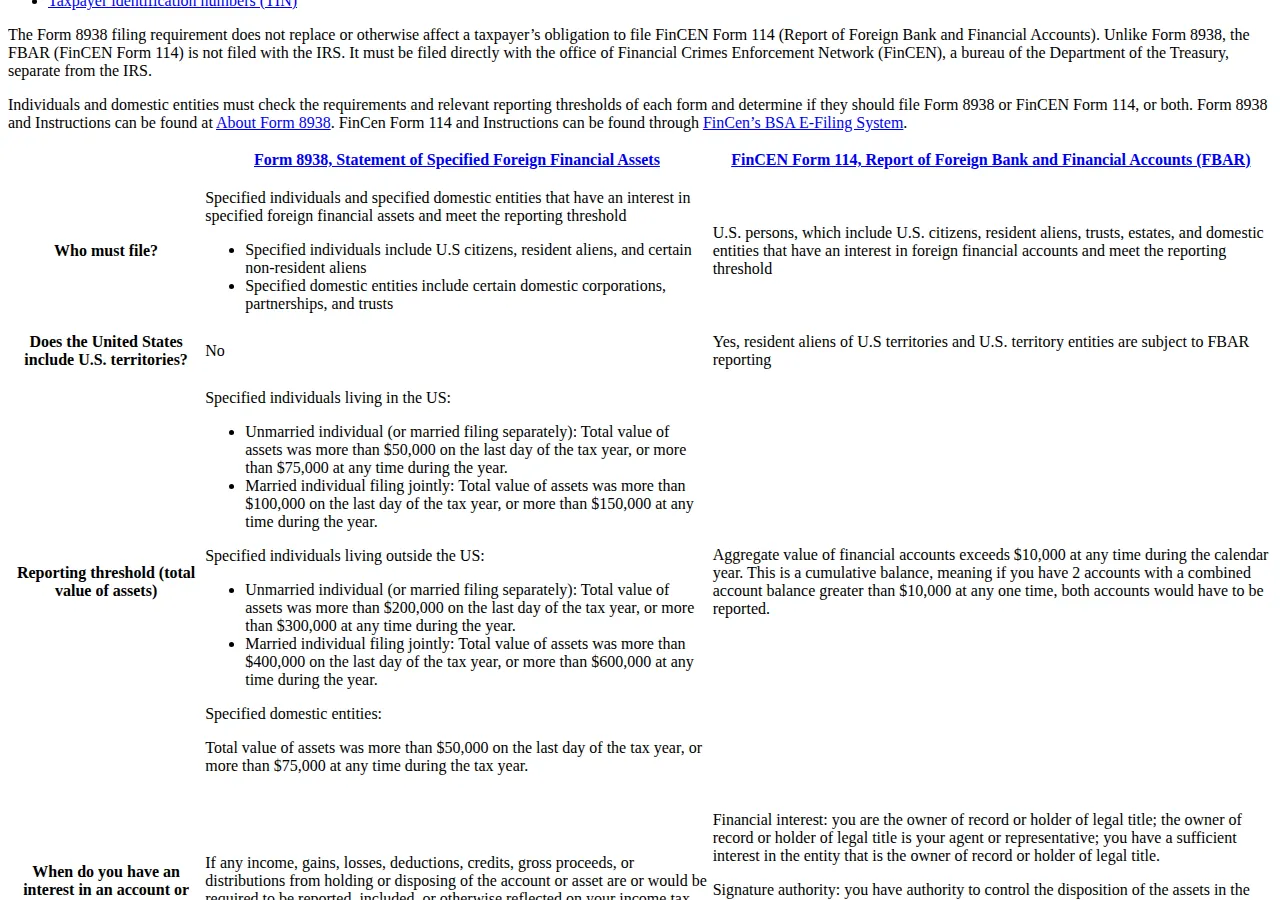
A single filer in the United States with $62,000 of specified foreign assets on December 31 exceeds the $50,000 last-day threshold and must file Form 8938, filed with the return — unlike the FBAR — and failure to file can extend the statute of limitations. Title 31 maximums are inflation-adjusted, so check current FinCEN figures.
!Qualified dividend rules in section 1(h)(11)
Line 8 asks: during 2025, did you receive a distribution from, or were you the grantor of, or transferor to, a foreign trust? A loan of cash or marketable securities is generally treated as a distribution. A "Yes" answer may require Form 3520, filed separately — not attached to Form 1040 — and the trust may also owe Form 3520-A, due March 16, 2026.
> [!TIP]
> Test the FBAR $10,000 threshold at the highest aggregate balance in the year, not the year-end balance. A mid-year spike that later fell below $10,000 still triggers the filing.
The line flow: from Schedule B to the tax
Schedule B is a feeder schedule: line 4 goes to Form 1040, line 2b; line 6 to line 3b; and the qualified portion of line 6 (1099-DIV box 1b) to line 3a.
Tax-exempt interest never enters Schedule B; it is reported on Form 1040, line 2a. The line 3a amount is priced through the Qualified Dividends and Capital Gain Tax Worksheet, or through Schedule D.
The filing sequence
Step 1 — Gather the 1099s: every Form 1099-INT, 1099-OID, and 1099-DIV, each payer listed separately, plus interest and dividends shown on no 1099.
Step 2 — Run the $1,500 test: compute line 4 and line 6 separately; if either exceeds $1,500, complete Part III.
Step 3 — Price the dividends: reconcile box 1b across all 1099-DIVs to Form 1040, line 3a; verify the 60-day holding period for stock bought near the ex-dividend date.
Step 4 — Test the foreign accounts: list every foreign account, including signature-authority accounts and cash-value policies; test the $10,000 FBAR threshold at the year's highest point and Form 8938 separately.
Step 5 — Land the lines: confirm line 4 on Form 1040, line 2b, line 6 on line 3b, and the qualified portion on line 3a before filing.
Schedule B rewards the filer who treats it as an operation rather than a formality: four gates, each with its own statute, threshold, and penalty. Run them in order and keep the 1099s.