What Form 1099-K actually reports
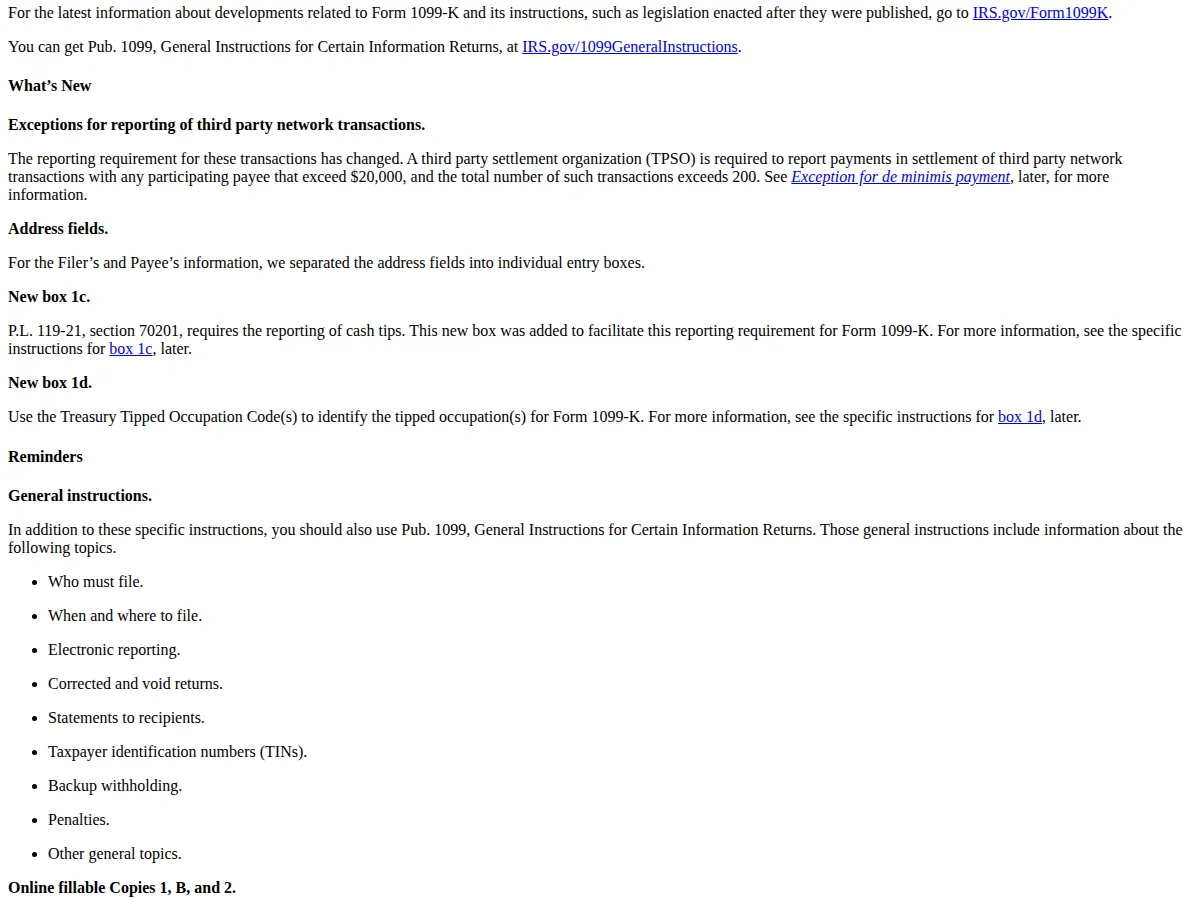
Form 1099-K is the information return that tells the IRS how much money moved through a payment platform to you. A payment settlement entity — a card processor or a third-party settlement organization (TPSO) such as PayPal, Venmo, Cash App, Stripe, or Etsy — files it for each payee and copies you. The form reports gross payments, not profit: the full amount customers paid, before platform fees, refunds, shipping, or sales tax. That single distinction is the source of nearly every 1099-K problem a small operator has, because the number on the form is almost never the number that belongs on the tax return.
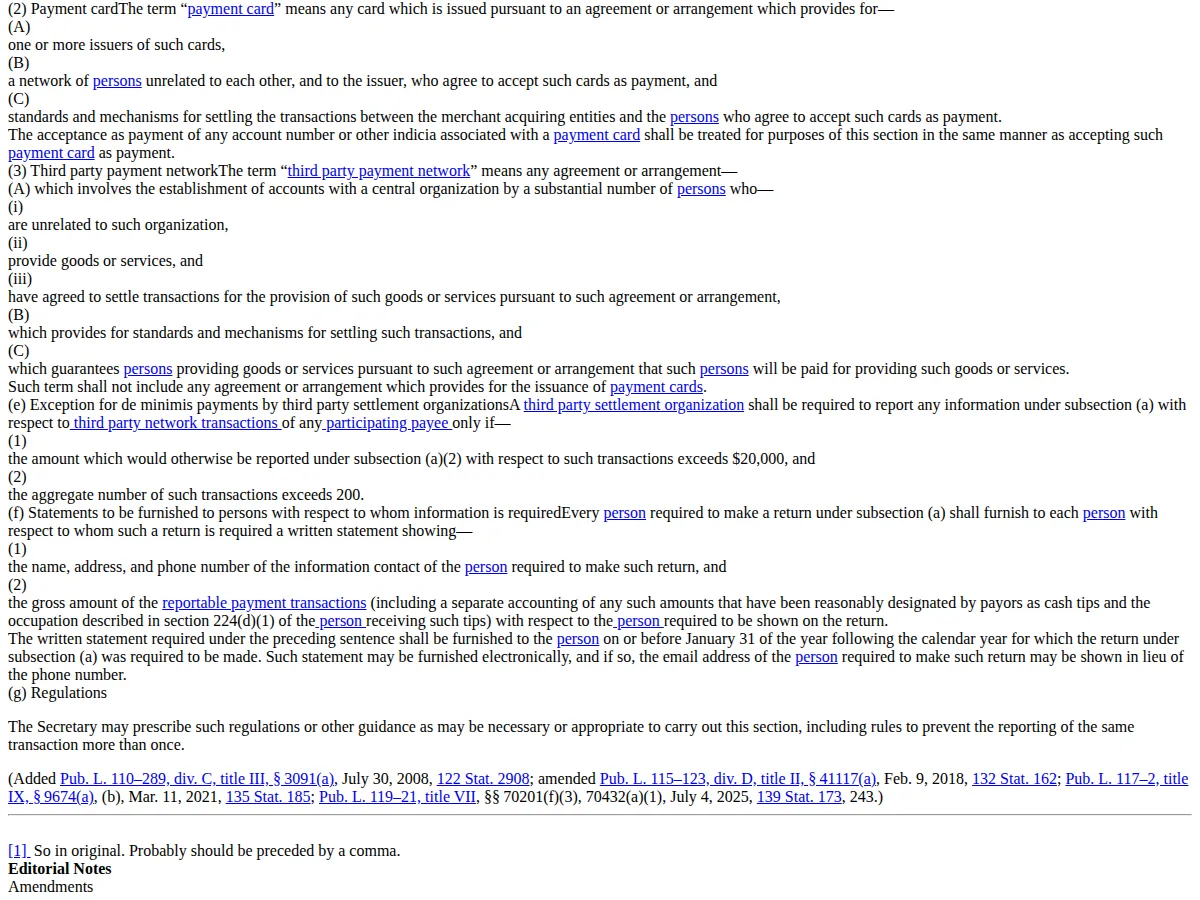
The reporting rule sits in 26 U.S.C. section 6050W. For a TPSO — a payment app or a marketplace — the form is required only when two conditions are both met: gross payments for the year exceed $20,000 and transactions exceed 200. That two-part test is the de minimis exception in section 6050W(e). Payment card transactions are different: a card processor reports from the first dollar, with no minimum at all, because the card network is the settlement entity and the statute gives it no de minimis exception.
> [!KEY TAKEAWAY]
> A 1099-K arrives only when a single platform pays you more than $20,000 and more than 200 times in the same calendar year. Miss either condition and that platform files nothing — but the income is still taxable, and a second platform with its own $20,000 does not combine with the first.
Who this guide is for, and who should stop here
This guide is for a sole proprietor, a single-member LLC, or a side seller whose customers pay through Venmo, PayPal, Cash App, Stripe, Square, Etsy, eBay, or a delivery platform. If your 1099-K box 1a is larger than the revenue on your books, or if you received a form for money that was never business income at all, the reconciliation in this guide is your filing season. If you are a C corporation or an S corporation that takes card payments, the same form reaches you, but your reconciliation runs through the corporate return, not Schedule C.
Who should not use this guide as a filing position: anyone deciding whether income is taxable at all. Receiving no 1099-K never makes income non-taxable — the form is a reporting trigger, not a taxability test. A seller who earned $8,000 through an app and received no form still reports $8,000. The threshold decides whether the platform tells the IRS — never whether you tell the IRS.
The threshold, as the statute writes it
Section 6050W(e) states the de minimis exception in two conjunctive conditions: the amount that would otherwise be reported must exceed $20,000, and the aggregate number of transactions must exceed 200. Both must be true. The test runs per TPSO, not per taxpayer: $19,000 through PayPal and $19,000 through Venmo is $38,000 of income and zero 1099-Ks, because neither platform crossed both of its own conditions. The test runs on gross payments: a seller who grossed $21,000 and refunded $4,000 still crosses the dollar condition.
| Scenario | Gross payments | Transactions | 1099-K issued? | Authority |
| :--- | :--- | :--- | :--- | :--- |
| Etsy seller, steady volume | $24,300 | 312 | Yes — both conditions met | 26 U.S.C. § 6050W(e) |
| Venmo side seller, high ticket | $25,000 | 150 | No — transaction count not met | 26 U.S.C. § 6050W(e) |
| PayPal seller, many small sales | $19,500 | 400 | No — dollar amount not met | 26 U.S.C. § 6050W(e) |
| Card processor, any volume | $312 | 3 | Yes — card transactions have no threshold | 26 U.S.C. § 6050W(a) |
| Friends splitting rent on Venmo | $6,000 | 48 | No — personal payments are not reportable | IRS Instructions for Form 1099-K |
Personal payments are outside the form entirely. Money friends send to split rent, a gift, a reimbursement for a shared dinner — none of it is a reportable payment transaction, because no goods or services changed hands. A seller who takes business payments through a personal account still gets reported on the business amounts, while the personal amounts ride along in the same gross figure and have to be backed out on Schedule C with records. The clean fix costs nothing: a separate business account on each platform.
The whiplash: how the threshold changed, and where it stands
The $20,000-and-200 rule is the original rule; the last five years were a detour. The American Rescue Plan Act of 2021 dropped the TPSO threshold to $600 with no transaction minimum, effective for 2022. The IRS delayed the change three times — Notice 2023-10 made 2023 a transition year with no penalties for good-faith reporting, and Notice 2024-85 set a phased path of $2,500 for 2025 and $600 for 2026. None of that phase-in ever reached a filing season. The One Big Beautiful Bill Act (P.L. 119-21), signed July 4, 2025, repealed the $600 rule in section 70432, retroactively to tax years beginning after December 31, 2021, and restored the original standard. The Instructions for Form 1099-K dated December 2026 print the restored rule.
| Period | TPSO threshold | Transaction minimum | Authority |
| :--- | :--- | :--- | :--- |
| 2021 and earlier | More than $20,000 | More than 200 | 26 U.S.C. § 6050W(e) |
| 2022–2024 (ARPA, as delayed) | $600 ordered; IRS transition relief | None ordered | ARPA § 9674; IRS Notice 2023-10 |
| 2025 (planned) | $2,500 planned | None planned | IRS Notice 2024-85 |
| 2026 and after (OBBBA) | More than $20,000 | More than 200 | P.L. 119-21 § 70432; Instructions for Form 1099-K (12/2026) |
The same law moved the companion form most freelancers know better: for payments made after December 31, 2025, the Form 1099-NEC and Form 1099-MISC threshold rises from $600 to $2,000, indexed for inflation. A client who paid a contractor $1,400 in 2026 no longer files a 1099-NEC for it — but the contractor still reports the $1,400.
> [!WARNING]
> Do not file on the $600 rule. Blog posts and platform emails written between 2022 and 2025 still tell sellers to expect a 1099-K at $600, and some platforms still issue forms below the federal threshold voluntarily or to satisfy a state rule. A form that arrives is real and must be reconciled; a form that does not arrive is not a tax holiday. The current federal rule is $20,000 and 200 transactions, and the instructions dated December 2026 are the authority.
Reading the boxes: what each number is, and what it is not
Box 1a is gross payment card and third-party network transactions — the total before any deduction. Box 1b breaks out card-not-present transactions, the online and keyed-in card payments with the highest fraud risk and processing cost. Box 3 is the number of payment transactions, the count that decides the second half of the threshold test. Box 4 is federal income tax withheld — backup withholding at 24 percent under section 3406 when the payee failed to furnish a correct taxpayer identification number, or when the IRS notified the payer twice in three calendar years that the TIN was incorrect. A number in box 4 is a credit on the return, not an extra tax: it is tax already paid. The TIN on the form is usually the payee's SSN for a sole proprietor, the EIN for an LLC, or an ITIN for a nonresident alien, and a CPA will check it against the return before filing, because a mismatch is what triggers backup withholding. Unlike W-2 wages, no FICA is withheld from platform payments — the net profit is subject to SECA tax on Schedule SE instead, and platforms settle payouts by ACH transfer into the account on file.
There is no box for platform fees, refunds, sales tax, or the cost of goods sold. The platform reports what it moved; the taxpayer reports what was kept. That gap is the reconciliation.
The reconciliation: turning box 1a into Schedule C line 1
The worked example below is illustrative, not a client file. A seller on one marketplace receives a 1099-K showing $48,000 in box 1a and 640 transactions. The seller's own records show $2,400 in platform fees, $1,800 in refunds, $3,600 in sales tax collected and remitted to the state, and $900 in personal reimbursements that ran through the same account by mistake. The gross receipts that belong on Schedule C line 1 are:
$
\text{Schedule C Line 1} = \$48{,}000 - \$2{,}400 - \$1{,}800 - \$3{,}600 - \$900 = \$39{,}300
$
Each subtraction has its own line and its own paper trail. Platform fees are an ordinary expense on Schedule C line 10, commissions and fees. Refunds reduce gross receipts on line 2, returns and allowances. Sales tax collected is never income — it passes through to the state and is backed out with remittance records. The $900 personal reimbursement is backed out with bank records showing it was never a sale. The IRS matching program compares box 1a against the return and flags one where line 1 is lower than box 1a with no explanation; the explanation is the reconciliation itself, kept with the return.
The same arithmetic runs in reverse for the seller who received no form. A seller with $14,200 through PayPal and $9,800 through Venmo received no 1099-K from either platform, because neither crossed both conditions. The taxable gross receipts are still $24,000, and the return reports $24,000. Treating a missing form as missing income manufactures an audit finding, not an escape from one.
The state thresholds that still send forms
Federal restoration did not touch the states. As of 2026, several states require platforms to report at much lower thresholds: Maryland, Massachusetts, Vermont, and Virginia at $600; Illinois at $1,000 with four or more transactions. A Massachusetts seller with $4,100 and 90 transactions receives a 1099-K because the state rule fires, and the form still has to be reconciled on the federal return.
| Jurisdiction | State 1099-K threshold | Federal threshold for comparison |
| :--- | :--- | :--- |
| Maryland, Massachusetts, Vermont, Virginia | $600 | More than $20,000 and more than 200 transactions |
| Illinois | $1,000 with four or more transactions | More than $20,000 and more than 200 transactions |
Deadlines, penalties, and the payer's side
The calendar belongs to the payer, but the payee needs it too: a late form arrives after the return is already filed. The payer must furnish the payee statement by January 31, and file with the IRS by March 2, 2026 on paper or March 31, 2026 electronically, under the General Instructions for Certain Information Returns. Penalties for failure to file and failure to furnish sit under sections 6721 and 6722.
For the payee, the deadline that matters is the return's own deadline, and the form's arrival does not extend it. File on the reconciled numbers and keep the reconciliation with the return. If a corrected form arrives after filing, an amended return is needed only if the corrected figure changes the tax — a correction that changes box 1a but leaves the reconciled line 1 unchanged needs a note in the file, not a new return.
> [!FOUNDER]
> "The 1099-K is the only form where the number printed on it is wrong by design. It reports what moved, not what you kept — which is why the reconciliation, not the form, decides your audit. Keep it where you can find it in three years, because that is when the letter arrives."
> — Enow A. Jovial, Founder & Chief Executive Officer
Operator boundaries
Do not commingle personal and business money on a payment platform: a personal reimbursement in a business account inflates box 1a, and a pattern of commingling is the fact an examiner points to when the reconciliation is questioned. Do not assume the $20,000 threshold protects your income — it protects the platform's reporting duty, not your tax. Do not ignore a 1099-K because the amount looks wrong: a wrong form that is never corrected is a matching-program notice waiting to happen, and the correction starts with the platform, in writing, before the return is filed. Do not treat a state-threshold form as a federal error. And do not pay tax on box 1a: the form is gross, the return is net.
Execution checklist
> [!TIP]
> Run the reconciliation in January, the week the forms arrive, not in April. The platform's correction desk is fast in January and slow in March, and a corrected form issued before you file costs an email — after you file, it costs an amended return.
Run the reconciled net profit through the tax estimator to see what the Schedule C result costs in tax, and read the Schedule C profit-and-loss playbook for the return this form feeds into. The contractor side is covered in the Form 1099-NEC contractor reporting playbook, where the threshold is now $2,000, and the quarterly side is in the quarterly estimated tax payments guide.