The threshold changed, and most templates still print $600
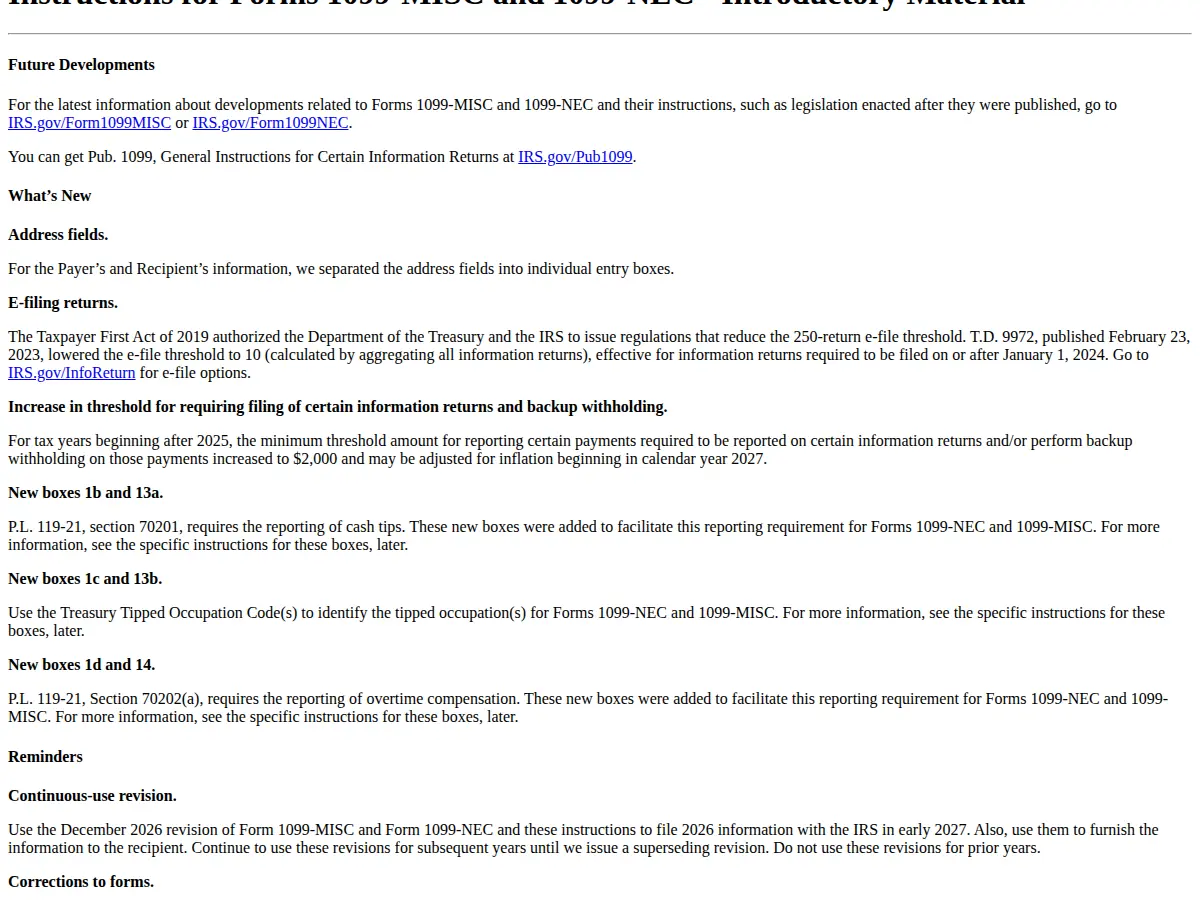
Every contractor-payment checklist written before 2026 starts with the same line: file Form 1099-NEC when you pay a nonemployee $600 or more. For payments made in 2026, that line is wrong. The December 2026 Instructions for Forms 1099-MISC and 1099-NEC state that for tax years beginning after 2025, the minimum threshold for reporting certain payments, and for backup withholding on those payments, increased to $2,000, with inflation adjustment possible from calendar year 2027. The statute is P.L. 119-21, section 70433, which replaced the $600 figure in IRC section 6041(a) with $2,000 for payments made after December 31, 2025. A 2025 payment of $700 still generated a form in early 2026; a 2026 payment of $700 does not. The test is the payment date, not the filing year.
> [!KEY TAKEAWAY]
> For 2026 payments, the 1099-NEC line is $2,000 per payee per calendar year, not $600, and the form is due to both the IRS and the contractor on January 31 — Monday, February 1, 2027, because January 31, 2027 is a Sunday. File on the annual total per payee, never on a single invoice, and collect the W-9 before the first payment: the penalty for a missing TIN is per form, and backup withholding runs at 24 percent.
Who this guide is for, and who should stop here
This playbook is for a payer: a business, nonprofit, or government unit that pays nonemployees for services in the course of a trade or business. If you pay a contractor to remodel your personal kitchen, no 1099 is owed, because the payment is not in the course of a trade or business. If your business pays the same contractor for the same work, the form is owed once the annual total clears the threshold.
Who should not use this guide alone: a payer with foreign payees, a payer reporting through a third-party settlement organization, and anyone whose contractors might be employees under state law. Foreign-payee documentation is a separate regime, and state classification tests can reclassify a contractor even when the federal form was filed correctly. Those cases need a CPA before January.
The $2,000 test, worked per payee
The threshold is an annual aggregate per payee: add every reportable payment to one payee across the calendar year, across every invoice and project. A single payment never decides the question alone.
$
\text{Reportable Total}_{\text{payee}} = \sum \text{all NEC payments to that payee in the calendar year}
$
$
\text{File Form 1099-NEC if } \text{Reportable Total}_{\text{payee}} \geq \$2{,}000 \text{ (2026 payments)}
$
Scenario, illustrative figures: a SaaS agency pays 23 contractors during 2026. Eighteen cross $2,000; five do not. The eighteen reportable totals sum to $412,000, and the five below the line sum to $6,100. The agency files eighteen forms, not twenty-three, and the $6,100 stays off the filing but stays in the ledger: one further payment before December 31 that pushes any of those five to $2,000 creates a filing duty on the full annual total, not just the crossing payment. The reverse failure is filing on every contractor who ever cleared $600 in a prior year, because the template was never updated.
| Payment year | NEC threshold | Authority |
| :--- | :--- | :--- |
| 2025 and earlier | $600 per payee per year | IRC section 6041(a) before amendment |
| 2026 | $2,000 per payee per year | P.L. 119-21 section 70433; IRS Instructions for Forms 1099-MISC and 1099-NEC (12/2026) |
| 2027 and later | $2,000, inflation-adjusted | IRS Instructions for Forms 1099-MISC and 1099-NEC (12/2026): adjustment possible from calendar year 2027 |
Payments that do not count toward the NEC total include credit-card and third-party-network payments, which belong in the 1099-K regime, and reimbursements that are not compensation for services. If a contractor is paid partly by card and partly by ACH or wire, only the bank-transfer portion counts — but keep the ledger split, exported as a CSV, to prove it.
Which form, which box: NEC vs MISC vs W-2 vs 1099-K
The form follows the payment, not the person. One payee can legitimately receive two forms from the same payer in one year — NEC for services, MISC for rent — if both totals clear their thresholds.
| You paid for | Form and box | 2026 threshold | Authority |
| :--- | :--- | :--- | :--- |
| Services by a nonemployee | 1099-NEC, Box 1a Nonemployee Compensation | $2,000 per payee | IRC section 6041A(a)(1); IRS Instructions (12/2026) |
| Services by an attorney | 1099-NEC, Box 1a | $2,000 per payee | IRC section 6041A(a)(1) |
| Rent for office, equipment, or land | 1099-MISC, Box 1 Rents | $2,000 per payee | IRC section 6041(a); IRS Instructions (12/2026) |
| Royalties | 1099-MISC, Box 2 Royalties | $10 or more | IRS Instructions (12/2026) |
| Other income, prizes, awards | 1099-MISC, Box 3 | $2,000 per payee | IRC section 6041(a); IRS Instructions (12/2026) |
| Gross proceeds to an attorney | 1099-MISC, Box 10 | Not raised with the $2,000 change; confirm the current box instructions before filing | IRC section 6045(f) |
| Wages to an employee | Form W-2, not a 1099 | Employment-tax regime | Publication 15 |
| Card or third-party network payments | Form 1099-K, filed by the settlement organization | Settlement-organization regime | IRC section 6050W |
The 2026 form carries three new boxes from P.L. 119-21: Box 1b for cash tips, Box 1c for Treasury Tipped Occupation Codes, and Box 1d for overtime compensation. A payer with none of those payments leaves them blank; a payer who has them must map the amounts before January. Box 2 reports direct sales of consumer products for resale totaling $5,000 or more, and Box 4 reports federal income tax withheld, where backup withholding lands.
> [!FOUNDER]
> "The January 31 deadline punishes the payer who treats contractor paperwork as year-end cleanup. The W-9 is a first-payment document, not a January document. By the time you are chasing TINs in January, you have already chosen between filing late and filing wrong, and the IRS charges for both."
> — Enow A. Jovial, Founder & Chief Executive Officer
Deadlines: the NEC has the tightest date in the family
Section 6071(c) requires Form 1099-NEC to be filed on or before January 31, paper or electronic, and the recipient copy carries the same date. There is no later electronic-filing date for the NEC as there is for the MISC, and the NEC is carved out of the usual automatic extension route, so plan to hit January 31. When the date falls on a weekend or legal holiday it moves to the next business day — which is why 2026 payments are due Monday, February 1, 2027.
| Action | Deadline for 2026 payments | Authority |
| :--- | :--- | :--- |
| Furnish 1099-NEC Copy B to the contractor | February 1, 2027 (January 31 is a Sunday) | IRC section 6071(c); IRS Instructions (12/2026) |
| File 1099-NEC Copy A with the IRS, paper or electronic | February 1, 2027 | IRC section 6071(c) |
| Furnish 1099-MISC recipient copies | January 31, moving to February 1, 2027 | IRS Instructions (12/2026) |
| File 1099-MISC with the IRS, paper | February 28, 2027 | IRS Instructions (12/2026) |
| File 1099-MISC with the IRS, electronic | March 31, 2027 | IRS Instructions (12/2026) |
Filing mechanics: W-9 first, e-file at ten, paper with a transmittal
1. Collect Form W-9 before the first payment. The W-9 gives you the payee's legal name and TIN, and its certification is what keeps backup withholding off the payment. A payer who pays first and asks later spends January chasing the people least inclined to reply.
2. Reconcile the ledger in December, not January. Sum reportable payments per payee, split card and network payments out, and flag every payee within $500 of the $2,000 line for a final check.
3. Decide the filing channel by count. T.D. 9972 lowered the e-file threshold to 10 information returns in aggregate, effective for returns required on or after January 1, 2024. At ten or more, e-file; below ten, paper is permitted, transmitting Copy A with Form 1096. The IRS IRIS portal e-files information returns free of charge.
4. Validate TINs before transmitting. A missing or incorrect TIN is both a penalty trigger and a backup withholding trigger, not just a delay.
5. Furnish, file, and retain in the same week. Furnish Copy B, file Copy A, and keep Copy C with the W-9 and the ledger. A correction is a second filing with its own deadline logic, so the first filing should be the careful one.
Corporations are generally excepted from information reporting, with attorney-fee and medical-payment exceptions, so a payment to an incorporated vendor usually needs no NEC. That exception has two edges: fees paid to an attorney, including a law-firm corporation, are reportable in Box 1a once the threshold is met, and medical payments and attorney fees break the exception for an S-Corp or C-Corp payee. Verify entity type from the W-9, not the invoice letterhead. Copy A also carries the payer's own EIN, and Box 1a income is generally subject to SECA self-employment tax on the contractor's return, while an employee doing the same work would have FICA tax withheld on a W-2 — which is why the classification warning below matters more than any box on the form.
Backup withholding: the 24 percent lever
Backup withholding applies when the payee fails to furnish a TIN as required, when the IRS notifies you the TIN is incorrect, or when the IRS notifies you the payee is subject to withholding for notified payee underwithholding. The rate is 24 percent, taken from future payments and reported in Box 4.
$
\text{Backup Withholding} = \text{Reportable Payment} \times 24\%
$
On a $10,000 payment with a missing TIN, withholding is $2,400 and the payee receives $7,600. A payer who pays the full $10,000 anyway can be held liable for the tax it should have withheld, converting a paperwork failure into a cash liability. The withholding trigger follows the new threshold: the December 2026 instructions raise it for the affected payments to the same $2,000 figure, so a sub-threshold payee with a missing TIN creates no withholding duty on that payment — but the missing TIN still has to be fixed before the payee crosses the line.
> [!WARNING]
> Misclassification is the failure mode this guide cannot fix with a form. Filing a 1099-NEC for someone who is legally an employee does not make them a contractor, and the employment-tax exposure dwarfs the information-return penalty. Section 530 relief, which can protect a payer who treated workers as nonemployees, requires that the payer filed Form 1099-NEC for those workers — necessary protection, never sufficient protection on its own.
Penalties: the ladder, worked on forty forms
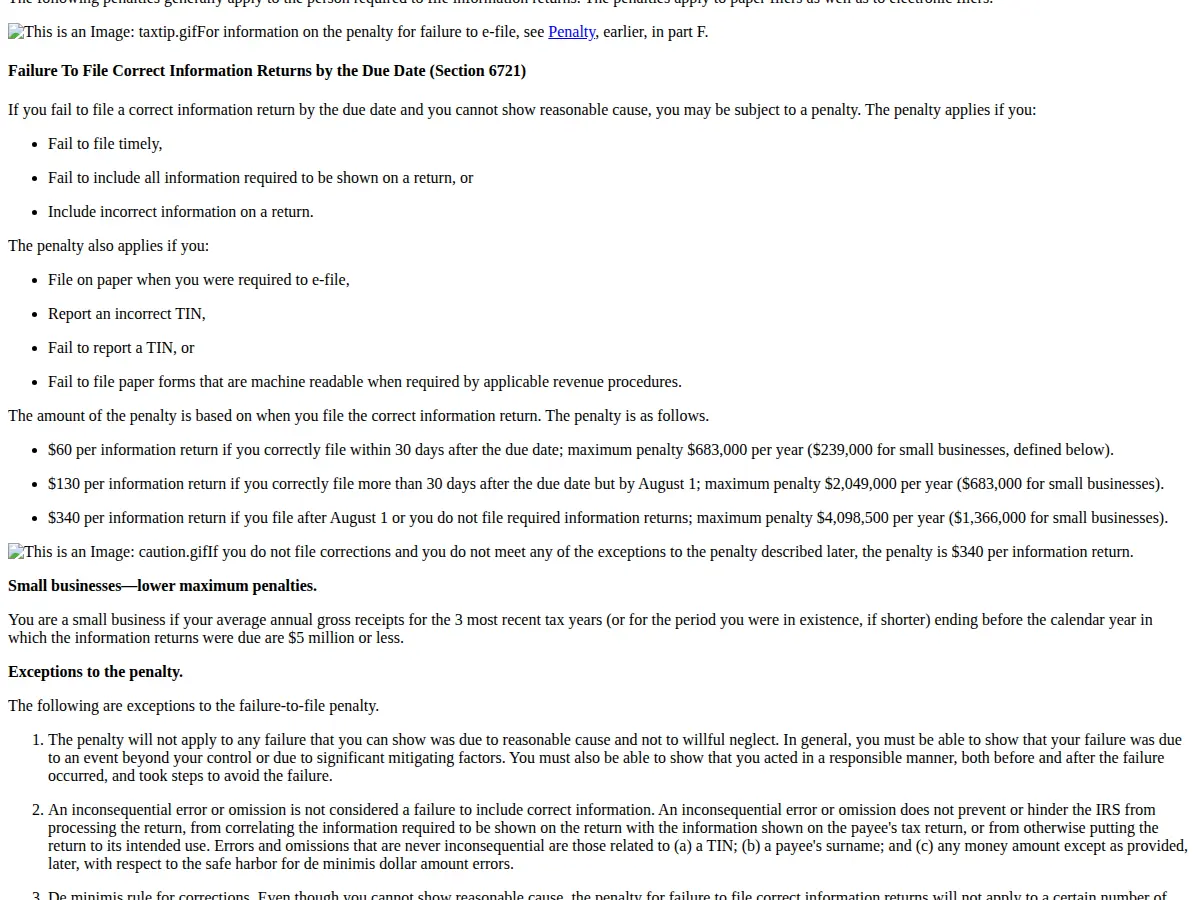
Failure to file a correct return by the due date, without reasonable cause, is penalized under IRC section 6721, and the amount depends on how late the correct return is filed. The small-business maximums apply when average annual gross receipts for the three most recent tax years ending before the calendar year the returns were due are $5 million or less.
| Correct filing timing | Penalty per return | Small-business annual maximum | Authority |
| :--- | :--- | :--- | :--- |
| Within 30 days after the due date | $60 | $239,000 | IRC section 6721; General Instructions |
| More than 30 days after, but by August 1 | $130 | $683,000 | IRC section 6721; General Instructions |
| After August 1, or not filed | $340 | $1,366,000 | IRC section 6721; General Instructions |
| Intentional disregard | At least $680, no maximum | No maximum | IRC section 6721; General Instructions |
$
\text{Penalty} = \text{Forms Late} \times \text{Per-Form Rate for the Filing Window}
$
Worked on the illustrative agency: forty forms filed 45 days late fall in the second window, so 40 multiplied by $130 equals $5,200. The same forty filed after August 1 cost 40 multiplied by $340, which equals $13,600. Forty forms never filed under intentional disregard cost at least 40 multiplied by $680, which equals $27,200, with no maximum. The ladder also applies to filing on paper when e-filing was required, reporting an incorrect TIN, and filing non-machine-readable paper forms. Failure to furnish a correct payee statement carries its own ladder under IRC section 6722, with the same $680 floor per statement. Reasonable cause — an event beyond the payer's control, with responsible action before and after — is the exception, and it has to be shown, not asserted.
Operator boundaries and the January checklist
This guide covers the federal filing operation. State rules vary: several states require their own copies or use the combined federal and state filing program, so confirm the state rule for every payee state before treating the federal filing as complete. The figures here are the December 2026 instruction figures for 2026 payments; check the 2027 inflation adjustment before the next cycle rather than carrying $2,000 forward by habit.
> [!TIP]
> Run the December reconciliation on the first business day of December, not the last. The payees who will not return a W-9 need three weeks of chasing.
Related reading on this site: the IRS Form 941 quarterly filing playbook for the employee side, the quarterly estimated tax payments guide for what the contractor does with the reported income, and the payroll provider comparison for the payroll system. Estimate the contractor's side with the tax estimator. The onboarding form behind this reporting is covered in our Form W-9 vs Form W-8BEN contractor onboarding playbook.