A Delaware LLC pays a $250,000 dividend to its German shareholder and sends the full amount — no form, no withholding, no deposit. The LLC was the withholding agent, Section 1442 required 30 percent withheld at the source, and under Section 1461 the LLC is personally liable for the $75,000 plus interest and penalties.
Who the withholding agent is
The Instructions for Form 1042 define the withholding agent as a U.S. or foreign person that has control, receipt, custody, disposal, or payment of any item of income of a foreign person subject to withholding — an individual, trust, estate, partnership, corporation, nominee, government agency, association, or tax-exempt foundation. A fund administrator paying royalties, a startup paying a foreign contractor's licence fee, a REIT paying a dividend to a foreign holder: each is a withholding agent the moment it controls the payment.
Two consequences follow. Acting through an agent does not move the liability: the withholding agent is liable for any failure of its agent to deposit the tax, even if the agent is itself separately liable. And liability is personal: Section 1461 makes every person required to deduct and withhold liable for that tax, and indemnifies the agent for amounts paid in accordance with the chapter — it protects the agent who withholds, not the one who does not.
The filing duty is just as wide: every withholding agent must file Form 1042 for the preceding calendar year — even if no tax was withheld and even if another agent did the withholding. If a Form 1042-S exists, a Form 1042 follows.
The 30 percent rule: Sections 1441 and 1442
Section 1441(a) states the general rule for nonresident alien individuals and foreign partnerships: every person having control, receipt, custody, disposal, or payment of the listed income items, to the extent they constitute U.S.-source gross income, must deduct and withhold a tax equal to 30 percent. Section 1442(a) applies the same rule to foreign corporations.
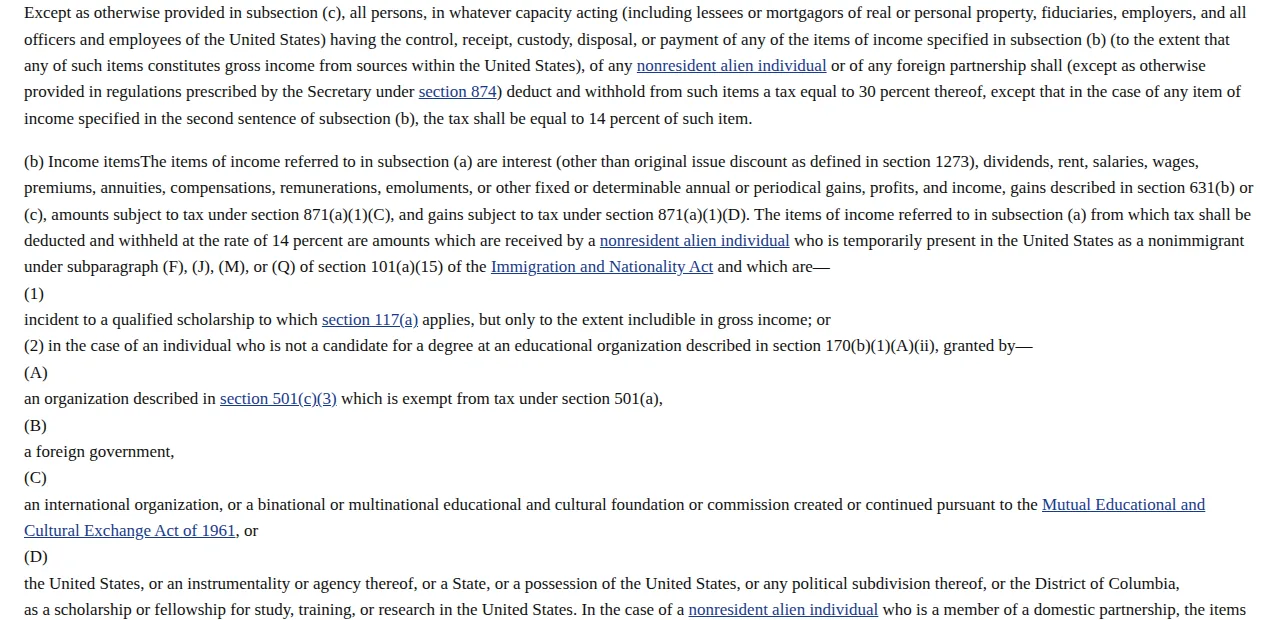
The income items in Section 1441(b) are the FDAP list: interest (other than original issue discount), dividends, rent, salaries, wages, premiums, annuities, compensations, remunerations, emoluments, and other fixed or determinable annual or periodical gains, profits, and income. The tax falls on the gross payment — no deduction for the recipient's expenses.
Example A — the dividend paid in full. A U.S. corporation pays a $250,000 dividend to a foreign corporate shareholder with no treaty claim on file. Withholding is 30 percent — $75,000; the shareholder receives $175,000. Paying the full $250,000 does not make the $75,000 disappear; it makes the corporation liable for it under Section 1461.
Three carve-outs matter: scholarships to F, J, M, or Q nonimmigrants are withheld at 14 percent; effectively connected income is excepted under Section 1441(c)(1) and taxed on the recipient's own return — the Form 1040-NR playbook for individuals, the Form 1120-F playbook for corporations; and portfolio interest is excepted under Section 1441(c)(9).
Treaty reduction: the W-8BEN operation
The 30 percent rate is the default, not the destination. A tax treaty can reduce it, claimed on paper before the payment: the beneficial owner certifies foreign status and claims treaty benefits on Form W-8BEN (individuals) or W-8BEN-E (entities); effectively connected income on Form W-8ECI; intermediaries on Form W-8IMY. The agent relies on the form — and an expired, incomplete, or inconsistent W-8BEN supports no reduction at all.
Example B — the treaty cut, illustrated. Take the same $250,000 dividend and assume the applicable treaty sets a 15 percent dividend rate — the actual rate comes from the specific treaty article; this figure is an assumption for illustration only. Withholding is $37,500 and the saving is $37,500. The saving is bought with documentation: no valid W-8BEN on file at payment time, no reduction.
Withholding applies at payment time, on the documentation held then. A W-8BEN arriving after the payment does not retroactively fix the withholding. Collect the form before the money moves and calendar its expiry.
Deposits: the quarter-monthly clock and EFTPS
Withholding is not a year-end exercise. The tax is deposited as it accumulates, through EFTPS or IRS Direct Pay — do not mail deposits to the IRS.
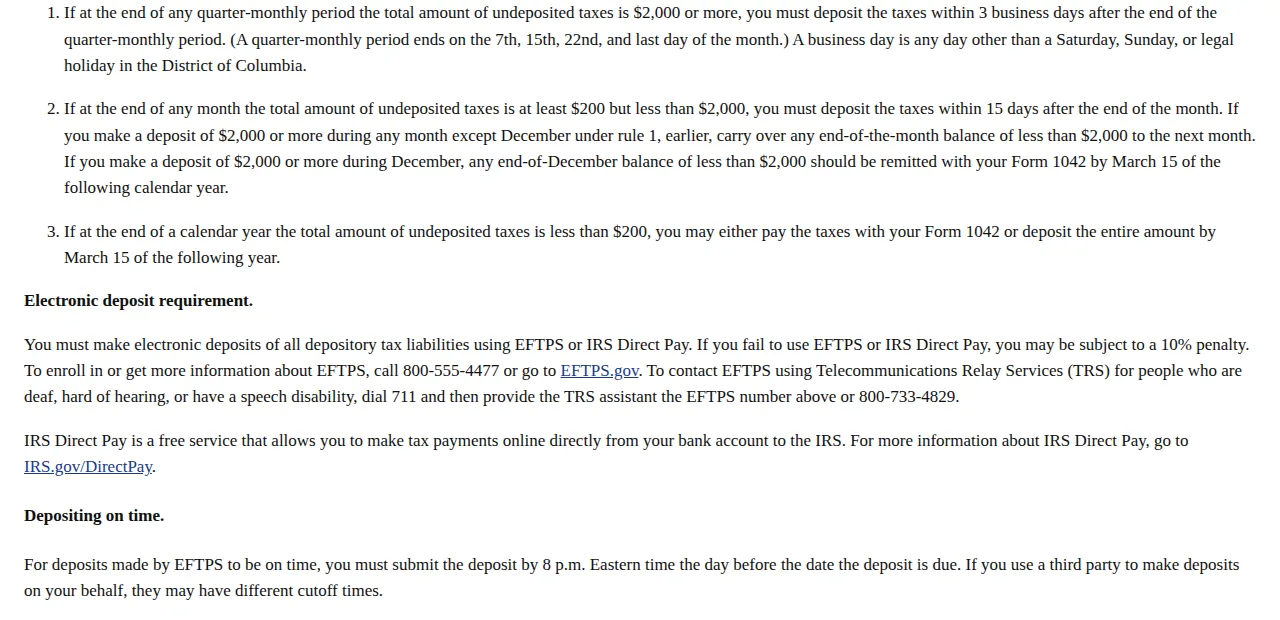
| Rule | Trigger | Deadline | Authority |
|---|---|---|---|
| Quarter-monthly | Undeposited tax of $2,000 or more at a quarter-monthly period end | Within 3 business days | Form 1042 instructions |
| Monthly | Undeposited tax of $200 to $2,000 at month-end | Within 15 days | Form 1042 instructions |
| Year-end small balance | Undeposited tax under $200 at year-end | With Form 1042 or by March 15 | Form 1042 instructions |
| Electronic only | All depository liabilities | EFTPS or IRS Direct Pay | Form 1042 instructions |
A quarter-monthly period ends on the 7th, 15th, 22nd, and last day of the month; a business day excludes Saturdays, Sundays, and District of Columbia holidays.
Example C — the royalty that triggers the clock. A company pays an $80,000 royalty to a foreign licensor on January 3, with no W-8BEN on file, and withholds 30 percent — $24,000. The quarter-monthly period ends January 7; the deposit is due within 3 business days, not on March 15.
Form 1042: the annual return
Form 1042 is the withholding agent's annual return for U.S.-source income of foreign persons. It reports tax withheld under Chapter 3 (excluding Sections 1445 and 1446 except as indicated), under Chapter 4 on withholdable payments, under Section 5000C on specified federal procurement payments, and under Section 877A on payments to covered expatriates. File one consolidated Form 1042 for both chapters — unless acting in more than one capacity, when a separate form is filed for each.
The return is due March 15: mail it to the IRS in Ogden, UT 84409, or file electronically. E-filing is required for financial institutions, agents filing 10 or more information returns a year, and partnerships with more than 100 partners. Form 7004 extends filing, not payment.
The return's spine is the Record of Federal Tax Liability, lines 1 through 60: the federal tax liability for each quarter-monthly period — liability, not deposits. Monthly totals must match lines 64b, 64c, and 64d, split between Chapter 3 and Chapter 4. Section 2 reconciles FDAP payments and must be completed even if no Chapter 4 amounts were withheld.
Form 1042-S: the recipient statement
Form 1042-S tells each recipient what was paid and what was withheld. Every withholding agent must file one for amounts paid during the preceding calendar year that are subject to reporting — even if no tax was withheld because the income was exempt under a treaty or the Code.
Both legs share one deadline: file with the IRS and furnish to the recipient by March 15 of the following calendar year, moving to the next business day if the 15th falls on a weekend or legal holiday. Paper Forms 1042-S go with Form 1042-T; Copy A to the IRS, Copies B, C, and D to the recipient, and all copies must match — a recipient copy that differs from the filed copy can delay the recipient's return.
Extensions are narrow: Form 8809 gives an automatic 30-day extension to file, requested by the due date; Form 15397 gives a one-time 30-day extension to furnish recipient copies, requested by fax by the furnishing due date. E-filing is required for filers of 10 or more information returns, partnerships with more than 100 partners, and all financial institutions; from January 1, 2026, 2025 Forms 1042-S go through IRIS, with FIRE retiring December 31, 2026.
The penalty regime
Three penalty systems stack on a withholding failure, and the instructions say the IRS will compute the amounts.
Late filing of Form 1042 costs 5 percent of the unpaid tax per month, up to 25 percent. Late payment costs usually one-half of 1 percent per month, up to 25 percent. Interest runs from the due date under Section 6621 even with a filing extension; Sections 6662 and 6663 add penalties for negligence, understatement, and fraud.
Example D — three months late on the royalty. The $24,000 withheld in Example C is still unpaid when Form 1042 is filed three months late. Late filing: 5 percent a month for three months — $3,600, under the 25 percent cap of $6,000. Late payment: one-half of 1 percent a month for three months — $360. The failure costs $3,960 before interest.
Late or incorrect Form 1042-S. The Section 6721 ladder prices each return by lateness: $60 filed within 30 days after the due date, $130 filed more than 30 days late but by August 1, and $340 filed after August 1 or never filed correctly. Annual maximums are $698,500, $2,095,500, and $4,191,500, with lower caps for a small business — average gross receipts of $5 million or less for the three most recent tax years. Intentional disregard costs the greater of $690 or 10 percent of the amount reportable, with no maximum. Failure to furnish a correct Form 1042-S costs up to $340 per failure.
Example E — the August 1 cliff. An agent files 120 Forms 1042-S after August 1: at $340 each the penalty is $40,800. Filed within 30 days of the due date, the same returns would cost $7,200 — a $33,600 difference.
Fixing mistakes: overwithholding and underwithholding
Overwithholding discovered by March 15 of the following calendar year can be fixed between agent and recipient using any undeposited tax: repay the recipient, reduce the deposit, and report the adjustment on Form 1042.
Overwithholding discovered after March 15 cannot be fixed that way: do not adjust the prior-year Form 1042 liability or deposits, and do not repay the beneficial owner — unless you are a QI, WP, or WT claiming a collective refund. The recipient claims a refund on its own return. Underwithholding is corrected under Regulation Section 1.1461-2(b) by withholding from later payments to the same recipient.
Decide before you pay: the decision table
| Payment | Withhold | Rate | Authority |
|---|---|---|---|
| Dividend, no treaty claim | Yes, at payment | 30% of gross | § 1441(a); § 1442(a) |
| Dividend, valid W-8BEN treaty claim | Yes, at payment | Treaty rate | § 1441; treaty article |
| Royalty or rent | Yes, at payment | 30% of gross, treaty may reduce | § 1441(b) FDAP list |
| Portfolio interest | No, if truly portfolio interest | 0% | § 1441(c)(9); § 871(h) |
| Effectively connected income | No Chapter 3 withholding | Taxed on recipient return | § 1441(c)(1) |
| Scholarship to F/J/M/Q nonimmigrant | Yes, at payment | 14% of includible amount | § 1441(b), second sentence |
Who should not run this playbook — and what to do instead
This playbook is for payers of U.S.-source FDAP income to foreign persons. It is not employee withholding: wages to a nonresident alien employee go on Form 941, under the Form W-4 playbook. It is not the foreign corporation's own return — the Form 1120-F playbook — or the U.S. shareholder's reporting on a foreign corporation — the Form 5471 playbook. One structure can owe all of these at once.
Do not use Form 1042 for U.S. persons: a U.S. payee documents itself on Form W-9, and the W-9 vs W-8BEN contractor onboarding playbook sets out the intake that keeps the two populations apart. A payment at a zero treaty rate still requires a Form 1042, and a payment with no net cash can still be a payment for tax purposes — for example, a dividend equivalent under Section 871(m).
Founder & CEO Insight — Enow A. Jovial
The withholding operation: checklist
- [x] Step 1 — Classify the payee: Foreign or U.S. person, beneficial owner or intermediary. Collect the right W-9 or W-8 form before the first payment.
- [x] Step 2 — Classify the income: FDAP or effectively connected, portfolio interest or royalty, scholarship or wages.
- [x] Step 3 — Apply the rate: 30 percent by default, the treaty rate on a valid W-8BEN, 14 percent for F/J/M/Q scholarships, zero for portfolio interest and ECI.
- [x] Step 4 — Withhold at payment: Deduct from the gross payment, never from the net.
- [x] Step 5 — Deposit on the clock: EFTPS or IRS Direct Pay; $2,000 or more at a period end goes within 3 business days.
- [x] Step 6 — File and furnish by March 15: One consolidated Form 1042, Form 1042-S filed and furnished to every recipient. Use Form 8809 or Form 15397 for the 30-day extensions, requested before the due date.
- [x] Step 7 — Retain and re-verify: Keep returns and reconstruction data for at least 3 years; re-verify W-8BEN validity before the next cycle.
Run the next payment through the tax estimator before the money moves: the rate, the deposit date, and the March 15 deadline are all knowable in advance.