The form that decides how much of the payment never reaches the payee
A founder hires a contractor, pays the invoice, and files the year-end return. Months later a notice arrives: the IRS wants 24 percent of every payment made to that contractor, plus the payor is liable for money it already handed over. The failure happened before the first payment, in the thirty seconds it takes to collect the wrong tax form. Two forms split every payee: Form W-9 documents a United States person and certifies a taxpayer identification number, and Form W-8BEN documents a foreign individual and establishes the withholding rate on that person income.
> [!KEY TAKEAWAY]
> Form W-9 certifies a United States person and a taxpayer identification number; its failure mode is 24 percent backup withholding under 26 U.S.C. § 3406. Form W-8BEN documents a foreign individual; its failure mode is 30 percent withholding under 26 U.S.C. § 1441. One punishes a missing number, the other taxes a foreign person income — and no single form covers both populations.
Who this guide is for, and who should stop here
This guide is for a founder, finance lead, or payroll operator who pays contractors from a United States business — especially across borders, where a developer in Lagos, a designer in Manila, and a consultant in Ohio can all sit in the same payment run. It is written for payors, not for payees filling in their own form.
It is not for a business that pays only W-2 employees through payroll: employees are documented on Form W-4 and reported on Form W-2, covered in our IRS Form W-2 employee wage reporting playbook. It is also not for payments to foreign entities, which use Form W-8BEN-E, or for foreign persons with effectively connected income, who use Form W-8ECI.
What Form W-9 actually does
Form W-9, Request for Taxpayer Identification Number and Certification, does three things in one page: it collects the payee legal name and taxpayer identification number — a Social Security number (SSN), an employer identification number (EIN), or an individual taxpayer identification number (ITIN); it collects the payee federal tax classification (LLC, S-Corp, or C-Corp); and it carries a certification, signed under penalties of perjury, that the number is correct, that the payee is not subject to backup withholding, and that the payee is a United States person. The form states the handling rule in plain type: give form to the requester, do not send to the IRS.
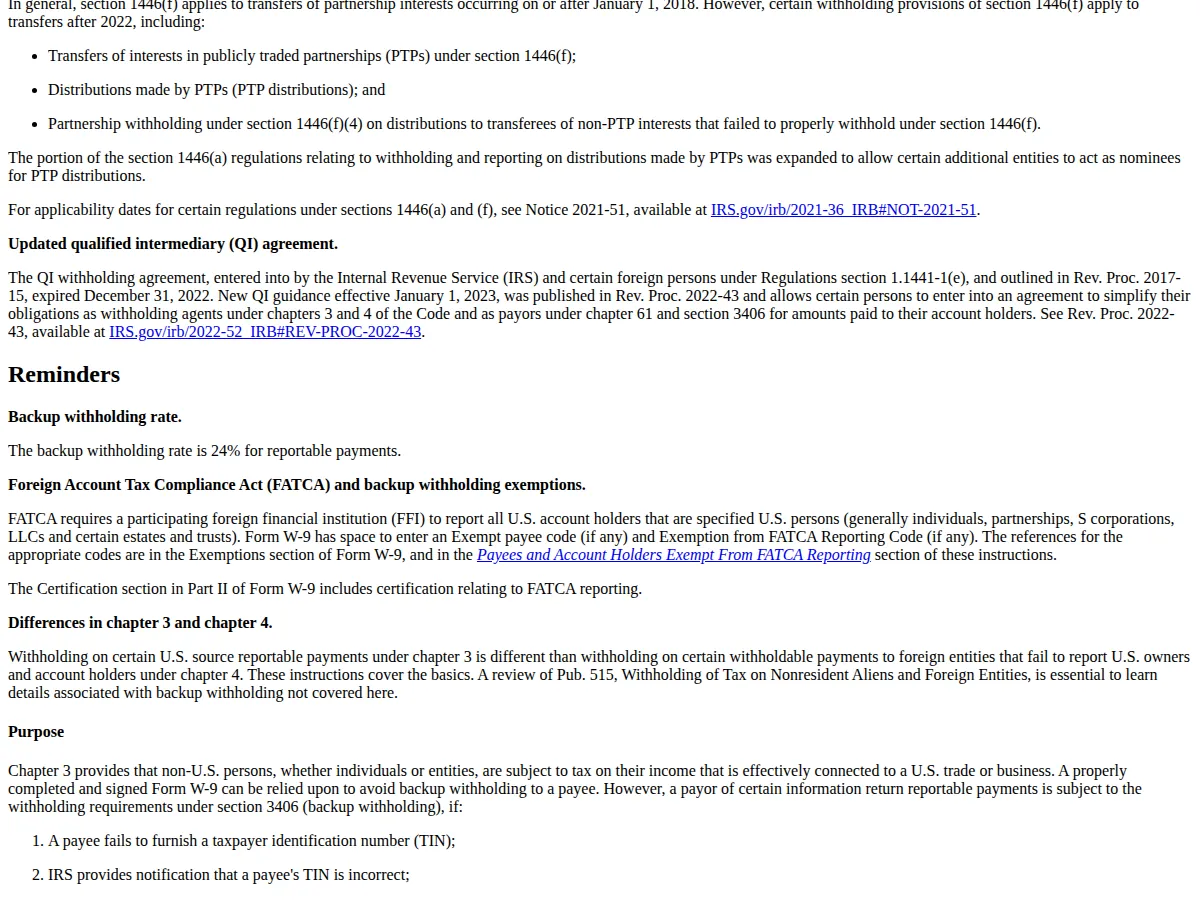
The requester instructions, revised March 2024, state the consequence in one line: the backup withholding rate is 24 percent for reportable payments. A payor must deduct, withhold, and deposit 24 percent of reportable payments made to a payee until the cause of the backup withholding is remedied.
Backup withholding applies when a payee fails to furnish a taxpayer identification number, when the IRS notifies the payor that the number furnished is incorrect, or when the payee is subject to backup withholding for underreporting interest and dividend income. The IRS communicates the second trigger with a CP2100 notice, and offers TIN matching e-services so a payor can check a name and number combination against IRS records before filing; a verified match is reasonable cause under section 6724(a). An individual taxpayer identification number that has not appeared on a federal return in three consecutive tax years has expired and must be renewed.
Form W-9 carries no expiration date in its instructions. It stays on file until the information on it changes. The contrast with the W-8BEN, which expires on a fixed clock, is the first operational difference a payor should internalize: the W-9 is collected once and maintained, while the W-8BEN is collected once and re-collected on schedule.
What Form W-8BEN actually does
Form W-8BEN, Certificate of Foreign Status of Beneficial Owner for United States Tax Withholding and Reporting (Individuals), documents a foreign individual and establishes how much tax the United States withholds from that person FDAP income. The instructions state the default plainly: foreign persons are subject to United States tax at a 30 percent rate on income received from United States sources. The statute behind it, 26 U.S.C. § 1441(a), requires every person having control of the listed income items to deduct and withhold a tax equal to 30 percent, with one named exception — items in the second sentence of subsection (b) are withheld at 14 percent.
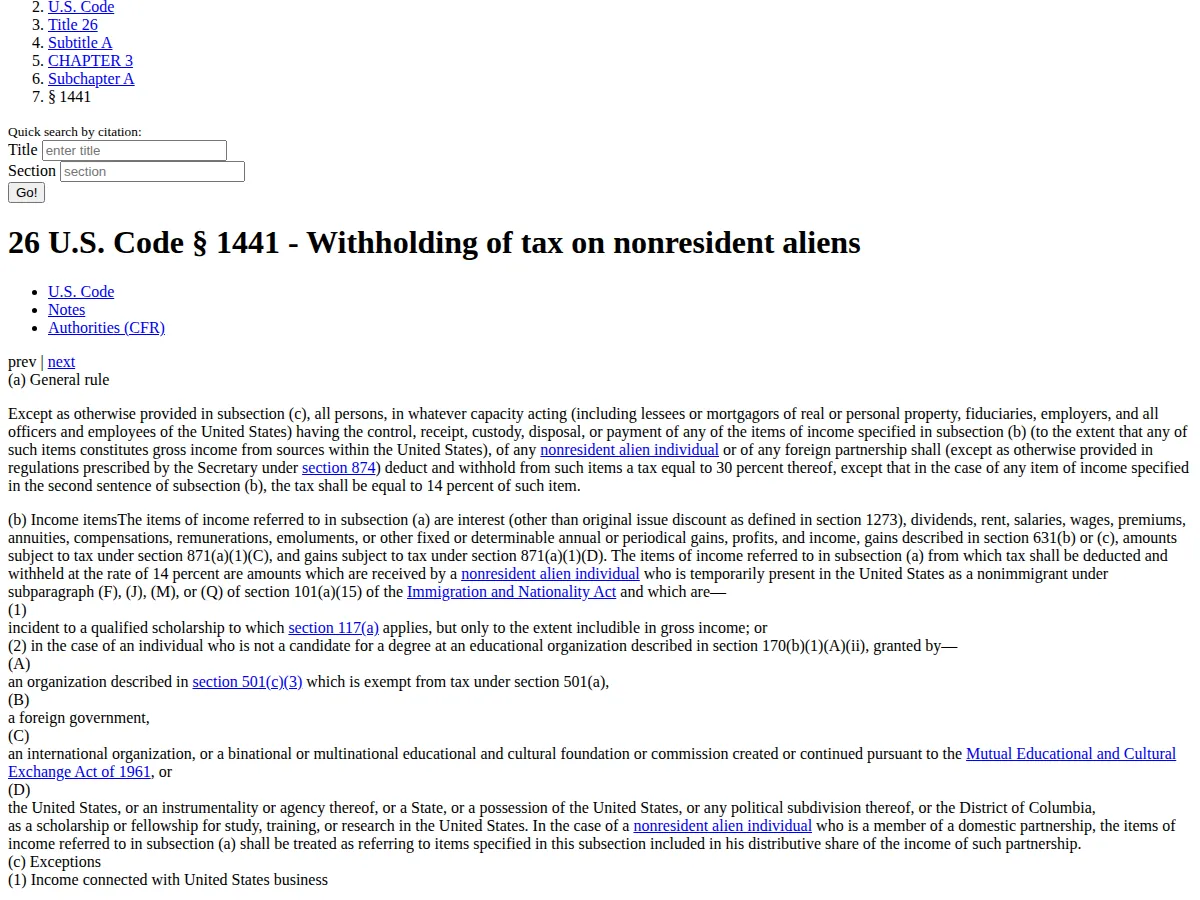
The income items in subsection (b) are the working definition: interest, dividends, rent, salaries, wages, premiums, annuities, compensations, remunerations, emoluments, and gains under section 871(a)(1)(C) and (D). The 14 percent items are narrower: scholarship and fellowship amounts received by a nonresident alien temporarily present as a nonimmigrant under subparagraph (F), (J), (M), or (Q) of section 101(a)(15) of the Immigration and Nationality Act.
Line 10 is where the payee claims a reduced rate of, or exemption from, withholding as a resident of a foreign country with which the United States has an income tax treaty. The treaty claim is the single most valuable line on the form: the difference between 30 percent and the treaty rate for that income type. A payor cannot invent a treaty claim for the payee. The claim must be on the form, with the treaty country and article stated, or the 30 percent rate applies. The form also documents chapter 4 status: a foreign financial institution may rely on a properly completed Form W-8BEN to establish a person chapter 4 status.
The validity clock is the part payors most often miss. Generally, a Form W-8BEN remains in effect from the date it is signed through the last day of the third succeeding calendar year, unless a change in circumstances makes any information on the form incorrect. The instructions give the worked example: a form signed September 30, 2015 remains valid through December 31, 2018, so a form signed January 15, 2026 is in force through December 31, 2029. When a change in circumstances makes any information incorrect, the payee must notify the withholding agent, payer, or financial institution within 30 days and file a new form. A move to a United States address is a change in circumstances; a move within the same foreign country generally is not, unless the form claims treaty benefits. Becoming a United States citizen or resident alien ends the 30 percent regime, and the payee must notify the withholding agent within 30 days and provide a Form W-9.
The form never goes to the IRS. The payee gives it to the withholding agent, the payer, or the financial institution before the payment is made, credited, or allocated. Failure to provide it when requested may lead to withholding at the 30 percent rate or the backup withholding rate under section 3406. Withholding is calculated at the moment of payment, not at year end.
Worked math: the same 60,000 dollars, three withholding outcomes
Scenario: a United States startup pays a contractor 60,000 dollars for a year of work, 5,000 dollars per monthly invoice. The only variable is the form on file. First, the clean W-9 outcome: a United States contractor provides a valid Form W-9 with a verified number, backup withholding is zero, and the payor reports 60,000 dollars on Form 1099-NEC — worked in full in our IRS Form 1099-NEC contractor reporting playbook.
Second, the missing W-9 outcome: the contractor never returns the form, or returns one with an incorrect number that the IRS flags on a CP2100 notice. Backup withholding applies at 24 percent:
$
\text{Backup Withholding} = \$60{,}000 \times 24\% = \$14{,}400
$
The payor withholds 1,200 dollars from each 5,000 dollar invoice and deposits it with the IRS. The contractor receives 45,600 dollars for the year instead of 60,000.
Third, the foreign contractor outcome: a foreign individual provides a valid Form W-8BEN with no treaty claim, and the 60,000 dollars is United States source income subject to chapter 3 withholding at 30 percent:
$
\text{Chapter 3 Withholding} = \$60{,}000 \times 30\% = \$18{,}000
$
The contractor receives 42,000 dollars. The 3,600 dollar gap between the 24 percent backup rate and the 30 percent foreign rate is the price of confusing the two regimes: backup withholding punishes a missing number, chapter 3 withholding taxes a foreign person. If the same contractor claims treaty benefits on line 10 and the treaty provides a zero rate, the withholding falls to zero — but only if the claim is on the form before payment.
| Attribute | Form W-9 | Form W-8BEN | Authority |
| :--- | :--- | :--- | :--- |
| Who provides it | United States person | Foreign individual | IRS Form W-9 and W-8BEN instructions |
| What it certifies | Taxpayer identification number and United States status | Foreign status and chapter 3 / chapter 4 status | Form W-9 Part II; Form W-8BEN Parts I–III |
| Failure rate | 24 percent backup withholding | 30 percent under § 1441; 14 percent for named scholarship items | 26 U.S.C. § 3406; 26 U.S.C. § 1441(a)–(b) |
| Validity | No expiration in the instructions | Signed date through last day of third succeeding calendar year | Instructions for Form W-8BEN |
| Change notice | Update records on new information | Notify withholding agent within 30 days | Instructions for Form W-8BEN |
| Treaty claim | None — United States persons do not claim treaties on a W-9 | Line 10; treaty country and article required | Instructions for Form W-8BEN, Line 10 |
| Where it goes | Kept by the requester; never sent to the IRS | Given to the withholding agent before payment | Form W-9 (Rev. March 2024); Instructions for Form W-8BEN |
| Wrong-form cost | Foreign payee certified as United States person | United States payee documented as foreign; 30 percent withheld | 26 U.S.C. §§ 3406, 1441 |
The onboarding sequence that prevents both failures
Step 1: Classify the payee before the form is sent. United States person receives a W-9; foreign individual a W-8BEN; foreign entity a W-8BEN-E; foreign person with effectively connected income (ECI) a W-8ECI. The classification question is asked once, in writing, at onboarding.
Step 2: Send the right form with a deadline tied to the first payment. The request states the payment date and the consequence of a missing form: backup withholding at 24 percent, or withholding at 30 percent, will apply.
Step 3: Validate the number before filing. Run the taxpayer identification number and name combination through the IRS TIN matching e-services before the information return is filed. A verified match is reasonable cause under section 6724(a) and reduces CP2100 notices.
Step 4: Read line 10 on every W-8BEN. A blank line 10 means the 30 percent rate applies. File the form with the treaty country and article visible, because the withholding agent must defend the rate later.
Step 5: Calendar the W-8BEN expiry. Every W-8BEN gets a diary date at the end of its third succeeding calendar year. A form signed in 2026 expires December 31, 2029. Renewal is requested 60 days before expiry.
Step 6: Re-collect on a change in circumstances. A payee who becomes a United States citizen or resident alien, moves to a United States address, or moves outside a treaty country must notify the withholding agent within 30 days and file a new form.
> [!WARNING]
> The withholding agent is liable for the tax it failed to withhold. A payor that pays a foreign contractor 60,000 dollars without a W-8BEN and withholds nothing has assumed an 18,000 dollar liability of its own, plus interest and penalties, under 26 U.S.C. § 1441. The same logic applies to backup withholding under section 3406: the payor that pays without collecting the W-9 owes the 24 percent it never took. Withholding is the payor liability, and the form is the only document that moves it.
> [!FOUNDER]
> "Every contractor dispute I have watched start with money started with a form nobody collected. The W-9 takes thirty seconds at onboarding and costs nothing. The W-9 you collect after the CP2100 notice arrives costs you the relationship and 24 percent of every payment you already made. Collect the form before the first dollar, read line 10 before the first foreign payment, and diary the expiry the day the form arrives."
> — Enow A. Jovial, Founder & Chief Executive Officer
Who should not use this playbook as written
A business that pays only through a payroll provider with no contractor population should not build this workflow — its withholding happens on Form W-4 and Form W-2. A business paying a foreign entity should not hand it a W-8BEN: entities use Form W-8BEN-E. A payor with a single foreign contractor should still collect the W-8BEN, but a calendar reminder is enough — the full diary system is for a population, not one form.
The most common failure mode is the drawer: the form is collected, filed, and never read. Line 10 is blank and nobody notices until the year-end return. The W-8BEN expired on December 31 and nobody diaried it, so January payments go out at 30 percent.
> [!TIP]
> Model the withholding before the first payment with the Self-Employed Tax and Quarterly Estimator: run the contractor gross through the 24 percent and 30 percent rates side by side. A contractor who sees the 14,400 dollar difference returns the form that day.
When the collection fails
Failure has four shapes. A missing W-9 is fixed by collecting the form and withholding 24 percent until it arrives. An incorrect number flagged on a CP2100 notice is fixed by requesting a corrected W-9 and withholding until the corrected number is furnished. An expired W-8BEN is fixed by requesting a new form before the next payment; payments made after expiry are withheld at 30 percent. A change in circumstances the payee never reported is fixed the same way, with the question asked at every renewal. None of these recoveries is available after the information return is filed with the wrong data on it — the correction then runs through Form 1099 corrections and amended deposits.