A German software company opens a New York sales office and books $1,000,000 of US revenue. A Singapore holding company owns a Miami warehouse and collects rent. Both are foreign corporations with US tax exposure, and both file the same return: Form 1120-F. The return taxes effectively connected income at the 21 percent corporate rate, then adds a second tax — the branch profits tax — on the earnings the branch keeps.
Who must file
The Instructions for Form 1120-F set the filing duty wide. A foreign corporation must file if, during the tax year, it was engaged in a trade or business in the United States — whether or not it had US-source income from that business, and whether or not a treaty exempts that income. It must also file if it had income treated as effectively connected; if it had US-source income whose tax was not fully satisfied by Chapter 3 withholding; or if it was, or had a branch that was, a qualified derivatives dealer.
Three facts follow. Treaty exemption does not excuse filing — it changes what the return claims, not whether one is filed. A corporation with no US office can still owe the return on US-source income that withholding did not fully cover. And a corporation claiming a refund of overwithheld tax files Form 1120-F to claim it, under the simplified procedure in Section I.
Effectively connected income: the Section 882 base
Section 882(a)(1) taxes a foreign corporation engaged in a US trade or business on its taxable income that is effectively connected with that business, at the rates in Section 11, 55, or 59A. Section 11(b) sets the corporate rate at 21 percent of taxable income. Gross income includes only effectively connected gross income, and Section 882(c)(1) allows deductions only to the extent they are connected with effectively connected income, apportioned under the regulations.
The deduction rule has a hard edge. Section 882(c)(2) provides that a foreign corporation receives the benefit of deductions and credits only by filing a true and accurate return: a corporation that files no return loses the right to take deductions and credits against effectively connected income. The tax then falls on gross income — and at 21 percent of gross, a low-margin branch can owe more in tax than it earned in profit.
Example A — the return as written. A foreign branch earns $1,000,000 of effectively connected income and claims $400,000 of connected deductions. Taxable income is $600,000, and the Section 882 tax is 21 percent of it, which is $126,000.
US-source FDAP income not effectively connected with the business — dividends, interest, royalties — is taxed at 30 percent under Section 881(a) and reported in Section I.
The branch profits tax: Section 884
Section 884(a) imposes a second tax, in addition to the Section 882 tax, equal to 30 percent of the dividend equivalent amount for the taxable year. The logic is parity: a foreign corporation operating through a US subsidiary pays corporate tax and then dividend withholding when it distributes profits to its foreign parent. A branch pays no dividend withholding, so the branch profits tax stands in its place, taxing the earnings the branch keeps as though distributed.
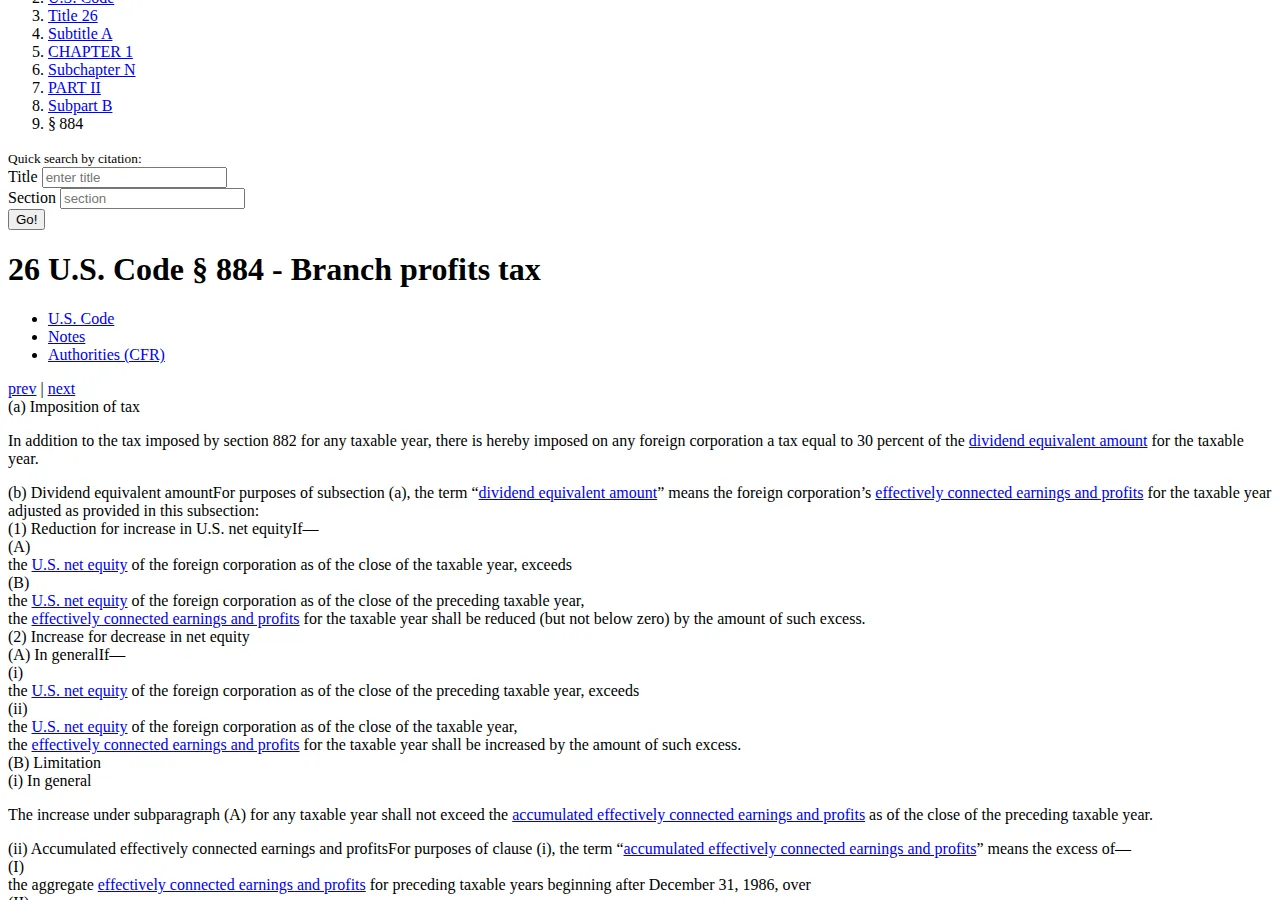
The dividend equivalent amount is defined in Section 884(b): effectively connected earnings and profits for the year, adjusted for the change in US net equity — US assets minus US liabilities. If US net equity rose, earnings and profits fall by the increase, down to zero: reinvested earnings are not taxed as a distribution. If it fell, they rise by the decrease, capped at accumulated effectively connected earnings and profits.
Example C — the combined burden. Take Example A again: $600,000 of effectively connected taxable income, $126,000 of Section 882 tax, and effectively connected earnings and profits of $474,000 after that tax. US net equity is unchanged, so the dividend equivalent amount is $474,000 and the branch profits tax is 30 percent of it, or $142,200. Total US tax is $268,200 on $600,000 of pre-tax profit — a combined rate of 44.7 percent.
Treaties and Form 8833
Section 884(e) coordinates the branch profits tax with income tax treaties. No treaty exempts a foreign corporation from the tax, or reduces it, unless it is an income tax treaty and the corporation is a qualified resident of the treaty country. Where those conditions hold, the rate is the rate the treaty specifies for branch profits — or, if it specifies none, the dividend rate for a wholly owned domestic corporation. The qualified-resident test in Section 884(e)(4) screens out treaty shopping: a corporation is generally not a qualified resident if 50 percent or more of its stock by value is owned by individuals who are neither residents of the treaty country nor US citizens or resident aliens, or if 50 percent or more of its income is used to meet liabilities to such persons. Publicly traded corporations qualify if their stock is primarily and regularly traded on an established securities market in the treaty country.
Section 6114(a) requires every taxpayer that takes the position a treaty overrules or modifies US internal revenue law to disclose that position on the return or on a statement attached to it. Form 8833 is the disclosure vehicle: the Instructions for Form 1120-F direct a corporation claiming a treaty exemption to complete item W(1) and attach Form 8833, and a protective return filed on a treaty position must attach it as well. The dual-residency tie-breaker guide walks through the same form from the individual side. The penalty for skipping the disclosure is in Section 6712: $1,000 per failure, or $10,000 for a C corporation, waivable on reasonable cause and good faith.
Example D — the treaty rate. The branch in Example C is a qualified resident of a treaty country with a 5 percent branch profits rate. The tax is 5 percent of $474,000, or $23,700 instead of $142,200 — total US tax $149,700, a combined rate of 24.95 percent instead of 44.7 percent.
Tax on excess interest: Section 884(f)
Interest is where the branch structure leaks. Section 884(f)(1) treats interest paid by the US trade or business as though paid by a domestic corporation, and taxes the excess — allocable interest that exceeds the interest actually paid by the branch — under Section 881(a), as if the excess were interest paid to the foreign corporation by a wholly owned domestic corporation on the last day of the taxable year. Allocable interest is interest allocable to effectively connected income, generally computed under the three-step formula in Regulation Section 1.882-5 and reported on Schedule I.
Example E — the interest leak. A branch with $500,000 of allocable interest that paid $300,000 itself owes 30 percent on the $200,000 excess, or $60,000. A treaty can reduce this rate too, but only if the corporation is a qualified resident — Section 884(f)(3) denies treaty benefits on branch interest to a corporation that is not.
The protective return
The protective return is the cheapest insurance in the foreign-corporation filing regime, and it exists for the corporation that believes it owes nothing. A foreign corporation conducting limited US activities that it determines do not give rise to effectively connected gross income should file one to safeguard its deductions and credits under Regulation Section 1.882-4(a)(3)(vi), in case that determination later proves wrong. The same applies to a corporation that determines it has no US tax liability under a treaty — for example, because its income is not attributable to a US permanent establishment.
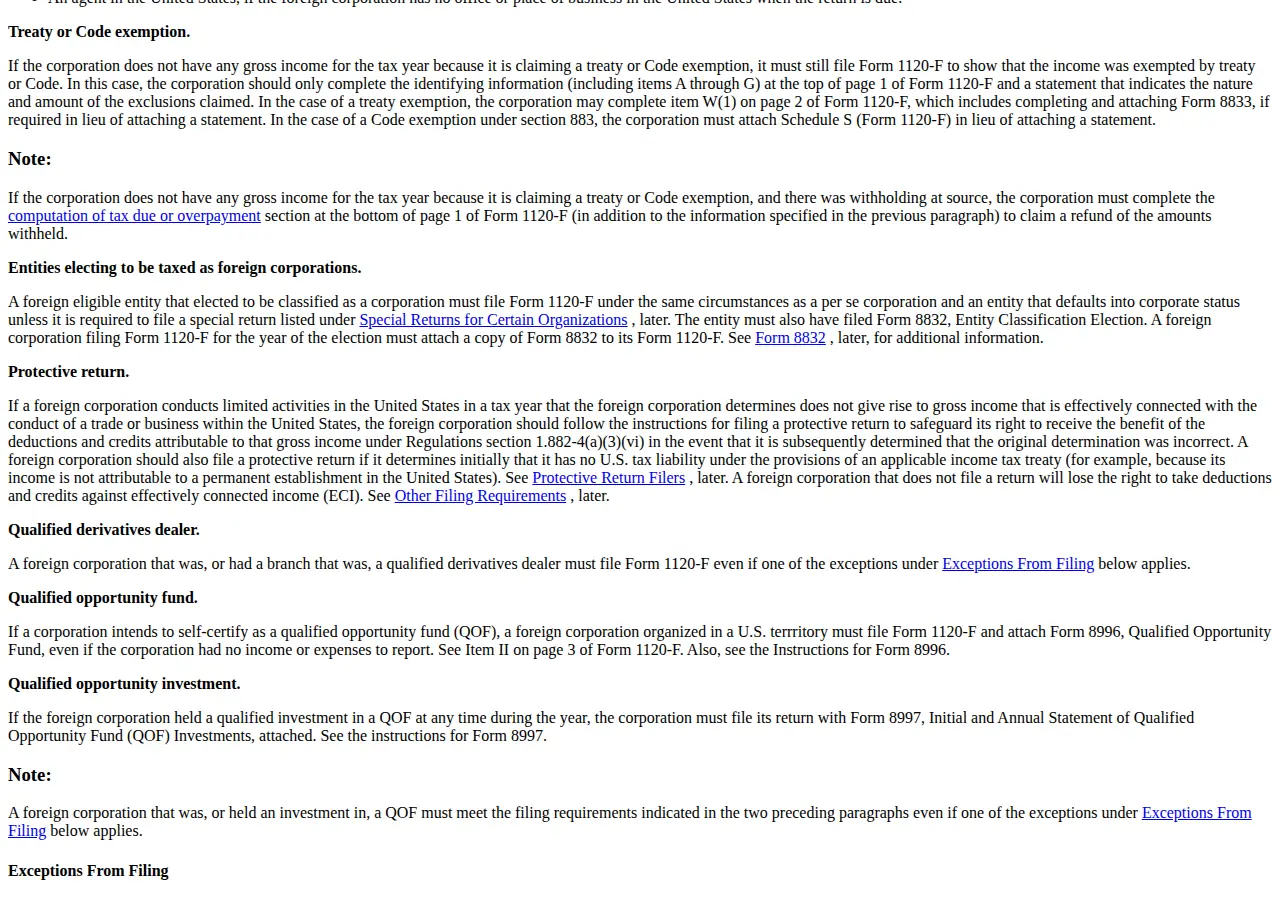
Filing one is a defined operation. Check the protective return box at the top of page 1, enter the name, address, and EIN, and provide the information required in items A through G. If the protective return is filed on a treaty exemption, attach a completed Form 8833. Complete page 2 items N, O, Q, T, V, W(1), W(2), X, Y, AA, and BB, and Section I on page 4.
Deadlines and the penalty stack
A corporation that maintains a US office must generally file by the 15th day of the 4th month after year-end — 15 April for a calendar-year corporation. A fiscal year ending 30 June files by the 15th day of the 3rd month. A corporation with no US office files by the 15th day of the 6th month — 15 June. File Form 7004 by the due date for an extension.
The penalty stack has three layers, and they compound. Section 6651(a)(1) adds 5 percent of the net tax for each month the return is late, up to 25 percent, unless the failure is due to reasonable cause — six months late on $126,000 of net tax is a $31,500 penalty, since five months at 5 percent reaches the cap. Section 6651(a)(2) adds 0.5 percent per month for late payment, also up to 25 percent. And Section 882(c)(2) can remove the deductions themselves, taxing gross income.
The third layer is information reporting. Section 6038A requires a 25-percent foreign-owned corporation to furnish information about its related parties and their transactions, and to maintain records sufficient to determine their correct treatment. The penalty is $25,000 for each taxable year of failure, plus $25,000 for each 30-day period the failure continues more than 90 days after the IRS mails notice of it. The Instructions for Form 1120-F list Form 5472 among the forms that may be required, and it carries the related-party reporting for the foreign corporation filer. Section 6038A(e) lets the IRS apply adverse rules to a transaction when the records are not produced, so a missing transfer-pricing file can decide the transaction's tax treatment.
File, protect, or incorporate: the decision table
| Choice | When it fits | Cost | Authority |
|---|---|---|---|
| File Form 1120-F as a branch | US trade or business, ECI present | 21% on ECI + treaty BPT rate | § 882; § 884(e) |
| File a protective return | Limited US activity, no ECI, treaty no-PE position | Preparation cost; preserves deductions | Reg. § 1.882-4(a)(3)(vi) |
| Incorporate a US subsidiary | Permanent presence, distributions planned | 21% + dividend withholding | § 11; § 881(a) |
| File nothing | No US activity or US-source income | Deductions forfeited; 5% a month to 25% | § 882(c)(2); § 6651(a)(1) |
Founder & CEO Insight — Enow A. Jovial
Who should not use the branch structure
A foreign corporation should not operate as a US branch when it plans regular distributions to the parent — the branch profits tax then applies every year, and a US subsidiary with a treaty dividend rate is usually cheaper. It should not use the branch when its US activity is a single project with a defined end, because the protective return and branch profits tax filings outlive the project by years. And it should not claim a treaty position without confirming qualified-resident status first.
Filing checklist
- [x] Step 1 — Filing duty: US trade or business, ECI present, US-source income not fully withheld, or qualified derivatives dealer. Any one triggers the return, even if a treaty exempts the income.
- [x] Step 2 — Classify income: FDAP income in Section I, effectively connected income in Section II.
- [x] Step 3 — Section 882 tax: ECI minus connected deductions, at 21 percent. Confirm the deduction and Schedule I interest allocations.
- [x] Step 4 — Branch profits tax: Effectively connected earnings and profits, adjusted for the change in US net equity, at 30 percent or the treaty rate. Confirm qualified-resident status.
- [x] Step 5 — Form 8833: Disclose any treaty-based position on the return or on Form 8833. An undisclosed position costs $10,000 under Section 6712 for a C corporation.
- [x] Step 6 — Protective return: Check the box, complete items A through G, attach Form 8833 if treaty-based. File it in the year of the activity.
- [x] Step 7 — Deadline: 15 April with a US office, 15 June without one, Form 7004 for an extension. Late filing costs 5 percent a month to 25 percent, and a missing return can cost the deductions.
- [x] Step 8 — Information loop: File Form 5472 for related-party transactions and maintain the Section 6038A records.
Run the combined 44.7 percent rate through the tax estimator before choosing between a branch and a subsidiary. And when the foreign corporation has US shareholders of its own, the Form 5471 playbook covers the reporting those shareholders owe on top of this return.