Cash Flow Statement Indirect Method: The Operator's Reconciliation Playbook
Net income tells you what a business earned under accrual accounting. The statement of cash flows tells you what it collected. The indirect method is the bridge between them: start with net income, add back the non-cash charges, strip out the non-operating gains, then adjust for every dollar parked in receivables, inventory, payables, and unearned revenue. What remains is operating cash flow, the number that decides whether a business can pay its people, service its debt, and fund its growth without borrowing.
A profitable company can still run out of cash. Revenue recognised before collection inflates profit while the bank balance falls. A warehouse full of unsold stock is profit already booked and cash already spent. The indirect method forces each movement into the open, so an operator can see whether earnings are converting into cash or merely accumulating on the balance sheet.
The authority is FASB ASC 230, Statement of Cash Flows, which requires the statement in a full set of financial statements. For SEC registrants the filing duty sits in Regulation S-X: the SEC Financial Reporting Manual requires a cash flow statement for the same periods as the statement of comprehensive income, per ASC 230-10-15-3, which for a Form 10-K means three years of audited cash flow statements. Interim statements follow S-X Articles 3 and 10.
> [!KEY TAKEAWAY]
> Net income answers whether the business was profitable. Operating cash flow answers whether it can pay its bills. When the two diverge for more than a quarter or two, the reconciliation lines, not the headline profit, explain why.
The three sections, and what belongs in each
ASC 230 sorts every cash receipt and payment into operating, investing, or financing. Operating covers the cash effects of the transactions that determine net income; investing covers buying and selling long-term assets and securities; financing covers borrowing, repaying debt, issuing stock, repurchasing stock, and paying dividends. Classification is not a matter of taste: it changes the ratios investors compute, and misclassification is one of the most common reasons cash flow statements get restated.
| Cash flow | Section | Authority |
| :--- | :--- | :--- |
| Cash collected from customers | Operating | ASC 230-10-45-16 |
| Interest and income taxes paid | Operating | ASC 230-10-45-17 |
| Purchase of property and equipment | Investing | ASC 230-10-45-13 |
| Proceeds from sale of equipment | Investing | ASC 230-10-45-12 |
| Repayment of debt principal | Financing | ASC 230-10-45-15 |
| Dividends paid and stock repurchased | Financing | ASC 230-10-45-15 |
The traps sit at the boundaries. Interest paid is operating under US GAAP, even though the borrowing that created it is financing, which surprises operators from IFRS, where interest paid may be financing. Principal repayments are financing; the interest portion is operating. Dividends received are operating; dividends paid are financing. A sale of equipment produces an investing inflow, while the gain or loss is removed from operating cash flow so it is not counted twice.
> [!WARNING]
> The statement of cash flows is a leading area of financial statement restatements, according to the SEC Chief Accountant's statement of 4 December 2023, and most of those restatements correct classification errors. Misclassifying a financing inflow as operating inflates the number lenders and investors watch most closely.
The indirect-method reconciliation, line by line
The indirect method starts where the income statement ends and works backwards to cash:
$
\text{Operating Cash Flow} = \text{Net Income} + \text{Non-Cash Charges} - \text{Non-Operating Gains} + \text{Non-Cash Losses} - \Delta\text{Operating Assets} + \Delta\text{Operating Liabilities}
$
Each adjustment has one job. Depreciation and amortisation are added back because they reduced net income without spending cash. Stock-based compensation is added back for the same reason. A gain on the sale of an investment is subtracted because its cash appears in investing, and leaving it in operating cash flow would double-count it. A loss on disposal is added back because the cash effect sits in investing.
Working capital follows a single rule that never changes. An increase in an operating asset is a use of cash and is subtracted. An increase in an operating liability is a source of cash and is added. Receivables rising means sales were booked faster than cash arrived, so subtract the increase; payables or unearned revenue rising means suppliers or customers funded the business, so add the increase.
Worked example: Meridian Supply Co.
Meridian Supply Co. is an illustrative distributor built for this guide, with round figures so every line reconciles. Revenue is 2,400,000 dollars; net income is 412,000 dollars.
| Reconciliation line | Amount in dollars | Sign rule |
| :--- | :--- | :--- |
| Net income | 412,000 | Starting point |
| Depreciation and amortisation | 96,000 | Add back |
| Stock-based compensation | 18,000 | Add back, non-cash |
| Deferred income taxes | 11,000 | Add back |
| Loss on disposal of equipment | 7,000 | Add back |
| Gain on sale of investments | (14,000) | Subtract |
| Accounts receivable increase | (58,000) | Asset up |
| Inventory increase | (31,000) | Asset up, cash out |
| Prepaid expenses increase | (6,000) | Asset up, cash out |
| Accounts payable increase | 44,000 | Liability up |
| Accrued liabilities increase | 19,000 | Liability up, cash in |
| Unearned revenue increase | 26,000 | Liability up, cash in |
| Income taxes payable decrease | (9,000) | Liability down |
| Net cash from operations | 515,000 | Reconciled total |
Verify it. Non-cash items: 412,000 plus 96,000 plus 18,000 plus 11,000 plus 7,000 minus 14,000 equals 530,000. Working capital: 530,000 minus 58,000 minus 31,000 minus 6,000 plus 44,000 plus 19,000 plus 26,000 minus 9,000 equals 515,000. That is a cash conversion ratio of 1.25 on net income of 412,000.
Investing used 159,000 dollars: capital expenditure of 142,000, proceeds of 21,000 from equipment sold, and purchases of investments of 38,000. Financing used 105,000 dollars: term loan proceeds of 60,000, loan repayments of 45,000, and owner distributions of 120,000. Net change in cash is 515,000 minus 159,000 minus 105,000, which equals 251,000. Opening cash of 188,000 plus 251,000 gives closing cash of 439,000, which must equal the balance sheet cash line.
$
\text{Free Cash Flow} = \text{Operating Cash Flow} - \text{Capital Expenditure}
$
For Meridian, free cash flow is 515,000 minus 142,000, which equals 373,000 dollars: a 15.5 percent margin on revenue, against an operating margin of 21.5 percent and a net income margin of 17.2 percent.
> [!FOUNDER]
> "I have watched founders celebrate a profitable year while their bank balance fell every month. Profit is a claim on the future. Operating cash flow is the present tense. If your reconciliation shows receivables and inventory eating more cash than your profit creates, you have a collection and stocking problem, and no amount of new revenue fixes it."
> — Enow A. Jovial, Founder & Chief Executive Officer
Proof from a real filing: Microsoft fiscal 2026
Microsoft Corporation, a C-Corp, filed its Form 10-K for the fiscal year ended 30 June 2026 on 29 July 2026, accession number 0001193125-26-323660 on EDGAR. Its cash flow statement uses the indirect method, as nearly every large issuer does. Figures below are from that filing, in millions of dollars.
| Microsoft fiscal 2026, in millions | 2026 | 2025 | 2024 |
| :--- | :--- | :--- | :--- |
| Net income | 133,749 | 101,832 | 88,136 |
| Depreciation, amortisation, and other | 38,534 | 29,433 | 20,958 |
| Stock-based compensation | 12,405 | 11,974 | 10,734 |
| Net cash from operations | 182,935 | 136,162 | 118,548 |
| Additions to property and equipment | (115,948) | (64,551) | (44,477) |
| Net cash used in investing | (139,500) | (72,599) | (96,970) |
| Common stock repurchased | (22,271) | (18,420) | (17,254) |
| Dividends paid | (26,445) | (24,082) | (21,771) |
| Net cash used in financing | (52,546) | (51,699) | (37,757) |
| Cash and cash equivalents, end of period | 20,935 | 30,242 | 18,315 |
Three facts jump out. Operating cash flow of 182,935 million against net income of 133,749 million is a cash conversion ratio of 1.37, driven by 38,534 million of depreciation and amortisation and 12,405 million of stock-based compensation. Capital expenditure nearly doubled in one year, from 64,551 million to 115,948 million. Free cash flow is therefore 182,935 minus 115,948, which equals 66,987 million, a 20.2 percent margin on revenue of 331,839 million, down from 71,611 million the year before even though operating cash flow rose by 46,773 million. The cash check ties: 30,242 plus 182,935 minus 52,546 minus 139,500 minus a 196 million exchange effect equals a net change of negative 9,307 million, and 30,242 minus 9,307 equals the reported closing balance of 20,935 million.
The direct-method alternative
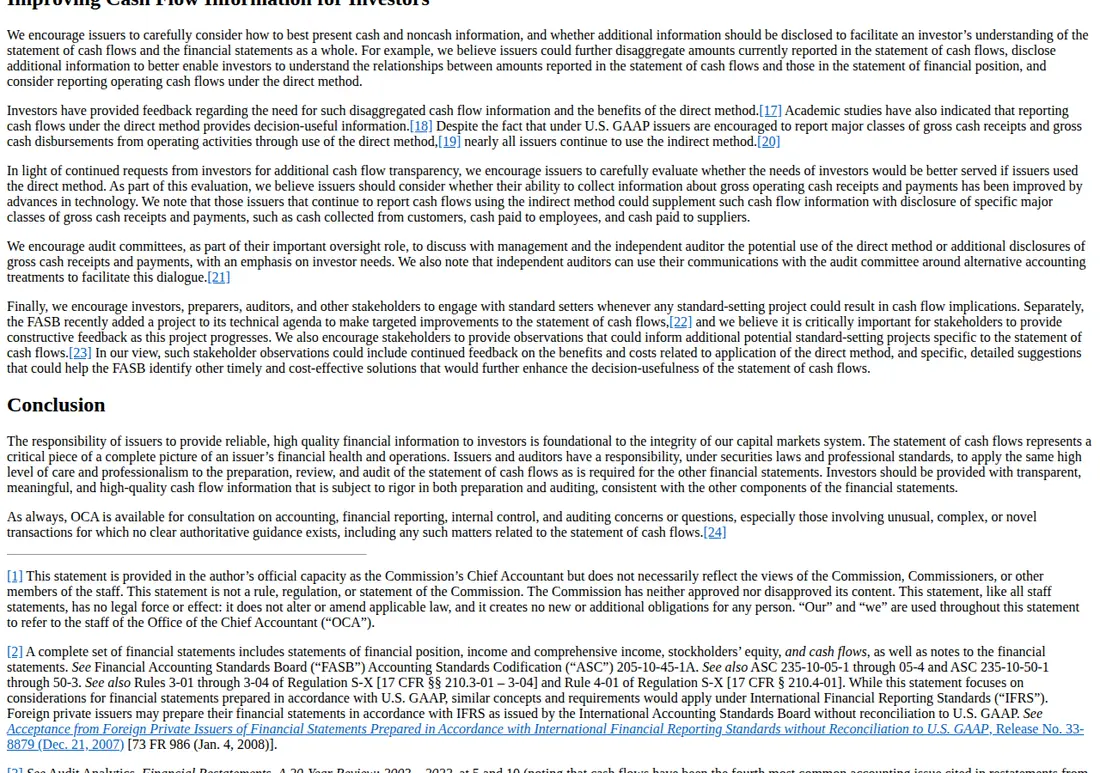
The direct method reports operating cash flow as gross receipts and gross payments: cash collected from customers, cash paid to suppliers and employees, interest paid, income taxes paid. It arrives at the same total as the indirect method. US GAAP encourages the direct method, and the SEC Chief Accountant's 2023 statement notes that investors have asked for the disaggregated information it provides. Nearly all issuers still use the indirect method, because their systems already produce accrual records.
Meridian's direct-method presentation of the same 515,000 dollars shows why investors prefer it. Cash collected from customers is revenue of 2,400,000 minus the 58,000 increase in receivables, which equals 2,342,000. Cash paid to suppliers and employees is 1,672,000, interest paid is 12,000, and income taxes paid are 143,000. Subtract the three payments from collections and the total is 515,000, the same total the indirect method produced.
The rule is to prepare the indirect method for the filing and keep a direct-method summary for the board. The indirect statement satisfies the auditor; the direct summary answers the question a non-accountant director actually asks: how much cash came in, and how much went out. An issuer on the indirect method can still disclose major classes of gross receipts and payments in the notes, which the SEC statement expressly suggests.
!SEC Chief Accountant statement urging issuers to consider the direct method
> [!TIP]
> Build the direct-method summary from the same ledger the indirect statement uses, not from a separate spreadsheet. Cash collected from customers equals revenue minus the change in receivables plus the change in unearned revenue. If that identity does not hold, the indirect statement built on top of it cannot be trusted either.
The 13-week cash flow forecast bridge
The annual statement looks backwards. Operators run the business forwards on a 13-week rolling forecast, one quarter at a time, updated every week: opening cash plus forecast receipts minus forecast disbursements equals closing cash, which must stay above the minimum cash floor. When the forecast breaches the floor, the operator acts in that week, not at quarter end.
Meridian opens week 1 with 439,000 dollars, the closing cash from its annual statement, and a minimum cash floor of 75,000 dollars.
| Week | Opening cash | Receipts | Disbursements | Closing cash | Headroom |
| :--- | :--- | :--- | :--- | :--- | :--- |
| 1 | 439,000 | 118,000 | 132,000 | 425,000 | 350,000 |
| 2 | 425,000 | 141,000 | 128,000 | 438,000 | 363,000 |
| 3 | 438,000 | 96,000 | 149,000 | 385,000 | 310,000 |
Week 3 is the stress week: receipts fall to 96,000 while disbursements rise to 149,000, and closing cash drops to 385,000. Headroom never comes close to the floor, so no action is needed, but the forecast has shown the dip three weeks before it happens. Receipts are forecast from the receivables ageing schedule, not from the sales pipeline: a sale is not a receipt until the customer pays.
Operator boundaries: who this is for, and who should avoid it
This playbook is built for founders and finance leads of operating businesses with real receivables, inventory, and payables, for controllers preparing their first audited cash flow statement, and for investors verifying earnings quality. It assumes accrual accounting.
A pre-revenue startup with no receivables and no inventory gains little from a full indirect reconciliation; a simple receipts-and-payments report serves it better. A cash business with no credit sales has no working capital adjustments to make. A fund whose cash flows are dominated by investment purchases should not force its statement into an operating narrative. A business reporting under IFRS must check the classification differences, notably interest and dividends, before applying the US GAAP rules here.
The monthly close checklist
Run this sequence at every month end.
1. Reconcile bank accounts to the general ledger; confirm closing cash agrees with the balance sheet.
2. Confirm net income agrees with the income statement, with no post-close journals unposted.
3. List every non-cash charge: depreciation, amortisation, stock-based compensation, provisions, deferred taxes.
4. Identify every non-operating gain and loss; confirm the related cash sits in investing or financing.
5. Compute the change in every operating asset and liability and apply the sign rule.
6. Confirm the operating total equals net income plus all adjustments.
7. Classify every investing and financing line against ASC 230.
8. Confirm net change plus opening cash equals closing cash, and closing cash equals the balance sheet.
9. Prepare the direct-method summary from the same ledger; confirm the same operating total.
10. Roll the 13-week forecast forward one week and confirm headroom above the minimum cash floor.
The most common failure is step 8. When the statement does not tie to the balance sheet, the error is almost always a misclassified item, an omitted non-cash transaction, or a foreign exchange effect in the wrong section. Do not force the total with a plug figure.
What usually goes wrong
The errors that restate cash flow statements are rarely exotic. A company classifies loan proceeds as operating because the loan funded operations. It reports equipment purchases as operating because the equipment is used in operations. It nets investment purchases and sales instead of showing gross flows. It omits the supplemental disclosure of non-cash investing and financing activities required by ASC 230-10-50-3. Each moves the operating cash flow number that investors and lenders rely on.
For the wider picture, read Cash Conversion Cycle: The DSO Reduction Playbook, Accounts Receivable Aging and Collections Playbook, and Automated Bank Reconciliation for a Multi-Currency Ledger. Deferred revenue gets its own treatment in Deferred Revenue on the SaaS Balance Sheet. Before budgeting the wider finance stack, run the Website Cost Estimator. Profit is earned when the work is done; cash arrives when the customer pays, the supplier is paid, the lender is serviced, and the asset is replaced. The indirect method lays out the distance between those two events in plain figures.