A company with $2,400,000 of annual credit sales and $480,000 in accounts receivable has a 73-day DSO — it waits two and a half months, on average, to be paid for work already delivered. Sorting that $480,000 into aging buckets, it finds $24,000 more than 90 days past due and a $30,000 allowance for credit losses its balance sheet has never carried. The difference is not effort. It is the aging schedule: five buckets, one reserve calculation, and a collections cadence that starts on day one, not day ninety.
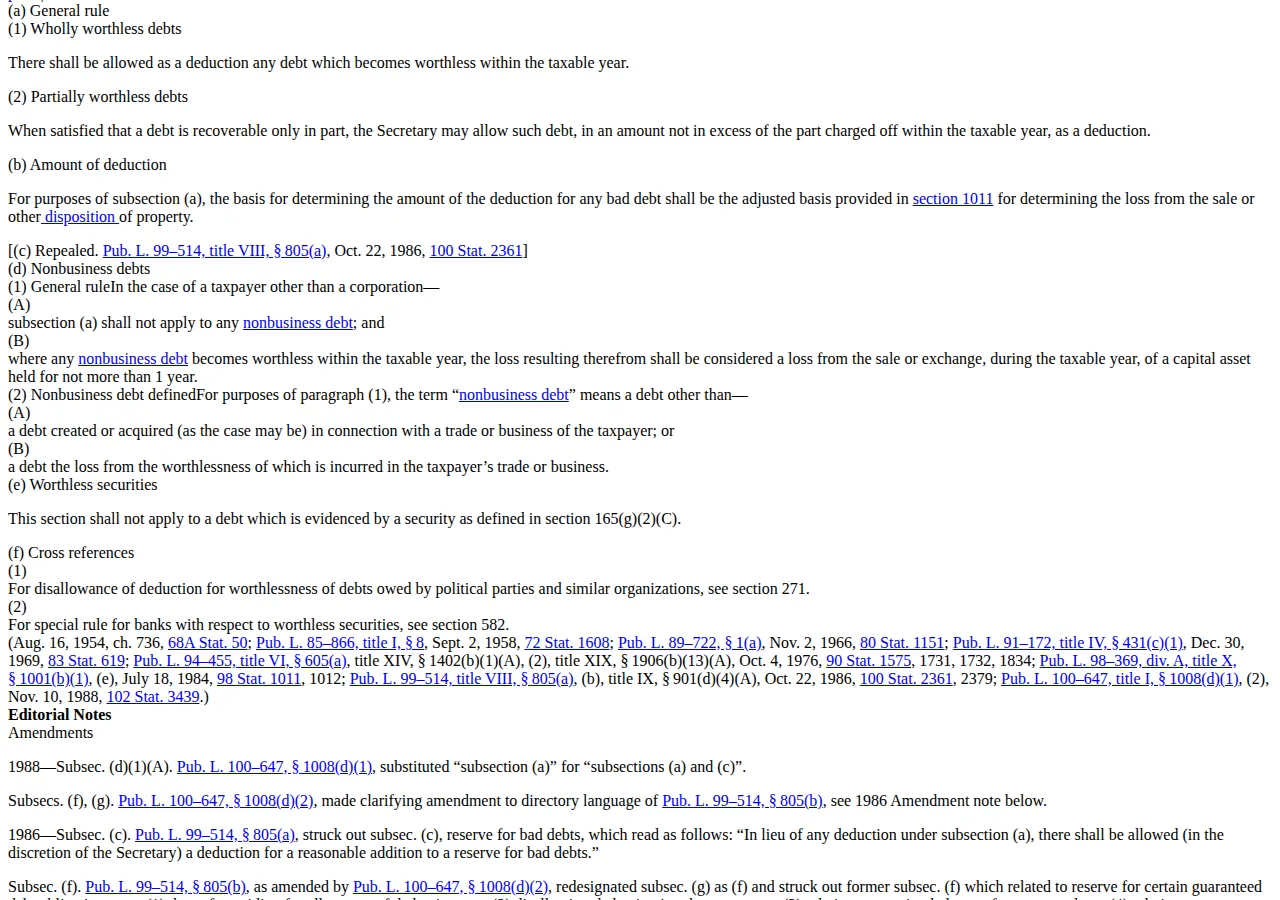
!Section 166 of the Internal Revenue Code, showing the wholly and partially worthless debt rules
What an accounts receivable aging schedule is, in one paragraph
An aging schedule sorts every unpaid customer balance by how long it has been outstanding: current, 1 to 30, 31 to 60, 61 to 90, and more than 90 days past due. Each invoice lands in exactly one bucket by its due date, not its invoice date, and the schedule is rebuilt monthly from the general ledger that produces the balance sheet. The schedule does three jobs at once: it prices the allowance for credit losses under ASC 326, it tells the collections team whom to call first, and it gives the chief financial officer one number — days sales outstanding — for how fast sales become cash.
> [!KEY TAKEAWAY]
> The aging schedule is the only report that turns a receivables balance into a decision. Without it, $480,000 is a single number nobody can act on. With it, the same $480,000 is five buckets with five actions, five reserve rates, and one clock that starts the day the invoice is due.
Why it matters
Receivables are the largest asset most B2B service businesses own, and the one most likely to be overstated. A dollar that will never be collected is not an asset; it is a loss not yet recognized. Three consequences follow. First, cash: every day of DSO is a day the company funds its customers instead of itself, and at an 8 percent line of credit the $480,000 balance costs $38,400 a year in interest alone. Second, covenants: lenders test the borrowing base on eligible receivables, and balances more than 90 days past due are routinely excluded, so a deteriorating schedule shrinks the credit line exactly when the company needs it.
The five buckets and the reserve they price
The standard layout has five buckets. The reserve rates below are the worked-example assumptions for the $2,400,000 company in this guide — labelled as assumptions, not a standard, because GAAP, through ASC 326, sets the method and leaves the rates to the company's own loss history.
| Bucket | Balance | Share of AR | Reserve rate | Allowance |
| :--- | :--- | :--- | :--- | :--- |
| Current | $240,000 | 50.0% | 1% | $2,400 |
| 1–30 days | $120,000 | 25.0% | 3% | $3,600 |
| 31–60 days | $60,000 | 12.5% | 8% | $4,800 |
| 61–90 days | $36,000 | 7.5% | 20% | $7,200 |
| 90+ days | $24,000 | 5.0% | 50% | $12,000 |
| Total | $480,000 | 100% | — | $30,000 |
The allowance is 6.25 percent of receivables, and the shape matters more than the total: half the reserve sits in the two oldest buckets, which hold only 12.5 percent of the balance. A 90-day bucket growing from 5 percent to 15 percent of receivables is a collections problem, not a sales problem.
$
\text{Allowance for Credit Losses} = \sum (\text{Bucket Balance} \times \text{Expected Loss Rate}) = \$30{,}000
$
> [!FOUNDER]
> "Every founder I meet can quote revenue to the dollar and the bank balance to the cent. Almost none can tell me their DSO — the number that decides whether the next payroll clears. Receivables are not revenue. Revenue is what you billed; cash is what you collected. The aging schedule measures the gap between the two." — Enow A. Jovial, Founder & Chief Executive Officer
DSO, average days delinquent, and the cash a faster close frees
DSO is the headline metric; average days delinquent is the diagnostic underneath it. DSO measures the whole receivables balance against sales; ADD subtracts the payment terms from DSO. A company on Net 30 with a 73-day DSO is 43 days delinquent on average — its customers pay 43 days after the contractual deadline.
$
\text{DSO} = \frac{\text{Accounts Receivable}}{\text{Annual Credit Sales}} \times 365 = \frac{\$480{,}000}{\$2{,}400{,}000} \times 365 = 73 \text{ days}
$
$
\text{Average Days Delinquent} = \text{DSO} - \text{Payment Terms} = 73 - 30 = 43 \text{ days}
$
The cash math is what makes the metric worth managing. Cutting DSO from 73 to 45 days shrinks receivables to the level 45 days of sales supports, and the difference is cash back in the bank.
$
\text{Target AR at 45-day DSO} = \$2{,}400{,}000 \times \frac{45}{365} = \$295{,}890
$
$
\text{Cash Freed} = \$480{,}000 - \$295{,}890 = \$184{,}110
$
At the same 8 percent line, the interest saving is $14,729 a year: $38,400 on the $480,000 balance against $23,671 on the $295,890 balance. Collecting the $24,000 in the 90-day bucket alone would cut DSO by 3.65 days, to 69.35. A collections program with a measurable target — 45-day DSO — pays for itself in interest saved before a single invoice is written off.
The CECL allowance under ASC 326
The allowance is governed by FASB Accounting Standards Codification Topic 326, the current expected credit losses model from Accounting Standards Update 2016-13. Three rules decide how the schedule is built. First, the allowance must reflect lifetime expected credit losses, not losses already incurred — a receivable is reserved from the day it is recorded, on past experience, current conditions, and reasonable forecasts. Second, the Board does not prescribe a method: an entity may use an aging schedule, and the FASB worked example builds the allowance from one exactly like the one above. Third, entities must disclose an aging analysis of past-due financial assets.
Topic 326 took effect for public business entities for fiscal years beginning after December 15, 2019, and the deferred timetable for private companies has since closed, so every GAAP filer reports under CECL in the 2026 tax year. The allowance is an estimate the company must defend to its CPA, not a plug: a reserve rate with no loss history behind it is a number the auditor will challenge, and a rate built from the company's own write-off history by bucket is a methodology.
The collections ladder: seven touches in ninety days
Collections fail when they start late. The ladder runs on the due date, not the age of the invoice, and each step has a named owner and a next step. A business that follows it collects most balances in the first three touches and never discovers a dead account at day 120.
1. Day 1 — Invoice with terms printed on it. Net 30, the due date, the late fee, and the payment link — or an ACH autopay mandate — on the invoice itself. An invoice without a due date is a donation request.
2. Day 7 — Automated reminder. A statement of the open balance and due date, by email and portal, with an ACH payment link. No phone call yet; the reminder separates the forgetful from the unwilling.
3. Day 15 — Personal follow-up. A call from the account manager, not the collections desk, asking whether the invoice was received and anything disputed. Disputes found here are fixed here.
4. Day 30 — Formal past-due notice. Written notice that the account is past due, with the balance, due date, and next step — to the customer and to the file.
5. Day 45 — Credit hold. No new work, shipments, or orders until the balance is current or a payment plan is signed. The hold is the most effective collections tool a business owns.
6. Day 60 — Demand letter. A written demand with a payment deadline, a late fee, and notice that the account will be referred for collection — sent by a named person, not a department.
7. Day 90 — Referral or write-off review. The account goes to a collections agency, to counsel, or to the write-off review under section 166. Nothing sits in the 90-day bucket without a decision.
> [!TIP]
> Put the credit hold at day 45, not day 90. A customer who still needs your product will pay to keep it; one who has moved on will not pay at any price. The hold makes the collections problem the customer's problem, while the balance is still small enough to collect in full.
Section 166: when a bad debt becomes a tax deduction
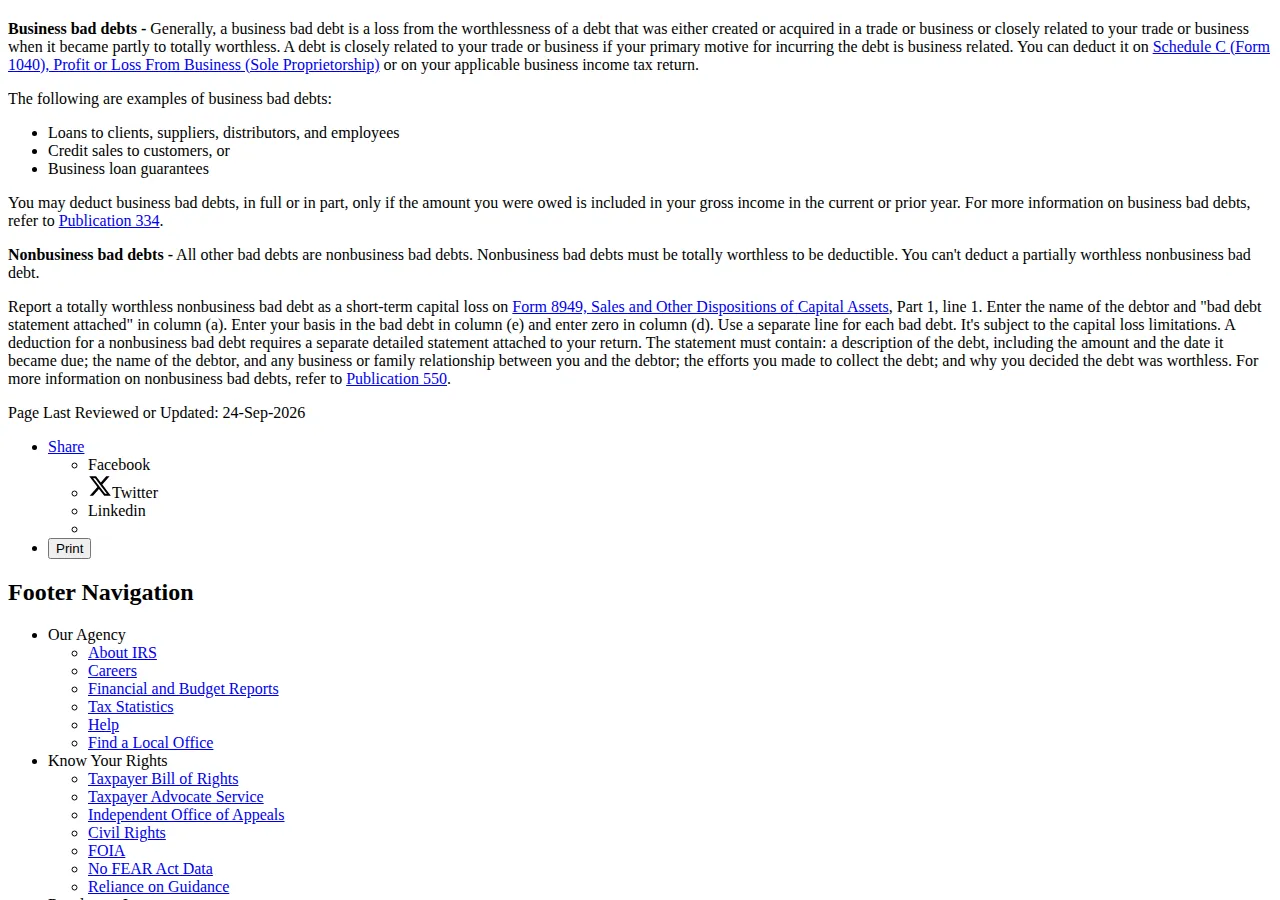
The tax side is governed by 26 U.S.C. section 166, as the IRS states it in Topic 453. A business bad debt — created or acquired in a trade or business, or closely related to it — is deductible when it becomes worthless, in full or in part. Every other debt is a nonbusiness bad debt: it must be totally worthless first, and it is reported as a short-term capital loss on Form 8949.
| Rule | Business bad debt | Nonbusiness bad debt |
| :--- | :--- | :--- |
| When deductible | When wholly or partially worthless, § 166(a) | Only when totally worthless, § 166(d) |
| How much | Up to the part charged off in the year, § 166(a)(2) | Full basis, as a short-term capital loss |
| Where reported | Schedule C, or the LLC or corporation return | Form 8949, Part 1, subject to capital-loss limits |
| Proof required | Reasonable collection steps; no court judgment required | Detailed statement of debt, debtor, efforts, why worthless |
Two traps decide most section 166 disputes. First, a cash-method taxpayer cannot deduct unpaid amounts never included in income: an unpaid invoice for services already performed was never in gross income for a cash-method business, so there is nothing to deduct. Second, a debt is worthless only when the facts show no reasonable expectation of repayment, and the taxpayer must show reasonable collection steps — the ladder above is the evidence. A loan to a relative or friend, made expecting it might not be repaid, is a gift, not a loan, and no deduction follows.
> [!WARNING]
> A partial write-off of a nonbusiness bad debt is worth $0. Section 166(d) allows it only when the debt is totally worthless, and the deduction is a short-term capital loss subject to the $3,000 annual limit against ordinary income. A founder who lends $40,000 to a friend's startup and recovers $10,000 has a $30,000 loss that produces at most $3,000 a year — ten years to use it, and only once the debt is entirely worthless.
The worked example shows the business side. The company charges off $12,000 — half the $24,000 in the 90-day bucket — after the demand letter and the credit hold produce nothing. Under section 166(a)(2) the deduction is the part charged off in the year, and at the 21 percent corporate rate the tax saving is $2,520. The remaining $12,000 stays in the allowance and the collections file until the agency reports or the account is closed.
!IRS Topic 453 on business and nonbusiness bad debts
Who should NOT run this playbook
This playbook is for businesses that sell on credit. A cash-only business with no receivables has no aging schedule to build, and a business whose customers all pay by card at the point of sale should spend its time on pricing, not collections. And a business with a single customer that owes everything should not build a ladder; it should renegotiate the contract, because one account is a concentration risk, not a collections queue.
Case study: the $2,400,000 company, one quarter later
The company starts the quarter with $480,000 of receivables, a 73-day DSO, and no allowance. It builds the schedule, sets the reserve at $30,000 from its own write-off history, and runs the ladder with the hold at day 45. Ninety days later it has collected $31,000 of the 61-to-90 bucket and $9,000 of the 90-day bucket, charged off $12,000, and ends with receivables of $428,000. DSO falls to 65 days; the re-estimated allowance is $13,300 — 3.1 percent of receivables, down from 6.25 percent.
Decision table: four ways to clear a stale balance
| Option | Cost | Speed | Control | Authority |
| :--- | :--- | :--- | :--- | :--- |
| In-house ladder | Staff time only | 90 days to decision | Full — terms, holds, relationships | ASC 326 allowance; § 166 charge-off |
| Collections agency | 20–35% contingency | 30–90 days after referral | Low — agency owns the contact | Agency contract; § 166 |
| Invoice factoring | 1–5% per 30 days | Cash in 1–2 days | None — factor owns the receivable | UCC Article 9; factoring agreement |
| Write-off under § 166 | Forgone balance; $2,520 saved per $12,000 | Immediate, once worthless | Full — but the balance is gone | 26 U.S.C. § 166(a); IRS Topic 453 |
The lesson is sequencing, not preference. The ladder runs first because it costs nothing and preserves the relationship. The agency runs second because a third party can say what the account manager cannot. Factoring is a financing decision, not a collections decision — it sells the receivable, it does not collect it. The write-off runs last, when the facts say the debt is worthless.
Execution checklist
The cash conversion cycle playbook runs the same DSO math across the full cycle, and the automated bank reconciliation playbook closes the loop on the cash side. Run the invoice generator to put the due date, the late fee, and the payment link on every invoice, because the collections ladder starts with an invoice that states its own terms.