Reconciliation does not fail on accuracy. It fails on volume.
A controller can reconcile 200 bank lines by hand in an afternoon and do it well. The same controller cannot reconcile 10,000 lines by hand in a month-end week, and the failure mode is not carelessness — it is arithmetic. Every unmatched line becomes an exception, every exception takes minutes, and minutes multiply past the close calendar. The ledger does not become wrong all at once. It becomes late, then estimated, then restated.
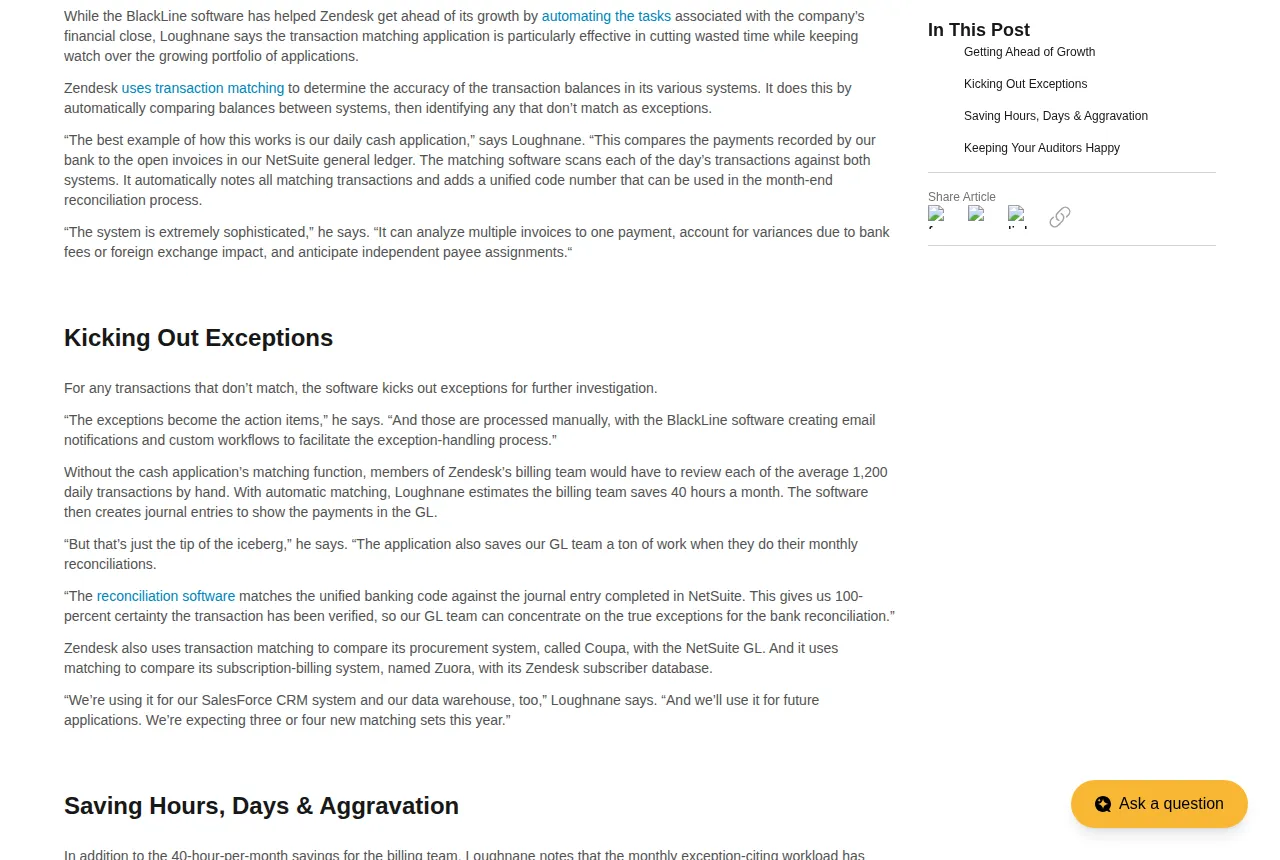
The vendor evidence for that claim is unusually concrete. BlackLine documents a Zendesk deployment in which transaction matching compares bank payments against open invoices in the NetSuite general ledger, automatically noting matching transactions and assigning a unified code for the month-end process. Without the matching function, the billing team would have reviewed an average of 1,200 daily transactions by hand; with it, the customer estimates the billing team saves 40 hours a month. The same account describes the exception philosophy that makes the system work: transactions that do not match are kicked out as exceptions, and, in the customer words, the exceptions become the action items, processed through notifications and custom workflows. That sentence is the whole playbook in miniature — automate the match, humanize only the exception.
> [!KEY TAKEAWAY]
> The goal of reconciliation automation is not to eliminate accountants. It is to invert their workload: from reviewing every line to reviewing only the lines that fail to match, under aging rules that force a decision. A ledger that auto-matches 95 percent of lines and ages the other 5 percent aggressively will close faster than a ledger that auto-matches 99 percent and lets exceptions sit.
Who this playbook is for, and who should stop here
This playbook is for controllers, founders, and CPAs running a ledger with more than one bank account, more than one currency, or more than one entity — and for any team whose month-end close regularly slips past the tenth business day because reconciliation is still open. It assumes the ledger already exists in QuickBooks Online, Xero, NetSuite, or a comparable system, and that bank feeds or statement imports are available. It is a workflow and measurement playbook, not a software review.
Do not use this playbook as a substitute for professional judgment if any of these apply: you are restating prior-period financials (remeasurement corrections to closed periods follow their own error-correction rules); you operate in a hyperinflationary economy, where ASC 830 applies a different functional-currency conclusion entirely; or your bank balances include client trust funds, where reconciliation is a regulatory duty with its own segregation rules. Those cases need a CPA before the workflow changes, because an automated match applied to the wrong population is worse than a slow manual one.
The match-rate math that sets the budget
Match rate is the single number that predicts whether the close will land. Define it strictly: transactions cleared by the engine with no human touch, divided by total bank transactions in the period. A transaction a human later confirms does not count, because the human time is the cost being measured.
$
\text{Auto-Match Rate} = \frac{\text{Transactions Cleared Without Human Touch}}{\text{Total Bank Transactions}} \times 100
$
$
\text{Exception Hours} = \text{Total Transactions} \times (1 - \text{Auto-Match Rate}) \times \text{Minutes per Exception} \div 60
$
Worked example A: the five-point swing
A SaaS company with 10,000 monthly bank transactions, at six minutes of investigation per exception:
| Auto-match rate | Exceptions | Exception hours per month |
| :--- | :--- | :--- |
| 85 percent | 1,500 | 150 hours |
| 92 percent | 800 | 80 hours |
| 97 percent | 300 | 30 hours |
Moving from 92 percent to 97 percent — five points of match quality — removes 500 exceptions and 50 hours a month. That is the business case for matching-rule work, stated without any vendor claim: it is the reader's own transaction count, multiplied by the reader's own exception time. Before buying software, measure both inputs for one month. A team that does not know its minutes-per-exception cannot evaluate any vendor match-rate promise, because the vendor quotes a rate and the team pays in hours.
The matching rules that move the rate are unglamorous and cumulative: exact-amount plus date-window matching first, then amount-plus-payee matching, then one-to-many matching for a single bank settlement covering several invoices, then FX-tolerant matching that allows a defined variance for bank fees and exchange impact. BlackLine customer account describes exactly this progression — the engine analyzes multiple invoices against one payment and accounts for variances from bank fees or foreign exchange impact. A rule set that only matches exact amounts on exact dates will plateau near 85 percent in any business with card settlements, payout batches, or FX. The plateau is a rule problem, and adding staff to a rule problem only buys hours at the plateau.
The exception queue: three buckets, three owners
An exception queue without aging rules grows until it is unusable, because the easy exceptions clear first and the hard ones compound. Our editorial analysis recommends three buckets with named owners and a decision deadline, not a priority flag nobody enforces:
| Bucket | Age | Owner | Required action |
| :--- | :--- | :--- | :--- |
| Fresh | Under 7 days | Staff accountant | Investigate, match, or request the missing document |
| Stale | 8 to 30 days | Controller | Decide: accrue, reverse, or escalate with a written reason |
| Critical | Over 30 days | CFO | Write off, accrue, or open a fraud and error review |
The critical bucket reverses the usual intuition: an exception older than 30 days is rarely a matching puzzle anymore. It is an unrecorded transaction, a duplicate recorded once by feed and once by hand, a timing item that will never clear, or a control failure such as an unauthorized payment. Each needs a journal, not a match, and the queue grows every month teams ask a matching engine to solve an accounting problem.
Two hygiene rules protect the queue from refilling. First, never post into a closed period to clear an exception — Airwallex describes two-way accounting sync that respects closed periods, and that discipline is the point: a correction to a locked month belongs in the current period with disclosure, not as a silent edit to history. Second, never delete an unmatched bank line. An unmatched line is evidence of a missing ledger entry; deleting it destroys the only record that the money moved.
The multi-currency sequence: remeasure, then translate, never the reverse
Multi-currency reconciliation adds a second matching problem on top of the first: the same balance exists in two currencies at two rates, and the ledger must state which rate produced which number. U.S. GAAP answers that question in FASB ASC 830, Foreign Currency Matters, and the sequence matters more than any single rate.
Step 1: determine the functional currency. ASC 830-10-45-2 defines the functional currency as the currency of the primary economic environment in which the entity operates. That conclusion drives everything after it, and it is not elective — an entity does not choose a convenient functional currency, it evidences one from where it generates and spends cash.
Step 2: remeasure foreign-currency transactions into the functional currency. Under ASC 830-20, monetary items — cash, receivables, payables, debt — are remeasured at the closing rate at each balance sheet date, with the resulting gain or loss in net income. Nonmonetary items carried at historical cost stay at historical rates. The remeasurement process is intended to produce the same result as if the books had been kept in the functional currency all along.
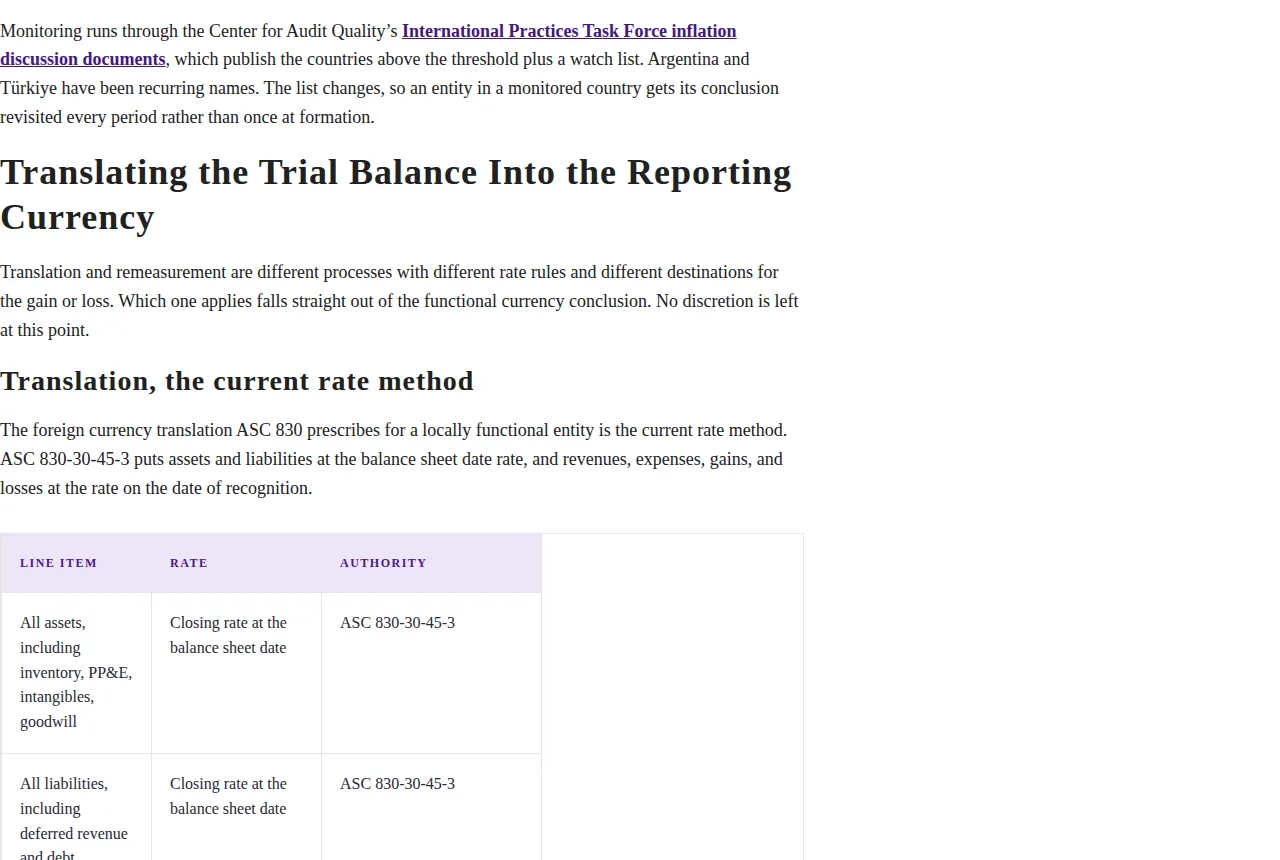
Step 3: translate foreign-entity statements into the reporting currency. Under ASC 830-30-45-3, the current rate method applies: assets and liabilities translate at the balance sheet date rate, and revenues, expenses, gains, and losses at the rate on the date of recognition (a weighted average is generally acceptable in practice). The resulting translation adjustment goes to other comprehensive income, not net income — the opposite destination from a remeasurement gain or loss.
Worked example B: the EUR payable that moves twice
A USD-functional company records a EUR 100,000 supplier payable when the rate is 1.10, then closes the quarter at 1.08, then settles at 1.12:
$
\text{Booking: } €100{,}000 \times 1.10 = \$110{,}000
$
$
\text{Quarter-End Remeasurement: } €100{,}000 \times 1.08 = \$108{,}000 \; \Rightarrow \; \$2{,}000 \text{ gain in net income}
$
$
\text{Settlement: } €100{,}000 \times 1.12 = \$112{,}000 \; \Rightarrow \; \$4{,}000 \text{ loss in net income}
$
The payable is reconciled in EUR first — is the EUR 100,000 still owed, in full, to the right vendor? — and only then remeasured in USD. Teams that reconcile the USD balance without reconciling the EUR balance will chase FX noise forever, because a USD difference can come from a rate move, a partial payment, or a missing invoice, and only the EUR ledger distinguishes them. The reconciliation rule is therefore: match in the transaction currency, remeasure in the functional currency, translate in the reporting currency, in that order, every close.
> [!WARNING]
> Never net a remeasurement gain against a translation adjustment, and never bury an FX difference in a suspense account past the close. Remeasurement gains and losses belong in net income; translation adjustments belong in other comprehensive income. Netting them hides volatility the reader of the financials is entitled to see, and a suspense balance carried past the close converts a measurement question into a control deficiency an auditor will find.
Decision table: rule-based, AI-assisted, or manual
| Approach | Best for | Auto-match ceiling in practice | Authority |
| :--- | :--- | :--- | :--- |
| Manual spreadsheet reconciliation | Under 500 monthly lines, single currency | Not applicable — every line is human-touched | Editorial analysis: exception hours exceed close capacity above this volume |
| Ledger-native bank rules (QuickBooks Online, Xero) | 500 to 2,000 monthly lines, one or two currencies | 85 to 92 percent with disciplined rules | Ledger bank-rule documentation; exception-hour math above |
| Dedicated matching platform (BlackLine, FloQast, Trintech class) | High volume, multi-entity, multi-currency, audit-trail requirements | 90 percent or higher on properly configured accounts | BlackLine customer account: 1,200 daily transactions, 40 hours a month saved |
| AI-assisted matching with human approval | Complex one-to-many settlements, FX variance, unstructured remittances | Above the rule-based ceiling, but only where approval is enforced | Airwallex: AI extraction and matching at point of spend, with two-way sync respecting closed periods |
Match the approach to the transaction count and the exception hours, not to the vendor category: a dedicated platform bought for 800 monthly lines is an expensive way to clear 60 exceptions, and a ledger-native rule set applied to 20,000 monthly lines is a slow way to miss the close.
Implementation checklist
Cross-border notes: FX feeds, cutoffs, and the close calendar
Three cross-border details routinely break an otherwise sound routine. First, bank feeds arrive on the bank calendar, not the ledger calendar — a Friday EUR settlement posting Monday still belongs to the prior week for matching, so the date-window rule must be wide enough to catch it. Second, cutoff discipline matters more than speed: a run on the second business day with complete feeds beats a run on the first with a missing account, because the missing account becomes the entire exception queue. Third, daily reconciliation beats month-end reconciliation by more than the calendar suggests: a daily routine catches a duplicate feed entry the day it posts, when the correction is one journal, while a month-end routine catches thirty at once, when the correction is a project.
> [!FOUNDER]
> "Every controller I have watched miss a close missed it the same way: the exceptions were nobody's job. The match rate was fine, the software was fine, and a hundred unmatched lines sat in a queue with no owner and no deadline. Automate the match, name the owner of every exception, and put a date on the decision. The ledger closes when the exceptions have owners, not when the software is purchased."
> — Enow A. Jovial, Founder & Chief Executive Officer
> [!TIP]
> Start the FX reconciliation with the bank statement in the transaction currency, not the ledger report in USD. Print or export the EUR statement, tick the EUR balance to the EUR subledger, and only then look at the USD remeasurement. Teams that start from the USD report spend the close arguing about rates; teams that start from the EUR statement spend it clearing transactions.
Related reading on this site: the cash versus accrual accounting guide for scaling businesses for the basis decision that sits under every reconciliation, the SaaS chart of accounts guide for the account structure the matches post into, and the B2B cross-border treasury guide for netting and FX-drag math at scale. To convert a foreign-currency balance at the closing rate before remeasuring, use the Multi-Currency Exchange Rate Converter. The reconciliations in this guide feed the month-end close checklist, which sequences the full close into five business days.