A SaaS company collects $120,000 on January 1 for a 12-month contract. The bank balance jumps $120,000 the same day. The revenue line does not. Under ASC 606 the company has sold a promise, not a product delivered — and the $120,000 sits on the balance sheet as a liability called deferred revenue until the service is actually delivered, $10,000 a month. Founders who read the bank balance as revenue overstate their business by exactly the deferred balance, and the correction usually arrives in the worst possible quarter: the one where churn spikes and the refunds come due.
What deferred revenue is, in one paragraph
Deferred revenue — also called unearned revenue — is cash collected before the performance obligation is satisfied. It is a contract liability under ASC 606, not income. The five-step model in ASC 606-10-25 decides when it becomes income: identify the contract, identify the performance obligations, determine the transaction price, allocate the price to the obligations, and recognize revenue as each obligation is satisfied. Until step five happens, the money is owed back to the customer in service or in refund, and the balance sheet says so.
> [!KEY TAKEAWAY]
> Deferred revenue is a liability, not a windfall. Every dollar in the deferred balance is a delivery obligation with a deadline — and the only honest way to read a SaaS balance sheet is cash in the bank minus deferred revenue still owed in service.
Why it matters
Deferred revenue is the single largest line on many SaaS balance sheets, and it distorts every metric a founder watches. Monthly recurring revenue looks stable while the deferred balance quietly decides whether the company can survive a churn wave. A $480,000 deferred balance against $60,000 of monthly burn is eight months of runway the company has already been paid for — provided the customers do not cancel and demand refunds. A company that treats the whole balance as available cash has already spent money it owes in service.
The second distortion is valuation. Buyers and lenders discount deferred revenue because it is not free cash flow: an acquirer pays for the revenue stream, not the cash already collected, and due diligence reconciles the deferred balance against the remaining performance obligations line by line. A $1,000,000 deferred balance with $400,000 of obligations already satisfied in service is worth $600,000 of future revenue, not $1,000,000 of cash.
> [!FOUNDER]
> "The first time I watched a founder celebrate a $120,000 annual prepayment as a $120,000 month, I knew the next board meeting would be a reckoning. The cash is real. The revenue is a schedule. Confuse the two and you will hire against money you owe in service." — Enow A. Jovial, Founder & Chief Executive Officer
The recognition schedule: $120,000 over 12 months
The arithmetic is mechanical, which is why there is no excuse for getting it wrong. A $120,000 annual contract, paid in full on January 1, with service delivered evenly over 12 months, recognizes $10,000 per month:
$
\text{Monthly revenue} = \frac{\$120,000}{12} = \$10,000
$
$
\text{Deferred revenue after } n \text{ months} = \$120,000 - (n \times \$10,000)
$
After three months the deferred balance is $90,000. After six months it is $60,000. On December 31 it is $0, and the full $120,000 has moved from liability to revenue. The cash never moves again — it arrived on January 1. Only the classification moves, month by month, and the monthly close exists to record exactly that movement.
The deferred-revenue waterfall
The monthly close runs on a waterfall. Opening deferred revenue, plus new billings, minus revenue recognized, equals closing deferred revenue. A worked example with round numbers, derived from the schedule above:
| Waterfall line | Amount |
| :--- | :--- |
| Opening deferred revenue (January 1) | $480,000 |
| New annual billings during the month | $150,000 |
| Revenue recognized during the month | $135,000 |
| Closing deferred revenue | $495,000 |
| Authority | ASC 606-10-25, contract-liability presentation |
The check is $480,000 + $150,000 − $135,000 = $495,000. If the close produces any other number, one of the three inputs is wrong — usually new billings recorded as revenue instead of deferred, or recognized revenue computed on cash collected instead of service delivered. The waterfall is the first control a CFO runs, and it takes five minutes.
A second, sharper version of the same math is the MRR waterfall. Opening MRR of $45,000, plus $6,000 of new MRR, plus $2,000 of expansion, minus $3,000 of contraction, minus $4,000 of churn, equals closing MRR of $46,000. The deferred balance is the stock; the MRR waterfall is the flow. Both must reconcile to the same contracts, and a gap between them is a billing-system defect, not a rounding error.
The tax side: IRC § 451(c) and the one-year election
Book revenue and tax revenue follow different clocks, and the gap is where founders get surprised. Under IRC § 451(c), an accrual-method taxpayer that receives an advance payment must include it in gross income in the year of receipt — unless it elects the one-year deferral. The election lets the taxpayer include the portion required under § 451(b) in the year of receipt and the remaining portion in the following taxable year. The election is made by category of advance payments, applies to the first year and every later year, and can be revoked only with the Secretary's consent.
The trap is the word "following." A 24-month prepayment of $240,000 received in 2026, with the election in place, is taxable in full in 2027 — even though GAAP recognizes only $120,000 of it in 2027 and the other $120,000 in 2028. The statute defers one year, not the whole contract. The book-tax gap in 2027 is $120,000 of taxable income with no matching book revenue, and the cash to pay that tax arrived in 2026 — a year earlier. Founders who spend the prepayment in 2026 and discover the 2027 tax bill are paying tax on money they no longer hold.
The statute also carves out what cannot be deferred at all. Rent, insurance premiums, payments on financial instruments, warranty contracts where a third party is the primary obligor, and payments subject to §§ 871(a), 881, 1441, or 1442 are excluded from the definition of advance payment. A SaaS subscription for services is inside the definition. A bundled hardware lease with a service contract may not be, and the allocation between the two decides how much can be deferred.
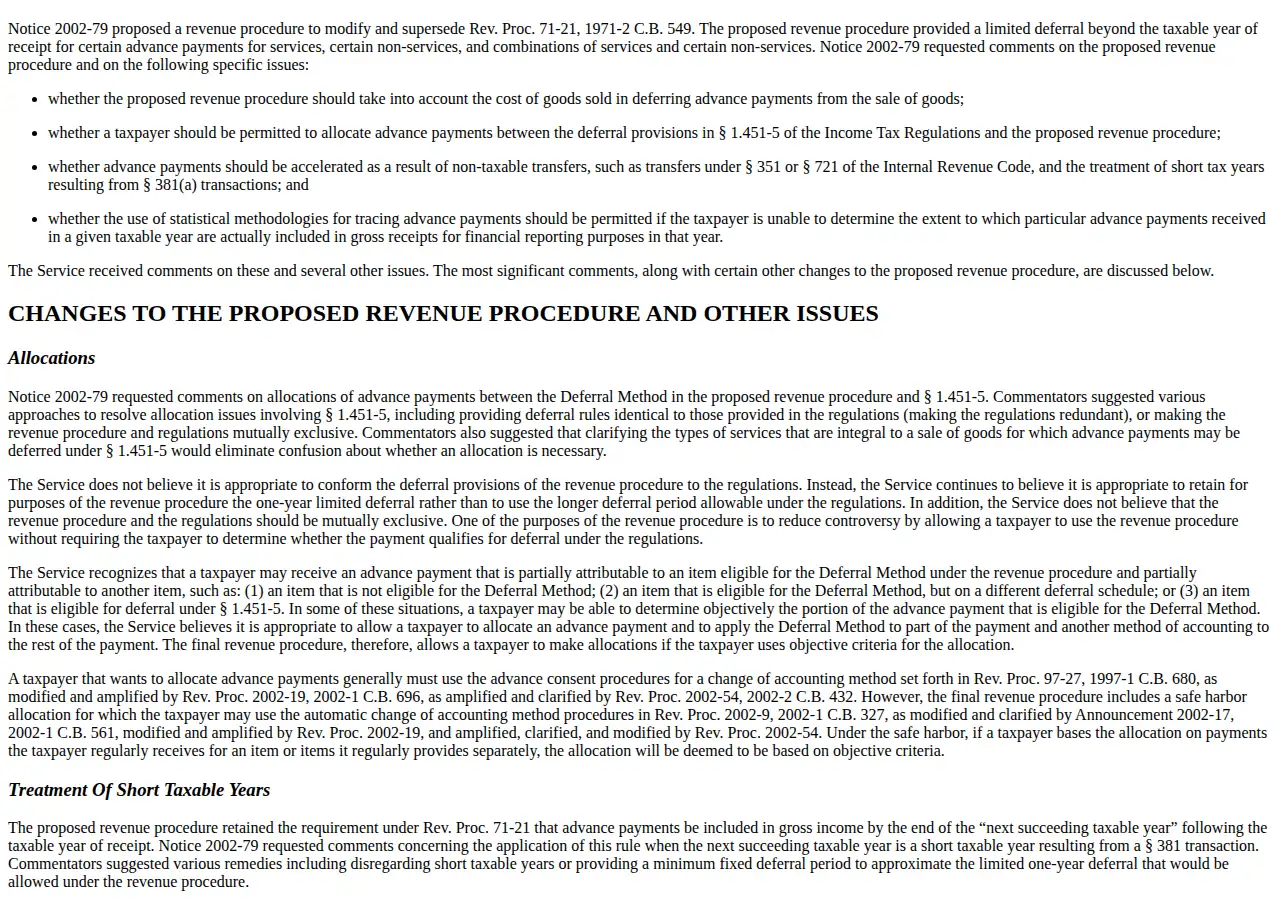
The one-year limit is not new law. Rev. Proc. 2004-34, the predecessor procedure, already allowed only a limited deferral to the next succeeding taxable year, and the IRS announcement finalizing it says so explicitly: the Service "continues to believe it is appropriate to retain for purposes of the revenue procedure the one-year limited deferral rather than to use the longer deferral period allowable under the regulations." Section 451(c) later codified the same one-year shape into the statute.
> [!WARNING]
> The § 451(c) election defers tax by one year, not by the contract term. A 24-month prepayment is fully taxable in the year after receipt. If the cash is spent in the receipt year, the following year's tax bill arrives with no matching cash — plan the reserve before signing annual contracts, not after.
Churn and refunds: when the liability comes back
Deferred revenue turns back into cash out the door when a customer cancels. A customer on a $12,000 annual contract cancels after four months. The company has recognized $4,000 and holds $8,000 in deferred revenue. Whether that $8,000 is refunded depends on the contract: a pro-rata refund clause returns it, a no-refund clause keeps it — and keeping it converts the $8,000 from deferred revenue to recognized revenue on cancellation, because the performance obligation is extinguished.
$
\text{Refund due} = \$12,000 - (4 \times \$1,000) = \$8,000
$
$
\text{Revenue on cancellation (no-refund clause)} = \$4,000 + \$8,000 = \$12,000
$
The churn math compounds. A company with $100,000 of monthly recurring revenue and 5% monthly logo churn loses $5,000 of MRR a month, or $60,000 of annual contract value. But the deferred balance falls faster than MRR when annual contracts churn, because each cancelled annual contract releases up to eleven months of deferred revenue at once. A 5% churn month on an annual-heavy book can cut the deferred balance by 15% or more, and the cash refund that follows is the same money the company counted as runway.
Annual vs monthly billing: the decision table
Annual billing accelerates cash and grows the deferred balance; monthly billing keeps the balance small and the churn visible. The choice is a trade-off between cash now and flexibility later.
| Attribute | Annual billing | Monthly billing | Authority |
| :--- | :--- | :--- | :--- |
| Cash collected | Full year upfront | One month at a time | ASC 606-10-25 |
| Deferred revenue created | 11 months at signing | Near zero | ASC 606 contract liability |
| Churn visibility | Hidden until renewal | Visible every month | MRR waterfall |
| Refund exposure | Up to 11 months per cancellation | One month | Contract terms |
| Discount typically offered | 10–20% (two months free) | None | Market practice |
| Tax treatment | § 451(c) one-year deferral | Taxed as received | 26 U.S.C. § 451(c) |
The break-even on the discount is straightforward. Monthly billing at $100 a month is $1,200 a year. Annual billing at $1,000 is a $200 discount — 16.7% — in exchange for $1,000 of cash eleven months early. If the company's cost of capital is below 16.7% a year, the discount costs more than the cash is worth. If the company is burning cash and cannot raise, the $1,000 today is worth the $200. The discount is a financing decision wearing a pricing label, and it should be approved like one.
The burn-multiple test
Deferred revenue feeds directly into the burn multiple — net burn divided by net new ARR. A company burning $180,000 a quarter and adding $240,000 of net new ARR runs a burn multiple of 0.75:
$
\text{Burn multiple} = \frac{\$180,000}{\$240,000} = 0.75
$
Below 1.0 is efficient; above 2.0 is a warning. The trap is counting gross new ARR while ignoring the deferred balance. A company that adds $240,000 of ARR by selling 24-month contracts at a 20% discount has added $192,000 of collectible value and $240,000 of delivery obligation. The honest burn multiple uses the discounted, collectible ARR — and the deferred balance is where the discount shows up first.
Who should NOT push annual prepayments
Annual billing is wrong for three kinds of company. First, a company whose product is not yet stable: every cancellation is a refund of up to eleven months, and the refund queue becomes a second churn metric. Second, a company with no tax reserve: the § 451(c) bill in the following year needs cash set aside in the receipt year. Third, a company selling to customers who may not survive the year: a bankrupt customer is a creditor, and the deferred balance is a claim the trustee will pursue. Monthly billing costs cash flow and buys honesty. For a pre-product-market-fit company, honesty is the cheaper trade.
> [!TIP]
> Run the waterfall before the board deck, not after. If opening deferred plus billings minus recognized revenue does not equal the closing balance, stop and find the error — a billing system that cannot reconcile its own waterfall cannot be trusted on any number downstream of it.
The monthly close in five steps
1. Pull the billing report. Export every invoice issued in the month, every payment collected, and every credit note issued, from the billing system — Stripe, Chargebee, or the ledger itself.
2. Build the waterfall. Opening deferred revenue plus new billings minus revenue recognized must equal closing deferred revenue. A gap means a billing record is misclassified.
3. Recognize by performance obligation. Multi-product contracts split the price across obligations — the software license, the onboarding, the support tier — and each recognizes on its own schedule. A single monthly figure for a bundled contract is a guess, not a close.
4. Book the tax reserve. Apply the § 451(c) election to the year's advance payments and set aside the following year's tax on the deferred portion. The reserve is a balance-sheet entry, not a hope.
5. Reconcile MRR to deferred revenue. The MRR waterfall and the deferred-revenue waterfall must point at the same contracts. A gap is a billing defect; fix the system, not the spreadsheet.
Execution checklist
Deferred revenue is the most honest number on a SaaS balance sheet because it cannot be spun: it is cash already received for work not yet done. A founder who manages it — who reconciles the waterfall monthly, reserves the tax, and prices the annual discount as financing — turns the liability into the company's cheapest source of capital. A founder who ignores it discovers the liability in the quarter the refunds arrive. The ASC 606 revenue recognition guide covers the five-step model this playbook applies, the cash conversion cycle playbook prices the working-capital side of collecting early, and the chart of accounts automation guide shows how to post the deferred-revenue entries without a manual journal every month. Run the numbers through the tax estimator before signing the next annual contract — the § 451(c) bill in the following year is part of the price.