Workers' Compensation Insurance: The Small Business Playbook
A roofer falls from a ladder on a Tuesday. By Friday the employer has three problems: a medical bill, a wage-replacement claim, and a letter from the state asking for proof of coverage. If the policy was bought, classified, and audited correctly, all three are the carrier's problem. If it was not, all three are the owner's.
Workers' comp pays medical care and part of the lost wages of an employee hurt on the job; in exchange the employee generally cannot sue the employer for the same injury. California states the bargain in one sentence: the right to recover compensation is, except as specifically provided, "the sole and exclusive remedy of the employee or his or her dependents against the employer" (Cal. Lab. Code § 3602(a)).
Who has to carry it
Coverage is mandatory in nearly every state. California Labor Code § 3700 orders that "[e]very employer except the state shall secure the payment of compensation" — by insuring with an authorized carrier, by obtaining a certificate of consent to self-insure, or, for public entities, by self-insuring. New York's Workers' Compensation Law § 50 uses the same structure: an employer "shall secure compensation" in the state fund, with an authorized insurer, or by proving financial ability and depositing securities.
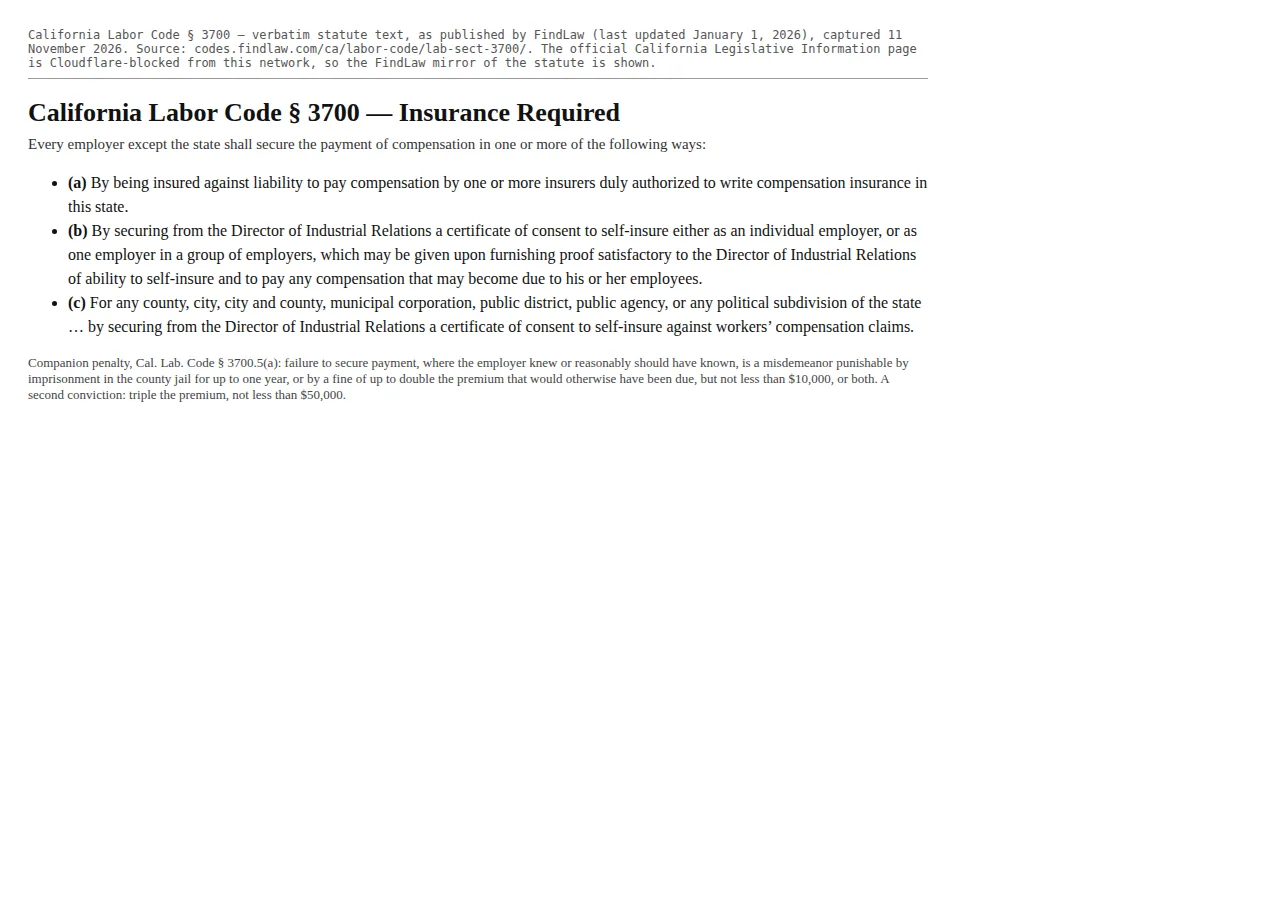
The penalties are criminal, not administrative. California Labor Code § 3700.5(a) makes a knowing failure to secure payment a misdemeanor: up to one year in county jail, or a fine of up to double the premium that would otherwise have been due, but not less than $10,000, or both; a second conviction runs to triple the premium, not less than $50,000. New York Workers' Compensation Law § 52 grades by headcount: five or fewer employees uninsured in twelve months is a misdemeanor fined $1,000 to $5,000; more than five is a class E felony fined $5,000 to $50,000.
Texas is the one exception. The Texas Department of Insurance, Division of Workers' Compensation, states: "In Texas, private employers can choose to carry workers' compensation insurance coverage, but it is not required in most cases." An employer that opts out — a nonsubscriber — keeps the right to be sued; the state notes coverage "limits liability if an employee sues your business for damages."
Whether an owner counts as an employee turns on entity form: a sole proprietor, partner, LLC member, and S-Corp or C-Corp officer are treated differently from state to state.
Class codes: the rate is the job, not the title
Premium is priced by what employees actually do, not by their job titles. The National Council on Compensation Insurance (NCCI) maintains the classification system used in most states, assigning each kind of work a four-digit class code with its own rate per $100 of payroll. California runs its own system through the Workers' Compensation Insurance Rating Bureau (WCIRB) and North Carolina through the North Carolina Rate Bureau (NCRB); other states run independent bureaus.
The most-used code is 8810, Clerical Office Employees NOC — a standard exception, which applies across industries instead of being folded into the company's governing classification. The NCRB's Basic Manual, Rule 1, assigns 8810 only when duties are limited to correspondence, computer programs, records, and files; telephone duties; data entry; and similar office work — and only when the work takes place in an area physically separated from the operating hazards. A related code, 8871, covers clerical telecommuters.
Misclassification is the most expensive clerical error in the policy. A receptionist coded to the governing class instead of 8810 is overcharged every payroll period; a field supervisor coded to 8810 is undercharged until the premium audit re-rates the payroll and bills the difference. The fix: written job descriptions, a site walk, and a classification review at every renewal.
The premium math: payroll divided by 100, times the rate
Manual premium is the simplest formula in commercial insurance:
Payroll is auditable payroll by class code; the rate is the filed rate for that code in that state, per $100 of payroll. Worked example — a twelve-person contractor with $600,000 of payroll in its governing class and $240,000 of clerical payroll, at assumed rates of $2.50 and $0.15 per $100:
Splitting the office payroll out of a $2.50 governing rate into a $0.15 clerical rate saves $5,640 a year on that $240,000 of payroll — and misclassifying it the other way costs exactly the same amount. The rates above are assumptions, not quotes; a Texas clerical rate recently ran $0.07 to $0.26 per $100 of payroll.
The experience mod: three years of losses, one multiplier
The experience modification factor — the mod — multiplies the manual premium. A mod of 0.85 on a $15,360 manual premium is $13,056; a mod of 1.25 is $19,200 — a $6,144 swing a year. On a $100,000 manual premium the same swing is $40,000:
NCCI's Experience Rating Plan compares an employer's actual losses against the losses expected for an employer of the same size, in the same class codes, in the same state, over the latest available three years. Better than average earns a credit below 1.00; worse earns a debit above it.
The formula splits every claim into a primary part and an excess part: frequency predicts future losses better than severity. In NCCI's worked example the split point is $18,500 and the state per-claim accident limitation is $200,000: a $500,000 loss is capped at $200,000, of which $18,500 counts as primary and $181,500 as excess; a $5,000 loss is entirely primary. Primary losses enter at full weight; excess losses enter multiplied by the weighting value W, small for a small employer and rising with size.
NCCI's worked numbers: payroll of $3,125,350 at an expected loss rate of 1.413 gives expected losses of $44,161; a D-ratio of 0.41 gives expected primary losses of $18,106 on the annual basis, and the worksheet's three-year expected excess is $115,498. With a weighting value of 0.16 and a ballast of $45,900, the stabilizing value is $142,918, and adjusted actual losses of $243,120 over adjusted expected losses of $242,971 produce a mod of 1.00, applied January 1, 2026.
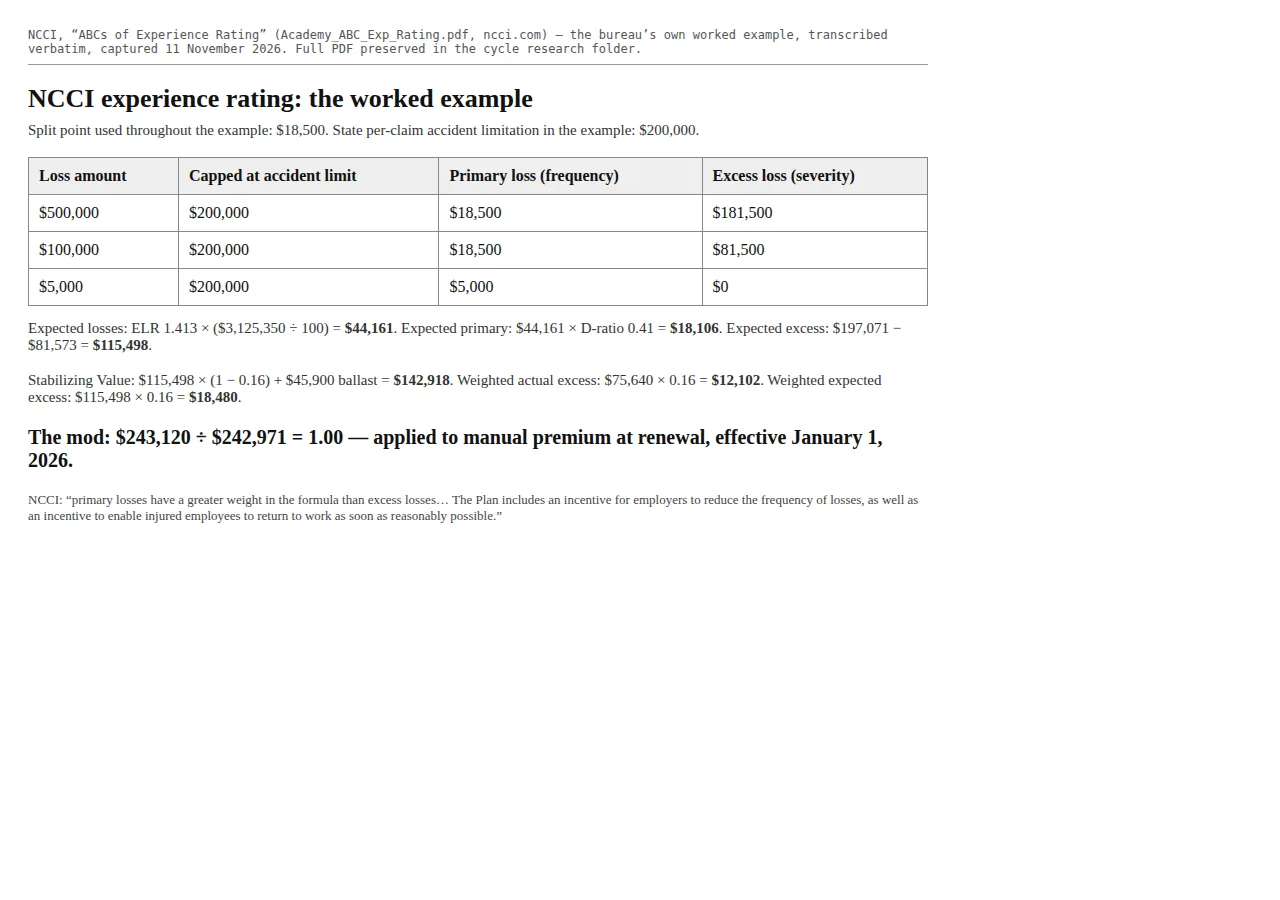
The frequency lesson falls out of the same arithmetic. With a weighting value of 0.16, one $100,000 claim contributes $18,500 of primary plus 0.16 × $81,500 of excess — $31,540 — to the mod numerator. Ten separate $5,000 claims contribute $50,000, because every dollar of a sub-split-point claim is primary and counts at full weight. That is why NCCI says the plan "includes an incentive for employers to reduce the frequency of losses, as well as an incentive to enable injured employees to return to work as soon as reasonably possible."
Founder & CEO Insight — Enow A. Jovial
>
The four monopolistic states
Four states run workers' comp as a state monopoly: North Dakota, Ohio, Washington, and Wyoming. The employer must buy statutory coverage from the state's own fund; no private insurer may write that coverage, and sending even one worker across the line means opening an account with that fund before the first payroll. Washington's Department of Labor & Industries states it flatly: "Washington State does not allow private workers' compensation coverage. You must purchase your coverage from L&I or be a certified self-insured employer." Ohio's Bureau of Workers' Compensation (BWC) is the exclusive source for Ohio employers.
The structural gap is employers' liability: a standard policy has two parts, Part 1 paying statutory benefits and Part 2 defending the employer when sued, but state-fund policies provide Part 1 only. Employers fill the hole with a stop-gap endorsement on their general liability policy — see our general liability vs professional liability vs cyber insurance playbook.
The premium audit
The premium on a policy is an estimate, priced on the payroll the employer expects to pay. At the end of the policy year the carrier checks the actual numbers — the premium audit. Nearly every policy is audited, and the result is no change, a refund, or a bill for additional premium. The audit reconciles payroll volume, classification, and subcontractor coverage, working from payroll records, quarterly Form 941 filings, W-2 and W-3 totals, and subcontractor certificates of insurance.
Add a misclassification the auditor finds — $100,000 of payroll coded to clerical 8810 at the assumed $0.15 rate that should have been coded to the governing class at $2.50:
Two rules bite hardest. In most audits only the straight-time portion of overtime wages counts toward auditable payroll, so overtime at time-and-a-half reported at full value is one of the commonest overpayments, and it is correctable. Ignoring the audit request is the worst option: the carrier may bill on its own estimate, and in states that use NCCI's audit noncompliance rule it can add a charge of up to two times the estimated annual premium. The dispute window is typically 60 to 90 days. Keep the audit file — payroll registers, 941s, W-2s, job descriptions, subcontractor certificates — and reconcile audited payroll to the 941s.
Return to work, and the OSHA clock beside it
The cheapest claim never becomes a lost-time claim. A return-to-work program — a written list of light-duty tasks, a doctor's restrictions honored on day one, a supervisor who calls within 24 hours — cuts the indemnity portion of a claim — the part the mod weights most heavily. Take a worker earning $900 a week: eight weeks away is $7,200 of wage loss; two weeks away plus six weeks of light duty is $1,800.
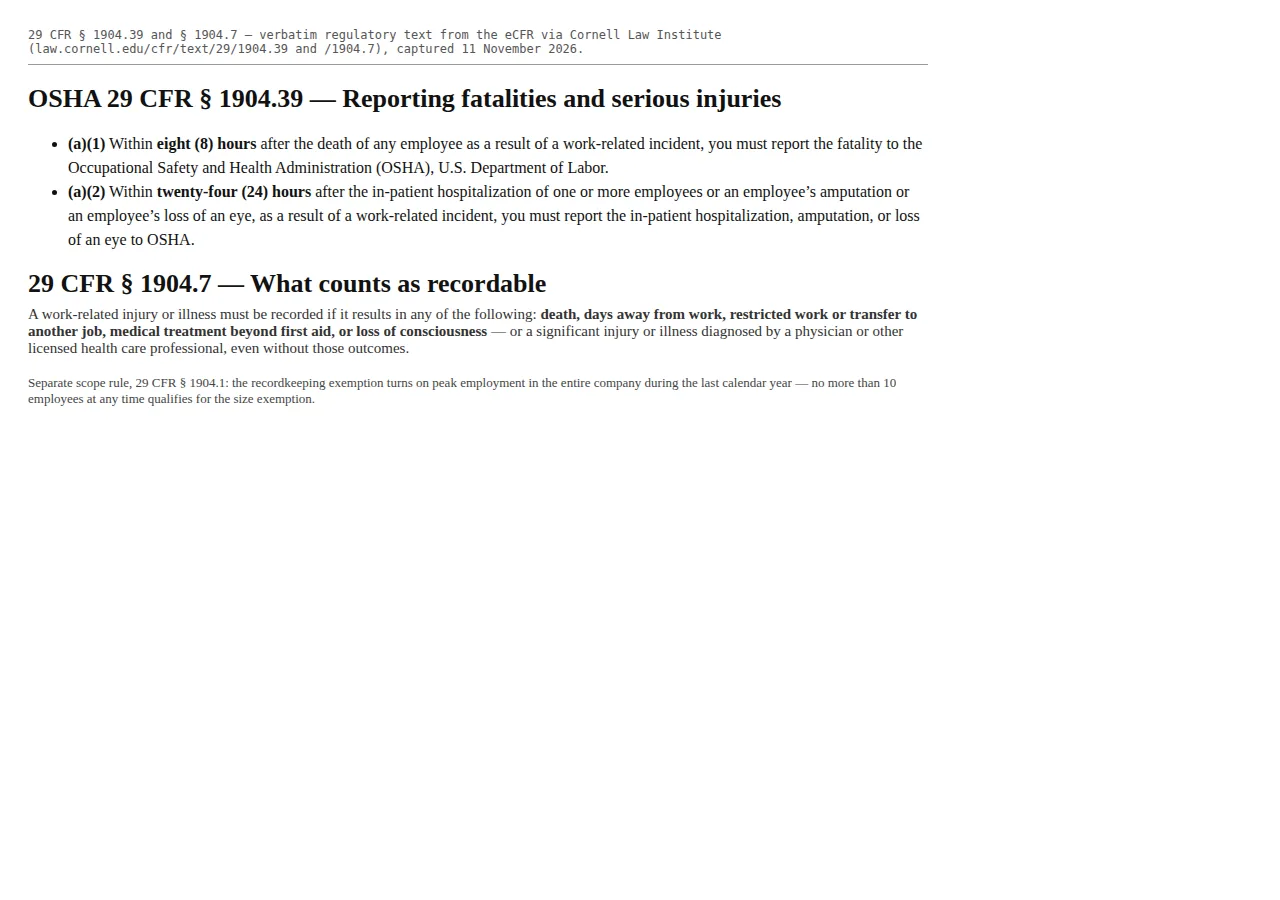
The regulatory clock is shorter than most owners expect. Under 29 CFR § 1904.39, a fatality must be reported to OSHA within eight hours, and an in-patient hospitalization, amputation, or loss of an eye within twenty-four hours. Under 29 CFR § 1904.7, a case is recordable on the OSHA 300 Log when it results in death, days away from work, restricted work or transfer, medical treatment beyond first aid, or loss of consciousness — or a significant injury diagnosed by a physician. The size exemption in § 1904.1 turns on peak employment in the entire company during the last calendar year: no more than 10 employees at any time qualifies.
Who this is for — and who should stop here
This playbook is for a small employer with W-2 employees in the United States, buying or renewing a workers' comp policy. It is not for a Texas nonsubscriber weighing whether to opt out, nor for a self-insurance application, which is a financial-strength filing with collateral and actuarial review. It is not legal advice.
The decision table
| Your situation | Buy | Why | Authority |
|---|---|---|---|
| Field crew plus office staff | Private carrier, split 8810 clerical payroll | Clerical rate is a fraction of the governing rate | NCRB Basic Manual Rule 1 |
| Prior claims pushing the mod above 1.10 | Private carrier plus safety and return-to-work program | Frequency is what the mod punishes | NCCI ABCs of Experience Rating |
| Employees in ND, OH, WA, or WY | State fund account, plus stop-gap endorsement on the GL | No private market; the fund policy has no Part 2 | Wash. L&I; Ohio Rev. Code ch. 4123 |
| No employees, contractors only | No policy — but collect every subcontractor's certificate | Uninsured subcontractors are picked up as employees at audit | NCCI Basic Manual |
The execution checklist
- Confirm coverage is in force before the first employee's first shift, in every state where work is performed — open a state-fund account first in North Dakota, Ohio, Washington, or Wyoming.
- List every role with its actual duties and work site; assign the class code from the duties, not the title; split 8810 clerical payroll only where the work is office-only and separated from operating hazards.
- Get the experience rating worksheet at renewal and check payroll, expected losses, the D-ratio, and every claim value against your own records.
- Put the return-to-work program in writing: the light-duty task list, the doctor's-restrictions process, and the 24-hour supervisor call.
- Post the OSHA clock: 8 hours for a fatality, 24 hours for a hospitalization, amputation, or loss of an eye; record the case on the 300 Log when it meets § 1904.7.
- Reconcile payroll monthly — payroll register to Form 941 to W-2 totals, by class code — and keep subcontractor certificates in the same file.
- At audit, report overtime at straight time only, dispute a misclassification within the 60-to-90-day window, and never ignore the audit request.
- Price the mod, not just the premium: run the ROI calculator on the $40,000 swing a 0.85-to-1.25 mod creates on a $100,000 manual premium.
- Coordinate the rest of the stack — the business interruption insurance playbook, the payroll cost comparison, and the IRS Form 941 playbook — and keep the EIN, the 941s, and the worksheet in one place.