Every month your bank sends your company an invoice for banking itself. It is called the account analysis statement, and most finance teams never open it. The PDF arrives, someone files it, and the fees keep compounding — $2,400 a month here, $4,100 there, year after year, priced by a schedule nobody on your side has read since the account was opened. The statement is not a bank statement. A bank statement shows your balance. An analysis statement shows every service the bank performed for you, the volume of each, the unit price it charged, and the earnings credit your deposit balances generated to offset the bill.
The machinery behind it is standardized. The Association for Financial Professionals (AFP) maintains a six-digit code for every cash management service — 010000 for account maintenance, 250102 for a one-day ACH item, 350100 for a domestic wire out — and more than 2,500 such codes exist in the United States. In the United States the statement travels electronically as an ANSI X12 EDI 822 file; internationally the same billing rides ISO 20022 camt.086. The codes are the join key: the same service under two different bank names carries the same AFP code, so a treasurer can line the two prices up side by side.
The anatomy of an analysis statement
An analysis statement has three sections. The balance section reports the ledger balance, the collected balance after float, and the average collected balance for the period — the number the earnings credit is computed on. The service-charge section lists every service used, with its volume, its unit price, and its total, each line tagged with the bank's own service code and, where the bank maps it, the AFP code. The settlement section reconciles the total service charge against the earnings credit allowance and shows the net amount actually debited.
The AFP code families are the map of the service-charge section — the first two digits name the family, the rest name the service and its variant:
| AFP family | Codes start | What lives there | Authority |
|---|---|---|---|
| Balance and compensation | 00 | 000230 Recoupment monthly | AFP Service Codes |
| General account services | 01 | 010000 Account maintenance; 010100 Debits posted | AFP Service Codes |
| Lockbox services | 05 | 050000 Wholesale lockbox monthly base | AFP Service Codes |
| General ACH services | 25 | 250000 ACH monthly base; 250102 ACH one-day item | AFP Service Codes |
| Wire and other funds transfer | 35 | 350100 Wire out, domestic; 350300 Wire in, domestic | AFP Service Codes |
| Information services | 40 | 400000 Previous-day reporting monthly base | AFP Service Codes |
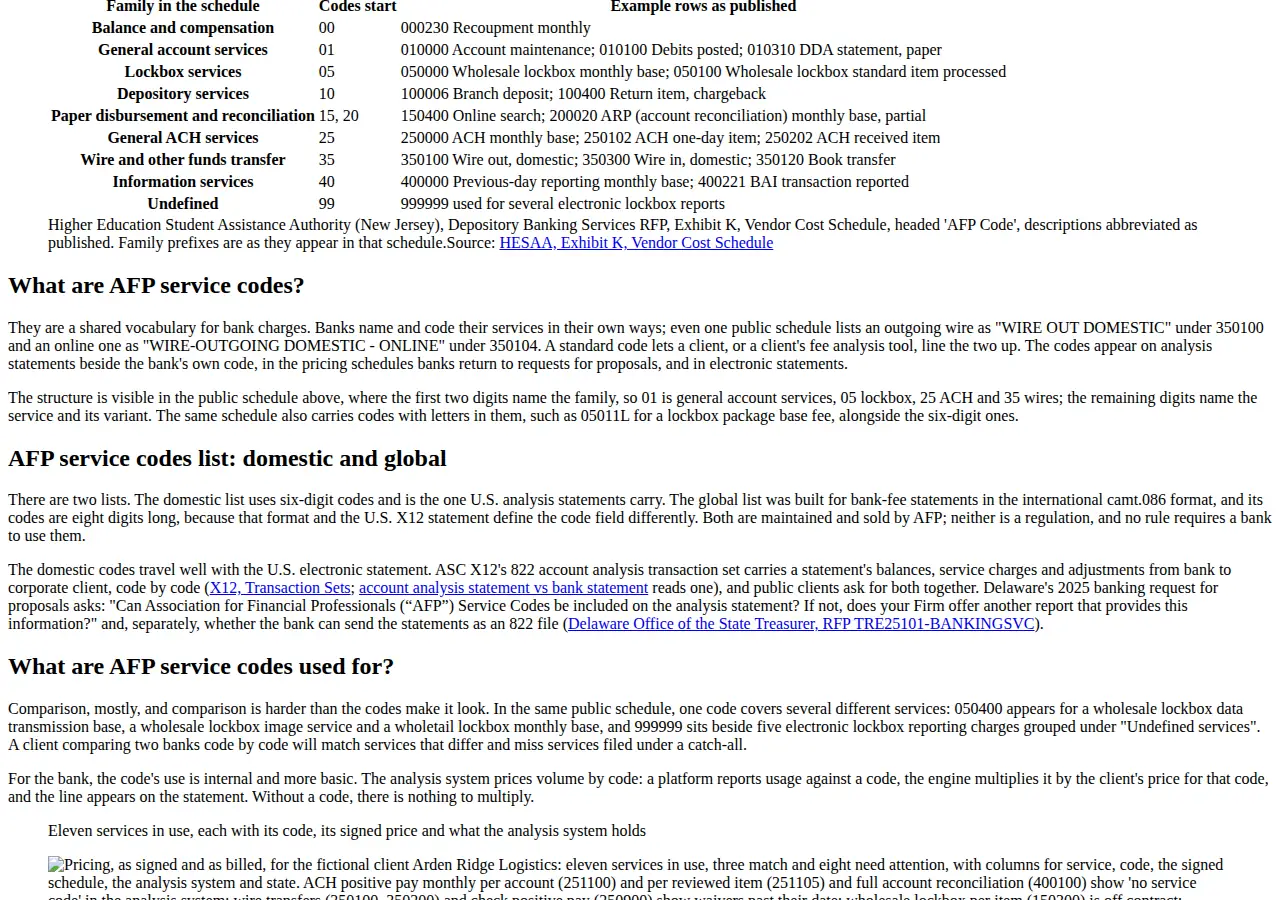
The codes are a dictionary, not a regulation. AFP publishes and sells the list; no rule requires a bank to use them, and one code can cover several services. A line carrying code 999999 — the "undefined" family — means the bank could not classify the charge, and it goes to the top of your review list.
The earnings credit rate, worked
The earnings credit rate (ECR) is the soft-dollar rate your bank applies to your average collected balance to produce an earnings credit allowance that offsets eligible service charges. It is not interest. You cannot withdraw it, it does not compound, and in most arrangements it offsets only that period's eligible fees — a balance that generates more credit than the month's fees wastes the excess. The formula is:
Since March 26, 2020 the Federal Reserve has set reserve requirement ratios to zero for all depository institutions, so the reserve factor in that formula is 1 today — the whole balance counts. Banks differ on day count: some use 365, some use 360, and a 360-day denominator pays about 1.4% more credit on the same balance.
Work it. A company holds a $2,000,000 average collected balance, its bank quotes a 2.00% ECR, and the period is 30 days:
Its itemized fees for the month come to $2,400: account maintenance on three accounts at $50 each ($150), 2,400 ACH items at $0.25 ($600), 40 wires out at $15 ($600), 25 wires in at $10 ($250), positive pay at $150, an ACH debit filter at $75, 800 lockbox items at $0.50 ($400), and previous-day reporting at $175. The $3,287.67 credit covers the $2,400 of fees in full, the net debit is $0, and $887.67 of credit evaporates — it cannot be banked for next month, and it cannot be spent on payroll.
That waste is the decision. The balance required to exactly offset a given fee at a given ECR is:
For $2,400 of fees at a 2.00% ECR over 30 days, the break-even balance is $2,400 × 365 / (0.02 × 30) = $1,460,000. This company holds $2,000,000, which is $540,000 above break-even. That $540,000 earns nothing where it sits: at the same 2.00% rate it would earn $887.67 a month as hard-dollar interest in a sweep, which is exactly the credit being wasted. Sweep the excess above the break-even balance into an interest-bearing vehicle every night, and leave the break-even balance in the analyzed account to pay the fees in soft dollars. Run the same arithmetic through the break-even calculator whenever the ECR or the fee schedule changes, because a 25-basis-point ECR move shifts the break-even balance on $2,400 of monthly fees by more than $160,000.
Balance compensation vs fee-based pricing
Every commercial account is priced one of two ways, and the choice is worth making deliberately rather than inheriting. Under balance compensation, you hold a balance and the bank pays your fees with the earnings credit it generates. Under fee-based pricing, you hold a minimal balance and pay the fees in cash each month. Neither is cheaper in the abstract; the answer depends on what your cash earns elsewhere.
| Approach | How fees are paid | When it wins | Authority |
|---|---|---|---|
| Balance compensation | ECR on the average collected balance offsets fees | ECR is close to your alternative yield and fees are stable | AFP Treasury in Practice Guide: Better Bank Fee Analysis |
| Fee-based pricing | Cash debit each month; balances swept to earn interest | Your sweep yield beats the ECR by 50+ basis points | AFP Treasury in Practice Guide: Better Bank Fee Analysis |
| Hybrid | Break-even balance stays; excess sweeps nightly | Fees are lumpy month to month | Federal Reserve reserve requirements at 0% since Mar 26, 2020 |
The hybrid row is where most companies land. It also exposes the lever nobody uses: the ECR itself is negotiable, and it lags the market in both directions, so an ECR that has not been reviewed since the last rate cycle is almost certainly stale.
The seven leak checks
Work the statement in this order, every quarter. The whole pass takes an afternoon for a company with fewer than ten accounts.
- Match the statement to the signed price schedule. Compare every unit price against the fee schedule in your treasury management agreement. Banks reprice services, and the AFP guide's central finding is that a complete analysis uncovers pricing errors first.
- Hunt duplicate AFP codes. The same service billed under two codes, or one code covering several services, is the most common leak. Any service appearing twice gets a query to the bank in writing.
- List services billed but never used. Lockbox, positive pay, and reporting services are switched on once and billed forever. If the volume column shows zero for three consecutive months, close the service; the bank will not close it for you.
- Check the FDIC assessment line. Ask the bank for the dollars insured behind the deposit-insurance pass-through on the statement.
- Verify the ECR against the market. If your quoted ECR trails the market rate for the same balance tier by more than 50 basis points, renegotiate or move the excess balance to a sweep.
- Reconcile volumes against your own systems. Your ERP knows how many ACH items and wires you sent. If the bank's volume is higher, the difference is a service you did not authorise or a counting error — either way it is money.
- Inventory the accounts. Close accounts with no activity and no purpose. Every open account carries a maintenance charge and a fraud surface, and the AFP guide lists closing unnecessary accounts as one of the three direct savings a complete analysis produces.
Positive pay and the UCC § 4-406 clock
Positive pay is the service that makes the statement worth reading promptly. You transmit a file of issued checks — number, amount, payee — and the bank pays only items that match. The service costs $150 a month in the example above; a single altered check it stops is worth years of that fee. Its companion, the ACH debit filter, blocks unauthorised ACH debits before they post.
UCC § 4-406, "Customer's Duty to Discover and Report Unauthorized Signature or Alteration," sets the sequence. Subsection (c) requires the customer to examine the statement with reasonable promptness and promptly notify the bank of anything that should reasonably have been discovered. Subsection (d) precludes the customer from asserting an unauthorised signature or alteration by the same wrongdoer on later items, once the customer has had a reasonable period — not exceeding 30 days — to examine and notify, if the bank proves the failure and a loss. Subsection (f) is the hard stop: a customer who does not discover and report within one year after the statement or items are made available is precluded from asserting the unauthorised signature or alteration at all, without regard to care or lack of care on either side. Subsection (e) is the only softening: if the customer proves the bank failed to exercise ordinary care in paying the item and that failure substantially contributed to the loss, the loss is split according to how much each side's failure contributed. None of that helps a company that never opened the statement — the one-year clock in subsection (f) runs from availability, not from discovery, which is why the quarterly review is a compliance control, not an accounting nicety.
Sweeps, zero-balance accounts, and the excess
Once the break-even balance is known, the rest follows. A nightly sweep moves every dollar above it out of the analyzed account into an interest-bearing money-market vehicle. A zero-balance account (ZBA) structure does the same across accounts: disbursement accounts hold zero overnight, funded each morning for exactly the day's clearings. The failure mode is a sweep that never fires because the threshold was set once and never revisited — recompute the break-even balance at every fee review.
Founder & CEO Insight — Enow A. Jovial
Who this is not for
This playbook is for companies with commercial analyzed accounts and balances large enough that the earnings credit matters — roughly, monthly fees above $500 and average collected balances above $250,000. A single-account business on a flat-fee small-business package gets nothing from it: the statement is one line and the ECR does not apply.
The quarterly fee review
- [x] Pull the 822 files. Twelve months of EDI 822 statements in one spreadsheet: period, account, service, AFP code, volume, unit price, total charge.
- [x] Recompute the earnings credit. Verify the bank's arithmetic on one month by hand before trusting the other eleven.
- [x] Recompute the break-even balance. Fees times 365 divided by ECR times days. Reset the sweep threshold to the new number the same day.
- [x] Query every duplicate and every 999999. In writing, citing the AFP code and the signed price schedule. Keep the replies for the next negotiation.
- [x] Close what is unused. Services with three months of zero volume, accounts with no purpose. Confirm in writing and check the next statement.
- [x] Renegotiate the ECR. Bring the twelve-month file and a competing quote. An ECR that has not moved since the last rate cycle is a price increase in disguise.
The related operations: the 13-week cash flow forecast sets the balances the ECR is computed on, the cash conversion cycle determines how much cash is available to hold, and automated bank reconciliation checks the statement's volumes against your ERP every day rather than every quarter.