Term Life vs Whole Life vs Universal Life Insurance Playbook
Term Life vs Whole Life vs Universal Life Insurance Playbook
Three policies can all pay $500,000 when the insured dies, and they can cost $36, $285, or $463 a month for the same 35-year-old. Term life rents protection and builds nothing. Whole life charges a level premium for life and builds cash value on a guaranteed schedule. Universal life splits the policy into premium, death benefit, and cash value, and lets the owner change each one. Business uses: the key-person-insurance-buy-sell-agreement-funding-playbook. Estate side: the revocable-living-trust-vs-irrevocable-trust-estate-playbook.
Step 1: The three types in plain terms
Term life covers a set period — 10 or 20 years, or to a stated age such as 65 — and pays only if the insured dies inside it. The National Association of Insurance Commissioners lists level, decreasing, renewable, convertible, and return-of-premium variants. It has no cash value.
Whole life covers the insured for life at a level premium and builds cash value on a schedule set at issue. Early premiums exceed the cost of protection, and the excess funds the later years. State law requires nonforfeiture values.
Universal life combines term insurance with a cash account that earns interest tax-deferred. The California guide says it "treats the three elements of the policy — premium, death benefit, and cash value — separately," and lets the owner change or skip premiums and change the death benefit. The policy stays active only while the cash value covers the insurance costs, which rise with age.
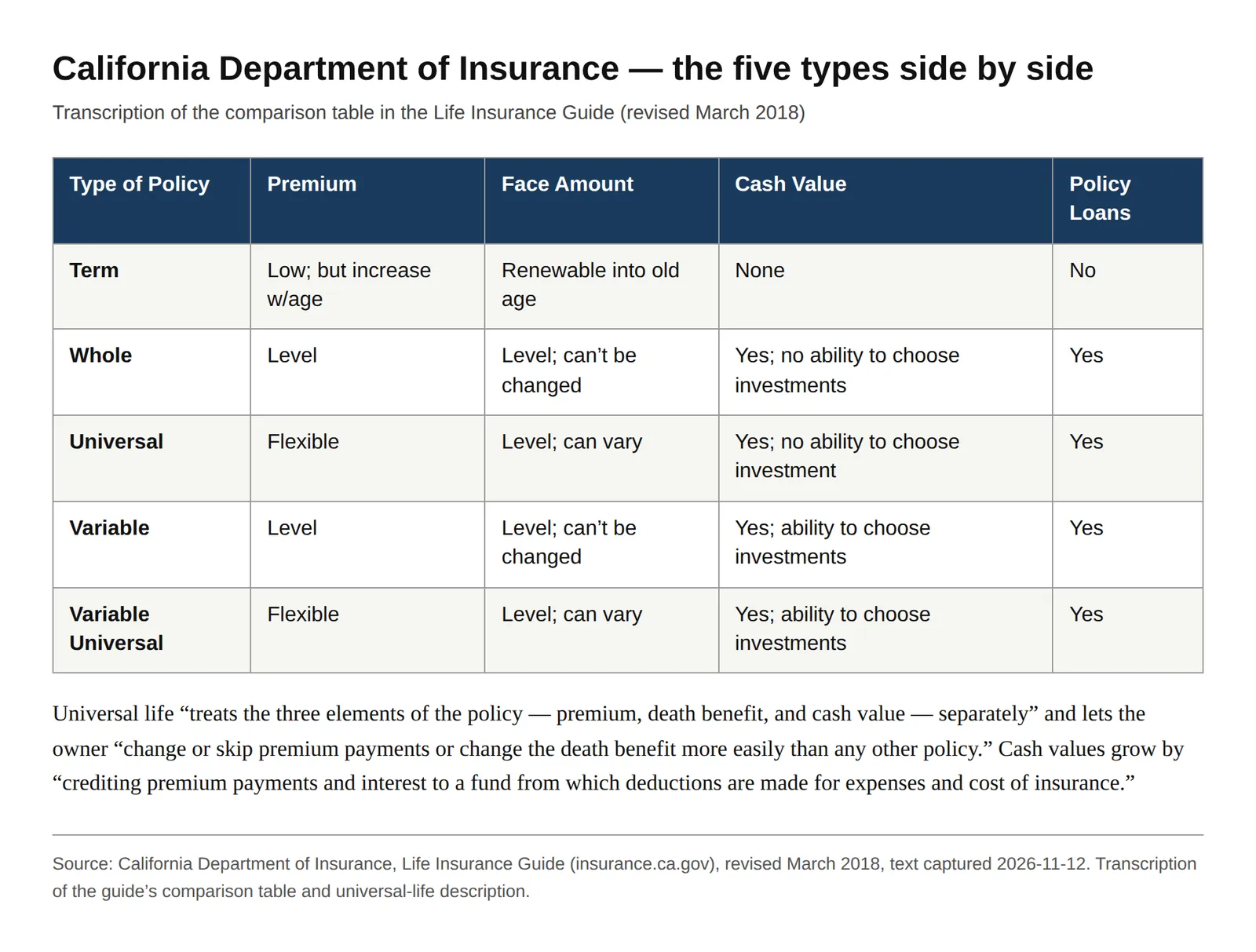
| Policy type | Lasts | Premium | Cash value | Guaranteed |
|---|---|---|---|---|
| Term | 10, 20, or 30 years | Lowest; rises at renewal | None | Death benefit in term |
| Whole | For life | Level for life | Yes, guaranteed | Premium, death benefit, cash value |
| Universal | For life, while cash value lasts | Flexible | Yes, rate-sensitive | Little; no-lapse needs on-schedule payment |
| Authority | California Department of Insurance (March 2018); NAIC (November 14, 2025) | — | — | — |
Step 2: What $500,000 costs at 35 and 40
The anchor figures are MoneyGeek's $500,000 life insurance page (2026 rates), from more than 30 providers for healthy nonsmokers in good health. Survey averages, not quotes.
| Policy, $500,000 coverage | 35, female | 35, male | 40, female | 40, male |
|---|---|---|---|---|
| 20-year term | $29/mo | $36/mo | $37/mo | $44/mo |
| Whole life | $418/mo | $463/mo | $482/mo | $537/mo |
| Universal life | $244/mo | $285/mo | $293/mo | $345/mo |
| Authority | MoneyGeek (2026) | — | — | — |
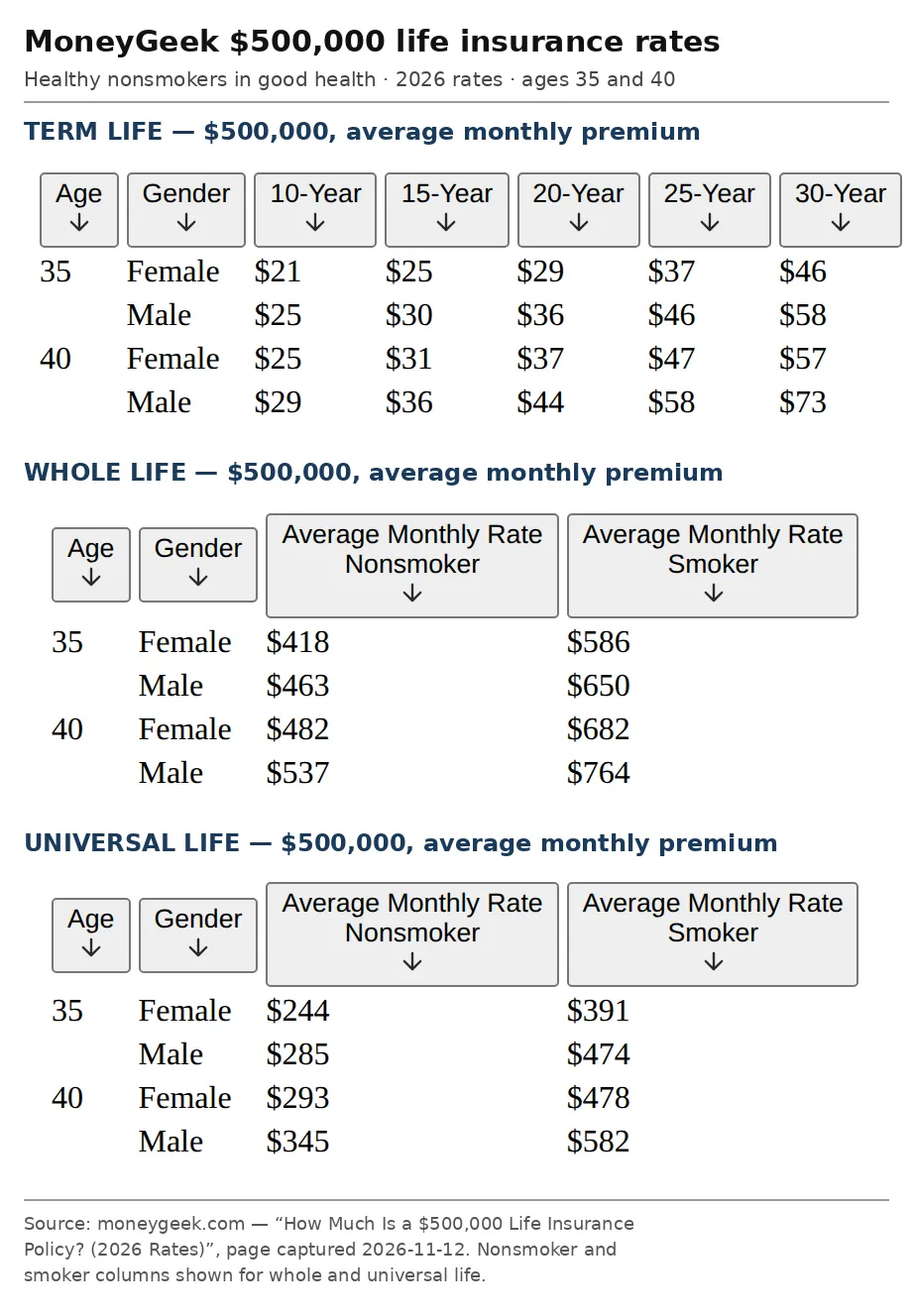
At 35, whole life costs 12.86 times the 20-year term premium for a man and 14.41 times for a woman; universal life costs 7.92 and 8.41 times. Whole life also runs about 62 percent more than universal life for a man at 35. Policygenius's Price Index for October 2025 (13 carriers, Preferred health class) puts the same $500,000 20-year term at $23.10 a month for a 30-year-old woman and $29.56 for a man, against MoneyGeek's $24 and $30.
Health and smoking move the numbers more than age does. A 35-year-old man who smokes pays $116 a month for the same 20-year term policy instead of $36 — 3.22 times the nonsmoker rate. A woman in poor health pays $42 instead of $29. Waiting costs money too: the same term rises from $30 a month at 30 to $44 at 40. At 40, the cheapest quotes are $29 for women and $35 for men, from Banner Life, Pacific Life, Protective Life, and Transamerica. The cheapest quotes save $96 to $108 a year at 40. Check the NAIC complaint index too.
Step 3: Worked example — Daniel, 35, buys $500,000
Daniel is a fictional healthy 35-year-old nonsmoker. Every input is a stated assumption from the MoneyGeek anchor table, not a quote. He buys $500,000 of coverage for 20 years:
Whole life costs $102,480 more than term over 20 years, buying coverage that does not expire at 55 plus cash value. Universal life costs $59,760 more than term and $42,720 less than whole life. For a woman: $6,960, $100,320, and $58,560.
The standard test is buy term and invest the difference: Daniel saves $427 a month — $463 minus $36. Invested monthly for 20 years, that grows to $175,511 at 5 percent and $222,436 at 7 percent:
That is the number the whole-life cash value has to beat — and no verified cash value at year 20 was available, the honest gap in this playbook. Run it on your own numbers with the ROI calculator.
How much coverage Daniel needs is separate. The rule of thumb is 10 to 12 times annual income; Policygenius recommends 10 to 15 times. On an $80,000 salary that is $800,000 to $960,000. A needs build — $800,000 income replacement, a $350,000 mortgage, $200,000 college costs, minus $50,000 savings — comes to $1,300,000. The 2025 Insurance Barometer Study (LIMRA, January 2025) found 51 percent own life insurance and 40 percent say they need more.
Step 4: The cost-index test — comparing policies on one number
A monthly premium is not a cost comparison: a whole-life premium buys a death benefit and a cash value, while a term premium buys only the death benefit. State regulators solved this with the cost comparison index, codified in Wisconsin Administrative Code Ins 2.14. The surrender cost index is the annual cost of $1,000 of coverage after the cash value is credited back: divide the year-20 cash surrender value by 34.719, the 20-year factor at 5 percent; accumulate the annual premiums at 5 percent to year 20 and divide by the same factor; subtract; divide by the thousands of coverage.
Run it on Daniel's whole-life policy. His annual premium is $5,556. Accumulated at 5 percent for 20 years, the premiums reach $192,900, and divided by 34.719 the equivalent level premium is $5,556. Now assume, as a stated illustration only, that the guaranteed cash surrender value at year 20 is $60,000 — a stated assumption, not a verified market figure. Divided by 34.719, the cash value is worth $1,728 a year:
The net payment cost index sets the cash value to zero. The cash value cuts the index by 31.1 percent, from $11.11 to $7.66 per $1,000. The same calculation on Daniel's term policy gives $0.86 per $1,000 — term is cheaper by a factor of nine. Use guaranteed values, never illustrated ones.
Step 5: The tax layer — what the statutes actually say
Section 101(a)(1) excludes from gross income any amount received under a life insurance contract and paid by reason of the death of the insured. IRS Publication 525 agrees: proceeds generally are not taxable unless the policy was turned over for a price or acquired in a reportable policy sale.
Employer-owned policies are the exception. Section 101(j)(1) caps the exclusion at the premiums paid by the employer, unless notice-and-consent are met and the insured falls into a status exception — an employee in the 12 months before death, a director at issue, a highly compensated employee under § 414(q), or a highly compensated individual under § 105(h)(5). Notice and consent must happen before issue.
Section 7702(a) defines a life insurance contract as one that meets the cash value accumulation test of § 7702(b) or the guideline premium requirements of § 7702(c) plus the cash value corridor of § 7702(d). The accumulation test caps the cash surrender value at the net single premium needed to fund future benefits, at the lesser of 4 percent or the insurance interest rate.
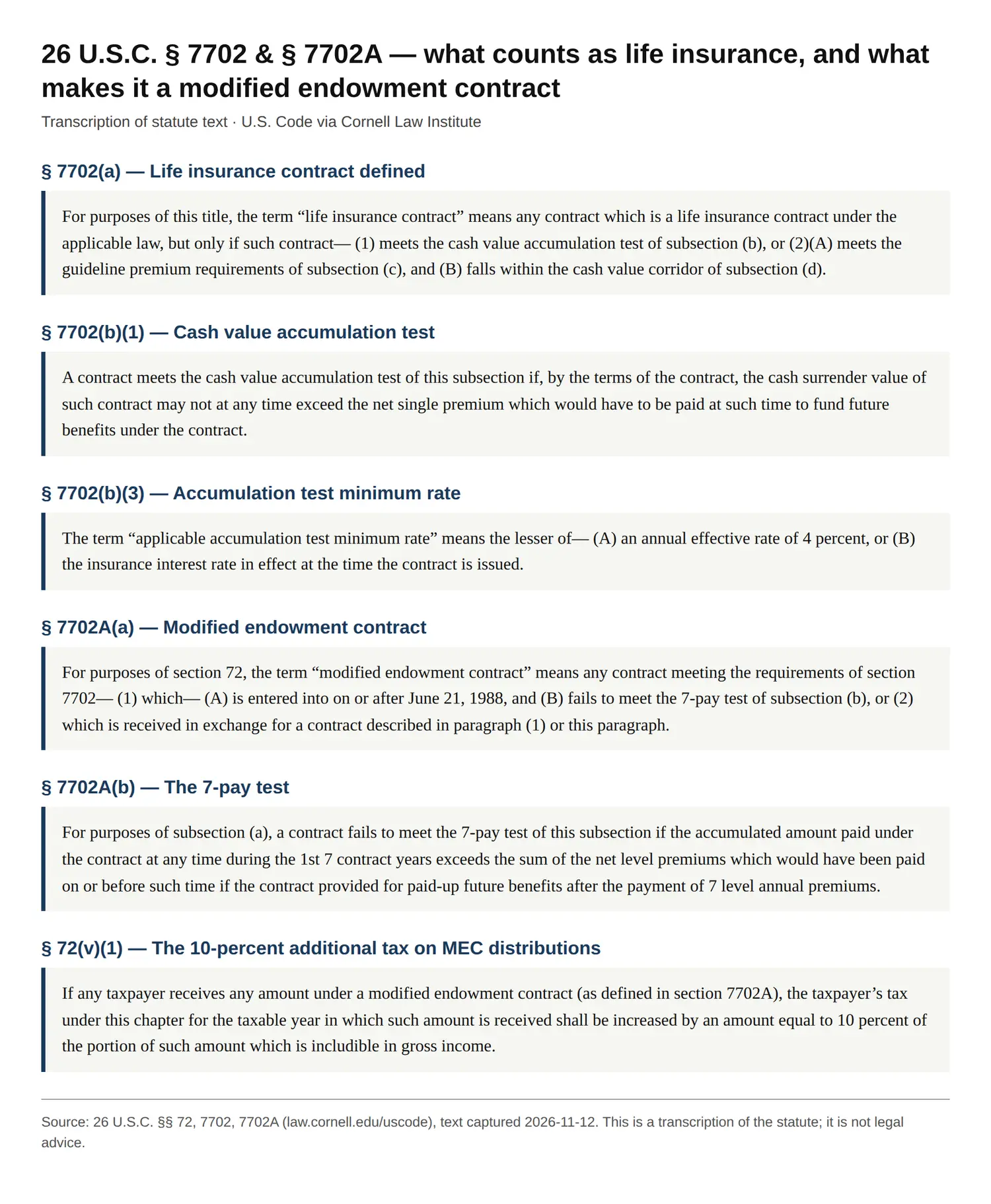
Section 7702A(a) treats a contract entered into on or after June 21, 1988 as a modified endowment contract if it fails the 7-pay test of § 7702A(b): the premiums paid in the first seven years exceed the net level premiums that would have paid up the contract after seven level annual premiums. Withdrawals are taxed income-first under § 72(e)(10), and § 72(v)(1) adds a 10-percent additional tax on the taxable part before age 59½.
The deduction rules run the other way. Section 264(a)(1) allows no deduction for premiums if the taxpayer is directly or indirectly a beneficiary, and § 264(a)(4) generally disallows interest on debt to buy or carry such a policy. A business that names itself beneficiary cannot deduct the premiums.
Step 6: The business-owner layer — key person and buy-sell funding
A business buys life insurance for two reasons: to survive the death of a person it cannot replace quickly, and to fund the purchase of a dead owner's share. The key-person policy pays the business, which covers the revenue gap. The buy-sell policy pays the surviving owners or the business, which buys the deceased owner's interest. The mechanics are in the key-person-insurance-buy-sell-agreement-funding-playbook.
The paperwork is where the identifiers live. The business files the policy under its own EIN, not the owner's SSN, and the buy-sell agreement names the insured by SSN or ITIN where the insurer requires it. An LLC, an S-Corp, and a C-Corp fund a buy-sell differently: the C-Corp owns the policy and deducts nothing, the S-Corp passes the economics through, and the LLC's operating agreement must name the owner and recipient. FICA and SECA do not apply to the death benefit, but the CPA must reconcile the cash value on the GAAP books against the tax basis. Get the designation right first — the probate-estate-settlement-playbook shows what happens when the designation no longer matches the owner's wishes.
Step 7: The risk layer — lapse, failure, and the fine print
Universal life's risk is lapse: the policy stays in force only while the cash value covers the monthly cost of insurance and expenses, and that cost rises every year. Suppose Daniel keeps paying the $285 monthly target premium — $3,420 a year — and, at 65, the annual cost reaches $6,000. The shortfall is $2,580 a year, and a $20,000 cash value covers it for about 7.75 years:
After that the policy lapses with no death benefit. Term life lapses the same way, but the owner knows the date; whole life lapses only if premiums stop, and the nonforfeiture values give paid-up insurance or cash value instead.
If the insurer fails, the state guaranty associations are the backstop. The National Organization of Life and Health Insurance Guaranty Associations states that associations exist in all 50 states, the District of Columbia, and Puerto Rico, and most provide at least $300,000 in death benefits, $100,000 in cash surrender values, and $250,000 in present value of annuity benefits.
The grace period is usually 31 days after the premium due date. The free-look period in California is at least 10 days after the owner receives the policy — 30 days for seniors. The contestable period runs one or two years, during which the insurer can refuse a claim for omissions or untrue statements; the suicide clause applies if the insured dies by suicide within the first two policy years.
Step 8: The buying operation
- Size the coverage first, with the 10-to-12-times rule or the needs build in Step 3.
- Decide the type from the need: temporary is term; permanent is whole or guaranteed universal life.
- Get the medical exam and apply for the best health class you can honestly claim.
- Compare at least three insurers on the same coverage and term, and check the NAIC complaint index.
- For any permanent policy, demand both cost indexes at years 10 and 20, in writing, on guaranteed values.
- Read the beneficiary designation before signing, and confirm it matches the estate plan.
- Review the in-force illustration yearly for universal life; re-shop term two years before it expires.
Do not buy permanent insurance before the emergency fund exists — a policy that lapses in year three is the most expensive coverage of all. See the emergency-fund-playbook.
The build operation, start to finish
- [x] Name the need, the term, and the dollar amount from the 10-to-12-times rule.
- [x] Price all three types on the same person, age, health class, and coverage.
- [x] Run the 20-year totals and buy-term-and-invest-the-difference at 5 and 7 percent.
- [x] Run both cost indexes at years 10 and 20, on guaranteed values.
- [x] Confirm the tax treatment: § 101(a), § 7702, § 7702A 7-pay test.
- [x] For a business-owned policy, complete § 101(j) notice and consent; file Form 8925 yearly.
- [x] Set the beneficiary designation to match the estate plan; review the illustration annually.
Founder & CEO Insight — Enow A. Jovial