The Emergency Fund Playbook: How Much, Where to Park It, and How to Build It on a Real Paycheck
Maya is single, takes home $4,800 a month, and spends $3,200 on essentials: rent $1,400, utilities $180, groceries $420, transport $260, phone $65, insurance $240, minimum debt payments $385, and prescriptions $250. That leaves $1,600 a month of breathing room. Her emergency fund target is $19,200 — six months of essentials — built at $400 a month — 8.3 percent of her take-home pay.
The need is not abstract. The Federal Reserve's 2025 household survey: 63 percent of adults said they would cover a hypothetical $400 emergency with cash, savings, or a credit card paid off at the next statement — below the 68 percent peak of 2021. Twelve percent could not pay $400 by any means. Only 55 percent had set aside money for three months of expenses; 30 percent could not cover three months by any means. More than half — 59 percent — had a major unexpected expense in the prior year, most often a vehicle, home, or medical bill.
What counts as an emergency — decide before it happens
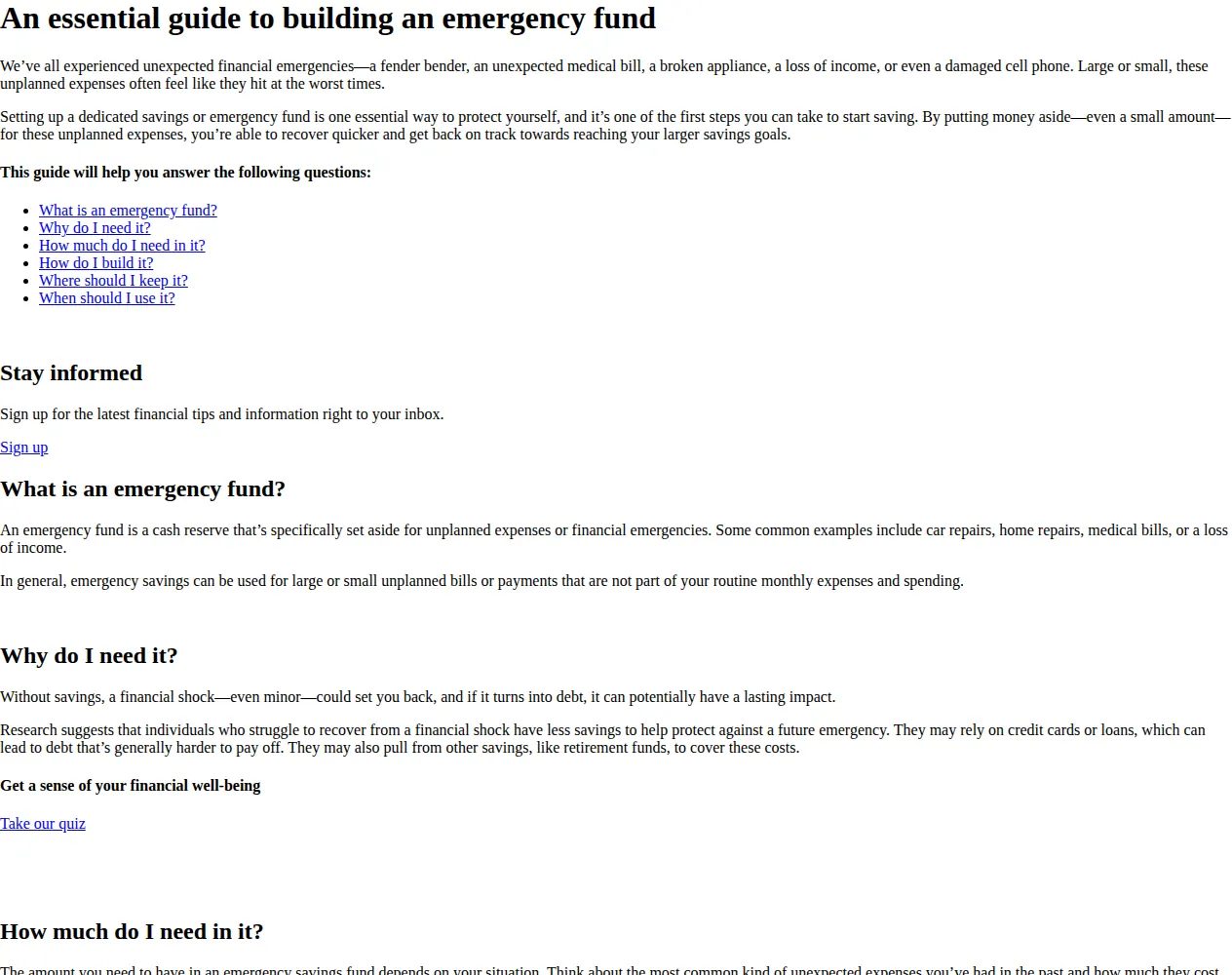
The Consumer Financial Protection Bureau puts it plainly: "An emergency fund is a cash reserve that's specifically set aside for unplanned expenses or financial emergencies. Some common examples include car repairs, home repairs, medical bills, or a loss of income." Two tests, both must pass: unplanned, and a need rather than a want. A failed transmission passes both; a holiday sale, a wedding gift, and a phone upgrade fail one or the other.
| Expense | Emergency? | Why | Authority |
|---|---|---|---|
| Car repair that keeps you at work | Yes | Unplanned, and income depends on it | CFPB guide |
| Uncovered medical bill | Yes | Unplanned health cost | CFPB guide |
| Vacation, gifts, new phone | No | Planned, recurring, or a choice | CFPB guide |
The Bureau's advice is equally direct: "Set some guidelines for yourself on what constitutes an emergency," and "don't be afraid to use it if you need it. If you spend down what's in your emergency savings, just work to build it up again." The other side: using a card or a loan for the same bill "may grow significantly larger than your original bill because of interest and fees."
How much — four layers, each with a job
The fund is four layers stacked in order, each answering a different shock. Vanguard frames the first two by shock type: spending shocks need "at least $2,000 or enough money to cover 2 to 4 weeks of expenses," whichever is greater; income shocks need "three to six months' worth of living expenses." The FDIC points the same way: "Financial experts generally recommend that you have at least six months of living expenses in a federally insured product, such as a savings account or a certificate of deposit (CD)."
| Layer | Target | Job | Months of runway |
|---|---|---|---|
| Starter | $1,000 | First buffer | 0.31 |
| Spending shock | $2,000 | A repair without debt | 0.63 |
| Income shock, three months | $9,600 | A lost paycheck | 3.00 |
| Income shock, six months | $19,200 | A real job loss | 6.00 |
The spending-shock layer is the larger of $2,000 and half a month of essentials: half of $3,200 is $1,600, so $2,000 governs. The runway column is the target divided by monthly essentials: $1,000 covers about nine days of Maya's life, $2,000 about nineteen, $9,600 a full quarter, $19,200 half a year.
Go to nine or twelve months — $28,800 or $38,400 for Maya — when the income itself is fragile: a single-income household with dependents, a self-employed worker, or a commission or seasonal worker. The extra months price a fragile income's longer replacement time. A dual-income household with stable jobs and no dependents can stop at three months — the second paycheck is itself a layer of the fund.
Building it — the timeline on a real paycheck
The build is a transfer, not a resolution. The CFPB calls automatic recurring transfers "one of the easiest" ways to save consistently, and the FDIC gives the smallest honest version: "if you are paid every other week and put $20 into your savings account each pay period, that adds up to $520, plus interest, to your savings each year." Twenty dollars a paycheck is not a plan for a $19,200 fund — at that pace the starter alone takes almost two years.
Maya saves $400 a month by direct deposit split: her employer sends $400 straight to the emergency account by ACH before the rest reaches checking.
| Monthly saving | $1,000 starter | $2,000 shock layer | $9,600 (3 months) | $19,200 (6 months) |
|---|---|---|---|---|
| $300 | 4 months | 7 months | 32 months | 64 months |
| $400 | 3 months | 5 months | 24 months | 48 months |
At $400 a month the starter completes on the third transfer and the shock layer lands in month five; the three-month target takes two years, the six-month target four. Slow — and the only speed that survives a real budget.
Two accelerants do not depend on willpower. A tax refund — the FDIC notes refunds "provide a great opportunity to start a new savings account" — sent straight to the fund, $1,500 is nearly four months of $400 transfers in one move. The rule that protects the build: the fund lives in its own account, away from daily checking — the CFPB's test is that the money be "safe, accessible, and in a place where you're not tempted to spend it on non-emergencies."
Where to park it — yield is real money, access is the constraint
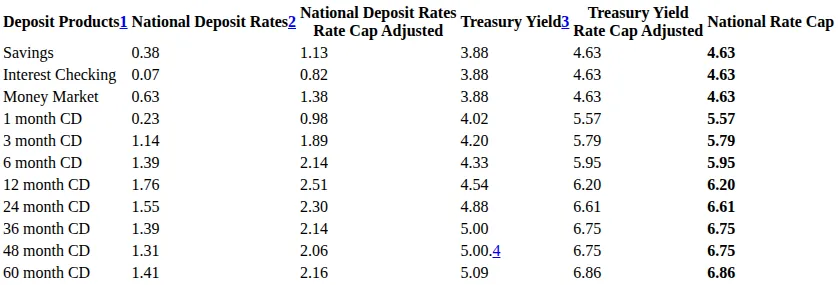
A fund that earns nothing is still a fund, but the gap between nothing and a competitive rate is hundreds of dollars a year on a finished balance. The FDIC's national rates for October 2026, revised October 19, 2026, show what "nothing" looks like: savings 0.38 percent, money market 0.63 percent, a 6-month CD 1.39 percent. The accounts that compete for emergency money pay roughly eight times more, and the choice turns on one question: how fast must this layer be in your hands?
| Parking spot | Rate, Nov 2026 | Access speed | Best layer | Authority |
|---|---|---|---|---|
| National-average savings | 0.38% APY | 1–3 days | None | FDIC, Oct 2026 |
| High-yield savings | 3.20–3.30% APY | 1–3 days | Spending shock | Ally, SoFi, Capital One |
| 13-week Treasury bill | 4.159% investment rate | At maturity | Months 3–6 | TreasuryDirect, Nov 9, 2026 |
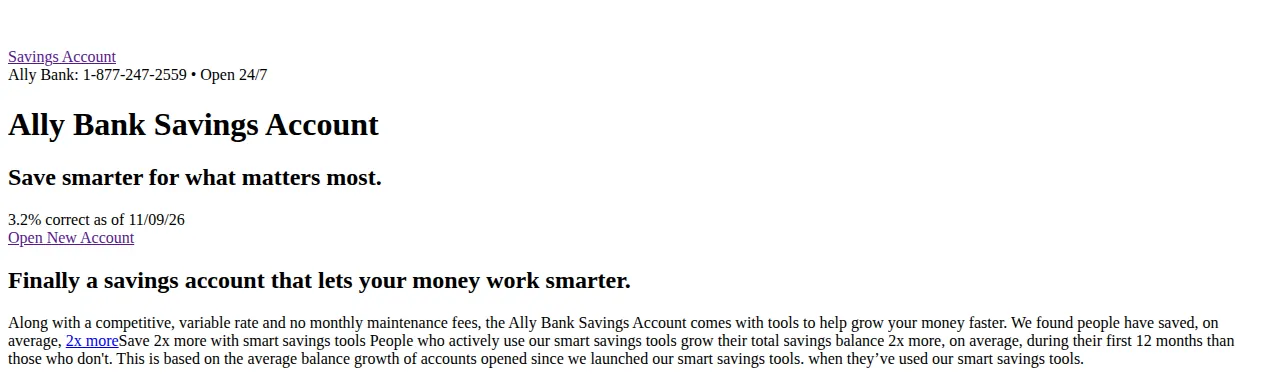
Rates current as of November 11, 2026: Ally pays 3.2 percent APY, "correct as of 11/09/26" on its own page; SoFi pays 3.30 percent APY with eligible direct deposit, and 4.40 percent with a limited-time boost ending December 31, 2026; Capital One's 360 Performance Savings is 3.20 percent by corroborated secondary reads. Our high-yield savings comparison prices all three head to head.
One year of simple interest on the finished $19,200 fund:
| Parking spot | Rate | One year on $19,200 |
|---|---|---|
| National-average savings | 0.38% | $72.96 |
| Ally / Capital One | 3.20% | $614.40 |
| SoFi | 3.30% | $633.60 |
| 13-week Treasury bill | 4.159% | $798.53 |
Treasury bill interest is exempt from state tax under 31 U.S.C. section 3124(a): "Stocks and obligations of the United States Government are exempt from taxation by a State or political subdivision of a State." Federal tax still applies. At a 22 percent federal and 5 percent state marginal rate:
The after-tax gap is $160.32 a year. The tax estimator runs the same comparison on your own numbers.
The bill's price is access: bills sell at a discount and pay face value at maturity. The November 9, 2026 auction set the 13-week investment rate at 4.159 percent, with a $100 minimum and weekly auctions. A ladder turns that structure into access: split $19,200 into three $6,400 rungs of 13-week bills, one maturing each month, and re-buy a fresh bill at each maturity. The three rungs together earn $199.09 per 91-day quarter at the November 9 rate. Our Treasury bills vs money market funds comparison works the same ladder against a fund. Two frictions: TreasuryDirect redeems bills at maturity, so an early exit means selling through a brokerage, and the rate resets at every auction — 4.159 percent is a November print, not a promise. That is why only months three through six ride the ladder.
One more boundary: the Federal Reserve deleted the six-per-month savings withdrawal limit from Regulation D in April 2020 — but banks may still set their own limits.
What it costs not to have one — the $1,200 repair
The fund's value is easiest to see in the bill it prevents. Take a $1,200 car repair on a credit card at 24.99 percent APR, a stated model rate, paid off over twelve fixed months. The monthly rate is 24.99 percent divided by 12, or 2.0825 percent, and the fixed payment is:
The repair costs $168.57 more than the repair. Left unpaid six months, the balance grows to $1,357.97 — $157.97 of interest, nothing paid down. The minimum-payment path is worse: at a 2 percent minimum with a $25 floor, the first payment is $25.00 against $24.99 of interest, so the balance barely moves, and the model runs 380 months — over 31 years — with $8,290.14 of interest. Your card's formula differs, but the shape is the same: a minimum payment covers interest, not principal. A $2,000 shock layer ends the whole story at $1,200 flat. That is the fund's return, and no APY table captures it.
The business version — same layers, separate money
A business needs its own emergency fund, and it must not share an account with the household's. The rule is three to six months of the business's essential costs in its own federally insured account, under the business's own EIN. A sole proprietor opens the account under an SSN; an LLC opens it under the EIN on its formation documents; a nonresident owner uses an ITIN where the bank accepts one. Money moves in by ACH on a fixed schedule, and the fund pays the business's bills only. FICA is the payroll tax on wages; SECA is the self-employed counterpart, and neither touches savings interest. An S-Corp owner takes FICA wages on Form W-2 plus distributions that generally are not gross income, while a C-Corp owner's dividends enter income in full. A CPA works from GAAP books; the fund's math runs on cash: GAAP tells you whether the business is profitable, the fund balance whether it survives a bad quarter.
When to use it — and how to refill it
Use the fund for the expenses on your list and nothing else — the CFPB's line is "don't be afraid to use it if you need it." The refill rule keeps a used fund from becoming an empty one: when a withdrawal lands, pause every optional goal and route the freed cash back into the fund first, at the same monthly amount that built it, until the balance is whole again.
Founder & CEO Insight — Enow A. Jovial
Execution checklist
- Step 1: Add up one month of essential expenses and write the number down.
- Step 2: Multiply by three and by six for your income-shock targets; $1,000 and $2,000 are the first two layers.
- Step 3: Open a dedicated high-yield savings account away from daily checking, and confirm it is FDIC-insured.
- Step 4: Set an automatic transfer or direct-deposit split for payday, and date the first transfer this week.
- Step 5: Write your emergency list and tape it to the account.
- Step 6: When the balance passes $2,000, open a TreasuryDirect account and start a three-rung 13-week bill ladder.
- Step 7: Check the rate once a quarter; if the ladder's edge disappears, let the rungs mature back into savings.
- Step 8: When you use the fund, pause optional goals and refill at the same monthly amount.
- Step 9: Recompute the targets every year — a rent rise changes the monthly essential, and the fund must move with it.