Probate & Estate Settlement Playbook
Probate & Estate Settlement Playbook
Probate is the court-supervised process that moves a dead person's property to the living: the court confirms the will, appoints someone to run the estate, makes creditors come forward and be paid, and only then lets the rest go to the heirs. The executor who knows the fee schedule, the claim deadlines, and the tax clocks finishes the job; the one who learns them one letter at a time pays in delay and personal liability.
This playbook covers the settlement operation: what passes through probate, the personal representative's duties, the statutory fees, the creditor-claim window, the small-estate shortcuts, property in another state, and the two tax returns beside the court case. The trust choice sits in the revocable-living-trust-vs-irrevocable-trust-estate-playbook, the exclusion math in the estate-tax-exemption-15-million-obba-portability-playbook, the return itself in the irs-form-706-estate-tax-return-filing-playbook.
Step 1: what goes through probate and what does not
Only the decedent's probate assets go through the court. The federal gross estate is wider: § 2031(a) counts the value at death of all property, wherever situated; § 2033 adds all property to the extent of the decedent's interest; § 2036 pulls back transfers where the decedent kept a life estate; § 2038 pulls back transfers the decedent could revoke.
| Asset | Probate? | Authority |
|---|---|---|
| Solely owned bank account | Yes | State probate code |
| Real property, decedent's name alone | Yes | State probate code; situs rule |
| Joint tenancy with survivorship | No — to the survivor | Deed terms |
| Life insurance / retirement, named beneficiary | No — to the beneficiary | Beneficiary designation |
| Payable- / transfer-on-death account | No — to the named person | Account designation |
| Assets in a revocable living trust | No — trustee distributes | Trust instrument |
The test is the title: if it already names who takes the asset at death, the court has nothing to transfer.
Step 2: the personal representative
Probate opens on a petition: in California, Probate Code § 8000 lets any interested person commence proceedings, asking the court to appoint a personal representative and admit the will to probate. The will usually names the executor; without one, the court appoints an administrator in the § 8461 priority order — spouse first, then children, parents, siblings, and on down to the public administrator and creditors. Letters prove the appointment, and their issue date starts every deadline in this playbook.
IRS Publication 559 states the duties: collect the decedent's assets, pay the creditors, distribute the rest to the heirs or beneficiaries. Behind it sits the executor's real job: apply for the estate's own employer identification number (EIN) — never file the estate's returns under the decedent's Social Security number (SSN) after the final return — and file Form 56, notice of fiduciary relationship. A beneficiary with no SSN files Form W-7 for an individual taxpayer identification number (ITIN). Where the estate holds an interest in a limited liability company (LLC), a partnership, or an S corporation, the income reaches Form 1041 on a Schedule K-1, and the entity's classification — partnership, S-Corp election, or C-Corp — decides how it is taxed. Most executors hire a certified public accountant (CPA) and keep cash-basis books. Estate income is not wages, so no Federal Insurance Contributions Act (FICA) or Self-Employment Contributions Act (SECA) tax applies; distributions go by check or automated clearing house (ACH) transfer, receipt kept.
The duties carry personal liability. If the estate cannot pay all its debts, the debts due to the United States are paid first, and a personal representative who distributes assets ahead of them — with notice of the tax, or failing due care in finding it — is personally responsible up to the amount distributed. Publication 559 gives two exits: Form 4810, request for prompt assessment, which cuts the IRS assessment window to 18 months, and Form 5495, request for discharge, after which the IRS has 9 months to state the tax due; if it does not, the executor is discharged.
Step 3: what probate costs — the California fee schedule
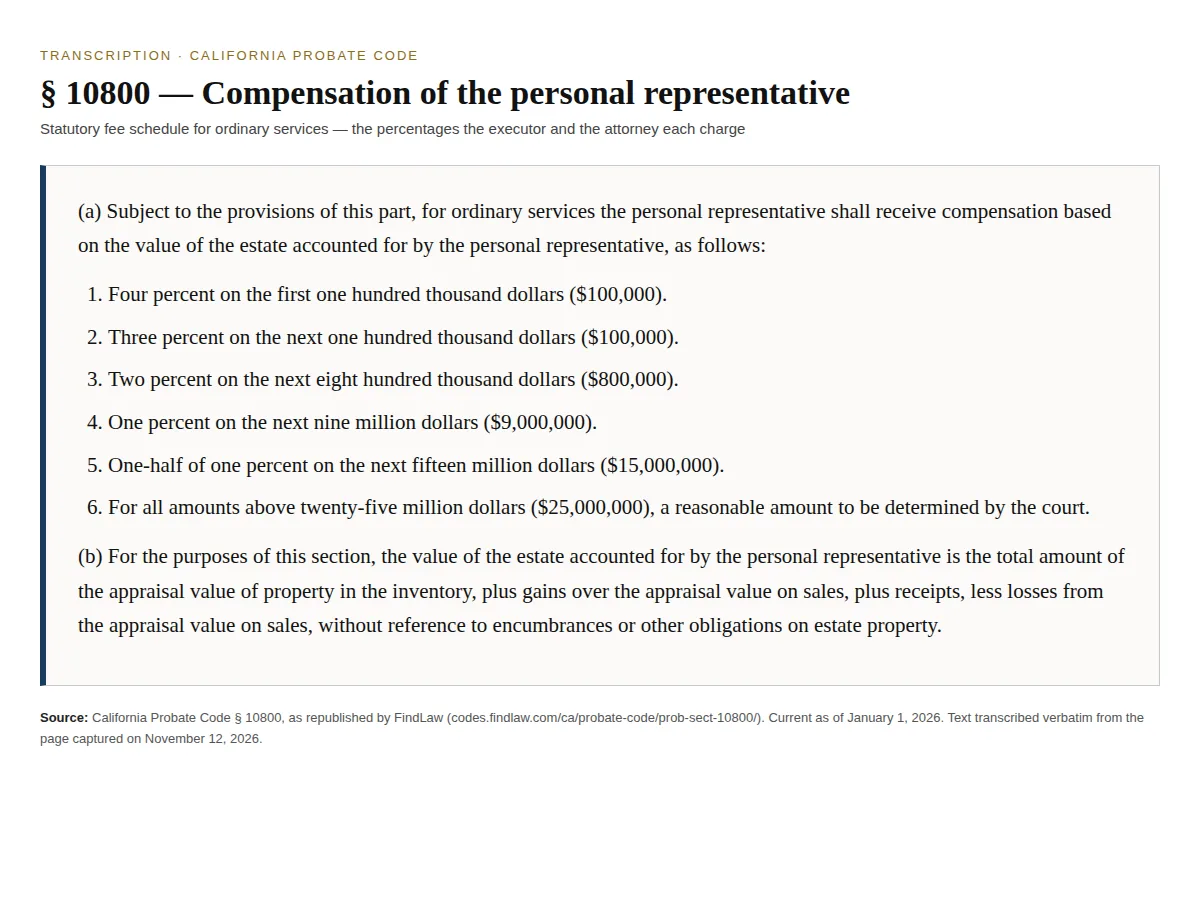
California sets the executor's ordinary fee by statute. Probate Code § 10800(a) fixes the percentages; § 10800(b) fixes the base: the total appraisal value of the inventory, plus gains on sales, plus receipts, less losses — "without reference to encumbrances or other obligations on estate property." Each rate applies only to the dollars inside its tier.
| Tier | Rate |
|---|---|
| First $100,000 | 4% |
| Next $100,000 | 3% |
| Next $800,000 | 2% |
| Next $9,000,000 | 1% |
| Next $15,000,000 | 0.5% |
| Above $25,000,000 | Court-set |
Worked example: on a $1,000,000 estate the tiers give $4,000 + $3,000 + $16,000 = $23,000.
The estate pays the schedule twice. With the referee's 0.1 percent fee and the $435 filing fee added:
| Probate estate | One fee | Both fees | All-in cost |
|---|---|---|---|
| $500,000 | $13,000 | $26,000 | $26,935 |
| $1,000,000 | $23,000 | $46,000 | $47,435 |
The mortgage trap: a $900,000 house with a $700,000 mortgage holds $200,000 of equity, but § 10800(b) ignores encumbrances, so the fee is charged on the full $900,000:
That is $21,000 each, $42,000 combined — 21 percent of the $200,000 of equity the estate holds. Heavily mortgaged property is the most expensive probate asset relative to what the heirs receive. Extraordinary fees for litigation, tax work, or a contested sale sit on top, court-set. Run the combined figure through the ROI calculator against the cost of the trust that would have kept these assets out of probate.
Step 4: creditor claims and the notice clock
The personal representative must give notice of administration to the known or reasonably ascertainable creditors — Probate Code § 9050 — and § 9051 sets the deadline: the later of four months after letters issue, or thirty days after the personal representative first learns of the creditor. § 9100 gives the creditor's deadline: the claim must be filed before the later of four months after letters are first issued, or sixty days after notice is mailed or personally delivered.
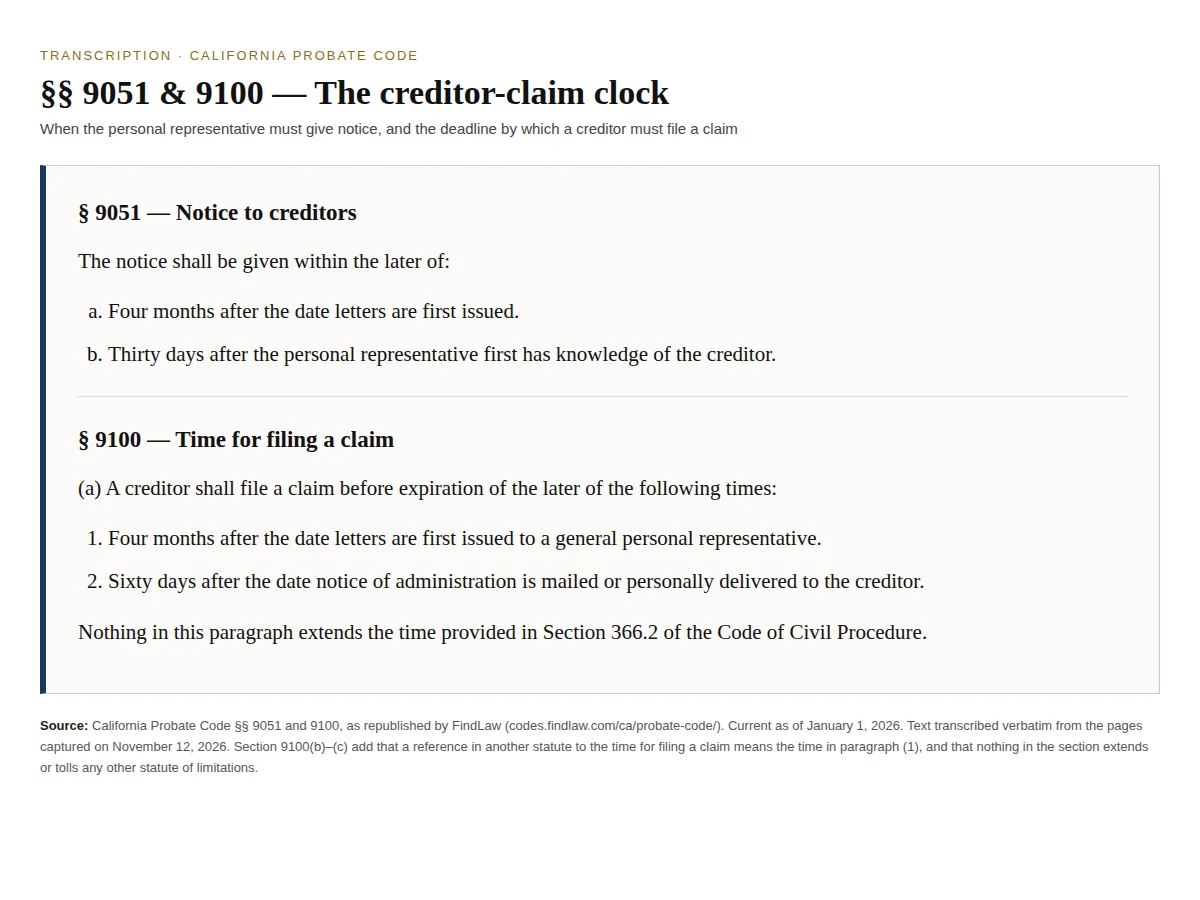
Letters issue March 1, 2026 and notice is mailed March 10: four months after letters is July 1, sixty days after notice is May 9, so the deadline is July 1. A creditor first learned of on June 15 has until August 14. The later-of rule protects the late-found creditor and punishes the slow executor. Behind both deadlines sits the outer limit: Code of Civil Procedure § 366.2 gives one year after the date of death to commence an action, and nothing in § 9100 extends that time.
Step 5: the small-estate shortcuts
The numbers change, so check the current statute before relying on any of them:
| State | Threshold | Authority |
|---|---|---|
| California | $208,850 gross value in California | Prob. Code § 13100, as adjusted by § 890 |
| New York | $50,000 personal property | SCPA § 1301 |
| Texas | $75,000, excluding homestead and exempt property | Estates Code § 205.001 |
| Florida | $150,000, deaths on/after July 1, 2026; $75,000 before | Fla. Stat. § 735.201 |
California's affidavit under § 13100 needs 40 days elapsed since death; where the only real property is the primary residence, § 13151 lets the successor petition for a court order at $750,000 or less as adjusted, with notice to heirs within five business days. New York excludes real property entirely and charges a $1.00 filing fee; SCPA § 1310(3) lets a debtor pay up to $15,000 directly, no sooner than 30 days after death. Texas allows the affidavit only for an intestate estate, with assets exceeding the known liabilities, two disinterested witnesses, and filing within four years of death. Florida's $150,000 threshold applies to deaths on or after July 1, 2026 under CS/HB 1337, Chapter 2026-57 — or where the decedent has been dead more than two years regardless of value — provided the will does not direct formal administration; the same act also raised the bank-account, tax-refund, and intestate routes to $2,000, $5,000, and $20,000.
Step 6: property in another state — ancillary probate
Real property is governed by the law of the state where it sits, so a probate court in the decedent's home state cannot transfer title to land in another state. A second proceeding — ancillary probate — opens in each state where the decedent held solely titled real property; the domiciliary probate handles the estate as a whole and the personal property. The Uniform Probate Code, adopted in part by roughly a third of the states, softens one edge: UPC § 4-201 lets a debtor deliver personal property to the domiciliary executor. It does not touch real property. A vacation home in a second state means a second probate — so hold out-of-state real property in a trust or an entity.
Step 7: the two tax returns beside the court case
Probate and tax run on separate tracks. The decedent's final income tax return, Form 1040 or 1040-SR, is due April 15 following the year of death. The estate's Form 1041 is due April 15 for a calendar-year estate — the Instructions put the 2025 return due April 15, 2026 — and § 6072(a) sets the general rule: calendar-year returns by April 15, fiscal-year returns by the 15th day of the fourth month after the tax year closes. Where a qualified revocable trust exists, the § 645 election on Form 8855 treats the trust as part of the estate.
Form 706 is due within 9 months after the date of death under § 6075(a); Form 4768 buys an automatic 6-month extension. A return is required where the gross estate exceeds the basic exclusion amount under § 2010(c) — the trigger of § 6018(a)(1) — and a nonresident noncitizen files at $60,000. § 2053(a) allows funeral and administration expenses, claims, and unpaid mortgages, and § 2056(a) allows property passing to the surviving spouse. Where no return is required, the portability election still matters: it can only be made on a timely filed Form 706, and the Instructions point executors who missed the window to Rev. Proc. 2022-32, which lets an estate that was not required to file submit the return on or before the fifth anniversary of death, with "FILED PURSUANT TO REV. PROC. 2022-32 TO ELECT PORTABILITY UNDER SECTION 2010(c)(5)(A)" across the top. Past the fifth anniversary, only a private letter ruling under Regulation § 301.9100-3 remains. The $15,000,000 exclusion for 2026 is worked in the estate-tax-exemption-15-million-obba-portability-playbook; the return's schedules in the irs-form-706-estate-tax-return-filing-playbook.
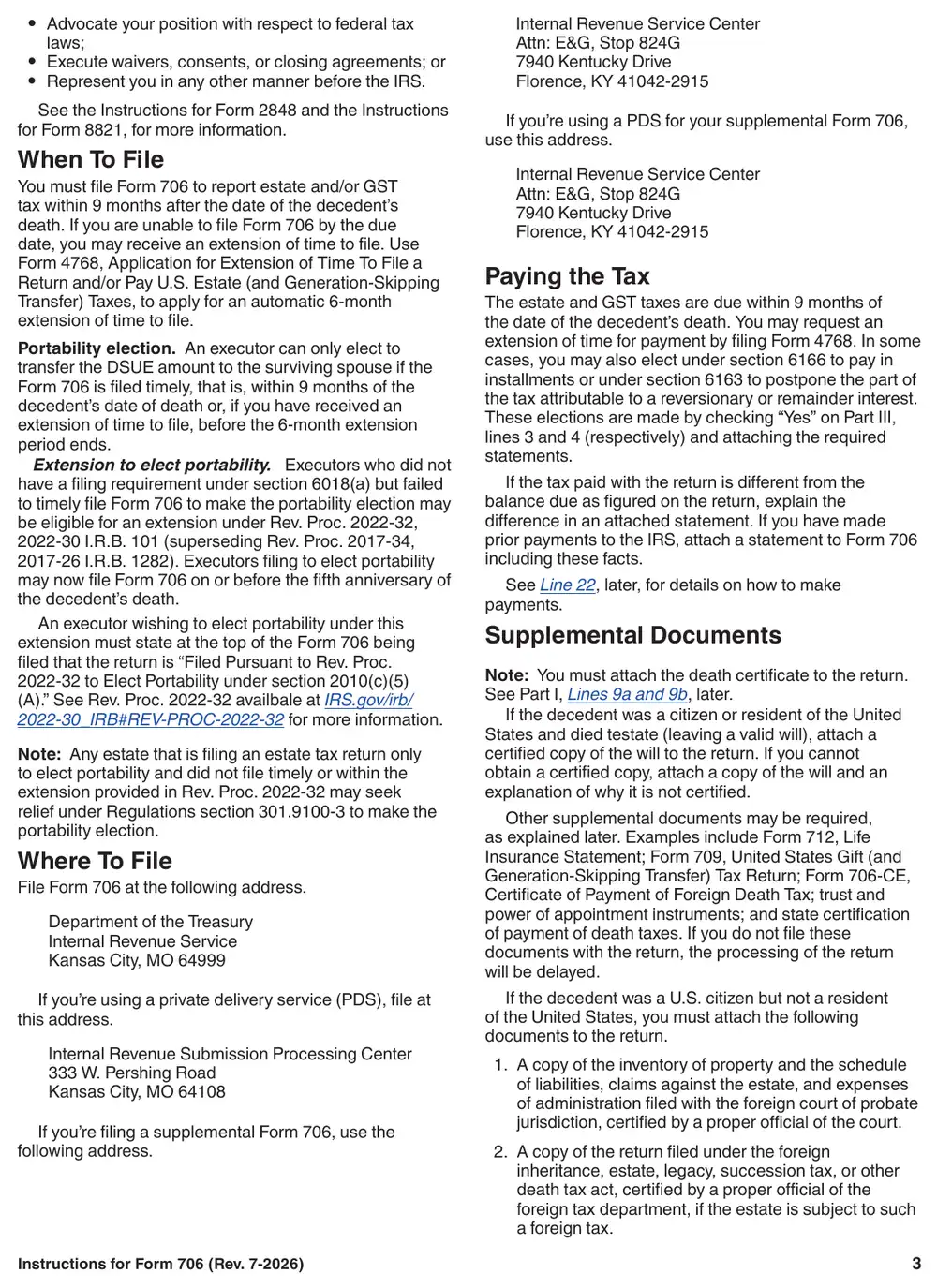
On a January 15, 2026 death: Form 706 is due October 15, 2026, Form 4768 extends filing to April 15, 2027, the late portability election stays open until January 15, 2031, and the final Form 1040 is due April 15, 2027.
Step 8: the master calendar
California Probate Code § 12200 sets the outer bound: petition for final distribution or file a status report within one year after letters issue, or 18 months where a federal estate tax return is required — March 1, 2027 without a Form 706, or September 1, 2027 with one, on the Step 4 letters. In order: death starts the final Form 1040 clock and the § 366.2 limit; letters issue starts the claim window and the § 12200 clock; letters plus four months is the notice and claim deadline; death plus nine months is Form 706 and the tax; death plus five years is the last day for a late portability election.
The build operation, start to finish
- Find the will, the trust instrument, and every beneficiary designation; sort assets into probate and non-probate.
- File the petition and obtain letters; the date letters issue starts every deadline.
- Apply for the estate EIN and file Form 56 the week letters issue.
- Inventory and appraise everything; the appraisal value sets the § 10800 fee base.
- Give notice to known creditors, publish for the unknown, log every notice date.
- Open ancillary probate in every state holding solely titled real property.
- File the final Form 1040 by April 15, Form 1041 on the estate's year, Form 706 within 9 months or on Form 4768.
- File Forms 4810 and 5495, wait out the claim window, then distribute and file the final accounting.
Founder & CEO Insight — Enow A. Jovial
The revocable-living-trust-vs-irrevocable-trust-estate-playbook compares the trust forms that keep assets out of probate, the estate-tax-exemption-15-million-obba-portability-playbook works the $15,000,000 exclusion and portability, and the irs-form-706-estate-tax-return-filing-playbook walks the return itself. Run the combined probate cost through the ROI calculator before funding a trust.