A SaaS business doing $10,000 a month in card sales pays about $320 a month to Stripe at published rates. The same volume on Adyen's published Interchange++ formula costs about $253 — at average interchange. On Checkout.com there is no published number, because Checkout.com quotes every merchant individually. This playbook prices all three from the vendors' own pages at $10,000, $50,000 and $200,000 a month, and shows the card mix at which the cheapest option changes.
Every figure is for US domestic cards at a $100 average order value. Formation is covered in our Stripe Atlas vs Clerky vs Northwest Delaware C-Corp formation playbook; sales-tax automation lives in our Stripe Tax nexus guide.
How card pricing actually works
Every card payment splits into interchange, scheme fees and the processor's markup. In the United States there is no cap on credit-card interchange, so your customers' card mix moves your real cost more than any headline rate.
A blended rate folds all three parts into one published percentage plus a fixed fee — the same price whatever card the customer uses. Interchange-plus (IC+ or IC++) passes interchange and scheme fees through at cost and adds a stated markup, so the price moves with each card.
Founder & CEO Insight — Enow A. Jovial
The three vendors at a glance
| Vendor | Pricing model | Published US online rate | Setup / monthly | Authority |
|---|---|---|---|---|
| Stripe | Blended flat rate; Interchange+ on custom plans | 2.9% + $0.30 per domestic transaction | None | Stripe pricing page |
| Adyen | Interchange++ | $0.13 + interchange + scheme fees + 0.60% (Visa / Mastercard) | None; minimum invoice by industry | Adyen pricing page |
| Checkout.com | Flat rate or Interchange++, tailored | Quote only | None published | Checkout.com pricing page |
Stripe publishes a number you can budget against today; Adyen a formula you can price once you know your card mix; Checkout.com a structure needing a quote. All three vendors publish API references alongside their pricing pages — the integration surface is the same API that charges the fees above.
Stripe: the published flat rate
Stripe's standard pricing, from its pricing page on 19 November 2026: 2.9% + $0.30 per successful online domestic card transaction. International cards add 1.5%, currency conversion a further 1%. In-person payments cost 2.7% + $0.05; ACH Direct Debit costs 0.8%. No setup, monthly or hidden fees.
Your cost per order never changes with the card. A $100 sale costs $3.20 whether the customer pays with regulated debit or a premium travel rewards card. Debit transactions pay the same 2.9% as rewards cards, so a debit-heavy business overpays on every sale.
Adyen: the published formula
Adyen publishes no flat rate: each transaction costs a fixed processing fee plus a method fee. For Visa and Mastercard that fee is interchange plus scheme fees plus a 0.60% markup, with the $0.13 fixed fee on top: $0.13 + Interchange++ + 0.60%. American Express in North America is $0.13 + 3.3% + $0.10; ACH Direct Debit is $0.13 + $0.27 flat. No setup, monthly, integration or closure fees; published fees are indicative.
Two conditions matter. First, an unpublished minimum invoice by industry or business model: at $10,000 a month the calculated saving is $67 a month, so a minimum near that figure would erase it — ask for it first. The bound is exact: if the minimum invoice is $320 a month or more, Adyen costs $320 at $10,000 volume, exactly Stripe's $320, and the whole saving is gone. Get the minimum in the same email as the rate card. Second, Adyen is sales-led: underwriting reviews your business model, and some industries are excluded.
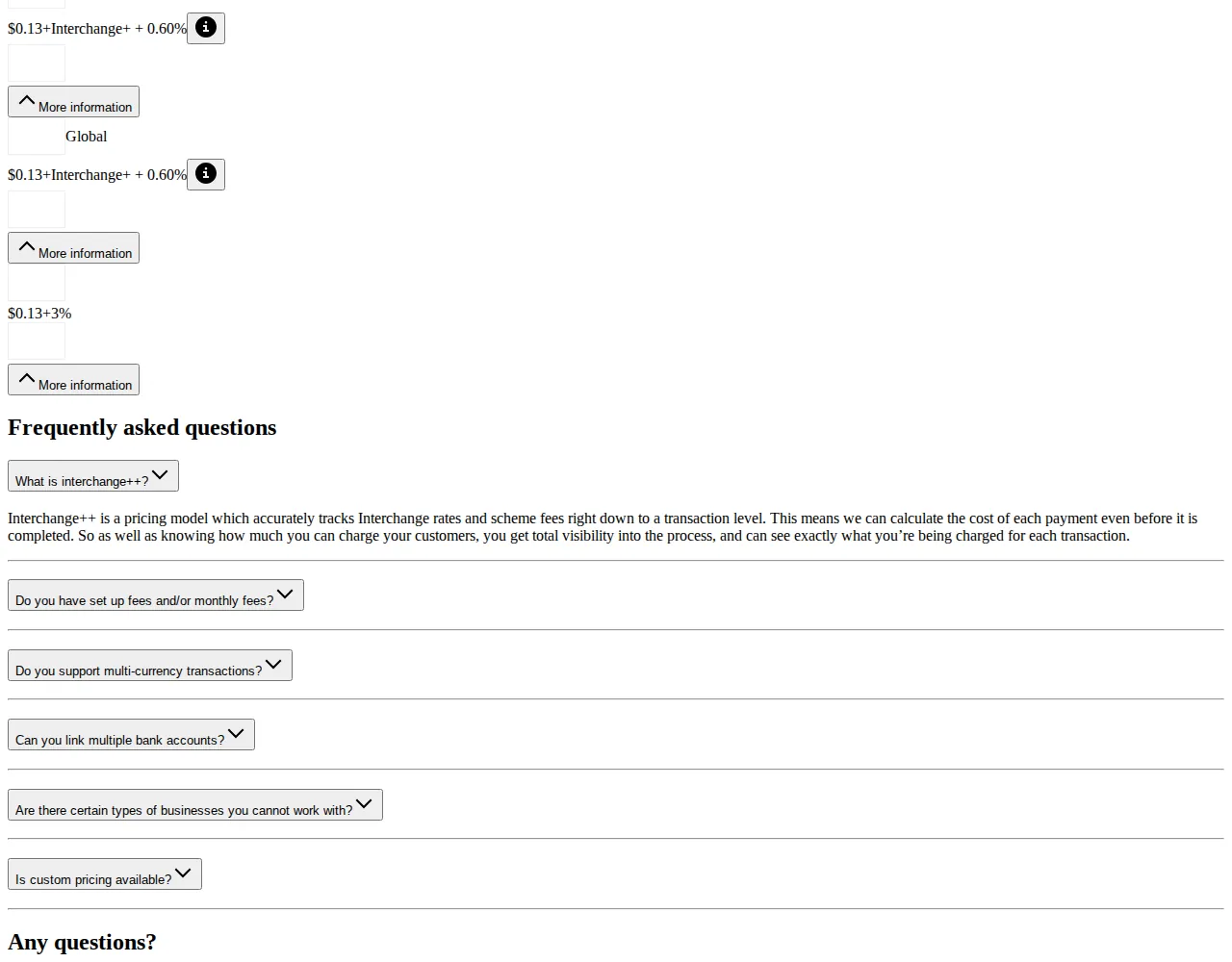
Adyen defines Interchange++ as interchange and scheme fees tracked to transaction level.
Checkout.com: the quote-only vendor
Checkout.com publishes no numeric rate: a flat rate priced on your business profile, or Interchange++ fees — both tailored. No setup, surprise or maintenance fees; 150+ currencies; domestic coverage in 45+ countries.
You cannot verify Checkout.com from its website: no rate, no per-transaction fee, no dispute fee. That is not a criticism — it sells acquiring performance and authorization rates to enterprise merchants — but it changes the evaluation to a structured quote process against Stripe's published figures. Any article printing a Checkout.com "rate" without a quote is inventing one.
Worked example 1: monthly cost at $10,000, $50,000 and $200,000
Assumptions: average order value $100, so $10,000 a month is 100 transactions, $50,000 is 500, $200,000 is 2,000 — all US domestic online card payments. Adyen costs pass-through interchange and scheme fees plus 0.60% plus $0.13 per transaction. Adyen publishes no single interchange figure, so this example uses a stated planning assumption of 1.80% blended interchange plus scheme fees for a typical mixed portfolio — an assumption, not a vendor figure. Replace it with your own statement data. Checkout.com has no published rate, so no column here.
| Monthly volume | Transactions | Stripe | Adyen (at p = 1.80%) | Adyen saving |
|---|---|---|---|---|
| $10,000 | 100 | $320.00 | $253.00 | $67.00 |
| $50,000 | 500 | $1,600.00 | $1,265.00 | $335.00 |
| $200,000 | 2,000 | $6,400.00 | $5,060.00 | $1,340.00 |
Check the $50,000 row: Stripe costs $0.029 \times 50{,}000 + 0.30 \times 500 = 1{,}450 + 150 = \$1{,}600$; Adyen costs $(0.0180 + 0.0060) \times 50{,}000 + 0.13 \times 500 = 1{,}200 + 65 = \$1{,}265$.
Card mix moves the Adyen column more than volume does. At $50,000 a month, a debit-heavy portfolio at 1.00% pass-through costs $(0.0100 + 0.0060) \times 50{,}000 + 65 = \$865$ (saving $735); a rewards-heavy portfolio at 2.40% costs $(0.0240 + 0.0060) \times 50{,}000 + 65 = \$1{,}565$ (saving $35).
Worked example 2: the break-even card mix
Set Stripe's cost equal to Adyen's and solve for the pass-through rate $p$ where they tie:
At $100 average order, break-even is 2.47%: below it Adyen is cheaper, above it Stripe is. At $50 it rises to 2.64%; at $500 it falls to 2.33%. Verify the $100 case: at $p = 2.47\%$ and $50,000 volume, Adyen costs $(0.0247 + 0.0060) \times 50{,}000 + 0.13 \times 500 = 1{,}535 + 65 = \$1{,}600$ — exactly Stripe's $1,600.
Two card types break the average. Amex on Adyen costs $0.13 + 3.3% + $0.10 in North America — $3.53 on a $100 sale against Stripe's $3.20. In person it inverts: Stripe charges 2.7% + $0.05 ($2.75 on $100); Adyen's formula at the 1.80% assumption gives $2.53.
| $100 sale | Stripe | Adyen |
|---|---|---|
| Domestic online card | $3.20 | $2.53 at the 1.80% assumption |
| American Express, North America | $3.20 | $3.53 |
| In-person card | $2.75 | $2.53 at the 1.80% assumption |
Adyen wins the average card and loses the Amex card; the mix, not the headline, decides the month.
International cards and foreign exchange
Stripe adds 1.5% for international cards plus 1% where conversion is required. Make 30% of that $50,000 business international cards needing conversion: Stripe rises from $1,600 to $1,600 + 0.015 \times 15{,}000 + 0.01 \times 15{,}000 = \$1{,}975$, an effective 3.95%. Adyen charges no flat surcharge — cross-border cards carry higher actual interchange through at cost — so its $1,265 base rises by an uplift only the merchant's statement can quantify.
Currency handling differs too. Stripe converts within the account from 0.5%, and settles in multiple currencies where you hold a local bank account for each. European checkouts add a PSD2 layer — Strong Customer Authentication, usually 3DS — which can change the authorization rate a quote assumes. Adyen links multiple bank accounts in multiple currencies and avoids conversion. Checkout.com's 150+ currencies and domestic acquiring in 45+ countries is its strongest claim: local acquiring typically lifts authorization rates. Price a conversion decision through our Multi-Currency Exchange Rate Converter first.
Payout timing and cash flow
All three settle on roughly the same clock. Stripe's standard US settlement for cards is 2 business days, but the first payout from a new account typically takes 7 to 14 days — budget for that gap at launch. ACH settles in 4 business days, or 2 for eligible US merchants. Instant Payouts reach a supported debit card in about 30 minutes, at 0.75% + $1.50 each.
Adyen batches by sales day with a 2-business-day payout delay in its example — Monday pays out Wednesday — and up to 2 more days for funds to reach the account. Stripe's payout rails carry their own fees on top of the processing rate: ACH payouts cost $0.50 next-day or $1.00 same-day, real-time payouts $2.50, and a Fedwire $25.00 — small against a $1,600 monthly bill, and worth pricing into the payout-clock comparison. Payouts are net: costs, refunds and chargebacks come out of the batch first. Checkout.com's default is T+2 for major domestic currencies including USD, EUR and GBP, and T+3 or above internationally, with daily, weekly, monthly or bimonthly schedules.
Disputes and chargebacks
A dispute costs more than the transaction value. Stripe charges $15.00 when a dispute is received, $15.00 when you counter it manually — refunded if you win — and $15.00 when you appeal, never refunded even if you win. Ten disputes, all countered, three won: $150 + $150 − $45 = $255 in fees before the seven lost transactions. The seven lost transactions also lose the sale itself — on a $100 average order that is $700 of revenue reversed on top of the $255 in fees, before any VAMP fine. A single arbitration loss can add several hundred dollars more; Adyen's chargebacks guide puts scheme arbitration at several hundred dollars per case, borne by the losing party. Adyen publishes no flat dispute fee — it is set in the contract — and its chargebacks guide warns scheme arbitration fees can run to several hundred dollars per case. Checkout.com likewise publishes no dispute fee: get it in writing.
Prevention is cheaper than handling: Stripe bundles Radar screening from $0.05 per screened transaction, Adyen runs fraud tooling across the full payment stack, and Checkout.com includes machine-learning fraud monitoring. Visa's VAMP programme fines excessive merchants $8 per disputed transaction.
Who each vendor fits — and who should avoid it
Stripe fits a business under $200,000 a month that values self-serve signup, predictable budgeting and the broadest product surface: Billing, invoicing, Radar, Capital and Connect on one account. Once volume and a debit-heavy mix make the saving real, the custom IC+ plan — not a vendor switch — is the first move.
Adyen fits a business with meaningful volume, a debit or standard-credit mix, and online plus in-person sales on one platform — including marketplaces needing multi-currency settlement. Avoid it below roughly $10,000 a month, where the unpublished minimum invoice can erase the saving, and avoid a sales process your business cannot pass underwriting for.
Checkout.com fits an enterprise merchant selling into many countries that cares most about authorization rates, with the volume to negotiate a tailored deal. Avoid it if you need a verifiable price before committing sales time, or if your volume is too small for a tailored enterprise quote.
How to decide: a six-step sequence
- Pull your card mix. Export 90 days of transactions as CSV: shares by card type, international share, average order value.
- Price Stripe exactly. Apply 2.9% + $0.30 to domestic volume, add 1.5% international and 1% conversion. This baseline needs no quote.
- Price Adyen with your own pass-through rate. Ask your processor for the blended interchange and scheme fees actually paid, add 0.60% and $0.13 per transaction, and compare with the 2.47% break-even at $100 average order. If under it, request Adyen pricing and the minimum invoice in the same email.
- Run a structured Checkout.com quote. Send all three vendors the same one-page brief — volume, average order, card mix, international share, settlement currencies — and require the rate or markup, per-transaction fee, add-ons, dispute fee and settlement speed in writing. Send the brief to all three at once, so the quotes arrive on comparable terms, and date-stamp each one: a quote is a snapshot, and Stripe's published rate is the only figure that cannot move while you wait.
- Price the payout clock, not just the rate. Confirm first-payout timing, settlement speed per currency, and any payout threshold or reserve.
- Negotiate from the table, then re-run the math. Take the best written quote back to the other two and re-run Worked Example 1 with the final numbers before signing. A verbal rate is not a rate.
Execution checklist
- [x] Export 90 days of transactions; calculate card-type shares.
- [x] Compute the Stripe baseline: 2.9% + $0.30, plus 1.5% international, 1% conversion.
- [x] Get actual blended interchange and scheme fees; test the 2.47% break-even.
- [x] Ask Adyen for its minimum invoice amount in writing before evaluating its formula.
- [x] Send Checkout.com the same one-page brief; require every fee in writing.
- [x] Confirm first-payout timing, settlement speed per currency, reserves and thresholds.
- [x] Re-run the monthly math with final written numbers before signing.
Where flat-rate pricing itself becomes the cost to beat, our Adyen vs Stripe vs Checkout.com enterprise pricing guide works the same comparison at $20 million-plus a year. For money leaving the business, the Wise vs Airwallex vs Payoneer payout fee guide prices the same $5,000 payout on all three rails.