Three vendors, three different things being priced
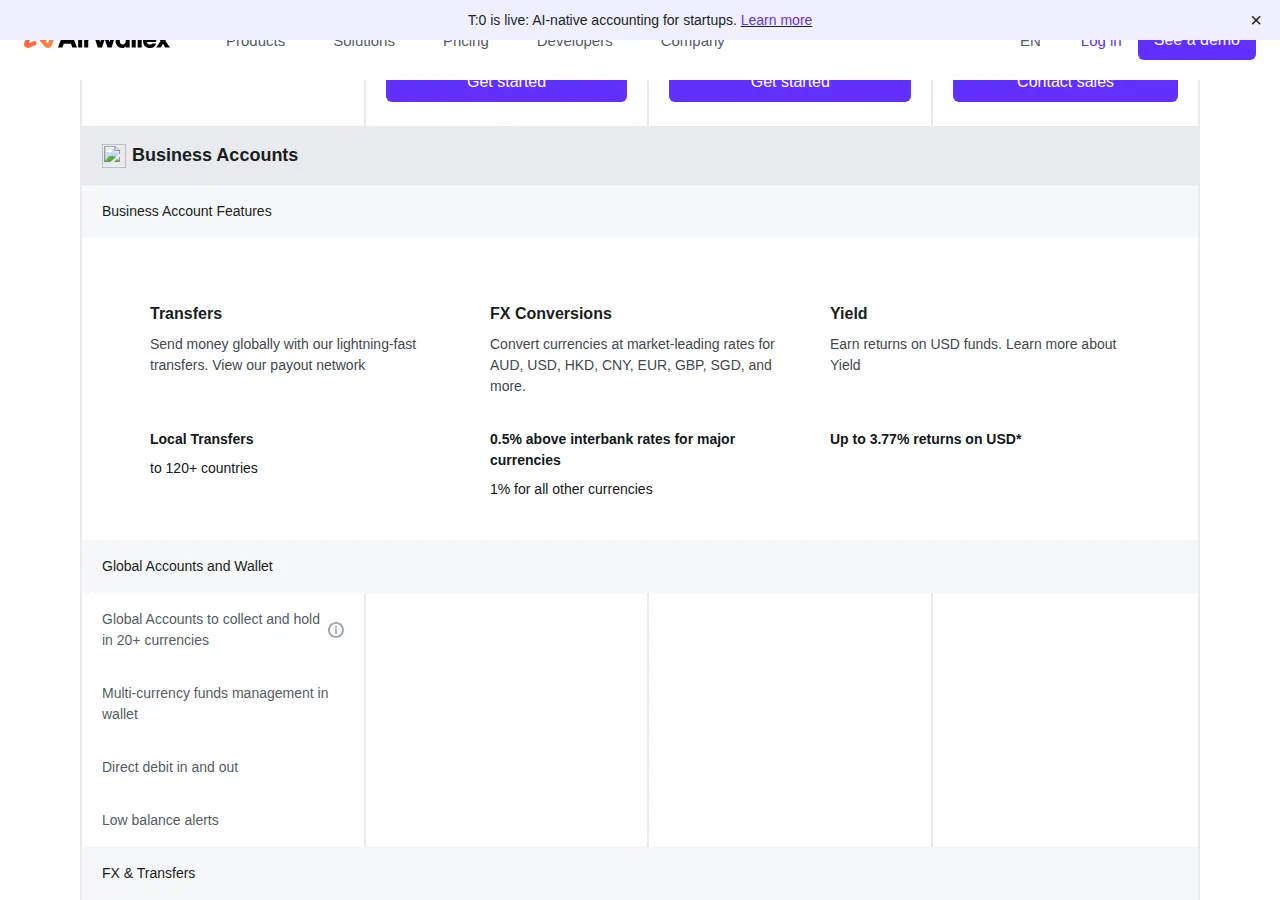
Ask what a cross-border payout costs and each vendor answers a different question. Wise answers with a conversion fee on the mid-market rate. Airwallex answers with a rail price — local transfers free, SWIFT transfers $15–$25 — plus a fixed FX margin over interbank. Payoneer answers with a corridor price that depends on where the sender sits, where the recipient sits, and whether the money stays inside Payoneer or leaves to a bank. Comparing headline percentages without naming the leg being priced is how a finance team picks the most expensive rail while believing it picked the cheapest.
This guide prices one concrete job: paying a contractor $5,000 from a U.S. business account to a contractor bank account abroad, in the contractor's local currency, every month. All figures below are from the vendors' own pricing pages, opened and read for this article, and every percentage is applied to the same $5,000 so the spread is visible instead of argued.
> [!KEY TAKEAWAY]
> On the same $5,000 payout, the published rates give roughly $12 on Wise (from 0.23%), $25 on Airwallex over a local rail (0.5%), and up to $54 on Payoneer (up to 1% plus up to $4). The ranking flips by corridor, rail, and whether the recipient must withdraw to a bank — so the decision is a routing rule, not a vendor loyalty.
The published rates, side by side
| Pricing element | Wise | Airwallex | Payoneer |
| :--- | :--- | :--- | :--- |
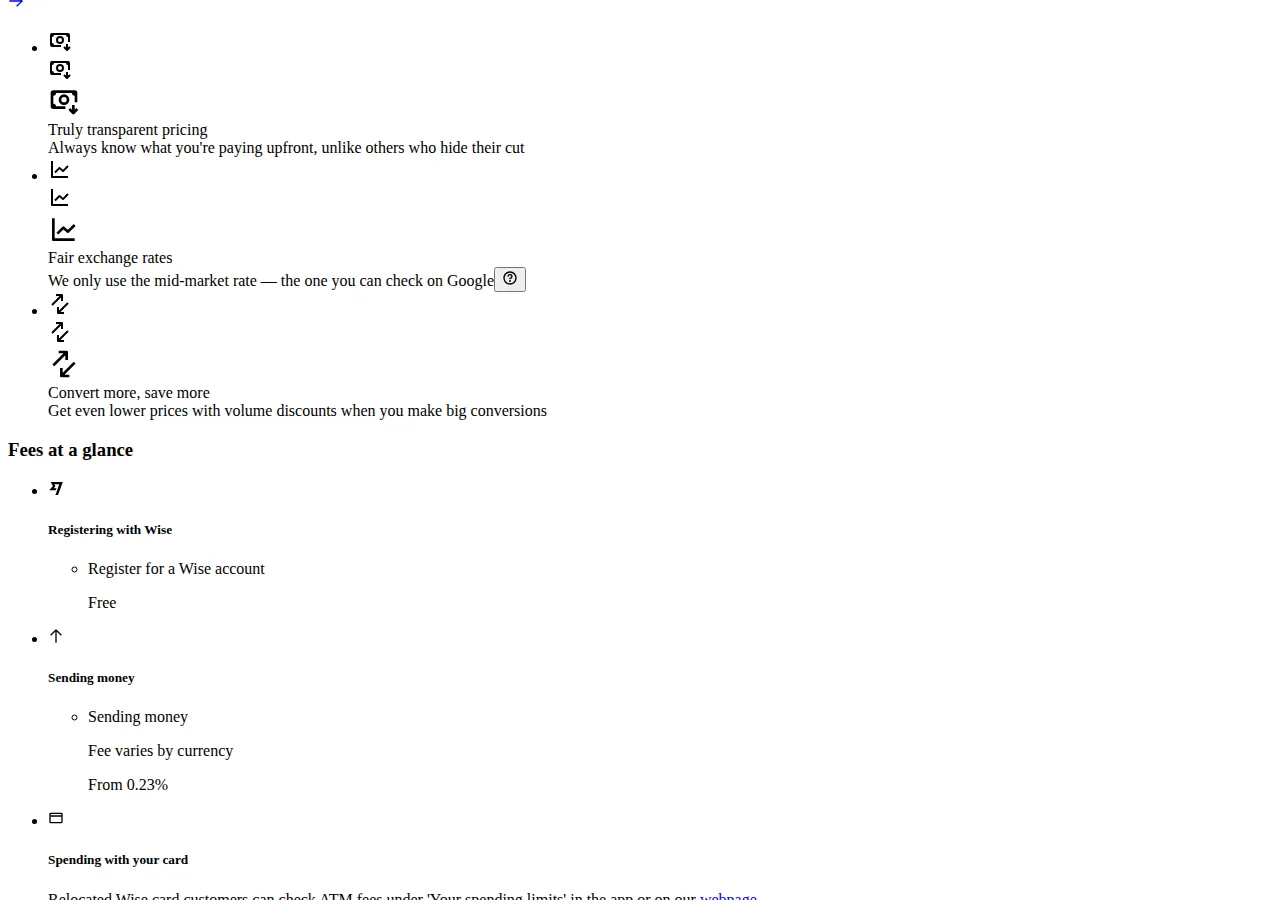
| Conversion / FX margin | From 0.23%, varies by currency, on the mid-market rate | 0.5% above interbank (major currencies); 1% (all others) | Conversion included in corridor pricing; balance-to-balance moves 0.50% |
| Local payout rail | Priced per transfer, varies by currency | Free batch transfers to 120+ countries; domestic USD/CAD transfers free | Same-country balance payout up to $4.00 |
| SWIFT / wire rail | Receiving a USD wire or SWIFT payment costs $6.11 | SWIFT transfers $15–$25 per transfer (SHA and OUR) | Cross-border balance payout up to 1% + up to $4.00 |
| Receiving accounts | Account details in 22 currencies, free; domestic receipts free | Global Accounts to collect and hold in 20+ currencies | Receiving accounts free in local currency; 1% (min $1.00) in a non-local currency |
| Account / plan cost | No subscription; Wise Multi-Currency Card $9 | Explore $0/user/month (up to 10 free Spend users); Grow $12/active Spend user/month | No monthly subscription; $29.95 annual fee if under $6,000 received in 12 months |
| Withdrawal to a bank | Varies by currency and rail | Local rails as above; SWIFT $15–$25 | To a local-currency bank account 1.2%–4%; same-country USD example $1.50 |
| Pricing-page vintage | Current page, read November 2026 | Current page, read November 2026 | Page states last updated 1 January 2026 |
Two reading notes matter. First, Payoneer's page is explicit that its prices are an estimation for the most standard fee structure and that the exact fee is shown in-account before confirmation — its ranges are wider because its pricing genuinely varies more by corridor. Second, Airwallex's $0 Explore plan is a plan price, not a payout price: the conversion margin still applies to every converted payout.
Worked math: one $5,000 payout, three bills
$
ext{Wise Cost} = $5{,}000 imes 0.23% = $11.50 quad ext{(from-rate; actual varies by currency)}
$
$
ext{Airwallex Local Cost} = $5{,}000 imes 0.5% = $25.00
$
$
ext{Airwallex SWIFT Cost} = $25.00 + $15 ext{--}$25 = $40.00 ext{--}$50.00
$
$
ext{Payoneer Payout Cost} = ($5{,}000 imes 1%) + $4.00 = $54.00 quad ext{(upper end of the published range)}
$
The recipient side changes the Payoneer figure further. If the contractor keeps the payout in a Payoneer balance and spends from it, the payout leg is the whole story. If the contractor withdraws $5,000 to a local bank account, the withdrawal leg adds 1.2%–4% — $60 to $200 — on top of whatever the payout leg cost. That double-leg structure is the single most common reason a Payoneer payout that looked competitive in the sender's dashboard arrives light: the sender priced leg one and the recipient paid leg two.
At monthly volume the spread compounds. Twenty $5,000 payouts — $100,000 a month — cost:
$
ext{Monthly Cost} = ext{Per-Payout Cost} imes 20
$
| Monthly volume ($100,000) | Monthly payout cost |
| :--- | :--- |
| Wise, from-rate | From $230 |
| Airwallex, local rail | $500 |
| Airwallex, SWIFT rail | $800–$1,000 |
| Payoneer, payout leg only (upper end) | Up to $1,080 |
| Payoneer, payout + withdrawal legs | Up to $1,080 + $1,200–$4,000 of withdrawal fees borne by recipients |
A finance team that reimburses recipient withdrawal fees — or grosses-up contractor pay to cover them — should price the Payoneer row with both legs. A team that does not should at least tell contractors which leg they bear, in writing, before the first payout.
Decision table: which rail for which payout
| Payout shape | Best first choice | Why | Authority |
| :--- | :--- | :--- | :--- |
| Single contractor, major currency, local rail available | Wise or Airwallex local | Lowest conversion cost; Wise from 0.23% undercuts 0.5% where its corridor fee is low | Wise pricing; Airwallex pricing |
| Batch payroll to 20+ contractors in 20+ countries | Airwallex | Free batch transfers to 120+ countries, multi-layer approval flows, one 0.5% conversion margin to model | Airwallex pricing |
| Contractor already on Payoneer, paid from marketplaces | Payoneer | Balance-to-balance transfers free; marketplace receipts free in local currency | Payoneer fees page |
| Contractor must receive by SWIFT to a bank with no local rail | Wise, then Airwallex | Wise conversion from 0.23% plus a defined receiving wire fee; Airwallex SWIFT adds $15–$25 | Wise pricing; Airwallex pricing |
| Payout to a country where only a bank withdrawal works | Price both legs before choosing | Payoneer withdrawal at 1.2%–4% can exceed the payout fee itself | Payoneer fees page |
| High-frequency micro-payouts under $100 | Airwallex local or Wise | Fixed fees dominate small payouts: Payoneer's up-to-$4 per payout is 4% on $100 before any percentage | Payoneer fees page |
The micro-payout row deserves emphasis because it reverses the headline ranking. On a $100 payout, Payoneer's up-to-$4 fixed fee alone is 4%; Airwallex local at 0.5% is $0.50; Wise from 0.23% is $0.23. Percentage tables flatter fixed-fee vendors at large amounts and punish them at small ones. Always divide the fixed fee by the payout size before comparing.
Operator boundaries: who should not use each
Wise is not a batch payroll system by default. Its strength is single transfers at a transparent conversion fee with volume discounts on large conversions. A team paying 50 contractors needs batch tooling, approval chains, and accounting sync — Airwallex's batch transfers, approval flows, and Xero/QuickBooks sync are built for that job, and Wise's per-transfer workflow will cost controller hours that never appear in the fee table.
Airwallex is not free. The Explore plan costs $0 per user, but every converted payout still pays 0.5% (major) or 1% (other currencies), SWIFT payouts pay $15–$25, and Grow costs $12 per active Spend user per month once the team needs its approval and automation features. Model the plan cost across the actual approver count, not the headline $0.
Payoneer is not a general-purpose payout rail. Its economics are built for marketplace sellers and contractors who already live inside Payoneer: free balance-to-balance moves, free local-currency receipts, and mass-payout tooling for platforms. Used as a generic way to push money to outside bank accounts, its corridor ranges (1.2%–4% on withdrawal) and its $29.95 annual fee on accounts receiving under $6,000 in 12 months make it the most expensive option in this comparison. If your contractors are not already on Payoneer, do not put them there for a single payout.
> [!WARNING]
> Never quote a payout fee without naming the corridor, the rail, and the leg. "Payoneer charges 1%" is false as a general statement — its own page prices same-country payouts up to $4, cross-border payouts up to 1% plus up to $4, and bank withdrawals at 1.2%–4%, all before corridor variation. A fee quoted without its corridor is a number waiting to be wrong, and the person who discovers the error is the contractor whose pay arrived short.
The accounting leg nobody prices
Paying from a balance held in the payout currency removes the conversion entirely, on all three platforms. Wise holds balances in the currencies it offers account details for; Airwallex holds 20+ currencies in Global Accounts; Payoneer holds multiple currencies in one account. A business that collects revenue in EUR and pays EUR contractors from the EUR balance pays no FX margin at all — the conversion fee only applies to the amount actually converted. The practical rule: route receipts into the currency you pay out in, hold the balance, and convert only the residual. Under ASC 830, foreign-currency balances still require remeasurement at each reporting date, so the saving is in fees, not in accounting work — but a $0 conversion fee beats a 0.23% one every month.
> [!FOUNDER]
> "Every payout vendor publishes a price list that is technically true and practically misleading, because none of them prices your payout — they price a corridor, a rail, and a leg. The operator who writes down the corridor, the rail, and both legs before the first transfer is the one whose contractors get paid in full."
> — Enow A. Jovial, Founder & Chief Executive Officer
Implementation checklist
> [!TIP]
> Start with the contractor's bank, not your dashboard. Ask each contractor for their local bank details and whether they already hold a balance on any of the three platforms. A contractor who already holds a Payoneer balance turns a $54 payout into a free balance-to-balance move; a contractor with only a local bank account turns the same platform into the most expensive rail. The payee's existing rails are a pricing input, not an afterthought.
Related reading on this site: the Wise vs Revolut cross-border comparison for the consumer-fintech side of the same decision, the Mercury vs Relay vs Wise business banking guide for the accounts that fund these payouts, and the B2B cross-border treasury guide for netting and FX-drag math at scale. To convert a payout amount at the current rate before sending, use the Multi-Currency Exchange Rate Converter.