The $39 versus $819 gap is not a price war
Three respected formation services will all file the same Delaware C corporation, and their headline prices span from $39 to $819. The gap is not a mystery once you read what each headline includes: Northwest charges $39 plus state fees, Stripe Atlas charges $500 all-in, and Clerky charges $819 for its Delaware incorporation package. One price excludes the state's fees, one absorbs them, and one bundles expedited filing, a first-year registered agent, and compliance reminders into a premium package. Comparing the headlines without the inclusions is how founders buy the cheapest headline and pay the most in year one.
This guide prices all three honestly: the headline, the first-year total, the second-year agent renewal, and the add-ons that sit outside each package. The figures come from the vendors' own pricing and package pages in November 2026, and every gap in those pages is named as a gap instead of filled with a guess.
> [!KEY TAKEAWAY]
> Northwest is the cheapest headline at $39 plus state fees, Atlas is the only all-in headline at $500 including government fees and the first year of registered agent service, and Clerky is the premium bundle at $819 including expedited filing fees and reminders. The cheapest first-year total depends on Delaware's state fees, which vary with your share structure, so Northwest wins only while those fees stay below about $461; above that, Atlas's all-in $500 is cheaper before any add-on.
Who this guide is for, and who should stop here
This guide is for founders incorporating a Delaware C corporation for a venture-backed startup, and for operators comparing formation services before filing. It covers the formation purchase only: the charter filing, the registered agent, the tax ID, and the founder documents that come with each package. It does not price the annual Delaware franchise tax, which is a separate yearly levy calculated on authorized shares or assumed par value, covered in the Delaware franchise tax calculation guide.
Stop here and hire a lawyer instead if the company has non-standard founder equity, a foreign parent, a regulated business line, or investors already negotiating terms. A formation service files standard documents well; it does not advise on your cap table. If you have not yet chosen between an LLC and a C corporation, decide that first in the LLC versus Delaware C-Corp guide, because no formation package fixes the wrong entity choice.
The three packages, side by side
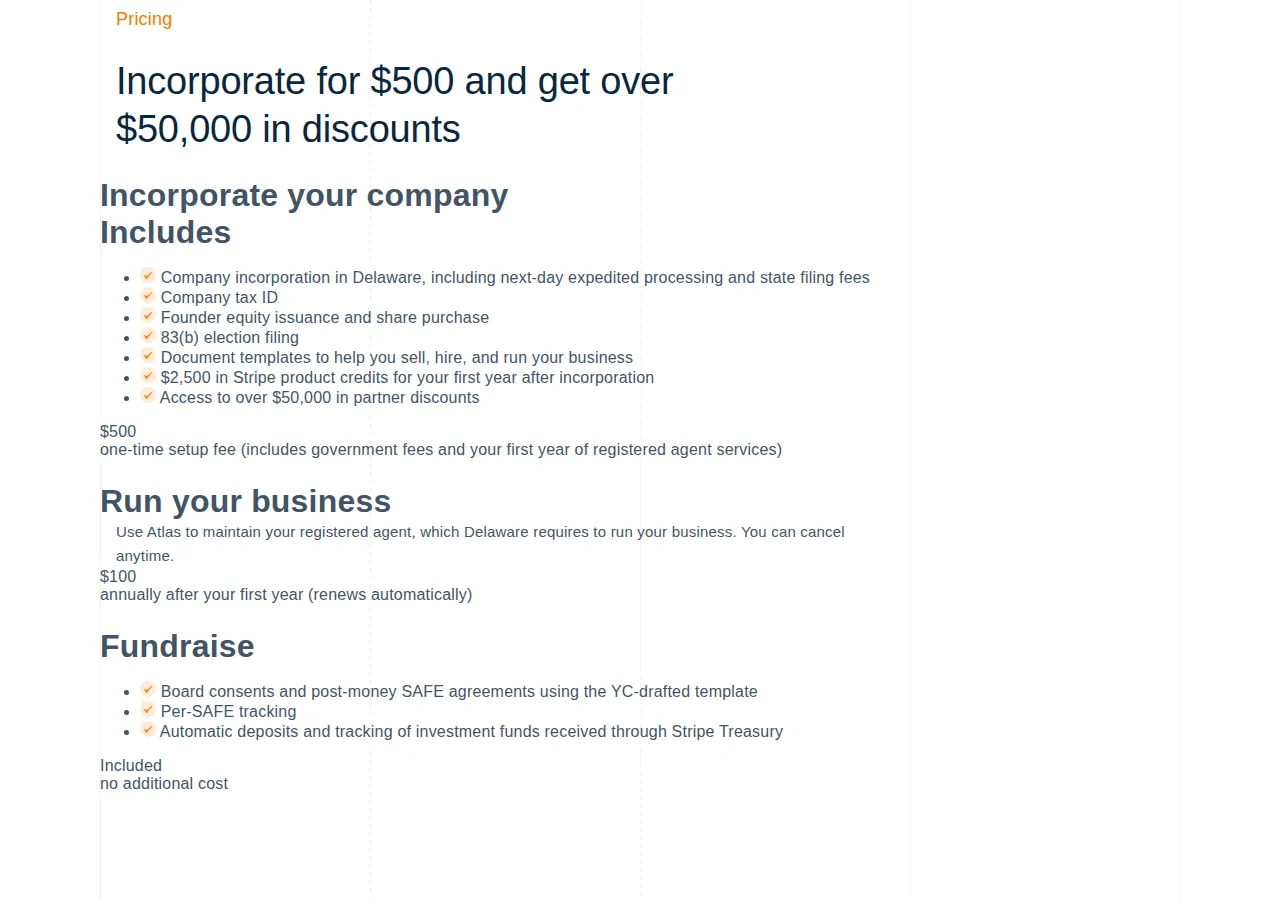
Stripe Atlas charges a $500 one-time setup fee that includes government fees and the first year of registered agent services, and $100 annually after the first year for the registered agent, renewing automatically. Its incorporation list names Delaware incorporation including next-day expedited processing and state filing fees, a company tax ID, founder equity issuance and share purchase, the 83(b) election filing, document templates for selling, hiring, and running the business, $2,500 in Stripe product credits for the first year after incorporation, and access to over $50,000 in partner discounts. Its page also states that more than 170,000 founders have used Atlas to incorporate in Delaware, and presents that scale as its own claim, not as an independent measurement.
Clerky charges $819 as a one-time fee for its Delaware incorporation package. The package includes Delaware incorporation, expedited filing fees for incorporation, the first-year Delaware registered agent fee, and annual report and franchise tax reminders. It expressly excludes add-ons and third-party fees for foreign qualification and for Maintenance products. Foreign qualification in California and New York costs $125 plus third-party fees on Clerky's page, with discounts starting at $160 with partners for other states.
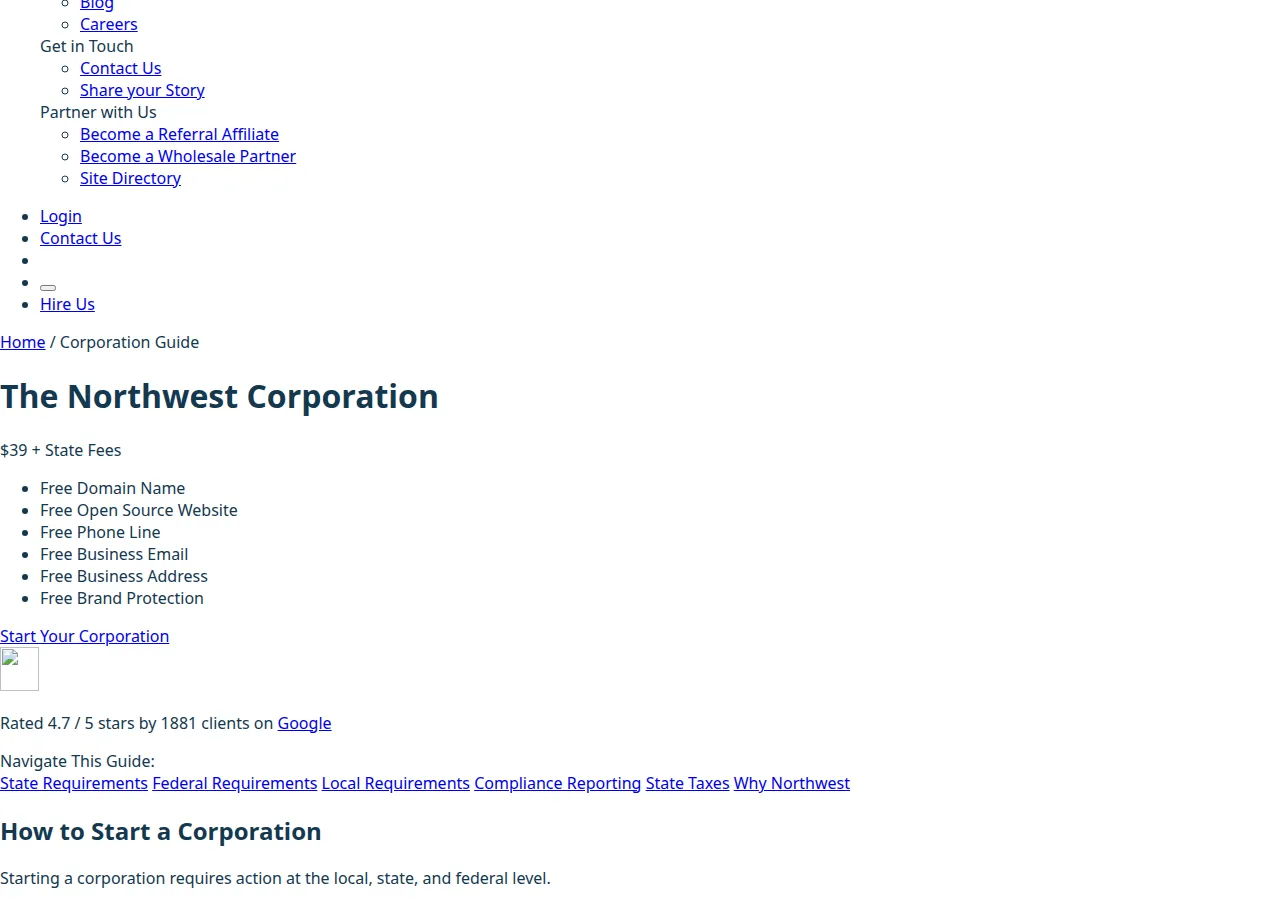
Northwest charges $39 plus state fees for its corporation formation, and the total includes one year of registered agent service. Its registered agent service costs $125 per year. Its corporation page also lists a free domain name, a free open-source website, a free phone line, a free business email, a free business address, and free brand protection as part of the formation offer. The state fees themselves are not a single number: Delaware's filing fees vary with the corporation's share structure, so Northwest's first-year total cannot be stated as one figure without knowing the authorized shares.
| Attribute | Stripe Atlas | Clerky | Northwest | Authority |
| :--- | :--- | :--- | :--- | :--- |
| Headline price | $500 one-time | $819 one-time | $39 plus state fees | Vendor pricing pages, November 2026 |
| Government and state filing fees | Included | Expedited filing fees included | Excluded, added on top | Vendor pricing pages |
| First-year registered agent | Included | Included | Included | Vendor pricing pages |
| Annual agent renewal | $100 per year after year one | Not priced on the package page; first year only | $125 per year | Vendor pricing pages |
| Founder equity and 83(b) | Named in the package | Not named in the package list | Not named in the package list | Vendor pricing pages |
| Foreign qualification | Not priced on the package page | California and New York $125 plus third-party fees | Not priced on the package page | Clerky pricing page |
Worked math: year one, year two, and the crossover
The only honest formula prices the headline, the state fees, and the renewal separately, because each vendor puts a different subset inside the headline:
$
\text{First-Year Total} = \text{Headline Fee} + \text{State Fees Outside the Package}
$
$
\text{Two-Year Total} = \text{First-Year Total} + \text{Year-Two Agent Renewal}
$
Atlas's first-year total is $500, because government fees are included and the first year of agent service is included. Its two-year total is $500 plus the $100 renewal, which is $600, before the franchise tax and any other state obligation.
Clerky's first-year total is $819, because expedited filing fees and the first-year agent are included. Its two-year total is $819 plus a renewal price that the package page does not state. This guide does not estimate that renewal, because an estimated renewal presented as a fact would be fabrication. The honest statement is that Clerky's second year costs $819 plus an unknown renewal, which makes it the most expensive two-year option on every renewal price above zero, and the gap only widens from there.
Northwest's first-year total is $39 plus Delaware state fees, with the first year of agent service included. Its two-year total is $164 plus Delaware state fees, because the second year adds the $125 agent renewal. The crossover against Atlas falls out of that arithmetic:
$
\text{Northwest Beats Atlas When: } \$39 + \text{State Fees} < \$500
$
$
\text{State Fee Crossover} = \$500 - \$39 = \$461
$
If Delaware's state fees for your share structure come in below $461, Northwest is cheaper in year one. If they come in above $461, Atlas's all-in $500 is cheaper before any add-on, and the gap grows in year two because Atlas renews at $100 against Northwest's $125. A founder with a large authorized share count, which raises Delaware filing fees, should therefore get the state fee figure in writing before assuming the $39 headline wins. Before filing, check the company name with the business name checker, because a rejected name restarts the clock on every package equally.
Foreign qualification changes the ranking again. A founder who must register to do business in a home state outside Delaware faces Clerky's stated $125 plus third-party fees for California and New York, and partner discounts starting at $160 for other states. Neither the Atlas nor the Northwest package page prices foreign qualification in the figures above, so a founder with a home-state qualification should add that line to all three totals before comparing, and should confirm in writing whether the chosen vendor handles it at all.
What the headline excludes, and why it matters
Every package excludes the Delaware franchise tax, which arrives every year on March 1 and is calculated on the corporation's capital structure, not on the formation vendor. The franchise tax guide on this site works the two statutory methods to the dollar, and its penalty warning carries over here: a report not filed by March 1 draws a $200 penalty plus interest, and an unpaid balance blocks a certificate of good standing. Formation is a one-time purchase; franchise tax is the annual bill that punishes founders who treat incorporation as finished business.
The packages also differ on what they name, and the unnamed items are where founders get surprised. Atlas names the company tax ID, founder equity issuance, and the 83(b) election filing in its package. Clerky's package list names incorporation, expedited fees, the agent, and reminders, but does not name the tax ID or the 83(b) filing in the list this guide read. Northwest's corporation page names the formation bundle and the agent, but does not name the tax ID or founder equity documents in the list this guide read. That does not mean those vendors lack those services; it means the package page does not promise them, and a founder who needs them should confirm them in writing before paying rather than assuming they are inside.
The same discipline applies to the free extras. Northwest's free domain, website, phone line, business email, business address, and brand protection are real lines on its corporation page, but they are services with their own renewal terms, and a free first year of anything is only free until it renews. Atlas's $2,500 in Stripe credits and $50,000 in partner discounts are real lines on its page too, but credits are not cash, and discounts are only valuable if the founder would buy the discounted product anyway. Price the formation; treat the extras as a tiebreaker, never as the reason.
> [!WARNING]
> Do not file with a service whose renewal price you have not seen. Clerky's package buys the first year of registered agent service, and the renewal price is not on the package page this guide read. Atlas renews at $100 and Northwest at $125, both stated. A founder who compares $819 to $500 without the renewal line is comparing a one-year price to a two-year price, and the error compounds every year the company stays incorporated.
Decision matrix and execution checklist
| Situation | Buy | Why the math says so | Authority |
| :--- | :--- | :--- | :--- |
| Standard venture C-Corp, wants one price | Stripe Atlas | $500 all-in, $600 over two years, EIN and 83(b) named | Stripe Atlas pricing |
| Low share count, state fees under $461 | Northwest | $39 plus state fees undercuts $500 in year one | Northwest corporation page |
| Wants expedited filing plus reminders bundled | Clerky | $819 bundles expedited fees, first-year agent, and reminders | Clerky pricing page |
| Home-state qualification needed | Price all three with the adder | Clerky states $125 plus third-party fees for California and New York | Clerky pricing page |
| Non-standard equity or foreign parent | Lawyer, not a package | No package page promises advice on those structures | Operator boundary, not a vendor claim |
> [!FOUNDER]
> "Founders shop formation the way they shop flights: by the headline, then they pay for the bags at the gate. The headline is a marketing number; the package list is the contract. Read the inclusions line by line, price year two before you celebrate year one, and remember that the cheapest incorporation is the one whose renewal you already know."
> — Enow A. Jovial, Founder & Chief Executive Officer
Operator boundaries: who should not pick each service
Do not pick Northwest on the $39 headline alone if your authorized share count is large, because the state fees that headline excludes can cross the $461 crossover and erase the saving. Do not pick Clerky if an unknown second-year renewal breaks your budget, because the package page buys year one and prices nothing after it. Do not pick Atlas for the partner discounts, because credits and discounts are not formation, and a founder who would not buy the discounted product has saved nothing. Do not pick any package if the entity choice is still open, because the wrong entity filed cheaply is still the wrong entity, and unwinding it costs more than any headline in this guide.
> [!TIP]
> File the franchise tax calendar entry on the day of incorporation, not in February. The March 1 deadline, the $200 penalty, and the good-standing block are all downstream of a filing most founders forget the moment the formation email lands, and the vendor that filed the charter is not the vendor that owes the tax.