The forty-two-dollar federal line, and the bill behind it
Every payroll return carries a line so small it looks like a rounding error: FUTA is 6.0 percent on the first $7,000 of each employee's wages, less a credit of up to 5.4 percent for the state tax paid on time — a net 0.6 percent, or $42 per employee per year.
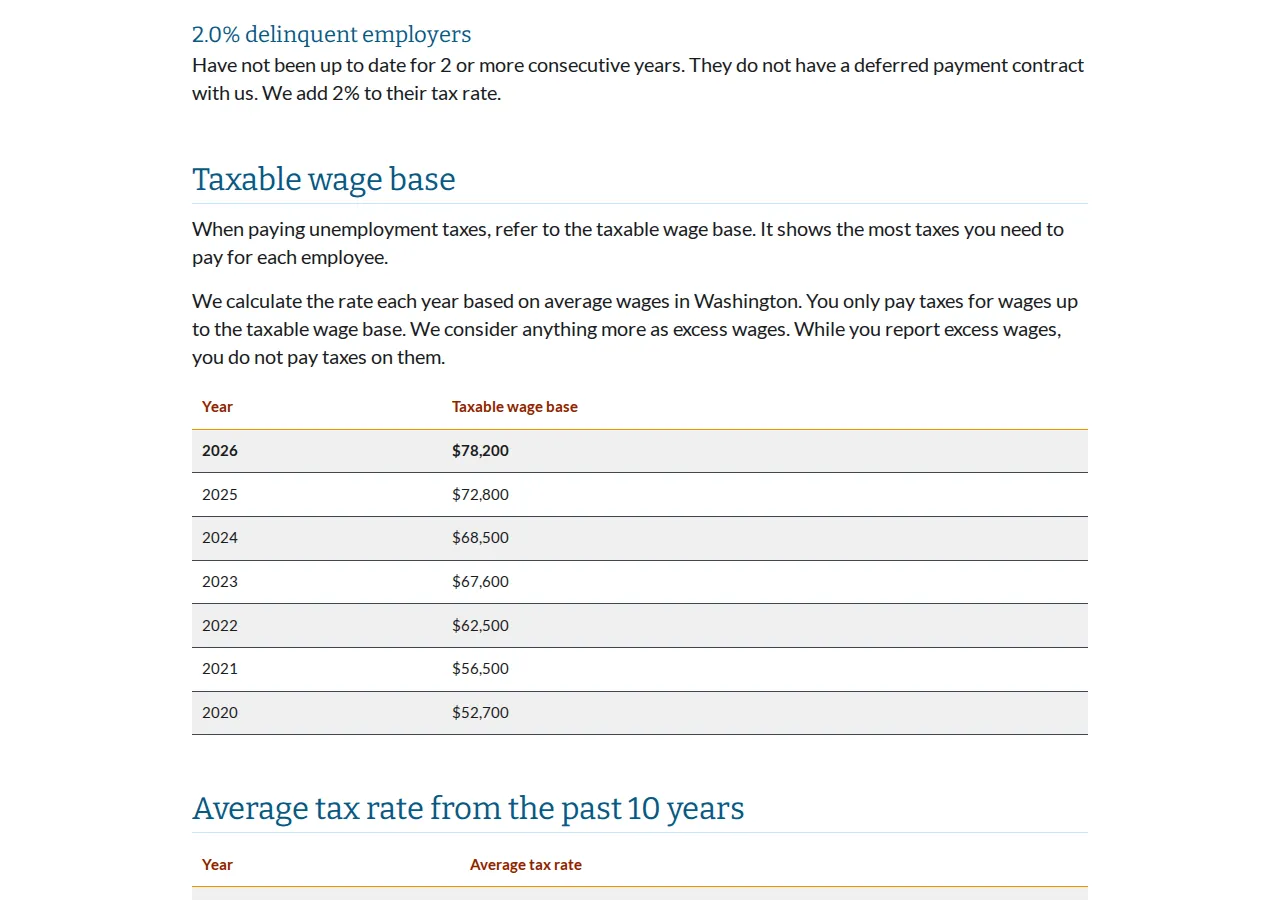
The state bill behind it is the one that moves the budget. SUTA — the state unemployment tax — is set by two numbers your state chooses: a taxable wage base and a rate your own layoff history writes. California taxes the first $7,000 of each employee's pay. Washington taxes the first $78,200. New York's base jumped from $12,800 to $17,600 for 2026. The federal line is a footnote. The state line is a hiring decision.
The federal frame: FUTA, the credit, and the states that lost it
The statute is 26 U.S.C. § 3301: a 6.0 percent tax on wages up to $7,000 per employee per calendar year. The wage base has not moved since 1983. Pay your state unemployment tax in full, on time, on the same wages, and the IRS credits up to 5.4 points against the 6.0 — a net 0.6 percent. No deposit is due until a quarter's cumulative liability passes $500, and Form 940 is due January 31 (February 10 if every deposit was made on time).
A state that borrowed from the federal government to pay benefits and has not repaid becomes a credit-reduction state; the Department of Labor publishes the list each year after November 10. The reduction starts at 0.3 points in the second consecutive year with an outstanding loan and grows 0.3 points a year. For 2026 the final list names one state: California, at 1.5 percent. The U.S. Virgin Islands repaid before the deadline, so it carries no 2026 reduction.
That extra $105 per employee goes into the fourth-quarter deposit due by the end of January. Our IRS Form 940 FUTA annual tax playbook runs the filing and deposit mechanics; this playbook prices the state side that determines the credit.
What SUTA is, and how the rate is built
Each state runs its own program under the same federal-state framework. Two numbers define the bill: the taxable wage base — the slice of each employee's annual pay the tax touches — and the contribution rate, experience-rated on the benefits paid to your former employees against the taxes you paid in.
Two rating methods are in use. The benefit-ratio method divides the benefits charged to your account over a lookback period by your taxable payroll — Washington uses four fiscal years. The reserve-ratio method subtracts benefits charged from taxes paid, then divides by taxable payroll — California's Schedule F+ is a reserve-ratio schedule. More benefits charged means a higher rate, up to the state's maximum; new employers get a flat rate for the first two to three years, and the rate notice for the next year arrives each December.
The bill sits on the same payroll stack as everything else: wages reported on Form W-2, employer FICA at 7.65 percent on those wages, Form 940 for the federal piece, and the state return on the agency's own form — California's DE 9 and DE 9C, New York's NYS-45 — all filed under the company's EIN. The entity type does not change the bill: an LLC, an S-Corp, and a C-Corp all pay SUTA on W-2 wages the same way, and a CPA reviewing the rate notice checks the wage base first, because a wrong base corrupts every number downstream. The bill is the employer's alone in most states — nothing is withheld from the paycheck. Alaska, New Jersey, and Pennsylvania are the exceptions, taking a small employee share (New Jersey's is 0.3825 percent for 2026). Coverage is not universal: several states exclude owner-officers from SUTA coverage, so check the rule before counting an owner's wages — an excluded officer's wages still count for FUTA at the full 6.0 percent on the first $7,000, because the federal credit only applies where state tax was paid.
Four states, one hiring decision
California sits at the $7,000 federal floor; Washington sits at $78,200, the highest base in the nation. The table is the 2026 position from the state agencies' own rate pages, cross-checked against the Equifax 2026 wage-base guide.
| State | 2026 wage base | New-employer rate | Experienced range | Max per employee, new employer | Authority |
|---|---|---|---|---|---|
| California | $7,000 | 3.4% | 1.5%–6.2% | $238 | CA EDD, DE 44 Rev. 52 |
| Texas | $9,000 | 2.70% | 0.32%–6.32% | $243 | TWC, 2026 rates |
| New York | $17,600 | 4.1% combined | 1.7%–9.5% | $721.60 | NY DOL, 2026 rates |
| Washington | $78,200 | 115% of industry avg (min 1%) | 0.27%–6.03% | $782 at 1% | WA ESD, rate table |
New York's row deserves a second look, because it moved the most. The base rose from $12,800 in 2025 to $17,600 in 2026 — a 37.5 percent jump — and from 2026 it adjusts every January 1 to 18 percent of the state average annual wage, so it will keep climbing. The new-employer rate is a 4.025 percent UI rate (3.40 percent normal plus the subsidiary contribution) with a 0.075 percent Re-employment Service Fund charge on top, for a combined 4.1 percent; the maximum new-employer cost rose from $524 to $721.60 per employee in one year. New York also repaid its federal UI loan with $8 billion of reserves, eliminating the Interest Assessment Surcharge, while the maximum weekly benefit rose from $504 to $869 in October 2025 — so future claims cost more even as rates eased.
The math at fifty seats
Take fifty employees each paid at least $60,000. In California and Texas every employee clears the base in the first quarter, so the bill is rate times base times headcount; in Washington the base is high enough that the rate applies to most of the salary.
Two findings fall out: Washington's average rate of 1.33 percent produces the highest bill by a factor of four over California, because the base is eleven times larger; and the new-employer rate is a honeymoon that ends after two to three years, when a layoff-heavy year can push the rate toward the 6.2 percent maximum. The ADP vs Gusto vs Paychex payroll pricing playbook prices the software that files these returns; the IRS Form 941 quarterly payroll tax filing playbook runs the quarterly deposit calendar the state returns ride on.
Experience rating: how the rate is actually set
The rate notice is not a negotiation; it is a formula with your history as the input. Washington's version is the most transparent: the Employment Security Department adds an experience tax (benefits charged over four fiscal years divided by taxable wages, capped at 5.4 percent), a social tax (benefits that cannot be charged to a specific employer, capped at 1.22 percent), and an Employment Administration Fund contribution of 0.02 to 0.03 percent. Experience plus social cannot exceed 6 percent. The department places you in one of 40 rate classes by benefit ratio.
Texas builds the rate from five components. The General Tax Rate is experience-rated from three years of chargebacks multiplied by a 1.20 replenishment ratio; the Replenishment Tax Rate was 0.21 percent in 2026, up from 0.15 percent in 2025, and it replenishes benefits that cannot be charged to a specific employer. The obligation and bond assessments were zero or interest-only in 2026. The commission calculates the combined rate as of October 1 and mails the notice in December.
California's Schedule F+ is Schedule F plus a 15 percent emergency surcharge, rounded to the nearest tenth, unchanged since 2025: the fund is still recovering pandemic-era borrowing from employers rather than from the general fund.
The credit-reduction trap, and the dumping line
The FUTA credit is the quiet link between the state fund and the federal return, and it cuts both ways. When California borrowed to pay benefits and did not repay, its employers lost 1.5 points of credit for 2026 — $105 extra per employee, with no action by the employer and no way to avoid it except hiring elsewhere. The extra tax is treated as incurred in the fourth quarter, so it lands in the deposit due by the end of January. Watch the Department of Labor's final list each November — the final list is set after November 10.
The harder line is SUTA dumping. The schemes are old and the names are plain: an established company with a high rate forms a shell, obtains a separate unemployment account, and reports a small number of wages through it until it earns the minimum rate; or a high-rate employer buys a dormant business with a clean history and moves its operations in so the combined account inherits the favorable rate; or a parent shifts payroll between sister companies; or an employer reports its workers under another employer's account — payrolling — which federal guidance treats as fraud.
Congress answered with the SUTA Dumping Prevention Act of 2004 (Public Law 108-295, signed August 9, 2004), which added subsection (k) to section 303 of the Social Security Act, 42 U.S.C. § 503, and made conforming state law a condition of keeping the state's program federally approved. Every state must now require mandatory experience transfers between commonly controlled employers, prohibit transfers when a business is acquired mainly for its rate, and impose meaningful civil and criminal penalties. New York's penalty is the greater of 10 percent of the wages subject to contribution in the last completed payroll year or $10,000, with a further $10,000 against anyone who advised the scheme. California charges the highest rate provided by law plus an additional 2 percent under section 977(c) of the Unemployment Insurance Code. The rate you inherit in a genuine acquisition is legitimate; the rate you manufacture is not, and the distinction is written into the statute.
Who this is for, and who should stop here
This playbook is for an operator hiring W-2 employees in one or more states, and the finance lead who budgets the state bill before the offer letter. It is not a substitute for the rate notice: the notice the state mails each December is the only authoritative rate for your account — a third-party table is a planning figure, not a filing figure. If your workforce is entirely 1099 contractors, none of this applies until a worker is reclassified — our contractor vs employee classification playbook runs the IRS 20-factor test, and reclassification rewrites the SUTA bill retroactively, with interest. If you hire through an employer of record, the EOR carries the SUTA bill at its rate — our Gusto vs Deel payroll vs global EOR playbook prices that trade-off. Run the state math with our pricing calculator before committing to a headcount plan in a new state.
Founder & CEO Insight — Enow A. Jovial
The execution checklist
Run it in order: Step 1 registration, before the first payroll; Step 2 the December rate notice; Step 3 the quarterly filing rhythm; Step 4 the November credit-reduction check; Step 5 the voluntary-contribution break-even; Step 6 the dumping line you never cross.
- [x] Register before the first payroll: open a state unemployment account in every state where an employee works — the account number is separate from your federal EIN.
- [x] Read the December rate notice: confirm the assigned rate and wage base; a missing notice is not a zero rate — the state will estimate wages and assign one.
- [x] Front-load the budget: the tax applies to the first dollars of the year, so a $7,000-base state collects the whole year's SUTA in the first quarter for a full-time hire; a $78,200-base state spreads it across the year.
- [x] File quarterly, pay quarterly: state returns ride the same calendar as the federal 941 — our IRS Form 941 playbook runs the deposit schedule — and late state payments cost federal credit as well as state penalties.
- [x] Check the November credit-reduction list: if your state is named, accrue the extra FUTA in the fourth quarter; California employers accrue $105 per employee for 2026.
- [x] Run the voluntary-contribution break-even: pay only when the rate saving exceeds the contribution, and respect the deadline — February 15 in Washington.
- [x] Never manufacture a rate: mandatory experience transfers follow common control, and an acquisition made mainly for the rate gets a new-employer rate plus penalties — get the treatment in writing first.