A founder hires three people in one month: a designer in Ohio, an engineer in Berlin, and a support agent in Manila. One payroll vendor cannot employ all three legally. Gusto runs US payroll — W-2 employees, state tax registration, Forms 941 and W-2. Deel is the legal employer where the founder has no entity — contracts, payroll, benefits, and compliance in 130+ countries. The mistake is putting a hire on the wrong side of the boundary, then discovering the classification was wrong when a tax authority asks.
The two prices, verified
Gusto's list prices are a monthly base fee plus a fee per person, month to month, with unlimited payroll runs. The vendor page renders its plan cards client-side, so our direct fetch on 15 November 2026 returned a Cloudflare challenge rather than the cards; the figures below are Gusto's published list prices as corroborated across independent reads of gusto.com/product/pricing in October and November 2026, and they match our own Gusto vs Rippling vs QuickBooks payroll playbook exactly.
| Vendor | Entry | Mid | Top | Authority |
|---|---|---|---|---|
| Gusto (US payroll) | Simple $49/mo + $6/person | Plus $80/mo + $12/person | Premium $180/mo + $22/person | gusto.com/product/pricing |
| Deel (global) | Contractors $49/mo | Contractor of Record $325/mo | EOR $599/mo; US PEO $125/mo | deel.com/pricing, read 15 Nov 2026 |
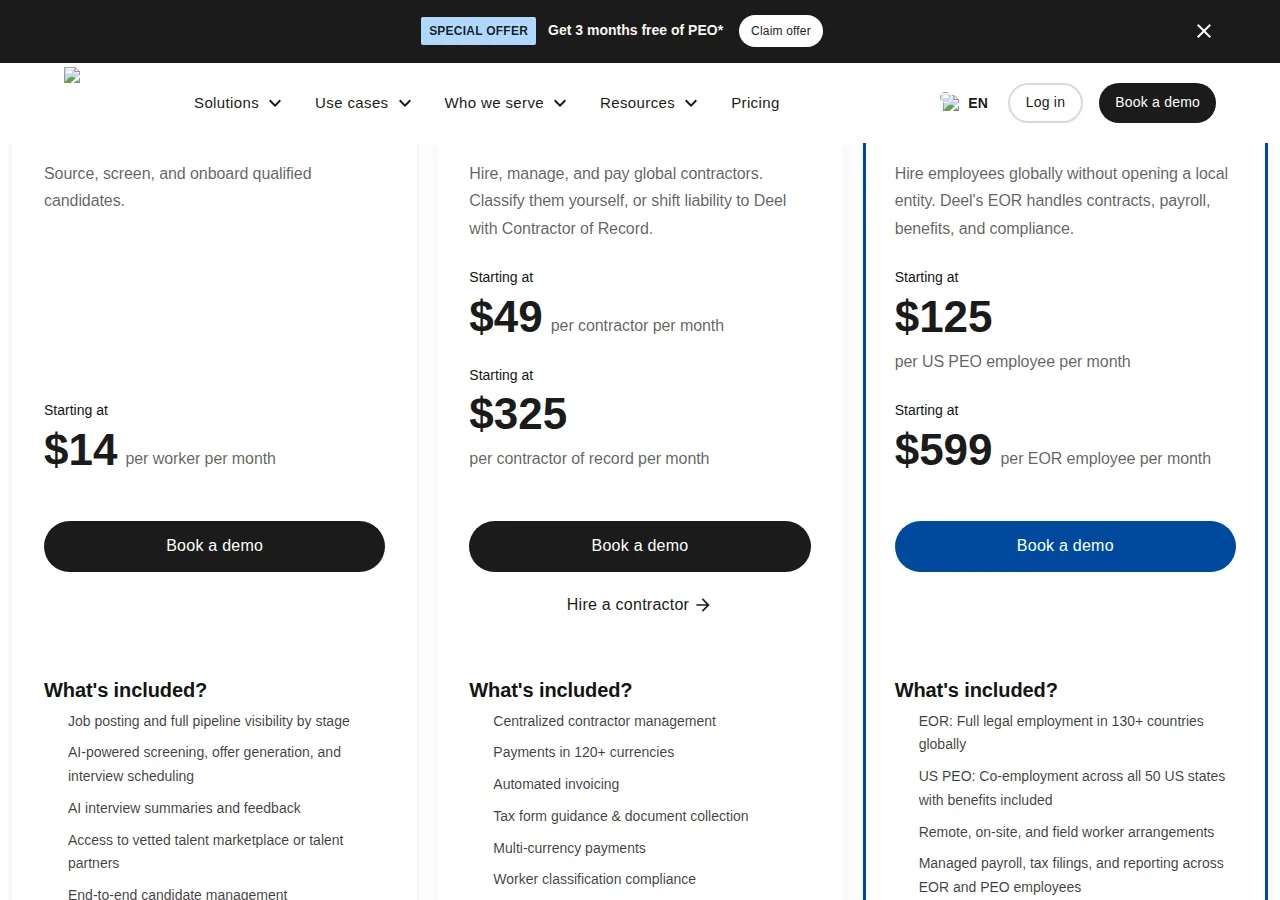
Deel's figures were read directly from deel.com/pricing on 15 November 2026, and the screenshot below shows all five starting prices on one screen: talent sourcing at $14 per worker a month, contractors at $49, Contractor of Record at $325, US PEO at $125, and EOR at $599. Every Deel figure is a starting price — the EOR quote varies by country, and the page offers 3 months free of PEO as a promotion, not a list price.
Two Gusto details from the vendor's own FAQ change the math. First, US contractors are billed at the per-person rate of the plan you select, and only in months when you have paid them — there is no separate contractor plan any more, and plan-update coverage reports the standalone Contractor Only plan closed to new customers on 1 October 2026. Second, global contractor payments carry no monthly per-contractor fee: Gusto charges only a small service and foreign exchange fee for each payment. Gusto is therefore the cheapest way to pay a genuine overseas contractor — and the riskiest, because Gusto does not classify the worker or carry the liability.
US payroll math: Gusto
Gusto's bill is a base fee plus a per-person fee, and the plan is chosen by the team's shape, not its size. Simple covers single-state payroll, tax filings, and employee self-service. Plus adds multi-state payroll, time tracking, and next-day direct deposit — the plan most multi-state teams actually need. Premium adds same-day and instant pay, custom admin roles, and a named account partner.
Example A — ten people, one state. Simple costs $49 plus 10 times $6, which is $109 a month, or $1,308 a year. Plus costs $80 plus 10 times $12, which is $200 a month, or $2,400 a year. Premium costs $180 plus 10 times $22, which is $400 a month, or $4,800 a year.
Example B — the multi-state trigger. A ten-person team spread across three states cannot use Simple at all: multi-state payroll requires Plus. The upgrade costs $91 a month — $1,092 a year — and it is forced by the second state, not by headcount. A team that hires its first out-of-state employee should budget the Plus price from that hire, not from the next renewal.
The add-ons matter at the margin. Priority Support costs $30 a month plus $3 per person on Simple and Plus, per Gusto's own FAQ. Keeping your own health insurance broker costs $6 per eligible employee a month. A ten-person Plus team with Priority Support pays $260 a month — and the broker integration adds another $60. The list price is the floor, not the bill.
Global EOR math: Deel
Deel's bill is per head, per month, with no base fee — and the per-head price is an order of magnitude above Gusto's, because Deel is the legal employer, not a payroll processor. EOR covers the local employment contract, payroll, tax filings, benefits, and compliance in 130+ countries. US PEO at $125 per employee a month is co-employment across all 50 US states with benefits included.
Example C — one EOR hire. One employee on Deel EOR costs $599 a month, or $7,188 a year, before salary, employer taxes, and benefits. Five EOR hires cost $2,995 a month, or $35,940 a year, before salary. The EOR fee is the cost of having no entity — and it is charged whether the hire works out or not.
Example D — contractor vs EOR. A contractor on Deel costs $49 a month, or $588 a year. The same head as an EOR employee costs $599 a month, or $7,188 a year. The gap is $550 a month, or $6,600 a year per head. That gap is not a fee to negotiate. It is the price of employment status: the contract, the benefits, the termination protection, and the liability Deel carries as the employer of record.
Example E — the US comparison that misleads. Ten US hires on Deel PEO cost $1,250 a month. The same ten on Gusto Plus cost $200 a month. The $1,050-a-month gap — $12,600 a year — is real, but the products differ: PEO bundles benefits administration and co-employment, while Gusto Plus is payroll plus HR tools and the buyer still sources benefits separately. Compare PEO against Gusto Plus plus a benefits broker, not against Gusto Plus alone.
The boundary decision
The decision is a routing rule, not a preference. Run every hire through it, and the vendor picks itself.
| Hire | Route | Monthly vendor cost | Authority |
|---|---|---|---|
| US employee, one state | Gusto Simple | $49 + $6/person | gusto.com/product/pricing |
| US employee, multi-state | Gusto Plus | $80 + $12/person | gusto.com/product/pricing |
| US employee, benefits bundled | Deel US PEO | $125/employee | deel.com/pricing |
| Overseas contractor, genuine | Gusto global payments or Deel Contractors | Per-payment fee, or $49/mo | Gusto FAQ; deel.com/pricing |
| Overseas worker, classification risk | Deel Contractor of Record | $325/mo | deel.com/pricing |
| Overseas employee, no entity | Deel EOR | $599/mo | deel.com/pricing |
| Overseas employee, own entity | Deel Global Payroll or Gusto + local payroll | Quote per country | deel.com/pricing |
The Deel vs Remote vs Oyster EOR pricing playbook prices the EOR side of this table across three vendors, and the Gusto vs Rippling vs QuickBooks payroll playbook prices the domestic side across three payroll vendors. This playbook is the boundary between them: it answers which side a hire belongs on, not which vendor wins inside a side.
Misclassification: the line that costs real money
The cheapest route in the table — the $49 contractor — is also the one that carries the most risk, because the label does not decide the status. The IRS applies common-law rules: facts showing the degree of control and independence fall into three categories, and businesses must weigh all of them. There is no magic number of factors that makes a worker an employee or a contractor, and no single factor stands alone.
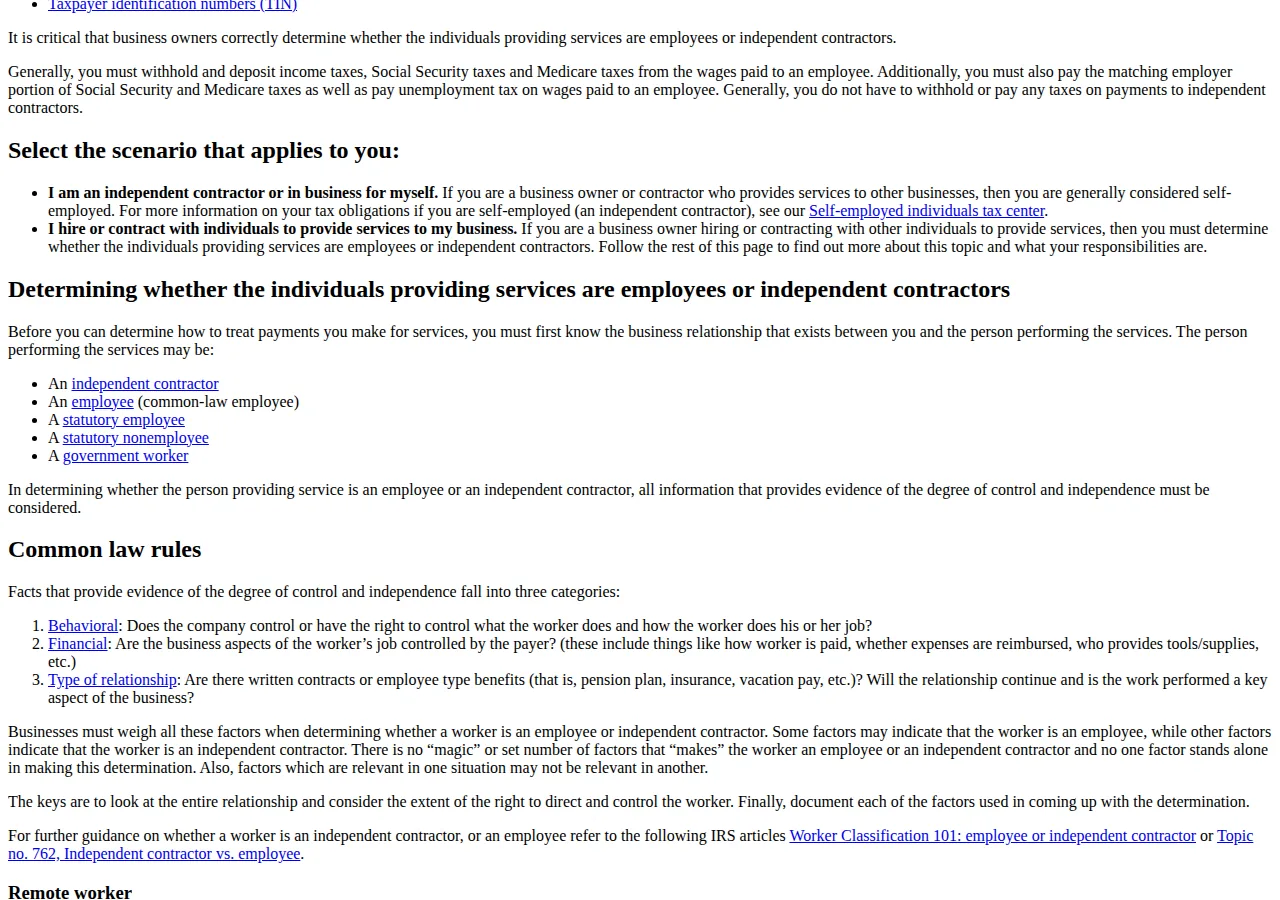
The three categories, from the IRS page itself, are behavioral control — does the company control what the worker does and how they do it; financial control — are the business aspects of the job controlled by the payer, including how the worker is paid, whether expenses are reimbursed, and who provides tools; and type of relationship — written contracts, employee-type benefits such as pension, insurance, and vacation pay, whether the relationship continues, and whether the work is a key aspect of the business. A worker paid monthly, given a company laptop, set hours, and a manager's direction fails the test on all three categories at once, whatever the contract calls them.
The exposure is not a single fine. A reclassified worker triggers back withholding, the employer share of Social Security and Medicare, corrected Forms 941, state unemployment and workers' compensation, and benefits the worker should have received. Form SS-8 — Determination of Worker Status for Purposes of Federal Employment Taxes and Income Tax Withholding — is the IRS vehicle for asking the question formally, and either the business or the worker can file it. The contractor vs employee classification playbook walks the twenty-factor test in full. Run the three-category test through the ROI calculator before choosing the $49 route.
The conversion ladder
When a contractor relationship matures into employment, convert it on a ladder, not in one jump. Each rung costs more and moves liability off the buyer.
Rung 1 — contractor, $49 a month. The buyer classifies the worker, pays through Deel Contractors or Gusto global payments, and carries the classification risk. Use it only for genuinely independent workers: own tools, own schedule, multiple clients, paid per deliverable.
Rung 2 — Contractor of Record, $325 a month. Deel carries the classification liability. The cost rises $276 a month — $3,312 a year — and the buyer keeps the contractor relationship while Deel warrants the classification. Use it when the work looks like employment but the engagement is short or the headcount case is not yet made.
Rung 3 — EOR employee, $599 a month. Full local employment: contract, payroll, benefits, termination protection. The cost rises $274 a month from Rung 2 — $3,288 a year — and the worker becomes an employee of Deel in their country. Use it when the hire is permanent, full-time, and core to the business.
Rung 4 — own entity plus payroll. When EOR headcount in one country passes the point where $599 a month per head exceeds the cost of a local entity and payroll, incorporate and run payroll there. There is no published threshold for this rung, because entity costs vary by country; price it per country and revisit it every year.
Who should not buy what
Do not buy Deel EOR for a US hire: Gusto Plus does the same job for $200 a month for ten people against $5,990 on EOR. Do not buy Gusto for an overseas employee: Gusto runs US payroll, and a Berlin engineer paid through it has no employment contract under German law. Do not keep a full-time, single-client, manager-directed worker on the $49 contractor rung to save $550 a month — the reclassification exposure is a multiple of the saving. And do not compare Deel PEO against Gusto Plus without adding the benefits broker to the Gusto side.
Founder & CEO Insight — Enow A. Jovial
Hiring checklist
- [x] Step 1 — Route the hire: US employee to Gusto, overseas employee with no entity to Deel EOR, genuine overseas contractor to Deel Contractors or Gusto global payments.
- [x] Step 2 — Price the plan the geography forces: Multi-state means Gusto Plus at $80 plus $12 per person, not Simple. Count the add-ons: Priority Support at $30 plus $3 per person, broker integration at $6 per eligible employee a month.
- [x] Step 3 — Run the three-category test: Behavioral control, financial control, type of relationship. Document each factor and the conclusion — the IRS weighs the whole relationship, and the file is the defence.
- [x] Step 4 — Pick the rung: $49 contractor for genuinely independent work, $325 Contractor of Record where classification is doubtful, $599 EOR for permanent full-time hires.
- [x] Step 5 — File Form SS-8 when in doubt: Either side can ask the IRS to determine worker status. A determination beats a reclassification.
- [x] Step 6 — Convert on the ladder: Contractor to Contractor of Record to EOR to own entity, one rung at a time, with a new local contract at each step.
- [x] Step 7 — Re-price every year: EOR fees are starting prices that vary by country, and Gusto has repriced twice since 2024. Confirm both at renewal.
The boundary is the whole decision. A US hire on Gusto Plus costs $200 a month for ten people; the same ten on Deel EOR cost $5,990 — and the right answer is not the cheaper number, it is the hire's location. Run the per-head math through the ROI calculator for your own team shape, then route every hire through the table before the offer goes out.