The tax that moved upstairs
A partner in a New York partnership earning 1,000,000 dollars of pass-through income paid New York income tax personally and deducted it on Schedule A. The Tax Cuts and Jobs Act capped that deduction at 10,000 dollars, so most of the state tax became nondeductible federally. The pass-through entity tax election moves the same tax bill one floor up: the entity pays it, the entity deducts it, and the owner claims a state credit for the share. The deduction changes address, from the owner return to the entity return.
IRS Notice 2020-75, issued November 9, 2020, is the document that makes the move safe. It says a Specified Income Tax Payment — a state or local income tax imposed on and paid by a partnership or an S corporation — is deductible by the entity in computing its non-separately stated taxable income for the year of payment. The payment is not separately stated to the owners under sections 702 or 1366, so it never appears on the owner Schedule A and is not counted toward any owner SALT limitation. The notice covers payments made on or after November 9, 2020, reaching back to tax years ending after December 31, 2017.
The cap the election escapes
Section 164(b)(6), as rewritten by Public Law 119-21, section 70120, caps an individual state and local tax deduction. The amount is 40,000 dollars for 2025, 40,400 dollars for 2026, rising 1 percent a year through 2029, then 10,000 dollars from 2030. The cap phases down by 30 percent of modified adjusted gross income over a threshold — 500,000 dollars in 2025, 505,000 dollars in 2026 — and cannot fall below 10,000 dollars. A married individual filing separately gets half of each figure. At 600,000 dollars of 2025 MAGI the owner is at the 10,000 dollar floor: 100,000 dollars of excess times 30 percent is the 30,000 dollar reduction.
That schedule is why the election still matters. An owner with 65,000 dollars of state and local tax deducts 40,000 dollars and strands 25,000 dollars; an owner at the floor deducts 10,000 dollars and strands 55,000 dollars. The election recovers the stranded part by moving the state income tax to the entity, which section 164(b)(6) does not reach. The SALT cap 40,000 dollar playbook prices the cap, the phase-down, and the 2030 cliff; this playbook prices the election that gets around it.
| Year | Cap (MFJ) | Phase-down | MAGI at the floor | Authority |
|---|---|---|---|---|
| 2025 | 40,000 dollars | 500,000 dollars | 600,000 dollars | § 164(b)(7) |
| 2026 | 40,400 dollars | 505,000 dollars | 606,333 dollars | § 164(b)(7) |
| 2027–2029 | Prior year plus 1 percent | Prior year plus 1 percent | Rises with the threshold | § 164(b)(7) |
| 2030 | 10,000 dollars | None | Cap is the floor | § 164(b)(7) |
Worked example: New York, 1,000,000 dollars of PTE income
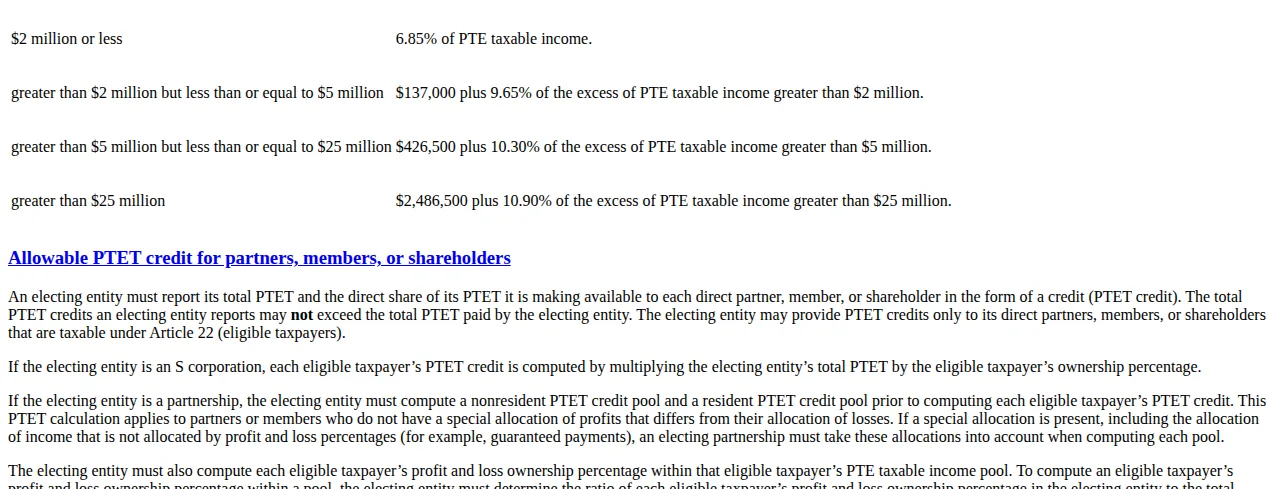
Example: a two-partner New York partnership earns 1,000,000 dollars of PTE taxable income, all New York source, split equally. Article 24-A imposes the PTET in four brackets — 6.85 percent to 2,000,000 dollars, 9.65 percent to 5,000,000, 10.30 percent to 25,000,000, and 10.90 percent above — so the whole base sits in the first bracket.
The entity deducts the 68,500 dollars federally, so each partner K-1 income falls by 34,250 dollars. The owner also pays 10,000 dollars of property tax. Without the election the owner SALT is 78,500 dollars, capped at 40,000 dollars — 38,500 dollars stranded. With the election the entity deducts 68,500 dollars and the owner deducts the 10,000 dollars of property tax, so the stranded 38,500 dollars is recovered. At the 37 percent top rate under section 1, the recovered deduction is worth 14,245 dollars before the QBI drag.
The QBI drag then takes its cut: the 68,500 dollar payment lowers qualified business income, so the section 199A deduction falls by 20 percent of 68,500 dollars, or 13,700 dollars, costing 5,069 dollars of tax at 37 percent. The net federal saving is 9,176 dollars — the figure a CPA should quote, not the 25,345 dollars from multiplying the whole PTET by 37 percent and ignoring the cap room and the QBI effect.
On the New York side, each partner claims a 34,250 dollar PTET credit on Form IT-653; any excess is refunded without interest under Tax Law section 606(kkk). The credit is not free at the state level: the claimant adds it back through Form IT-225, so the state taxes the addback at the owner marginal rate. The election is made online through the entity Business Online Services account, January 1 through March 15, by an authorized person only, and is irrevocable after the first estimated payment due date. Estimates are due March 15, June 15, September 15, and December 15, each at least 25 percent of the required annual payment — the lesser of 90 percent of current-year PTET or 100 percent of prior-year PTET; a first-year elector uses 90 percent of current-year tax. Payments go by ACH debit only. The annual return is due March 15, with a six-month extension available.
Worked example: California, 500,000 dollars of qualified net income
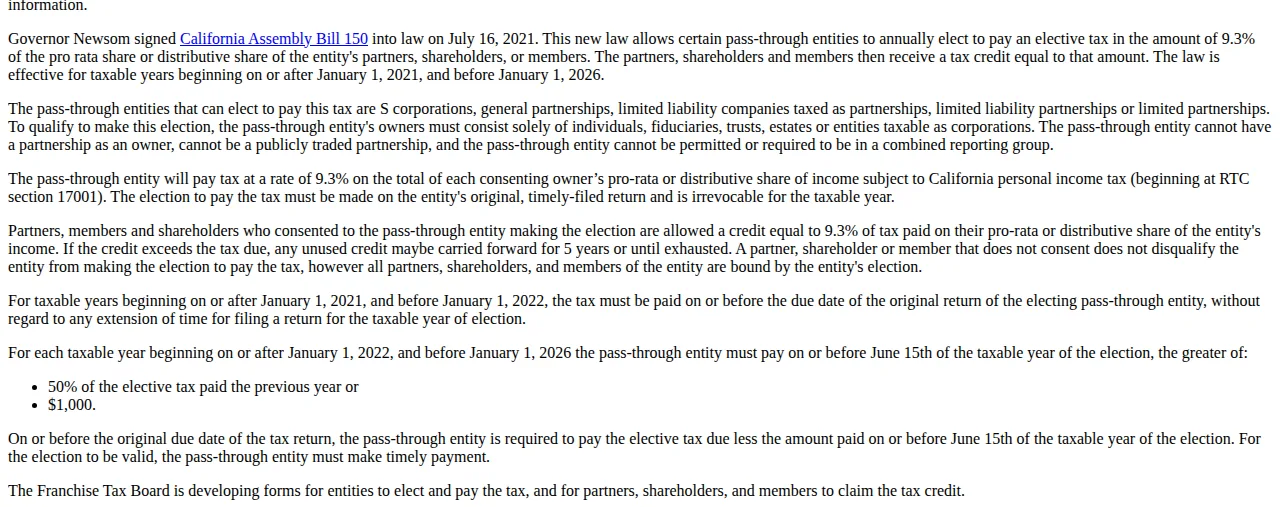
Example: a California S corporation with 500,000 dollars of qualified net income elects under Assembly Bill 150, signed July 16, 2021. California charges a flat 9.3 percent on the consenting owners share of income subject to California personal income tax, under Revenue and Taxation Code section 17052.10.
The owners receive a credit equal to 9.3 percent of their share. The credit is nonrefundable, and any unused credit may be carried forward up to five years, per the 2025 instructions for Form FTB 3804-CR. Assume the owner personal SALT already fills the 40,000 dollar cap, so the whole 46,500 dollars is incremental: gross federal value at 37 percent is 17,205 dollars; the QBI drag is 20 percent of 46,500 dollars, or 9,300 dollars, taxed at 37 percent for 3,441 dollars; the net is 13,764 dollars.
California differs in three places. First, the election is made on the entity original, timely filed return and is irrevocable for the taxable year — no March 15 window, no separate filing. Second, for tax years from 2022 the entity must pay by June 15 the greater of 1,000 dollars or 50 percent of the prior-year elective tax, with the balance due on the original return due date. Third, eligibility is narrow: owners must be solely individuals, fiduciaries, trusts, estates, or entities taxable as corporations — no partnership owner, no publicly traded partnership, no combined reporting group. A non-consenting owner does not disqualify the entity, but every owner is bound by the election. The FTB September 2021 notice states the law covers tax years 2021 through 2025; the AICPA December 2025 map carries California to December 31, 2030 — confirm the current year on the FTB site.
The state map: 36 states and one city
As of December 19, 2025, the AICPA map counts 36 states and one locality — New York City — with an enacted PTET. Pennsylvania and the District of Columbia have active proposed bills; nine states have no owner-level personal income tax; Delaware, North Dakota, and Vermont have an owner-level tax but no regime. Connecticut is the outlier: mandatory from 2018 through 2023, elective from 2024. Regimes sunset on fixed dates — Minnesota, Oregon, Utah December 31, 2025; Virginia December 31, 2026; California December 31, 2030; Illinois permanent.
| State | Rate | Credit | Election deadline | Authority |
|---|---|---|---|---|
| New York | 6.85–10.90 percent, four brackets | Refundable, Form IT-653 | March 15 | Article 24-A |
| California | 9.3 percent flat | Nonrefundable, 5-year carryforward | Timely filed return | R&TC § 17052.10 |
| Connecticut | Mandatory to 2023, elective from 2024 | Credit per statute | DRS calendar | AICPA map, Dec 2025 |
The QBI drag, priced honestly
The QBI interaction is the most commonly skipped line in PTET marketing: Notice 2020-75 puts the payment into non-separately stated income, the base from which qualified business income is measured. Section 199A(a) allows 20 percent of qualified business income, so every PTET dollar shrinks the section 199A deduction by 20 cents for an owner who otherwise gets the full 20 percent. At 37 percent, that is 7.4 cents of tax per PTET dollar, and it applies to the whole PTET amount, not only to the stranded part. In the New York example the drag is 5,069 dollars; in California it is 3,441 dollars. Owners already phased out of section 199A — specified service trades or businesses above the thresholds — feel no drag at all, one of the few situations where being phased out helps. Section 199A is now permanent: Public Law 119-21, section 70105, struck the December 31, 2025 sunset from section 199A(i) and widened the wage-limitation phase-in to 75,000 dollars single and 150,000 dollars joint. The section 199A QBI deduction playbook runs the phase-out math, and the Schedule K-1 playbook shows how the reduced income reaches the owner return.
Election mechanics and the calendar
Founder & CEO Insight — Enow A. Jovial
Who should NOT elect
Do not elect if your state has no PTET regime — Delaware, North Dakota, and Vermont have nothing to elect into. Do not elect if your personal SALT sits below the cap; the election recovers nothing and adds compliance cost. Do not elect on a small entity where CPA fees and quarterly administration exceed the net saving — on a 10,000 dollar PTET the net saving after the QBI drag is roughly 2,960 dollars at 37 percent where the owner is already at the cap. Do not elect if a corporate partner or a partnership-partner holds a large share: the credit cannot reach them and the entity still pays. Do not elect in a loss year: the payment is deductible against income that may not arrive, and New York forbids transferring estimated payments to the partners — the entity files and claims the refund itself.
The execution sequence
- Confirm the state has a regime: check the AICPA map, then the state revenue page. Do not rely on last year list — regimes sunset.
- Price the election on last year numbers — PTET at the state rate, minus the SALT already deductible under the cap, at the owner marginal rate, less the QBI drag at 20 percent — and check it in the tax estimator.
- Check owner eligibility: every owner who needs the credit must be a direct individual subject to the state personal income tax. Flag corporate and partnership owners.
- Calendar the deadline: New York elects January 1 to March 15; California prepays by June 15. Diary February 1 as the decision date.
- Make the election through the right channel: New York, authorized person, online; California, original timely filed return, Form FTB 3804.
- Fund the estimated payments: New York quarterly by ACH debit; California June 15 prepayment of the greater of 1,000 dollars or 50 percent of prior-year tax.
- Claim and reconcile: issue K-1 statements with each owner share, claim the credit on Form IT-653 or FTB 3804-CR, add it back on Form IT-225 in New York, and carry any unused California credit forward five years.
The execution checklist
- [x] State regime confirmed: AICPA map plus state revenue page, sunset date noted.
- [x] Net saving priced: PTET, cap room, QBI drag, and state addback in one calculation.
- [x] Owners screened: direct individuals only for the credit; corporate and partnership owners flagged.
- [x] Deadlines diarised: February 1 decision, March 15 New York election, June 15 California prepayment.
- [x] Election made correctly: authorized person in New York; timely filed return in California.
- [x] Payments funded: quarterly ACH in New York; June 15 prepayment in California; no transfers.
- [x] Credit claimed: Form IT-653 or FTB 3804-CR filed, Form IT-225 addback made, unused credit carried forward.
The election is worth exactly what the worked math says — no more. On a 1,000,000 dollar New York base that is 9,176 dollars net; on a 500,000 dollar California base, 13,764 dollars net. Both assume the owner is at the 37 percent rate, gets the full 20 percent section 199A deduction, and has no other shelter for the state tax. Change any assumption and the answer changes: the election is a calculation first and a filing second. The Schedule K-1 versus 1099 playbook covers which form the owner receives for the reduced income.