Two forms, two opposite mistakes
Every January, two kinds of paper land on the same desks. A Schedule K-1 taxes a partner on income the partnership never sent them. A Form 1099 reports money a payer actually paid. Recipients read the K-1 like a pay stub and underpay; payers file a 1099 for a partner and double-report income that already passed through on the K-1.
Who gets which form
The decision is the relationship, not the amount — partner, shareholder, contractor, landlord, lender, seller, employee, or beneficiary — and the table below maps each one to its form.
| Recipient | Form received | What it reports |
|---|---|---|
| Partner in a partnership or LLC taxed as a partnership | Schedule K-1 (Form 1065) | Distributive share of income, loss, deductions |
| Shareholder in an S corporation | Schedule K-1 (Form 1120-S) | Pro rata share of corporate items |
| Independent contractor | Form 1099-NEC, Box 1 | Nonemployee compensation paid |
| Landlord, prize winner, or other payee | Form 1099-MISC | Rents, prizes, other income |
| Platform or payment-app seller | Form 1099-K | Gross third-party network payments |
The boundary that trips operators is the partner who also works for the business: services are paid as guaranteed payments, reported on the K-1 in Box 4 under section 707(c), and the same partner can also receive a 1099-NEC for separate nonemployee compensation.
What changed in 2026: the thresholds moved
The One Big Beautiful Bill Act, signed July 4, 2025, rewrote the two numbers every payer memorized. Section 70433 substituted 2,000 dollars for 600 dollars in section 6041(a), for payments made after December 31, 2025: a contractor paid 1,500 dollars across 2026 gets no 1099-NEC; the same payments in 2025 required one. Section 70432 reinstated the original Form 1099-K threshold in section 6050W(e) — more than 20,000 dollars and more than 200 transactions — retroactive to 2022, cancelling the planned 600 dollar step for 2026. The IRS confirmed it in IR-2025-107 (October 23, 2025).
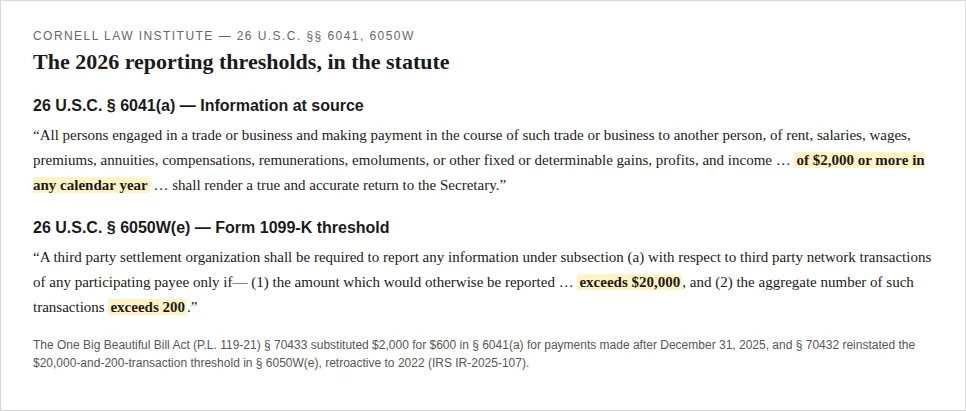
Royalties and gross proceeds paid to an attorney are reported under their own instruction-level thresholds in the Instructions for Forms 1099-MISC and 1099-NEC, not the section 6041(a) figure — confirm the current thresholds in the revision in force before filing. From 2027 the 2,000 dollar figure is indexed under section 6041(h). Three cautions: the threshold governs paperwork only — ten clients at 1,500 dollars each still means 15,000 dollars reported; several states kept their own 600 dollar threshold; and the W-9 rule did not change — collect the number at onboarding.
The K-1 side: taxed before the cash
Section 702(a) requires each partner to take into account separately the distributive share of the partnership's items, and section 702(b) preserves each item's character as if the partner had realized it directly. Section 1366(a) does the same for S corporation shareholders, on a pro rata share. The partnership pays no income tax itself; the tax lands on the owners, one K-1 at a time.
Take a stated example: a partnership earns 200,000 dollars and distributes nothing. A 25 percent partner reports 50,000 dollars of income and owes tax on it, with zero cash in hand. That is phantom income. The cure is planning: tax distributions in the partnership agreement, or cash reserves held against the K-1. The same partner the next year, allocated a 60,000 dollar loss, cannot simply deduct it: the loss must clear four gates in order — sections 704(d), 465, 469, and 461(l) — and a loss that fails a gate is suspended, not lost. The full gauntlet is in the Schedule K-1 playbook.
Two boxes recipients most often miss: Box 14, self-employment earnings, and Box 20, code Z, the section 199A information. A general partner with 90,000 dollars of net earnings from self-employment owes the SECA tax on 92.35 percent of that figure, at 15.3 percent:
The 12.4 percent Social Security portion is 10,306.26 dollars and the 2.9 percent Medicare portion is 2,410.34 dollars, both on the K-1 figure, not on cash distributed. Box 20, code Z, feeds Form 8995 or 8995-A; phaseout rules are in the section 199A QBI deduction SSTB phaseout playbook. Run the estimate first with the tax estimator before the K-1 arrives.
The 1099 side: the payer reports, you report again
A 1099 is the payer's return, not yours: section 6041(a) requires any person engaged in a trade or business who pays 2,000 dollars or more in the calendar year to render a return. The payer files it and furnishes your copy; you report the income yourself — Schedule C for a contractor, Schedule E for a landlord, Schedule B for interest and dividends. The form reports gross amounts: no expenses netted, no losses. A contractor paid 50,000 dollars reports the gross amount and deducts expenses separately; a partner allocated 50,000 dollars reports it with no Schedule C at all.
Box numbers: 1099-NEC Box 1, nonemployee compensation; 1099-MISC Box 1 rents, Box 2 royalties, Box 3 other income, Box 10 attorney gross proceeds; 1099-K gross platform payments before fees, refunds, or shipping; 1099-INT and 1099-DIV interest and dividends at a 10 dollar threshold. Detail is in the 1099-NEC contractor reporting playbook.
Backup withholding is the enforcement arm: section 3406(a)(1) requires the payer to withhold at the fourth lowest rate under section 1(c), which the IRS states plainly as 24 percent. It triggers when the payee fails to furnish a taxpayer identification number — an EIN, SSN, or ITIN — the IRS flags the number as incorrect, or the payee underreported interest and dividend income. The withheld amount is not a penalty and not lost: it is reported on the 1099 and claimed as a credit:
The trigger is almost always a missing or wrong W-9 — which is why the W-9 belongs at onboarding, not at year end.
Deadlines: the 2026 tax year, due in 2027
The K-1 rides on the entity return: Form 1065 is due March 15, 2027 for a calendar-year partnership, and the K-1s must reach partners by the same date. Form 7004 buys a six-month extension of the filing deadline to September 15, 2027 — it extends filing, never payment. The 1099-NEC is due January 31 for both copies — February 1, 2027, because January 31 falls on a Sunday — with no automatic extension. The 1099-MISC recipient copy follows the same date; the IRS copy is due March 1, 2027 on paper, March 31, 2027 e-filed.
| Form | Recipient copy | IRS copy | Extension |
|---|---|---|---|
| Schedule K-1 (Forms 1065 / 1120-S) | March 15, 2027 | March 15, 2027 | Form 7004 |
| Form 1099-NEC | Feb. 1, 2027 | Feb. 1, 2027 | None automatic |
| Form 1099-MISC | Feb. 1, 2027 | Mar. 1, 2027 paper; Mar. 31, 2027 e-file | Form 8809 |
| Form 1099-K / 1099-INT / 1099-DIV | Feb. 1, 2027 | Mar. 1, 2027 paper; Mar. 31, 2027 e-file | Form 8809 |
Form 8809 gives a 30-day extension to file most information returns — not Forms W-2 and 1099-NEC — and never extends the furnishing date. At 10 or more information returns, e-filing is mandatory under Treasury Decision 9972; the IRS offers IRIS, its free filing portal.
The penalty ladder, worked per return
Sections 6721 and 6722 are two penalties for two failures — failing to file a correct return with the IRS, and failing to furnish a correct payee statement. For returns due in 2026: 60 dollars per return within 30 days after the due date, 130 dollars if more than 30 days late but by August 1, 340 dollars after August 1 or not filed; intentional disregard costs at least 680 dollars per return or statement, with no maximum. Annual maximums: 683,000 dollars, 2,049,000 dollars, and 4,098,500 dollars for large businesses; 239,000 dollars, 683,000 dollars, and 1,366,000 dollars for small businesses.
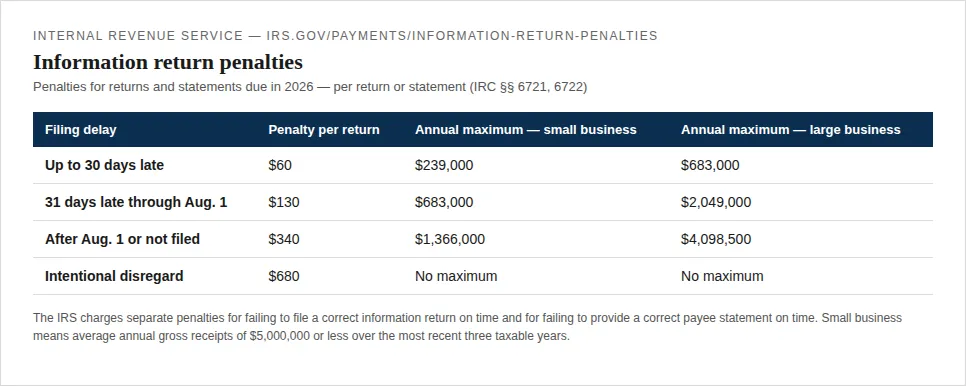
Forty 1099-NECs filed after August 1 cost 40 times 340 dollars on each side:
The same forty forms corrected within 30 days cost 40 times 60 dollars on each side:
The K-1 side has its own meter: a late Form 1065 costs 255 dollars per partner per month, up to 12 months, under section 6698 — the same figure applies to a late Form 1120-S under section 6699 — and a late K-1 adds 340 dollars per statement under section 6722. Four partners, three months late:
For returns due in 2027, section 6698 rises to 260 dollars per partner per month (Revenue Procedure 2025-32).
The decision table
| Decision dimension | Schedule K-1 | Form 1099 | Authority |
|---|---|---|---|
| Who receives it | Partner / S-corp shareholder | Contractor, landlord, seller, investor | IRC §§ 702, 1366, 6041 |
| What it measures | Share of entity income | Gross amount paid | IRC §§ 702(a), 6041(a) |
| Taxed without cash? | Yes — taxed when allocated | No — reports cash actually paid | IRC § 702 |
| Loss reported? | Yes, subject to four gates | Never — deductions on your return | IRC §§ 704(d), 465, 469 |
| 2026 reporting threshold | None | 2,000 dollars; royalties and attorney proceeds under instruction-level thresholds | IRC § 6041(a) |
| Recipient deadline, 2026 year | March 15, 2027 | Feb. 1, 2027 (NEC, MISC) | IRS instructions |
| Withholding on the form | None | 24 percent if TIN fails | IRC § 3406; IRS |
| Late penalty, per form | 255 dollars per partner/month; 340 per K-1 | 60 to 340 dollars per return, twice | IRC §§ 6698, 6721, 6722 |
Founder & CEO Insight — Enow A. Jovial
Cross-border: 1042-S and the foreign owner
A foreign recipient does not get a 1099 for U.S.-source fixed income: section 871(a) imposes a 30 percent tax on fixed or determinable annual or periodic (FDAP) income — interest, dividends, rents, royalties — received by a nonresident alien from U.S. sources, and the payer withholds it and reports it on Form 1042-S. A treaty can cut the rate, sometimes to zero for interest, but only with Form W-8BEN furnished before payment. Without it, the payer withholds the full 30 percent. A foreign partner in a U.S. partnership still receives a Schedule K-1, plus Schedule K-3, with the partnership withholding under section 1446 on effectively connected income (ECI).
Who should not rely on which form
Do not treat a K-1 as proof of income received: a lender underwriting on the K-1 total without checking distributions lends against cash that never arrived. Do not treat a 1099 as proof of profit: a contractor with 50,000 dollars on a 1099-NEC and 48,000 dollars of expenses has 2,000 dollars of profit, which the form never shows. Do not file a 1099 for a partner's distributive share: the K-1 already reports it, and the duplicate invites a matching notice. Do not skip the 1099 because the contractor is a friend or paid in cash: the method does not change the duty.
The January sequence
- Collect the numbers. W-9 or W-8BEN on file before the first payment.
- Classify each payee. Partner, contractor, lender, seller — the relationship picks the form.
- File the 1099s first. February 1, 2027 for NEC and MISC — no automatic extension on the NEC.
- Furnish the K-1s by March 15. The K-1s share the entity return's date.
Execution checklist
- [x] Classify every payee before the first payment — the relationship picks the form.
- [x] Collect W-9 or W-8BEN at onboarding.
- [x] Track the 2026 thresholds: 2,000 dollars for NEC and MISC, royalties and attorney gross proceeds under their own instruction-level thresholds, 20,000 dollars and 200 transactions for 1099-K.
- [x] Calendar the two deadlines: 1099-NEC February 1, 2027, no extension; K-1s March 15, 2027.
- [x] Reserve for phantom income: tax on 50,000 dollars allocated and zero distributed is still owed.
- [x] Run the K-1 gates before deducting: basis, at-risk, passive, excess business loss.
- [x] Correct within 30 days: the 60 dollar tier beats the 340 dollar tier by 280 dollars per form per side.
- [x] E-file at 10 or more returns.
The K-1 tells an owner what the business earned for them; the 1099 tells a payee what a business paid them. File the one the relationship requires, on the date it requires, with the number it requires.