The decision is storefront or marketplace
A seller with a product and a first hundred orders faces one decision before any other: sell from a storefront you own, or sell inside a marketplace that already has the buyers. Shopify is the storefront; Etsy and Amazon are the marketplaces. A storefront charges rent plus a card rate; a marketplace charges a percentage of every sale for the demand it delivers. Comparing a monthly plan to a referral fee without running both against the same month of sales is how sellers pick the expensive channel and blame the product.
This guide runs all three against identical months — 5,000 and 50,000 dollars of gross merchandise volume at a 40 dollar average order value, or 125 and 1,250 orders. Fees below were read from the vendors' own pages on November 7, 2026, or corroborated across independent 2026 reads. Amazon's numbers use a 40 dollar home-goods item at the standard 15 percent referral fee, fulfilled as a small standard parcel.
> [!KEY TAKEAWAY]
> At 5,000 dollars a month, Shopify Basic costs 211.50 dollars, Etsy costs 531.25 dollars, and Amazon Professional with FBA costs 1,186.24 dollars. At 50,000 dollars the same three cost 1,854.00, 5,312.50, and 11,502.49 dollars. Shopify is cheapest at both levels and Amazon the most expensive by a wide margin — because Amazon sells you buyers, not checkout.
The fee stack: every line, all three channels
The three fee stacks, line by line:
| Fee line | Shopify (Basic, annual billing) | Etsy (US seller) | Amazon (Professional + FBA) | Authority |
| :--- | :--- | :--- | :--- | :--- |
| Monthly plan | 29 dollars | None | 39.99 dollars | Shopify; Amazon pricing pages |
| Listing fee | None | 0.20 dollars per item, renews per sale, expires after 4 months | None | Etsy Fees & Payments Policy |
| Per-sale percentage | None — card rate instead | 6.5% on price plus shipping and gift wrap | 15% referral fee on total price | Etsy policy; Amazon pricing page |
| Payment processing | 2.9% + 0.30 dollars per order | 3% + 0.25 dollars per order | Included in referral fee | Shopify pricing page; Etsy policy + 2026 reads |
| Third-party provider fee | 2% if you use a provider other than Shopify Payments | Not applicable | Not applicable | Shopify pricing page |
| Fulfillment fee | None — you ship it | None — you ship it | 3.06 dollars per small standard unit, plus 3.5% fuel surcharge since April 17, 2026 | Amazon pricing page; 2026 FBA tables |
| Storage fee | None | None | 0.78 dollars per cubic foot Jan–Sep; 2.40 dollars Oct–Dec | 2026 FBA tables |
| Optional extras | Grow 89 dollars; Advanced 359 dollars | Etsy Plus 10 dollars a month; Offsite Ads 15%, or 12% over 10,000 dollars trailing sales | Amazon Ads, per click | Shopify pricing page; Etsy policy |
The math at 5,000 dollars a month
Shopify: plan, card rate, per-order charge. Etsy: per-order stack times order count. Amazon: plan, referral, fulfillment times order count. All three use the same 125 orders.
$
\text{Shopify Monthly Fee} = \text{Plan} + (\text{Card Rate} \times \text{GMV}) + (\$0.30 \times \text{Orders})
$
Shopify Basic at 5,000 dollars: 29 + (0.029 × 5,000) + (0.30 × 125) = 29 + 145 + 37.50 = 211.50 dollars, or 4.23 percent of sales.
Etsy works per order. One 40 dollar order costs 0.20 dollars to list, 2.60 dollars in transaction fee, 1.20 dollars in payment processing, and 0.25 dollars in fixed processing — 4.25 dollars per order. Across 125 orders that is 125 × 4.25 = 531.25 dollars, or 10.63 percent of sales. Etsy's percentage is flat, so there is no volume discount to grow into.
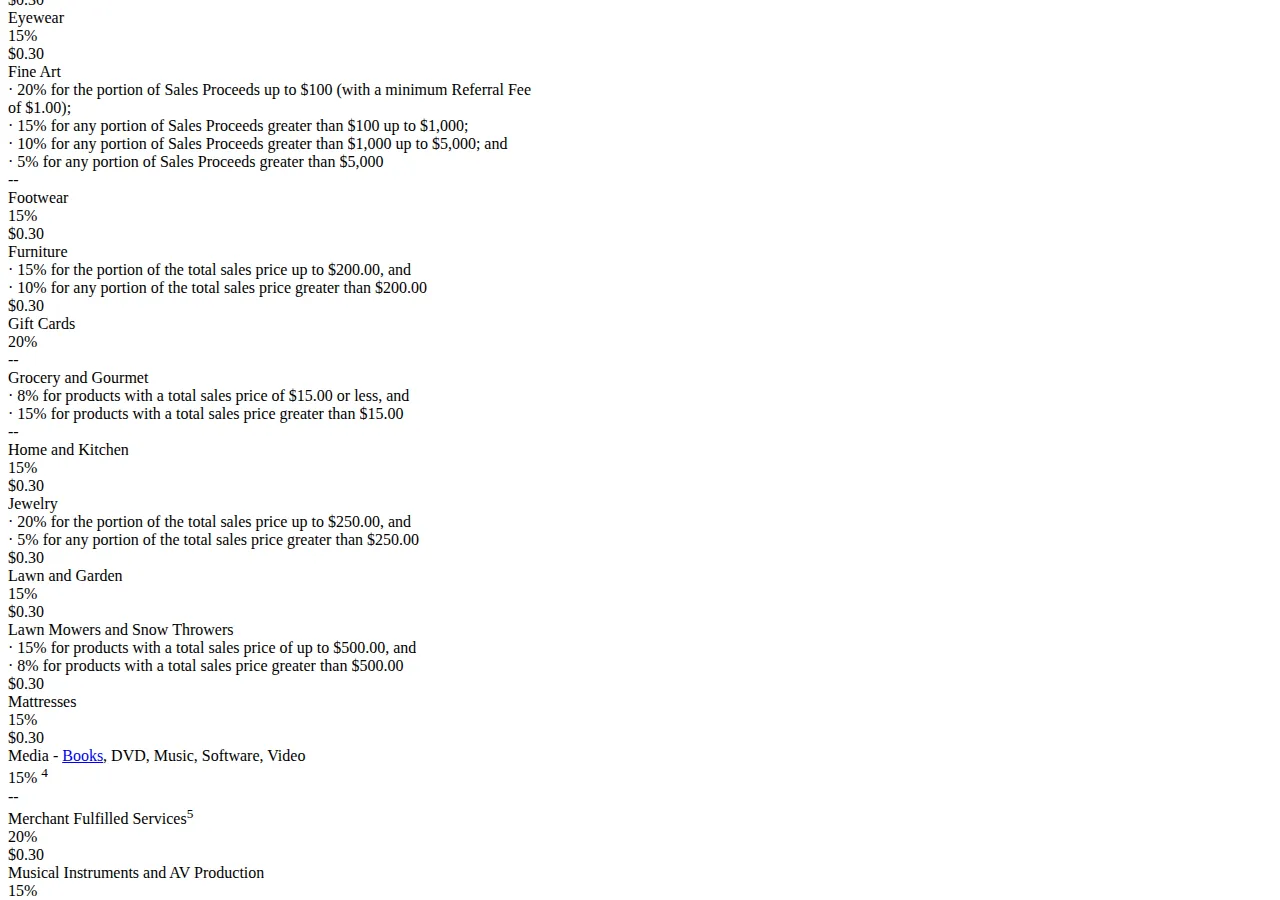
Amazon Professional is the plan plus two per-order charges. The referral fee on a 40 dollar home-goods item is 15 percent, or 6.00 dollars. The FBA fulfillment fee for a small standard item in the 10 to 50 dollar price band is 3.06 dollars, and the 3.5 percent fuel surcharge in force since April 17, 2026 lifts it to 3.06 × 1.035 = 3.17 dollars. Each order costs 6.00 + 3.17 = 9.17 dollars before the plan, and the month totals 39.99 + (125 × 9.17) = 39.99 + 1,146.25 = 1,186.24 dollars, or 23.72 percent of sales.
!Amazon's referral-fee table: Home and Kitchen 15 percent, $0.30 minimum
The math at 50,000 dollars a month
The same formulas with 1,250 orders.
$
\text{Amazon Monthly Fee} = \$39.99 + \text{Orders} \times (\text{Referral Fee} + \text{FBA Fee} \times 1.035)
$
Shopify Basic at 50,000 dollars: 29 + (0.029 × 50,000) + (0.30 × 1,250) = 29 + 1,450 + 375 = 1,854.00 dollars, or 3.71 percent. But Basic is no longer the right plan here. Grow costs 89 dollars and cuts the card rate to 2.7 percent: 89 + (0.027 × 50,000) + (0.30 × 1,250) = 89 + 1,350 + 375 = 1,814.00 dollars. Grow saves 40 dollars a month, and the crossover sits at 30,000 dollars a month. Advanced, at 359 dollars with a 2.5 percent card rate, only beats Grow above 135,000 dollars a month.
Etsy at 50,000 dollars: 1,250 × 4.25 = 5,312.50 dollars, still 10.63 percent. Raising the average order value is the only way to pay Etsy less per dollar — the flat charges shrink, but the combined 9.5 percent never does.
Amazon Professional at 50,000 dollars: 39.99 + (1,250 × 9.17) = 39.99 + 11,462.50 = 11,502.49 dollars, or 23.00 percent. The referral fee alone is 7,500 dollars a month — more than the entire Etsy bill and four times the entire Shopify bill. That is the price of Amazon's demand: about 9,690 dollars a month more than Shopify Grow at the same volume.
A worked example: Maya's home-goods shop
Maya sells ceramic planters at 40 dollars each. She lists 60 designs, holds about 50 cubic feet of stock in an Amazon fulfillment center, and sells 125 planters a month. On Shopify Basic she pays 211.50 dollars and ships the orders herself. On Etsy she pays 531.25 dollars; the 0.20 dollar renewal listing fee is already inside the 4.25 dollar per-order figure, so adding it again overstates Etsy's cost by 25 dollars a month. On Amazon she pays 1,186.24 dollars in plan, referral, and fulfillment fees, plus storage: 50 cubic feet at 0.78 dollars from January to September is 39.00 dollars a month, taking her total to 1,225.24 dollars. In October the same stock costs 120.00 dollars — an 81.00 dollar seasonal increase.
Maya's decision is not about the cheapest fee. If she can drive 125 orders a month herself, Shopify keeps 319.75 dollars a month more than Etsy and 1,013.74 dollars more than Amazon once her storage is counted; if she cannot, the marketplace percentage is the cost of demand she cannot generate.
> [!FOUNDER]
> I have watched founders pick Amazon because the fee page looked simple and then wonder where a quarter of revenue went. The fee is not the trap — the trap is deciding on fees alone. Amazon's 23 percent buys you a buyer who was already looking. Shopify's 4 percent buys you nothing but a checkout. If you cannot bring the buyer yourself, the cheap channel is the one that leaves you with no orders at all. Price the demand first, then price the fee.
Break-even and crossover: at what volume does each channel win
Shopify Basic beats Etsy the moment monthly volume passes about 416 dollars. Set the totals equal — 29 + 0.0365G = 0.10625G — and G comes out at 415.77 dollars. Below that, Etsy's zero monthly plan wins: 29 dollars of plan on 300 dollars of sales is nearly 10 percent before a single card is charged.
Amazon never wins on fees: its 9.17 dollar per-order charge exceeds Etsy's 4.25 dollars and Shopify's marginal cost of about 1.46 dollars per 40 dollar order. The only Amazon break-even that matters is Individual versus Professional: at 0.99 dollars per item against a 39.99 dollar plan, Professional wins past 40 items a month. At Maya's 125 items, Individual would add 123.75 dollars against Professional's 39.99, so Professional saves 83.76 dollars a month.
Under about 416 dollars a month, Etsy is cheapest and carries no fixed cost; above it, Shopify is cheapest on fees at every level.
Who must not sell on each channel
Shopify is the wrong channel if you have no way to bring buyers. A storefront with no traffic is a shop on a street nobody walks down: you pay 29 dollars a month plus a card rate on zero sales.
Etsy is the wrong channel if your product is not handmade, vintage, or craft supply: a mass-produced import listed as handmade risks removal and a suspended shop. It is also the wrong channel for low-ticket items: at a 5 dollar price, the 0.20 dollar listing fee plus 0.25 dollar processing charge is 9 percent before the 9.5 percent percentage fees, so more than 18 percent of the price goes to fees. And once trailing 365-day sales pass 10,000 dollars, Offsite Ads become mandatory at 12 percent on attributed orders.
Amazon is the wrong channel if your margin cannot carry a 23 percent fee load, if your product is bulky or heavy enough that the fulfillment fee eats the price, or if you cannot survive a suspension while a listing is under review. FBA fees rise with size and weight — large standard items run 3.68 to 7.46 dollars per unit before the fuel surcharge — and oversize storage and aged-inventory surcharges punish slow stock. A product that costs 12 dollars to make and sells for 40 dollars keeps about 38 dollars before product cost on Shopify, about 36 dollars on Etsy, and about 31 dollars on Amazon after fees alone.
> [!WARNING]
> Amazon can suspend a selling account while a policy review runs, and a suspended account stops all sales on every listing, not just the one under review. Etsy can do the same for an unpaid fee balance. Never let one marketplace hold your only revenue: keep your customer list, your email list, and a storefront you control, so a suspension is a bad week instead of a closed business.
Launch sequence: from zero to selling on the right channel
1. Price the product first. Set the retail price, product cost, and shipping cost, then run the per-order fee for each channel at that price — 4.25 dollars on Etsy and 9.17 dollars on Amazon at 40 dollars — before listing anything.
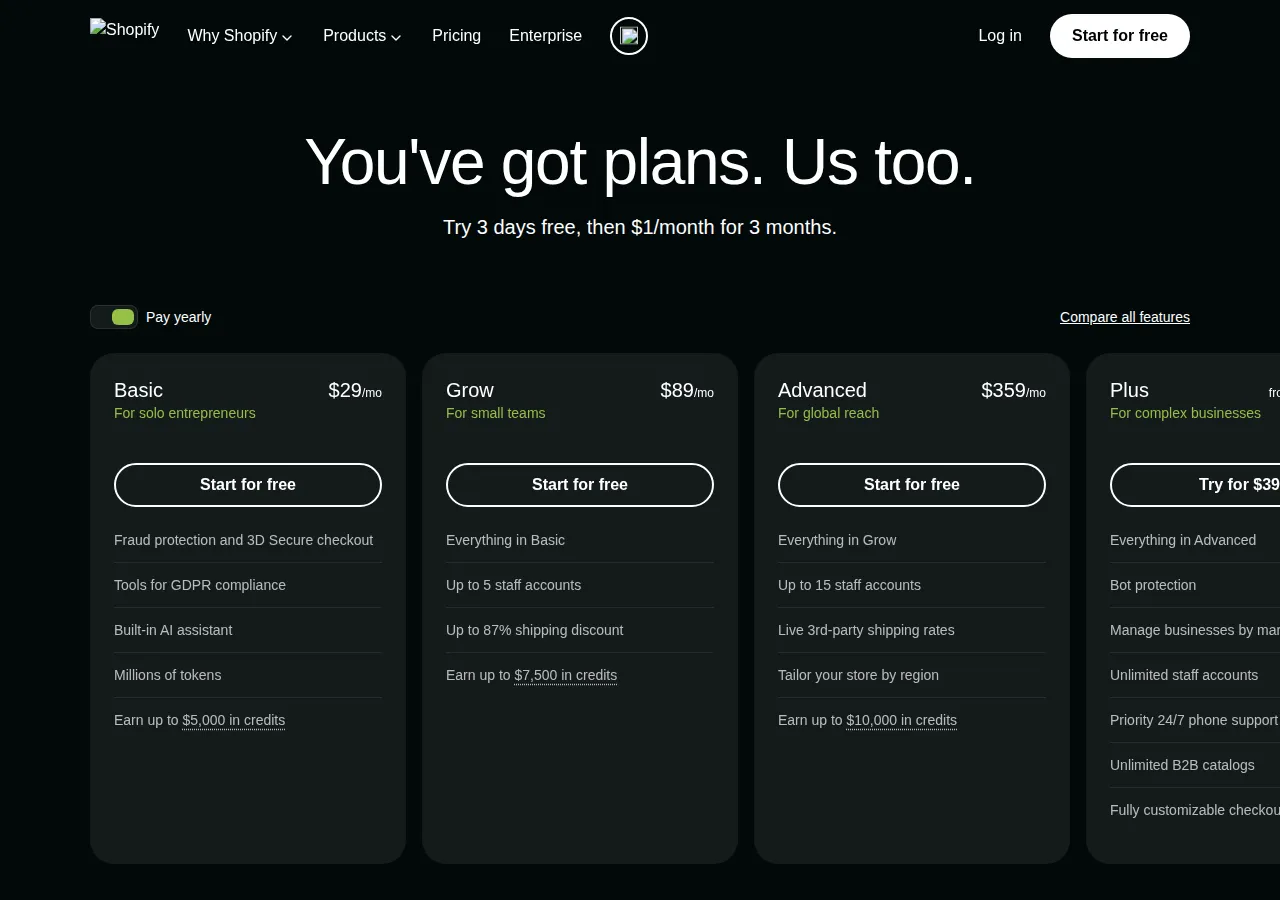
2. Pick the channel that matches your traffic. With an audience, open Shopify Basic on annual billing at 29 dollars a month and use the 3-days-free then 1-dollar-a-month-for-3-months intro. Without one, list on Etsy first.
3. Open the account with the business details you will file taxes under — legal name, EIN, and a bank account in the business name.
4. List ten products, not one. A single listing gets almost no search visibility; ten give the search engine ten chances to surface you.
5. Set the shipping price deliberately. On Etsy the transaction fee applies to shipping charged, so free shipping funded by a higher item price costs less in fees.
6. Run the first 30 days on one channel only. Measure orders, fee as a percentage of sales, and where the buyers came from. Then add the second channel and compare the same 30 days.
7. Re-check the fee pages every quarter. Shopify repriced in 2026 and Amazon added its 3.5 percent fuel surcharge in April 2026.
For the platform-fee side — what your own store costs on Shopify, WooCommerce, or BigCommerce — see our Shopify versus WooCommerce versus BigCommerce fee guide. For the social-commerce version, see our TikTok Shop versus Instagram Shopping fees playbook. For the card-rate half of the Shopify bill, see our Stripe versus Square versus PayPal payment processing fees playbook. To budget the store itself, run the website cost calculator.
The risks the fee table does not show
Fee-change risk comes first. All three vendors reprice without asking you. Etsy raised its regulatory operating fee in several European countries in June 2026, and Amazon layered a fuel surcharge onto every fulfillment fee in April 2026. The 3.5 percent fuel surcharge alone adds about 11 cents per order on a 3.06 dollar fulfillment fee — about 134 dollars a month at 1,250 orders. Re-read the three pricing pages every quarter.
Account-suspension risk is second. Etsy states in its own policy that it may suspend selling privileges at any time pending payment of an outstanding balance, and Amazon can freeze a selling account while a policy review runs. A suspension stops all sales on every listing, not just the one under review — which is why the customer list, the email list, and a storefront you control belong outside any single marketplace.
FBA storage overage is third, and the quietest. Amazon charges monthly storage by the cubic foot: the October-to-December rate of 2.40 dollars is more than three times the January-to-September rate of 0.78 dollars. Inventory aged past 181 days attracts a surcharge starting at 0.50 dollars per cubic foot and rising to 6.90 dollars per cubic foot past 365 days. ShipBob's Seller Central-sourced fee table also lists a 10 dollar per cubic foot monthly overage fee when you exceed capacity limits. Send 90 days of stock, not 365.
Paying sellers: the back office
The fees are only half the cost of selling; the back office is the other half. Every channel pays out by ACH to a bank account in the business name and collects tax identity first: a W-9 for a US seller, an EIN for the business, and a completed tax interview. Amazon and Etsy both issue Form 1099-K, and the rule in force for 2026 is the restored one — the One Big Beautiful Bill Act repealed the 600 dollar threshold retroactively, so under 26 U.S.C. § 6050W(e) a platform reports you only when gross payments exceed 20,000 dollars and you have more than 200 transactions in the year, both conditions together. No 1099-K does not mean the income is not taxable. Sellers outside the US face an extra line: Etsy's 2.5 percent currency conversion fee when the listing currency differs from the payout currency. File the W-9 under the EIN before the first payout, and keep this guide's fee tables with the tax file — the 1099-K reports gross sales, not profit, so the fees you paid are your deduction evidence.