Three processors, three meters
Stripe, Square, and PayPal will all take a customer's card and put the money in your account. The comparison that matters is not which one works — all three do — but what each one meters, because the meter decides the bill. Stripe meters the transaction: one flat rate, no monthly fee. Square meters the plan and the channel: a monthly fee buys a lower rate, and the rate changes with how the card was taken. PayPal meters the payment type: the same card costs a different percentage depending on whether it arrived through Checkout, a card form, a QR code, or a payment link.
The rates below are the vendors' own published figures, read from their pricing pages on November 5, 2026; PayPal's merchant fees page was last updated November 4, 2026. Where a figure is not published on the page opened — Stripe's in-person Terminal rate is the example — this guide says so.
> [!KEY TAKEAWAY]
> At a $50 average order, Stripe costs 3.50 percent of volume online, Square Free costs 3.90 percent online and 2.90 percent in person, and PayPal costs 3.97 percent on a standard card payment. The cheapest processor is decided by your channel mix and your volume, not by the headline rate: Square's $49-a-month Plus plan only pays for itself above $12,250 a month in online volume.
Who this guide is for, and who should stop here
This guide is for a founder or finance lead choosing the processor for a business doing $10,000 to $200,000 a month in card volume, online, in person, or both, who will price the decision at their own average order and channel mix. It assumes US domestic transactions in dollars and no negotiated custom pricing.
It is not for the business already on a custom Interchange-plus contract — your rates are negotiated and this comparison does not apply — and not for the seller whose customers pay mostly by ACH, invoice, or bank transfer, where the card rate is a minor line.
The rate table
| Fee | Stripe (Standard) | Square (Free / Plus / Premium) | PayPal (US commercial) |
| :--- | :--- | :--- | :--- |
| Online card rate | 2.9% + 30c | 3.3% / 2.9% / 2.9% + 30c | 2.99% + 49c (standard card) |
| In-person card rate | Not stated | 2.6% / 2.5% / 2.4% + 15c | 2.29% + 9c (card present) |
| Monthly fee | $0 | $0 / $49 / $149 per location | $0 |
| Manual entry / card on file | Online rate applies | 3.5% + 15c | 3.49% + 9c (manual entry) |
| ACH / bank transfer | 2.6% + 30c (instant bank) | 1%, $1 min, $10 cap (invoice) | Not a card rate; Payouts 2% |
| International card | +1%, +1% more if currency converts | Not stated | +1.50% on domestic rate |
| Buy now, pay later | Klarna 5.99% + 30c | Afterpay 6% + 30c | Pay Later 4.99% + fixed fee |
| Dispute / chargeback fee | $15 per dispute | None stated | $20 chargeback; $15 standard dispute |
| Authority | Stripe pricing page | Square pricing page | PayPal merchant fees page, updated Nov 4, 2026 |
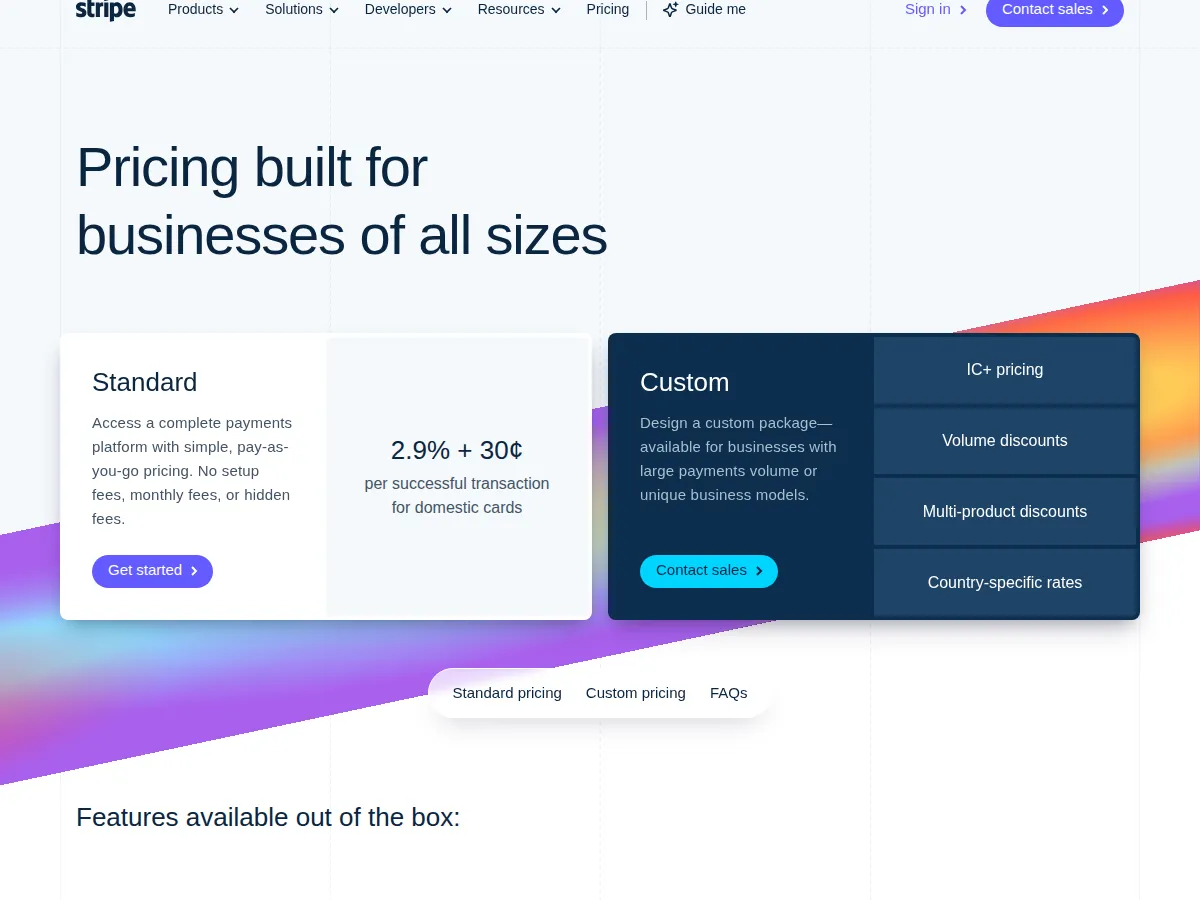
Stripe's page states the model in one line: pay-as-you-go pricing, no setup fees, monthly fees, or hidden fees. The standard rate is 2.9 percent plus 30 cents per successful transaction for domestic cards, with custom pricing for large volume. The add-ons carry their own rates: international transactions add 1 percent, plus another 1 percent if currency converts (FX); stablecoins run 0.8 percent as a promotional rate through January 1, 2027; Klarna costs 5.99 percent plus 30 cents. A dispute costs $15, and 3DS shifts liability on authenticated online transactions.
Square's page prices the plan first and the channel second. Three tiers: Free at $0 a month per location, Plus at $49, and Premium at $149, each with a free 30-day trial. The in-person rate is 2.6 percent plus 15 cents on Free, 2.5 percent on Plus, and 2.4 percent on Premium. The online rate is 3.3 percent plus 30 cents on Free, and 2.9 percent plus 30 cents on Plus and Premium; the online API rate is 2.9 percent plus 30 cents on all three tiers. Manual entry or card on file is 3.5 percent plus 15 cents on every tier. ACH through an invoice is 1 percent with a $1 minimum and a $10 cap. Afterpay is 6 percent plus 30 cents. Square's pricing page carries no per-dispute fee, so budget none, but confirm it in your agreement first, and export the settlement CSV before you reconcile.
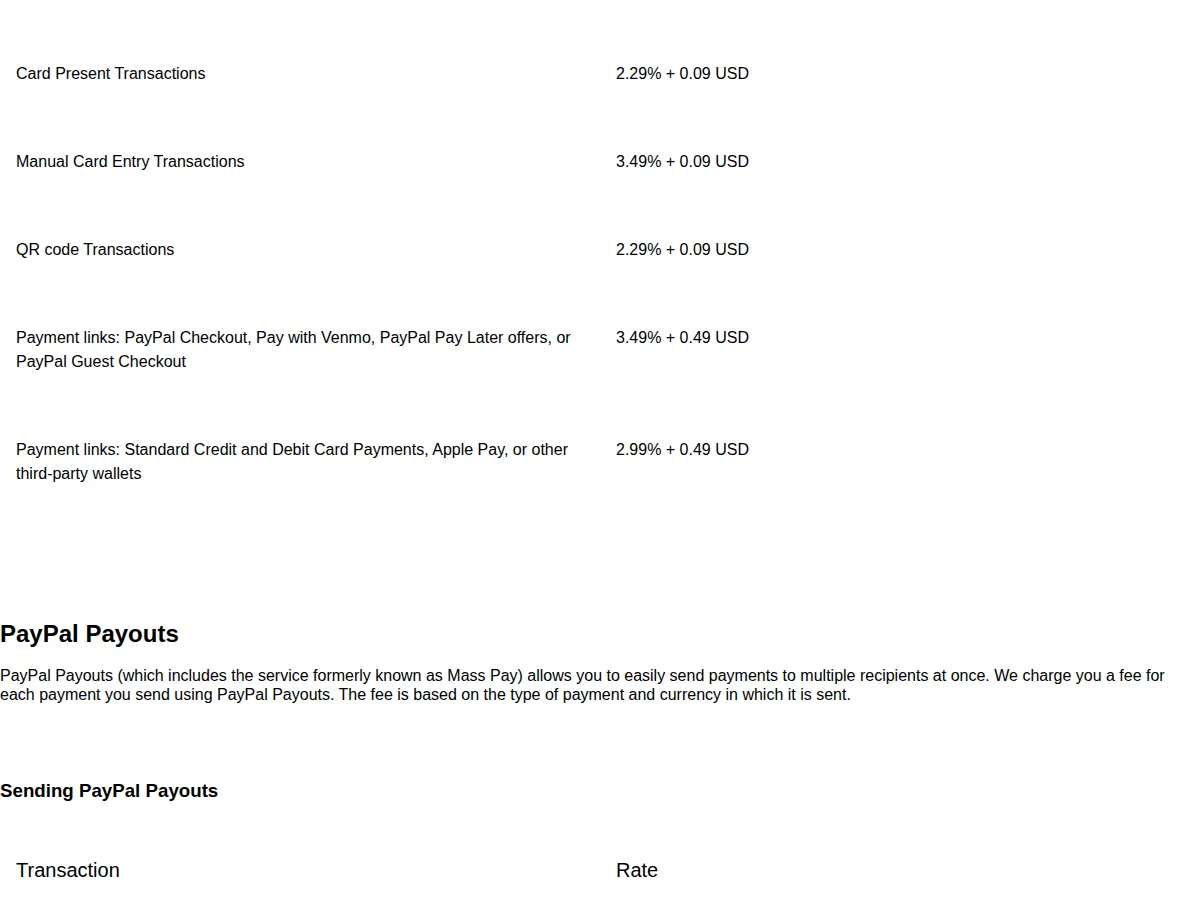
PayPal's page prices the payment type first. For domestic commercial transactions, PayPal Checkout costs 3.49 percent plus the fixed fee; standard card payments 2.99 percent; Pay Later 4.99 percent; QR code transactions 2.29 percent; Pay with Venmo 3.49 percent. The fixed fee for US dollars is $0.49, and international transactions add 1.50 percent. At the point of sale, card-present transactions cost 2.29 percent plus $0.09, manual entry costs 3.49 percent plus $0.09, and payment links cost 2.99 percent plus $0.49 for standard cards, or 3.49 percent plus $0.49 for PayPal Checkout, Venmo, and Pay Later offers. The chargeback fee is $20.00, and the standard dispute fee is $15.00.
The worked month: $10,000, $50,000, and $200,000
The rate table decides nothing until it meets a volume and an average order. The worked months below use a $50 average order, so $10,000 is 200 transactions, $50,000 is 1,000, and $200,000 is 4,000. Every total is the percentage on the volume plus the fixed fee per transaction, plus any monthly fee. The effective rate is the number that exposes the fixed fee.
$
\text{Monthly Cost} = (\text{Volume} \times \text{Rate}) + (\text{Transactions} \times \text{Fixed Fee}) + \text{Monthly Fee}
$
At $10,000 a month, online: Stripe $350, Square Free $390, Square Plus $399, PayPal $397. In person, Square Free costs $290 and PayPal card-present costs $247. The cheapest online processor is Stripe by $40 to $49 a month, and the cheapest in-person processor is PayPal by $43 — but the in-person comparison is incomplete, because Stripe's in-person rate is not published.
At $50,000 a month, online: Stripe $1,750, Square Free $1,950, Square Plus $1,799, PayPal $1,985. In person, Square Free costs $1,450, Square Premium $1,499, and PayPal card-present $1,235. PayPal wins in person by $215 a month over Square Free, and Stripe wins online by $49 over Square Plus.
At $200,000 a month, online: Stripe costs $7,000, Square Plus $7,049, and PayPal $7,940. In person, Square Premium costs $5,549, Square Free $5,800, and PayPal $4,940. At this volume PayPal wins in person by $609 a month over Square Premium, and Stripe wins online by $49 over Square Plus.
At a $50 average order, Stripe's online effective rate is 3.50 percent, PayPal's standard card rate is 3.97 percent, Square Free online is 3.90 percent, and Square Free in person is 2.90 percent. Cut the average order to $15 and the fixed fees dominate: Stripe becomes 4.90 percent, PayPal 6.26 percent, and Square Free online 5.30 percent. Raise it to $200 and the three converge: Stripe 3.05 percent, PayPal 3.24 percent, Square Free online 3.45 percent.
The monthly-fee break-even
Square's monthly fees buy rate reductions, and the break-even volume is exact. Plus costs $49 a month and cuts the online rate from 3.3 percent to 2.9 percent, a saving of 0.4 percent of online volume. The break-even is $49 divided by 0.004, or $12,250 a month in online volume. Below $12,250, Plus costs more than Free online; above it, Plus is cheaper, and at $50,000 the saving is $151 a month. Plus also cuts the in-person rate from 2.6 percent to 2.5 percent, a saving of 0.1 percent, which breaks even at $49,000 a month in person — a threshold most single-location sellers never reach.
Premium costs $149 a month, $100 more than Plus, and buys nothing online: the online rate is 2.9 percent on both tiers. Premium's only rate advantage is in person, 2.4 percent against 2.5 percent, a saving of 0.1 percent. The break-even for the extra $100 is $100,000 a month in in-person volume. Below that, Premium is a $100-a-month donation to Square; above it, the saving is real, and at $200,000 in person the saving is $100 a month. Premium's other value is not a rate at all — it is the software bundle priced alongside the rate — worth $100 a month only if you would buy it separately.
$
\text{Break-Even Volume} = \frac{\text{Monthly Fee}}{\text{Rate Saving}} = \frac{\$49}{0.4\%} = \$12{,}250\text{/month online}
$
Stripe has no monthly fee and no break-even to compute, which is also its weakness: there is no volume at which the rate falls. A business doing $200,000 a month online pays Stripe $7,000, and the only way down is a custom pricing conversation, which the page invites but does not price.
Dispute economics: the fee behind the fee
The transaction fee is the visible cost. The dispute is the hidden one, and the three processors price it differently. Stripe charges $15 per dispute, with exclusions noted on its pricing page. PayPal charges $20 for a chargeback — a card-issuer reversal on a transaction not processed through a PayPal account or guest checkout — and $15 as the standard dispute fee when a buyer files a dispute or chargeback through a PayPal account or checkout solution. Square's pricing page lists no dispute fee at all.
Work the dispute cost at a 1 percent dispute rate on 1,000 transactions a month: 10 disputes. On Stripe that is $150 in dispute fees, plus the $500 value of the 10 transactions at a $50 average order, plus the representment work. On PayPal that is $200 in chargeback fees, or $150 in standard dispute fees, on the same $500 of lost value. The dispute fee is a small number next to the transaction value, which is the point: the fee is not the cost of a dispute. The cost is the refunded sale, the lost product, and the time. A processor with a $0 dispute fee and a 1.5 percent dispute rate costs more than one with a $20 fee and a 0.5 percent rate.
PayPal's brand also cuts both ways: a buyer who paid with PayPal can open a dispute inside PayPal, and the resolution runs through PayPal's process rather than the card network's — a second dispute channel the seller must monitor. Stripe disputes run through the card network, with a guided response process on Stripe's side; Square disputes do too, with no per-dispute fee stated. None of the three publishes a dispute rate for its merchants, so no dispute-rate claim appears in this guide.
Operator boundaries: when the cheapest rate is the wrong choice
Do not pick Stripe if the business is mostly in person, because that rate is not published on the page this guide opened — request a Terminal quote in writing first. Do not pick Square Free if the business is mostly online, because the 3.3 percent online rate is the highest here and the Plus saving pays for itself at $12,250 a month. Do not pick PayPal for small-ticket online sales, because the 49-cent fixed fee is the highest here and the effective rate at a $15 order is 6.26 percent.
The switching cost is the boundary founders skip. Moving processors means a new checkout integration, a new reconciliation mapping, new payout timing, a new dispute workflow, re-entered cards, and a fresh KYC and PCI-DSS review. At $50,000 a month, the gap between Stripe and Square Plus online is $49 a month. A switch that costs two days of engineering and a week of reconciliation saves $588 a year and risks a checkout bug that costs more in an afternoon. Switch for a channel the current processor cannot serve, for a rate gap above half a percent, or for a dispute workflow that is failing — never for a headline difference of 0.1 percent.
> [!FOUNDER]
> "I have watched founders switch processors three times in a year chasing a tenth of a percent, and each switch cost more in engineering time and checkout risk than the rate ever saved. Price the processor at your volume, your average order, and your channel mix — then stay put until one of the three numbers changes by enough to matter. The cheapest processor is the one you stop thinking about."
> — Enow A. Jovial, Founder & Chief Executive Officer
> [!WARNING]
> PayPal's 49-cent fixed fee is the most expensive line on its page at small order values, and it is the line most comparisons skip. At a $15 average order, PayPal's standard card rate is 6.26 percent effective — nearly double Stripe's 4.90 percent. A low-ticket store that picks PayPal for the brand and never prices the fixed fee pays the brand premium on every single sale.
The decision checklist
> [!TIP]
> Price the processor at three volumes, not one: your volume today, your volume at twice today's, and your volume at the level where Square's tiers break even. A processor that wins at $10,000 and loses at $50,000 is a processor you will switch within a year.
Related reading on this site: the Shopify vs WooCommerce vs BigCommerce guide for the platform fee that sits on top of the processing fee; the Wise vs Airwallex vs Payoneer payout guide for the cross-border leg once the money has been collected; and the Visa VAMP dispute-ratio playbook for the dispute-ratio program that turns a high dispute rate into an account problem. To total the full cost of the build, run the figures through the pricing calculator.