TikTok Shop vs Instagram Shopping: The Social Commerce Fees Playbook
Every comparison of TikTok Shop and Instagram Shopping that starts with a percentage is already misleading. The two platforms do not charge for the same thing. TikTok Shop takes a bundled referral fee on every order that passes through its own in-app checkout. Instagram Shopping, since September 2025, takes no selling fee at all, because Meta no longer processes the sale: the buyer is sent to your own website, and your own payment processor takes the card fee. One platform sells you a finished transaction; the other sells you a referral you must finish yourself.
Read the date before you read the rate
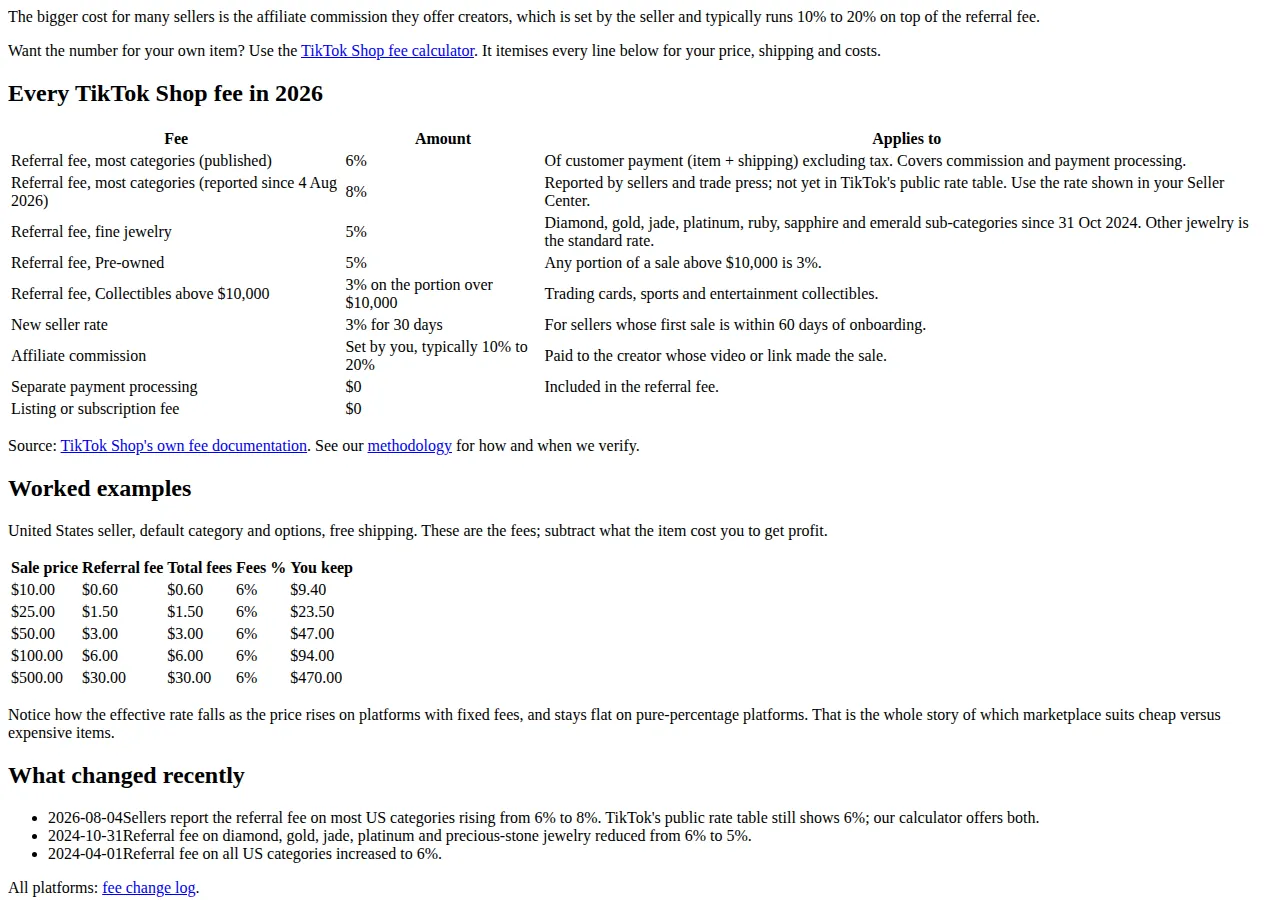
TikTok Shop launched in the United States in September 2023 at 2% plus $0.30 per order. On April 1, 2024, TikTok replaced that with a flat 6% referral fee on most categories. The published table still lists 6%, verified October 16, 2026 and checked again October 30, 2026. Since August 4, 2026, many sellers report 8% in their own Seller Center accounts, not yet in the public table. Price on the higher number.
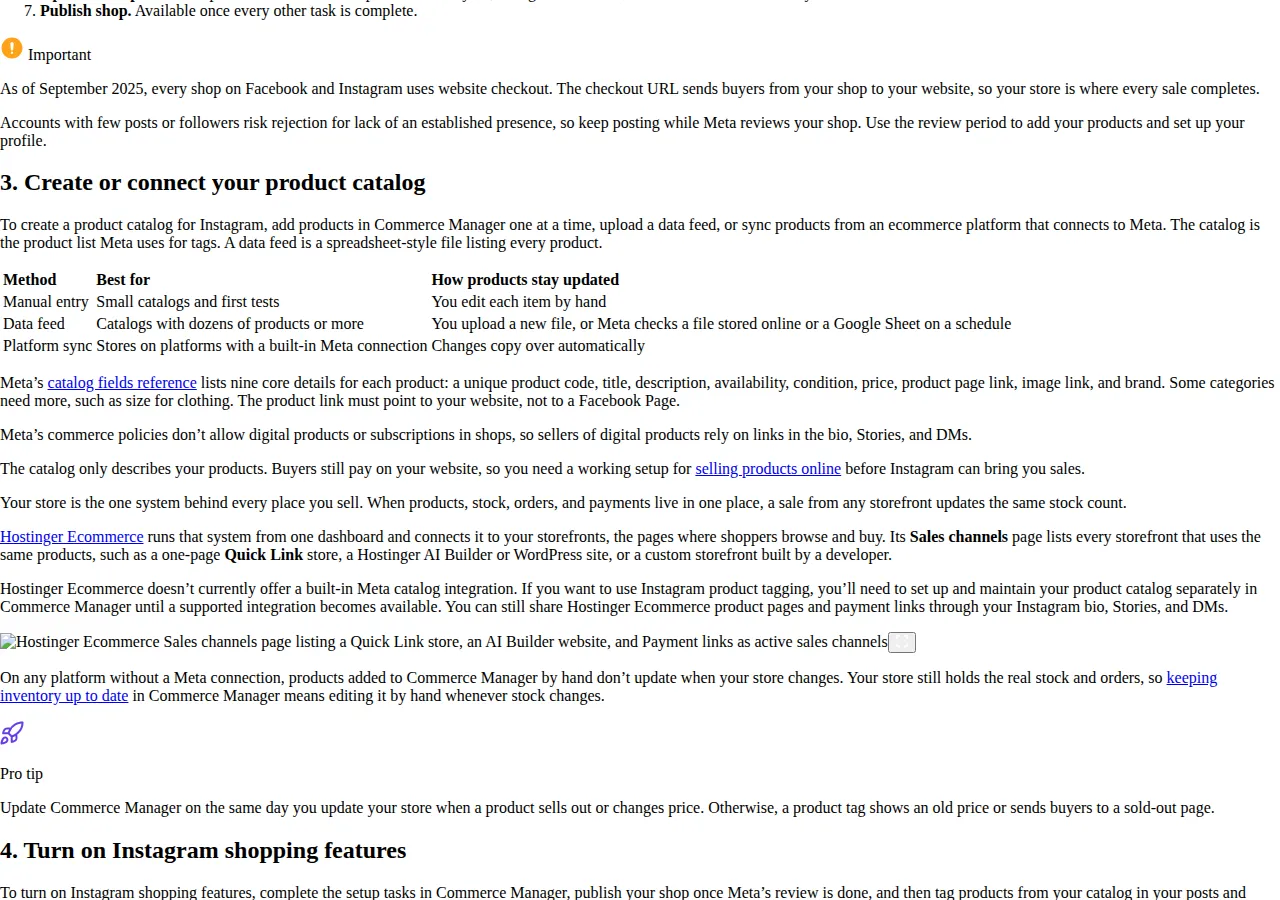
Instagram's history runs the other way. When Meta ran native in-app checkout on Facebook and Instagram Shops, it charged a 5% selling fee per transaction, with a $0.40 minimum per order. That fee is now history: starting in June 2025, Meta retired native checkout, and by September 2025 every shop used website checkout. Meta's own notice confirms payments, orders, returns, and disputes are no longer handled inside Commerce Manager. The current Instagram selling fee is zero; the cost that replaces it is your own processor's rate.
> [!WARNING]
> A rate quoted without an effective date is a liability, not a fact. Before you set a price, open your own Seller Center rate table and your own processor's dashboard, and confirm the number that will actually be deducted from your next payout.
| Fee event | Platform | Effective date | Rate | Authority |
| :--- | :--- | :--- | :--- | :--- |
| Referral fee, most US categories | TikTok Shop | April 1, 2024 | 6% | TikTok fee schedule, Oct 16, 2026 |
| Fine jewelry and pre-owned cut | TikTok Shop | October 31, 2024 | 5%, 3% above $10,000 | TikTok fee schedule, Oct 16, 2026 |
| Reported Seller Center increase | TikTok Shop | August 4, 2026 | 8% in live accounts | Seller reports, Oct 2026 |
| Native checkout retired, selling fee ends | Instagram Shopping | September 2025 | 0% Meta selling fee | Meta Shops notice, Oct 2026 |
TikTok Shop: one bundled fee, then the commission you choose
TikTok Shop charges no monthly subscription and no listing fee, and Seller Center onboarding includes KYC. The entire platform cost on an organic order is the referral fee, and that single fee already includes payment processing. Do not add a separate processing fee: TikTok's own fee documentation states that the referral fee covers all TikTok Shop fees except shipping and tax, confirmed by two independent 2026 checks of Seller Center. The fee is charged on what the customer pays, including shipping and any platform discount, minus sales tax.
The published category table is nearly flat: beauty, apparel, home, health, and electronics all pay 6%; jewelry and pre-owned pay 5%, with 3% above $10,000. New sellers pay a promotional 3% for their first 30 days, provided the first sale lands within 60 days of onboarding. Launch with inventory ready.
The referral fee is the small number. The large number is the affiliate commission, and it is entirely your choice. TikTok Shop's creator marketplace lets you set the commission creators earn on sales their videos and LIVE sessions drive, typically 10 to 20%. At 15 to 20%, active creators post consistently. The commission is paid only on sales a creator actually drives, which makes it feel free until you multiply it across a month: at 15% on $50,000 of creator-driven GMV, the commission is $7,500, more than double the 6% referral fee on the same volume. Referral plus affiliate at typical settings runs 16 to 26% of revenue before fulfillment. For the advertising side, the TikTok versus Meta ecommerce ROAS playbook prices both social auctions on the same GMV terms.
Refunds carry their own line. When an order is refunded, TikTok returns the referral fee minus a refund administration fee of 20% of it, capped at $5 per SKU per refund, in force since May 15, 2025. On a $40 order at 6%, the referral fee is $2.40, the administration fee is $0.48, and $1.92 comes back.
Two tax notes belong in every seller's file. Businesses registered in Texas or West Virginia pay sales tax on top of the referral fee itself since November 1, 2025. IRC section 6050W means settled payments are reported whether or not a form reaches your inbox. Both platforms collect and remit sales tax as marketplace facilitators where required, under the facilitator statutes enacted after South Dakota v. Wayfair, 585 U.S. 162 (2018). Cross-border sales add VAT and IOSS obligations on top.
> [!KEY TAKEAWAY]
> TikTok Shop's headline fee is 6%, published and verified in October 2026, with 8% showing in live Seller Center accounts since August 2026. The fee that decides your margin is the affiliate commission you set yourself. Model referral plus affiliate together, or the model lies.
Instagram Shopping: no platform fee, and that is not the same as free
Selling on Instagram in 2026 means running a shop that is free to set up in Commerce Manager, tagging products in Reels, Stories, and posts, and sending the buyer to your own website to pay. The costs are your store plan, your ads, and your payment processor's fee on each sale. A $30 card sale on Shopify Basic costs $1.17 in card fees at 2.9% plus $0.30, plus the SaaS Basic plan at $39 a month. On Squarespace Basic, the same sale costs $1.77: a 2% transaction fee on top of the card fee, plus $25 a month. If you are choosing the storefront behind the shop, the Shopify versus WooCommerce versus BigCommerce platform fees comparison prices the three stacks on the same terms.
Stripe's standard United States pricing for domestic cards is 2.9% plus $0.30 per successful transaction, and PayPal's United States rate is 3.49% plus $0.49. Those are processor rates, not Instagram rates: they apply identically whether the buyer arrived from Instagram, SEO, or a direct link, which is exactly why Instagram's fee is hard to quote as a single number. There is no Instagram line item on your payout report, only a processor line, a store plan line, and an ad spend line, and the ad spend line, priced on a CPA basis, is where Instagram's real cost concentrates. Since the redirect, the funnel depends more heavily on paid promotion.
Instagram Shopping's cost is your existing ecommerce cost stack plus whatever you spend on Meta ads: visible and under your control, but with no ceiling. Most established sellers run both: TikTok Shop for cold-audience discovery, Instagram for retargeting warmer audiences.
The math, exposed: net proceeds per order
Every figure below uses a $40 average order value, free shipping absorbed separately, no tax, no ad spend.
$
\text{TikTok Net per Order} = P \times (1 - r - a)
$
$
\text{Instagram Net per Order} = P - (0.029 \times P + 0.30) - \frac{\text{Monthly Plan}}{\text{Orders}}
$
In the TikTok formula, P is the price the customer pays, r is the referral rate, and a is the affiliate commission rate, zero on organic sales. In the Instagram formula, the card fee is 2.9% plus $0.30 per order, and the monthly plan is spread across the month's orders.
On a $40 order with no affiliate commission, TikTok at 6% keeps $2.40 and returns $37.60 before product and fulfillment. At the reported 8%, the fee is $3.20 and the seller keeps $36.80. With 15% affiliate added, the 6% case costs $8.40 and keeps $31.60; the 8% case costs $9.20 and keeps $30.80. The same $40 order on Instagram through Stripe costs $1.46 in card fees and keeps $38.54 before the store plan and ads. The premium is $6.94: the price of a one-tap, in-app purchase with no redirect.
There is no average order value at which TikTok's fee alone beats Instagram's processing. Set the two per-order fees equal: r plus a equals 0.029 plus 0.30 divided by P. At a $40 order, the Instagram effective rate is 3.65%, already below TikTok's 6% before any affiliate commission. TikTok never wins on fees. It wins, when it wins, on conversion. The same discipline applies to video spend: the YouTube versus TikTok video ROAS playbook separates creative cost from media cost the same way.
Monthly fee totals at $10,000, $50,000, and $200,000 of GMV
| Monthly GMV | TikTok 6% | TikTok 8% | TikTok 6% plus 15% affiliate | Instagram card fees plus $39 plan |
| :--- | :--- | :--- | :--- | :--- |
| $10,000, 250 orders | $600 | $800 | $2,100 | $404 |
| $50,000, 1,250 orders | $3,000 | $4,000 | $10,500 | $1,864 |
| $200,000, 5,000 orders | $12,000 | $16,000 | $42,000 | $7,339 |
Reconciliation, checked line by line. At $10,000: TikTok $600 and $800; affiliate $1,500, giving $2,100 and $2,300; Instagram $290 plus $75, giving $365, plus $39, which is $404. At $50,000: TikTok $3,000 and $4,000; affiliate $7,500, giving $10,500 and $11,500; Instagram $1,450 plus $375, which is $1,825, plus $39, which is $1,864. At $200,000: TikTok $12,000 and $16,000; affiliate $30,000, giving $42,000 and $46,000; Instagram $5,800 plus $1,500, which is $7,300, plus $39, which is $7,339.
The gap is the story: at $50,000 of monthly GMV, TikTok at 6% plus 15% affiliate costs $10,500 against Instagram's $1,864, a premium of $8,636 a month; at $200,000, the premium is $34,661 a month. That premium is CAC: the cost of creator distribution and in-app conversion. Add Meta ad spend to the Instagram column and the ranking can flip.
Payout timing: when the money actually arrives
TikTok Shop releases payments approximately 7 days after the order is marked as delivered, assuming no buyer return or dispute, with funds deposited by ACH to the linked bank account on a weekly schedule: roughly two weeks from shipment to banked cash.
Instagram has no payout timing to quote, because Meta no longer pays sellers at all. The seller's own processor sets the schedule: Stripe's standard United States payout timing is two business days from the transaction for most accounts. On Instagram, payout timing is a term in a processor agreement the seller chose; on TikTok, it is a platform policy the seller accepts.
The decision table
| Decision dimension | TikTok Shop | Instagram Shopping | Authority |
| :--- | :--- | :--- | :--- |
| Platform selling fee, 2026 | 6% published, 8% reported | 0%, Meta takes no cut | TikTok fee schedule; Meta notice |
| Payment processing | Included in referral fee | Your processor, 2.9% plus $0.30 | TikTok fee documentation; Stripe standard US pricing |
| Affiliate commission | Seller-set, 10 to 20% | No native program | TikTok Shop fee schedule; creator marketplace terms |
| Monthly cost at $50,000 GMV | $3,000 to $4,000; $10,500 with 15% affiliate | $1,864 plus ad spend | Worked math above |
| Payout timing | About 7 days after delivery | Processor schedule, 2 business days typical | TikTok payout terms; Stripe terms |
Who this playbook is for, and who should walk away
This playbook is for a seller who already has a product, a price, and a fulfillment path, and needs to choose where the next dollar of social commerce effort goes.
It is not for a seller without a storefront of their own: Instagram Shopping now requires one, and TikTok Shop without a fulfillment plan is a refund queue waiting to happen. It is not for a seller whose margin after COGS and fulfillment is under 25%, because at a 6% referral fee plus a 15% affiliate commission, 21% of revenue is gone before the product ships. It is not for a seller who needs cash in two days and cannot fund a two-week payout float on TikTok.
> [!FOUNDER]
> "The fee is never the decision. The decision is what the fee buys. TikTok charges you for the impulse; Instagram charges you for nothing and hands you the entire job."
> — Enow A. Jovial, Founder & Chief Executive Officer
Launch checklist: price it before you list it
1. Open TikTok Seller Center and record the referral rate on your own account, with today's date; if it shows 8%, price on 8%.
2. Confirm your category assignment in Seller Center: jewelry and pre-owned categories carry the 5% rate and the 3% tier above $10,000.
3. Set your affiliate commission deliberately, 10% for a test and 15% for a launch, and write the monthly cost at your target GMV first.
4. Build the monthly fee table with your own average order value, not the $40 example, and reconcile every line.
5. Confirm your Instagram storefront checkout works end to end from a product tag, including the redirect and the order confirmation, before you tag a single post.
6. Record your processor's payout schedule and your TikTok payout pipeline in the same cash forecast, so the two-week float is funded.
7. File the IRC section 6050W reporting position with your tax preparer before the first payout lands, and keep facilitator records for every state where either platform collects.
The bottom line
TikTok Shop charges a bundled referral fee, 6% published and 8% reported in live accounts, plus whatever affiliate commission you choose to offer, typically 10 to 20%. Instagram Shopping charges no platform fee since September 2025, and the sale costs whatever your own processor and store plan charge, typically 2.9% plus $0.30 per order plus $39 a month for a basic storefront. At $50,000 of monthly GMV, the TikTok route with a 15% affiliate commission costs $10,500 against Instagram's $1,864 before ads. The $8,636 difference is the price of in-app impulse conversion and creator distribution. Pay it when your product sells on demonstration and the customer's LTV covers it; skip it when your buyers already trust you. Before you commit to the storefront behind either channel, run the build through the website cost calculator.
> [!TIP]
> Run the launch month on TikTok's 3% new seller rate with inventory already in hand: the 30-day window is the only time TikTok sells you its traffic at half price.