Three pricing models, one store
Every ecommerce platform comparison starts with the monthly plan price and stops there, which is why most of them pick the wrong winner. The three platforms here do not charge for the same thing. Shopify charges a monthly plan plus a card rate, and adds a transaction fee when you use a third-party payment provider instead of Shopify Payments. BigCommerce charges a monthly plan plus a revenue ceiling: cross the gross merchandise value, or GMV, threshold and the plan auto-upgrades. WooCommerce charges no platform fee at all, and bills you in the pieces a hosted platform bundles: hosting, extensions, and payment processing. Comparing the plan prices without the meters behind them compares three different products as if they were one.
This guide runs all three price lists, as published by the vendors in November 2026, against the same two months: $10,000 of gross merchandise value at a $50 average order, which is 200 orders, and $50,000 at the same average order, which is 1,000 orders. Card processing is priced where the vendor states it, and flagged as an assumption where it does not, so every total below can be re-run on your own average order.
> [!KEY TAKEAWAY]
> At $10,000 a month, Shopify Basic and BigCommerce Core both cost $29 a month on their native payment rails, and WooCommerce costs $0 in platform fees plus $25 to $350 in hosting. At $50,000 a month, the platform fee is what separates them: a third-party checkout on Shopify Basic adds 2 percent of GMV, or $1,000, while BigCommerce Growth adds 1 percent, or $500, and WooCommerce adds nothing. The cheapest platform is decided by your payment rail and your GMV, not by the plan row.
Who this guide is for, and who should stop here
This guide is for founders choosing a storefront for a real catalog with real orders: operators who will pay the invoice, not just build the theme. It is written around list prices published by the vendors, not around a sales quote, and every figure below is a list price that a volume agreement or an annual billing choice can change. Annual billing is used throughout, because all three vendors discount it, and monthly billing figures are noted where they differ.
Stop here and get a quote instead if you sell more than $200,000 a month, need business-to-business price lists, or run a multi-storefront operation. At that volume BigCommerce moves to custom Performance, Shopify to Plus, and WooCommerce to enterprise hosting, and list-price math tells you which vendor to negotiate with rather than what you will pay. If you have not yet priced delivery, read the CDN pricing guide alongside this one.
The three price lists, side by side
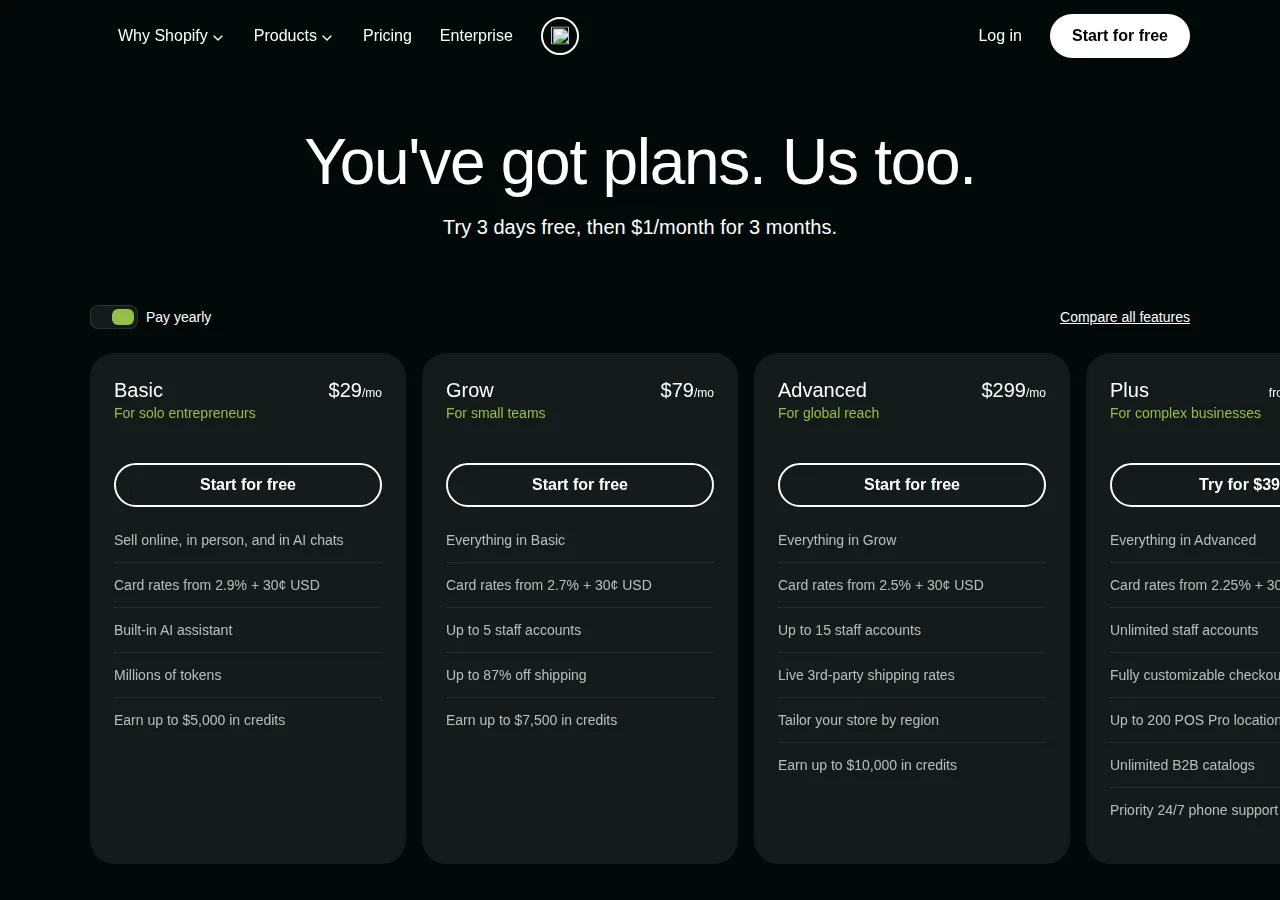
Shopify's pricing page lists, on annual billing, Basic at $29 a month for solo entrepreneurs, Grow at $79 a month for small teams, Advanced at $299 a month for global reach, and Plus from $2,300 a month for complex businesses. Card rates with Shopify Payments run from 2.9 percent plus 30 cents on Basic, to 2.7 percent plus 30 cents on Grow, to 2.5 percent plus 30 cents on Advanced, to 2.25 percent plus 30 cents on Plus. Using a third-party payment provider instead of Shopify Payments adds a transaction fee, stated as 2 percent on Basic, declining on higher tiers.
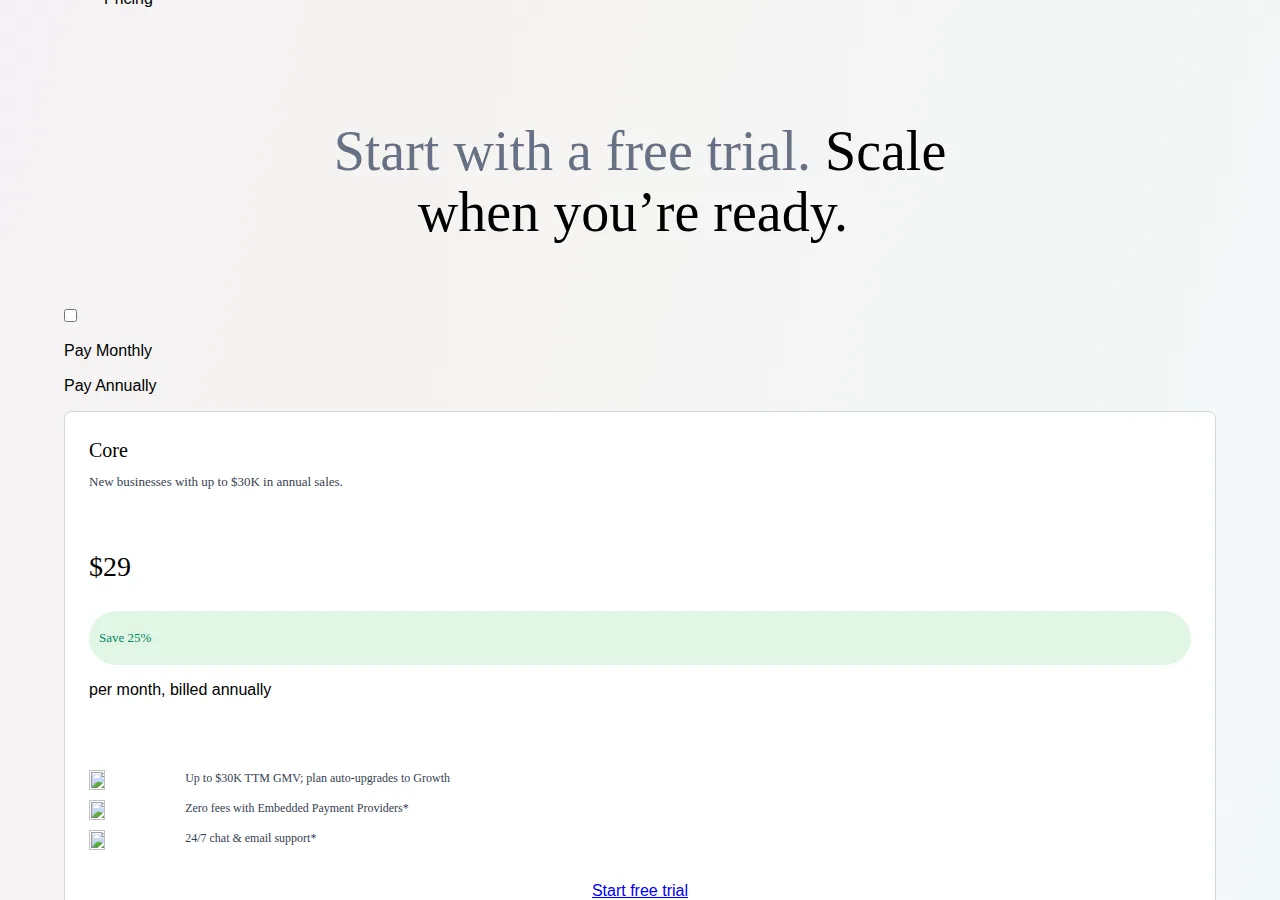
BigCommerce's pricing page lists, on annual billing, Core at $29 a month for new businesses with up to $30,000 in trailing GMV, Growth at $79 a month up to $100,000 in trailing GMV, and Scale at $299 a month up to $33,333 a month in GMV. Monthly billing is higher: Core $39, Growth $105, Scale $399. The plan auto-upgrades when the GMV threshold is crossed. Embedded payment providers carry zero platform fees on all three tiers, while orders through open payment providers carry a fee: 2 percent of eligible order GMV on Core and 1 percent on Growth. Above the Scale cap, Performance is custom, starting at $1,499 a month billed annually. BigCommerce measures GMV as gross order value minus 10 percent for plan thresholds, so a store's raw sales and its threshold GMV are not the same number.
WooCommerce's pricing page states the model in one line: the core platform is free, with no monthly subscription, no platform fee, and no revenue share. The costs are the pieces around it: hosting at $25 to $350 a month for most stores, scaling with traffic and performance needs, extensions at $29 to $299 a year each, and payment processing at about 2.50 to 2.90 percent plus 30 cents per transaction with WooPayments. There is no GMV cap, no auto-upgrade, and no platform transaction fee on any route, which makes WooCommerce the only platform here whose bill does not rise automatically with sales, and the only one whose bill can rise silently through extension renewals instead.
| Attribute | Shopify | BigCommerce | WooCommerce | Authority |
| :--- | :--- | :--- | :--- | :--- |
| Monthly plan, annual billing | Basic $29, Grow $79, Advanced $299 | Core $29, Growth $79, Scale $299 | $0, no subscription | Vendor pricing pages, November 2026 |
| Card rate, native rail | 2.9, 2.7, 2.5 percent plus 30 cents by tier | Processor rate, not stated on the pricing page; zero platform fee with embedded providers | About 2.50 to 2.90 percent plus 30 cents with WooPayments | Vendor pricing pages |
| Third-party or open-provider fee | 2 percent on Basic, declining by tier | 2 percent Core, 1 percent Growth | None | Vendor pricing pages |
| Revenue ceiling | None on listed plans | Core $30K trailing GMV, Growth $100K, Scale $33,333 a month, then auto-upgrade | None | BigCommerce pricing |
| Hosting and extensions | Included, unlimited hosting | Included | Hosting $25 to $350 a month; extensions $29 to $299 a year each | WooCommerce pricing |
Worked math: the same two months on all three meters
One formula keeps the comparison honest, with card processing separated from platform cost wherever the vendor does not state it:
$
\text{Monthly Platform Cost} = \text{Plan Price} + (\text{GMV} \times \text{Platform Transaction Rate})
$
$
\text{Monthly Card Cost} = (\text{GMV} \times \text{Card Rate}) + (\text{Orders} \times \$0.30)
$
Profile A is $10,000 of GMV at a $50 average order, or 200 orders, on the native payment rail. Platform cost is $29 on Shopify Basic, $29 on BigCommerce Core, and $0 on WooCommerce. Card cost on Shopify Basic is 2.9 percent of $10,000, which is $290, plus 200 times $0.30, which is $60, for $350, giving a Shopify total of $379. WooCommerce card cost at the WooPayments range is $250 to $290 plus $60, or $310 to $350, plus hosting at $25 to $350, giving a WooCommerce total of $335 to $700 before extensions. BigCommerce Core totals $29 plus whatever its embedded provider charges for processing, a rate the pricing page does not state, so no BigCommerce card total is invented here: the honest BigCommerce figure at this volume is a $29 platform cost plus a processor rate to be quoted.
Profile B is $50,000 of GMV at a $50 average order, or 1,000 orders. On the native rail, Shopify Grow costs $79 plus card cost of 2.7 percent of $50,000, which is $1,350, plus 1,000 times $0.30, which is $300, for a total of $1,729. WooCommerce card cost is $1,250 to $1,450 plus $300, or $1,550 to $1,750, plus hosting at $25 to $350, for a total of $1,575 to $2,100 before extensions. BigCommerce Growth costs $79 on the platform, plus its processor rate, again unstated on the pricing page.
The platform-fee comparison, which needs no processor assumption, is where the third-party rail decides the ranking. At $50,000 of GMV, a third-party checkout on Shopify Basic adds 2 percent, or $1,000, to the $29 plan, for a $1,029 platform cost. The same month through an open provider on BigCommerce Growth adds 1 percent, or $500, to the $79 plan, for a $579 platform cost. WooCommerce adds $0 in platform fees on any rail. A store that must use a third-party processor, because of its gateway, its region, or its existing merchant account, therefore pays $450 a month more in platform fees on Shopify Basic than on BigCommerce Growth at this volume, before a single card fee, and pays nothing in platform fees on WooCommerce at any volume.
The ceiling comparison is the second decision. At $200,000 a month, Shopify Advanced still lists $299 a month with no GMV cap, and WooCommerce still charges no platform fee, with hosting as the only scaling line. BigCommerce Scale, capped at $33,333 a month in GMV, is already passed, and Performance starts at $1,499 a month billed annually on contracted terms. A store forecasting past the Scale cap should therefore price Performance before it crosses, because the auto-upgrade turns a $299 plan into a negotiated contract without a published intermediate step. To budget the storefront build around the platform, run the pricing calculator and the website cost calculator, and to price the delivery layer behind the storefront, see the CDN pricing guide.
Where each price breaks
Shopify's price breaks on the payment rail, not on the plan. For the processor comparison behind the rail — Stripe, Square, and PayPal priced at three volumes — see our Stripe vs Square vs PayPal processing fees guide. A founder who picks Basic for the $29 headline and checks out through a third-party provider pays $1,000 in transaction fees on a $50,000 month, thirty-four times the plan price. Pick the rail first: if Shopify Payments is available in your market, the platform fee is zero and the card rate is the whole story; if it is not, price the third-party fee at your actual GMV before comparing plans.
BigCommerce's price breaks on the ceiling. The auto-upgrade is a feature for a growing store and a trap for a seasonal one: a single strong month can push trailing GMV over a threshold, and the GMV definition, gross order value minus 10 percent, means the threshold arrives at higher raw sales than the headline suggests. A store with a holiday peak should model trailing GMV month by month before choosing a tier.
WooCommerce's price breaks on the stack. No platform fee sounds like a saving until the extension list grows: ten paid extensions at the top of the $29 to $299 range cost up to $2,990 a year, plus hosting that scales with traffic, plus maintaining WordPress, the theme, and the extensions. A lean stack with a capable operator keeps WooCommerce cheapest at every volume here; a heavy stack with no operator pays for the freedom in maintenance instead of platform fees.
> [!WARNING]
> Never compare a plan price to a platform fee at one GMV and call the decision made. A $29 plan with a 2 percent transaction fee costs $1,029 at $50,000 a month, a $79 plan with a 1 percent fee costs $579, and a free platform with $350 hosting and ten extensions costs more than either. Re-run the platform fee, the card cost, and the hosting line at your own average order and GMV every quarter, because average order moves the per-transaction fee and GMV moves both the transaction fee and the BigCommerce tier.
Decision matrix and execution checklist
| Situation | Buy | Why the math says so | Authority |
| :--- | :--- | :--- | :--- |
| Under $10K a month, wants hosted simplicity | Shopify Basic or BigCommerce Core | $29 plan, $379 all-in on Shopify at $50 average order | Vendor pricing pages |
| Must use a third-party processor at $50K | WooCommerce, or BigCommerce Growth | $0 platform fee on WooCommerce; $579 on BigCommerce Growth against $1,029 on Shopify Basic | Vendor pricing pages |
| Forecast past $33,333 a month in GMV | Price BigCommerce Performance early | Scale cap auto-upgrades to custom from $1,499 a month | BigCommerce pricing |
| Lean catalog, capable operator, any volume | WooCommerce | No platform fee, no cap, hosting $25 to $350 for most stores | WooCommerce pricing |
| Wants one invoice, one vendor, no stack | Shopify on Shopify Payments | Plan plus card rate, zero platform transaction fee | Shopify pricing |
> [!FOUNDER]
> "Founders shop platforms the way they shop rent: by the monthly number on the page. The monthly number is the smallest number on the invoice. What matters is the percentage behind it, the ceiling above it, and the stack beside it. Price the meter, price the rail, and count the extensions, and the cheapest platform picks itself."
> — Enow A. Jovial, Founder & Chief Executive Officer
Operator boundaries: who should not pick each platform
Do not pick Shopify Basic with a third-party processor at scale, because the 2 percent transaction fee outgrows the plan price by an order of magnitude. Do not pick BigCommerce on the Core headline if a seasonal peak will push trailing GMV past $30,000, because the auto-upgrade arrives without a negotiation. Do not pick WooCommerce if nobody on the team will maintain WordPress, because an unmaintained store is a security liability, not a saving. Do not pick any platform on the plan price alone if your average order is far from $50, because the per-transaction fee moves every total in this guide, and a $15 average order pays twice the per-order fee share of a $30 average order at the same GMV.
> [!TIP]
> Test the rail before the theme. Open the payment provider you will actually use, confirm its availability in your market and its processing rate in writing, and only then compare plan prices. A theme can be rebuilt in a weekend; a payment rail chosen for the wrong fee schedule costs a percentage of every order until you migrate, and migration is the most expensive project in ecommerce.