Type shareasale.com into a browser today and you land on Awin. ShareASale, the Chicago affiliate network founded in 2000, has been owned by Awin since 2017, and in 2026 Awin folded new ShareASale sign-ups into its own plans. The three-way comparison every merchant still asks for — ShareASale vs Impact vs Awin — is therefore two live sign-ups and one legacy schedule: Awin Access and Accelerate, impact.com's four tiers, and ShareASale's last published terms for the merchants already on it.
Who this guide is for, and who should stop here
This guide is for the merchant choosing where to run an affiliate program — a Shopify, WooCommerce, or BigCommerce store paying partners a percentage of each sale — and for the affiliate weighing which network's merchants pay best. It gives the fee structures from the vendors' own pricing pages, the per-sale math at a $100 order, the annual totals at 100 and 500 sales a month, and the three break-even points that decide the choice.
Stop here if you only want to set up a program: the affiliate marketing program setup playbook covers commission structures, cookie windows, and the FTC disclosure rules. Stop here if you are comparing affiliate software you host yourself — this is networks only, where the network recruits the partners, tracks the sales, and moves the money. And stop here if your store sells nothing online: none of these three networks has an offline product.
The fee structures, from the vendors' own pages
| Network | Entry cost | Monthly fee | Per-sale fee | Minimum term |
|---|---|---|---|---|
| ShareASale (legacy) | $550 one-time access fee + $100 deposit | $35 minimum | 20% of the commission paid | None stated |
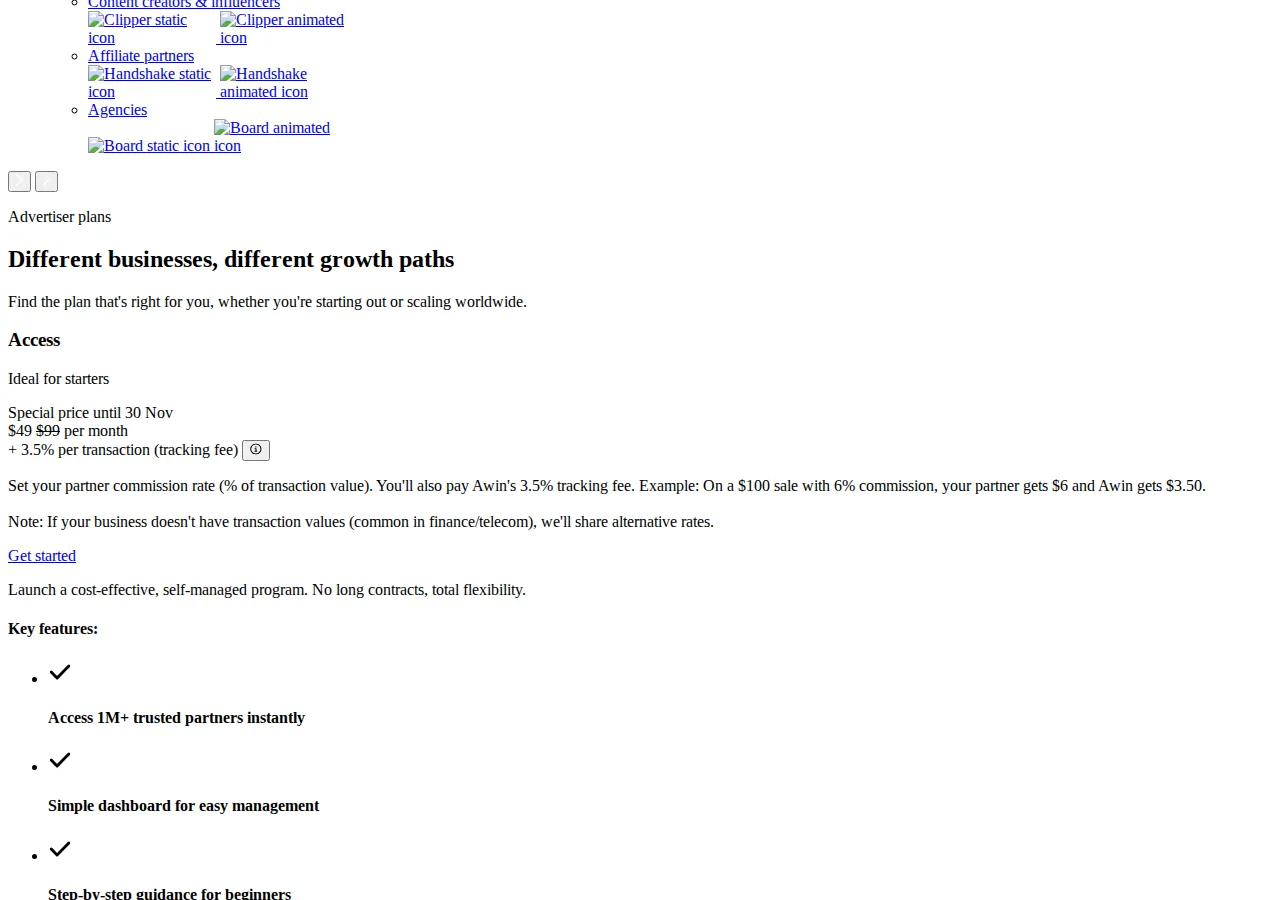
| Awin Access | None | $49 (special price to Nov 30; $99 list) | 3.5% of transaction value | 3 months |
| Awin Accelerate | None | $99 (special price to Nov 30; $199 list) | 2.5% of transaction value | 3 months |
| Awin Advanced | None | Custom | Custom | Custom |
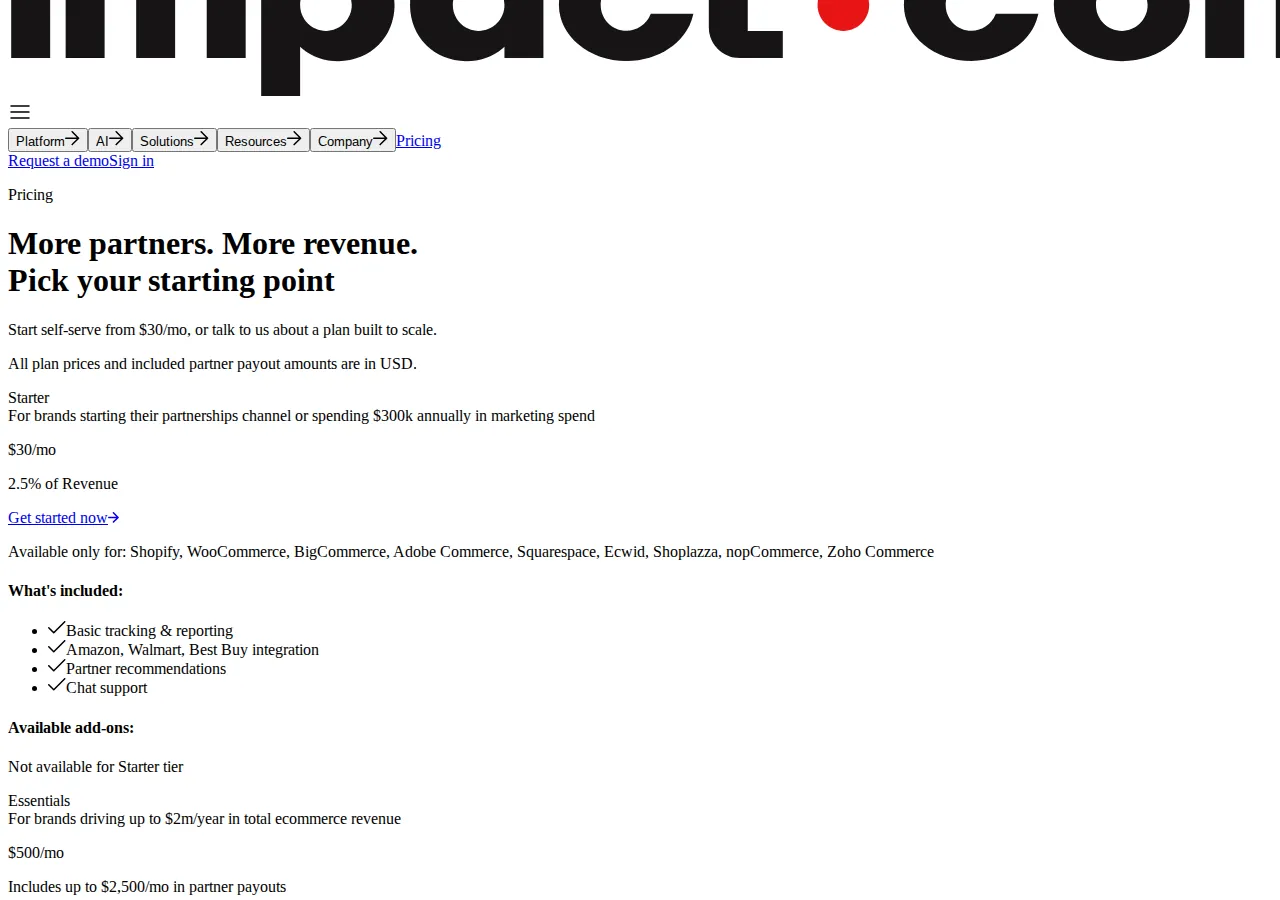
| Impact Starter | None | $30 | 2.5% of revenue | None stated |
| Impact Essentials | $250/hour setup and onboarding | $500 | None — covers payout processing up to $2,500 a month | None stated |
| Impact Pro | $250/hour setup and onboarding | $2,500 | None — covers payout processing up to $14,300 a month | None stated |
| Impact Enterprise | Custom | Custom | Custom | Custom |
Three facts in that table do the most work. First, ShareASale's $550 access fee and $100 deposit are the last published ShareASale schedule: Awin's own page now routes new ShareASale sign-ups to Awin plans, so a new merchant cannot buy the ShareASale schedule at all — it survives only for existing merchants. Second, Awin's $49 and $99 prices are special prices running until November 30, with list prices of $99 and $199 behind them; the per-transaction fee is the permanent part, the monthly fee is the part that can double. Third, Impact's Essentials and Pro fees buy payout capacity, not payouts: the merchant still pays the affiliates the commissions, and the $500 or $2,500 a month is the platform fee for processing up to that volume.
Worked math 1: one $100 sale at a 10 percent commission
Example: a $100 order, the merchant pays the partner 10 percent — $10 of commission. What each network adds on top:
The partner receives the full $10 on every network: the network fee is the merchant's cost, never a deduction from the partner's commission. At this order size and commission rate, legacy ShareASale is the cheapest per sale at $12.00, and Awin Accelerate ties Impact Starter at $12.50. Awin Access is the most expensive per sale at $13.50, and its $49 monthly fee has not been counted yet.
The crossover is the interesting number. ShareASale's fee is 20 percent of the commission; Awin Access's fee is 3.5 percent of the sale. They are equal when the commission rate satisfies:
Below a 17.5 percent commission rate, ShareASale's percentage-of-commission is cheaper than Awin Access's percentage-of-sale. Above 17.5 percent, Awin Access wins. A merchant paying 5 percent commissions — $5 on a $100 order — pays ShareASale $1.00 a sale and Awin Access $3.50. A merchant paying 25 percent commissions pays ShareASale $5.00 and Awin Access $3.50. The commission rate you set decides which fee base is cheaper, which is why the comparison cannot be settled by looking at the fee percentages alone.
Worked math 2: the annual totals at 100 and 500 sales a month
Two volumes, same $100 order and 10 percent commission — $10,000 a month in partner commissions at 100 sales, $50,000 at 500.
At 100 sales a month:
| Network | Monthly total | Annual total, year 1 |
|---|---|---|
| ShareASale (legacy) | $35 + $200 = $235 | $2,820 + $550 setup = $3,370 |
| Awin Access | $49 + $350 = $399 | $4,788 |
| Awin Accelerate | $99 + $250 = $349 | $4,188 |
| Impact Starter | $30 + $250 = $280 | $3,360 |
At 100 sales a month, Impact Starter and legacy ShareASale are effectively tied — $3,360 against $3,370 in year one — and both beat Awin Accelerate by more than $800 a year. Awin Access is the most expensive at this volume, and at its $99 list price the annual total rises to $5,388.
At 500 sales a month:
| Network | Monthly total | Annual total, year 1 |
|---|---|---|
| ShareASale (legacy) | $35 + $1,000 = $1,035 | $12,420 + $550 setup = $12,970 |
| Awin Access | $49 + $1,750 = $1,799 | $21,588 |
| Awin Accelerate | $99 + $1,250 = $1,349 | $16,188 |
| Impact Starter | $30 + $1,250 = $1,280 | $15,360 |
At 500 sales, Impact Starter is the cheapest live sign-up at $15,360 a year, and legacy ShareASale is cheaper still at $12,970. Awin Access is the worst value at this volume: $21,588 a year, $6,228 more than Impact Starter. Impact Essentials does not fit this volume at all: its $2,500-a-month payout capacity is below the $5,000 a month in commissions the program pays, so the merchant needs Pro at $2,500 a month — $30,000 a year — for a program Awin Accelerate runs for $16,188.
Worked math 3: the three break-even points
Awin Access vs Accelerate: 50 sales a month. Accelerate costs $50 more a month and saves $1.00 a sale ($3.50 minus $2.50 on a $100 order). The upgrade pays for itself at:
Below 50 sales a month at a $100 average order, stay on Access. Above it, Accelerate is cheaper every month after, and the gap widens with volume.
Impact Pro vs Awin Accelerate: $96,040 of monthly GMV. Impact Pro is a flat $2,500 a month; Awin Accelerate is $99 plus 2.5 percent of GMV. They are equal when:
At a 10 percent commission rate that is $9,604 a month in partner payouts — inside Pro's $14,300 capacity. Above roughly $96,000 of monthly GMV, Impact Pro beats Awin Accelerate: at the full $14,300 of payouts, Awin Accelerate costs $3,674 a month against Pro's $2,500, a $1,174 monthly saving. Below that line, Awin Accelerate wins by thousands.
Impact Essentials vs Pro: $200 against $175 per $1,000 of payouts. Essentials costs $500 a month for $2,500 of payout capacity — $200 per $1,000 processed. Pro costs $2,500 for $14,300 — about $175 per $1,000. Essentials exists for programs that need its features — API-based tracking, custom commission rates, Data Lab — not for the cheapest processing. A program paying exactly $2,500 a month in commissions should compare Essentials at $500 against Awin Accelerate at $99 plus 2.5 percent of $25,000 GMV, or $724.
What the fee table does not show
Recruitment. ShareASale lists more than 16,000 merchants and 240,000 affiliates; Awin's Access plan promises access to more than 1,000,000 trusted partners instantly. Impact does not sell a network count — it sells a platform, and the merchant recruits its own partners or buys the Creator and Advocate add-ons.
Attribution and tracking. Awin's plans differ on commission rules: Access allows three commission groups, Accelerate and Advanced allow unlimited groups, with rules by product, category, SKU, new or existing customer, coupon code, and clicks. Impact Starter includes basic tracking and reporting; API-based tracking and custom commission rates start at Essentials. A program that pays different rates for new and returning customers needs Accelerate or Essentials, not Access or Starter.
Payment thresholds. A ShareASale affiliate is paid once the balance reaches $50, by ACH or check — ShareASale does not use PayPal. The threshold that matters to the merchant is the deposit: ShareASale's $100 minimum deposit pre-funds commissions and fees, and Awin's 3-month minimum term means the first quarter costs at least $147 on Access even if no sale ever tracks.
The disclosure rule. Every affiliate link in the program is an endorsement, and 16 CFR § 255.5 requires the material connection between the advertiser and the endorser to be disclosed. The merchant's agreement should require it, and the merchant should audit for it: the regulator's failure is charged to the merchant whose name is on the sale, not to the partner who posted the link.
The bookkeeping footing. The program runs under the merchant's entity — LLC, S-Corp, or C-Corp — with the EIN on the network agreement and the CPA booking commissions as a marketing expense under GAAP, not as COGS. US partners paid $600 or more in a year are reported on Form 1099: the network collects the W-9, the merchant's CPA files the 1099-NEC or 1099-MISC, and the payout moves by ACH. A sole proprietor running the program under an SSN instead of an EIN should fix the entity before the first payout, not after the first 1099 season.
Who should not use each one
Do not choose Awin Access if you will sell more than 50 orders a month through affiliates: the 3.5 percent tracking fee is the highest per-sale rate here, and Accelerate pays for itself at 50 sales. Do not choose Impact Essentials for a program paying more than $2,500 a month in commissions: the payout cap forces an upgrade to Pro at five times the price. Do not choose legacy ShareASale as a new merchant: it is not for sale — new sign-ups go to Awin. Do not choose Impact Starter if your store is not on Shopify, WooCommerce, BigCommerce, Adobe Commerce, Squarespace, Ecwid, Shoplazza, nopCommerce, or Zoho Commerce. And do not choose any of the three on price alone: the cheapest network with no partners is the most expensive program you will ever run.
Founder & CEO Insight — Enow A. Jovial
Decision checklist
- [x] Step 1: Set the commission rate first — The rate decides the fee base: below 17.5 percent, ShareASale's percentage-of-commission beats Awin Access; above it, Awin wins.
- [x] Step 2: Forecast the volume — Below 50 affiliate sales a month, Awin Access; above it, Accelerate. Below $96,000 of monthly GMV, Accelerate; above it, Impact Pro.
- [x] Step 3: Check the platform — Impact Starter only for the nine listed store platforms; Awin and ShareASale are platform-neutral.
- [x] Step 4: Price the year on list prices — Awin's $49 and $99 are special prices to November 30; the year costs $99 and $199 a month after that.
- [x] Step 5: Budget the deposit and the term — ShareASale's $100 deposit; Awin's 3-month minimum term, $147 minimum on Access.
- [x] Step 6: Write the disclosure into the agreement — 16 CFR § 255.5 requires the material connection disclosed; audit partners for it.
- [x] Step 7: Test the total in the pricing calculator — Run the monthly cost through the pricing calculator before signing a year of annual billing. For the store itself, the Shopify vs WooCommerce vs BigCommerce platform fees playbook prices the cart the program runs on, and the Klaviyo vs Mailchimp vs Kit email marketing playbook prices the email that feeds it.