Affiliate Marketing Program Setup: The Commission Playbook
An affiliate program is a sales channel you pay for only after the sale lands — and a liability from the moment the first partner posts a link. Four decisions decide it: rate, cookie window, platform, and disclosure wording.
Who this is for — and who should stop here
This guide is for a merchant whose product already sells — an ecommerce store, a software vendor, or a services business with a checkout that can carry tracking. It is not for a business with no sales history: an affiliate program cannot create demand.
> [!FOUNDER]
> "An affiliate program is the only channel where you set the price of a customer before you buy the customer. That advantage disappears the day the platform fee, the coupon leak, or the disclosure failure prices the customer for you."
> — Enow A. Jovial, Founder & Chief Executive Officer
Commission structures: pick the one your margin can carry
Three structures cover nearly every program. Pay-per-sale pays a percentage of the order value — the ecommerce standard. A 10% rate on a $120 average order value pays $12 per sale; no sale, no payout. Its weakness is that the rate is blind to margin — 10% on a product with a 15% gross margin leaves almost nothing after the platform fee. Revenue share pays a percentage of revenue over a defined period — the subscription standard. A partner who refers a subscriber at 20% of the first twelve months' revenue is paid as the customer pays; the cost is accounting complexity, because refunds and churn change what is owed. Flat bounty pays a fixed dollar amount per defined action. Amazon Associates publishes bounties of this kind: $30 for a Prime for Young Adults trial, $25 for Audible Premium Plus Annual, $20 for an Audible Standard trial, and $15 for Amazon Business. A bounty fits when the action has a fixed value; it fails when a $30 bounty lands on a $25 first order. Tiered rates — 8% to $10,000 in monthly referred revenue, 12% above it — reward volume without renegotiation; cap recurring commissions at twelve months, since they become a permanent liability. Write the rate, the qualifying-sale definition, the refund window, and the payout schedule into the program terms before recruiting: a rate argued after the sale is a dispute; a rate published before it is a term.
> [!KEY TAKEAWAY]
> The commission rate is a cost line — rate plus platform fee plus tracking fee — divided into the margin on the order. If that arithmetic does not clear your margin, no volume of partner traffic fixes it.
The one formula that prices the whole program
Every platform here charges in a different shape, so the only number that compares them is the effective commission rate: everything the program costs in a month, divided by attributed revenue.
$
\text{Effective rate} = \frac{\text{Partner commissions} + \text{Platform subscription} + \text{Tracking fees}}{\text{Attributed revenue}}
$
Assume 5,000 referred clicks at 2.0% conversion into 100 orders at a $120 average order value: attributed revenue is $12,000. At a 10% pay-per-sale rate the partner commission is $1,200. On Awin Access at $49 per month plus a 3.5% per-transaction tracking fee, the platform cost is $49 plus $420, or $469. Total cost is $1,669, so the effective rate is $1,669 divided by $12,000 — 13.91%, against a headline rate of 10%.
Cookie windows and attribution: who gets paid for one sale
A cookie window is the time after a click during which a purchase still credits the affiliate. Amazon Associates runs the shortest well-documented window: a claim expires 24 hours after the click, unless the customer added the item to a cart, in which case carted items count if bought within 89 days. Short windows stop the merchant paying for customers who would have bought anyway; long windows recruit better partners. Amazon's own fee-schedule page did not load from our network; the Amazon figures in this guide are corroborated across independent 2026 reads that each cite Amazon's published schedule.
Attribution decides which partner gets paid when more than one touched the sale. Last-click pays the final click — simple, standard, and systematically unfair to the introducer. First-click pays the introducer and starves the closer. Multi-touch splits it by a rule the merchant defines. Take 100 attributed orders at a $120 average order value and a 10% rate, each touched by two affiliates — A introduced the product, B closed the sale. Under last-click, B earns 100 times $12, or $1,200, and A earns nothing; under first-click the numbers reverse; under a 50/50 split each earns $600. Same sales, $1,200 moving between two people on the strength of a setting. Publish the model in the program terms; never change it retroactively.
Network, in-house, or someone else's program
| Option | What you pay | Authority |
| :--- | :--- | :--- |
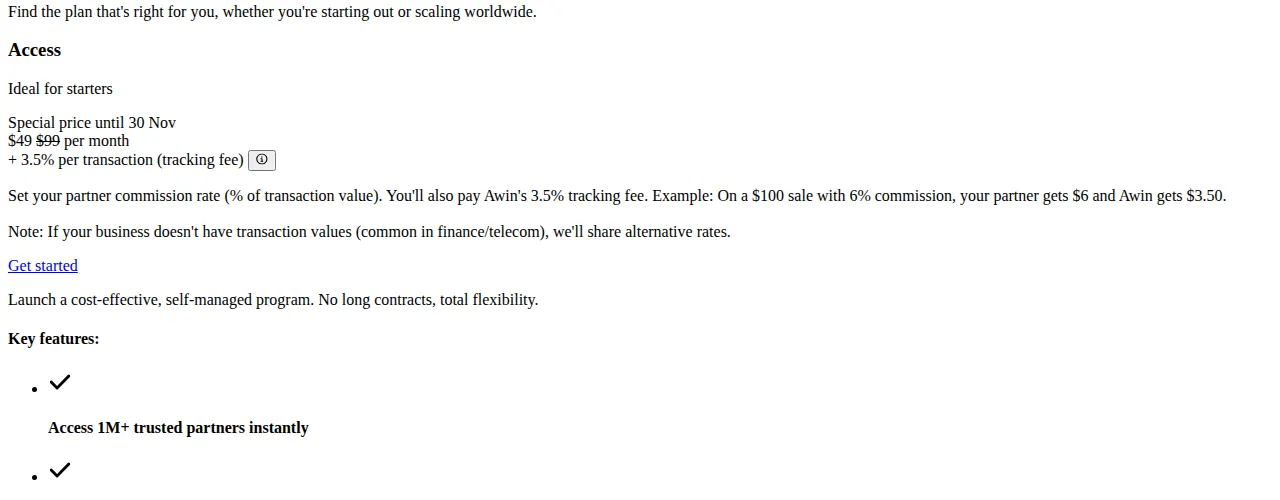
| Awin Access | $49/mo + 3.5% per transaction | Awin pricing |
| Awin Accelerate | $99/mo + 2.5% per transaction | Awin pricing |
| Impact Starter | $30/mo + 2.5% of revenue | Impact pricing |
| Impact Essentials | $500/mo, incl. $2,500/mo payouts | Impact pricing |
| Impact Pro | $2,500/mo, incl. $14,300/mo payouts | Impact pricing |
| In-house tracking | Software + staff time | Your own cost ledger |
| Amazon Associates | You are the affiliate | Amazon schedule |
What the networks actually charge
Access costs $49 per month on special until November 30 ($99 standard) plus a 3.5% tracking fee, with the first month free and a three-month minimum term. Accelerate costs $99 per month on special ($199 standard) plus a 2.5% tracking fee, adding automation and APIs. Awin's own example: on a $100 sale with a 6% commission, the partner gets $6 and Awin gets $3.50 on Access, or $2.50 on Accelerate.
Impact prices by the merchant's size. Starter is $30 per month plus 2.5% of revenue, for brands spending up to $300,000 a year on marketing, on nine named commerce platforms: Shopify, WooCommerce, BigCommerce, Adobe Commerce, Squarespace, Ecwid, Shoplazza, nopCommerce, and Zoho Commerce. Essentials is $500 per month for brands up to $2 million a year in total ecommerce revenue, including $2,500 a month in partner payouts. Pro is $2,500 per month for brands between $2 million and $15 million a year, including $14,300 a month in payouts, with API tracking and custom commission rates. Setup costs $250 per hour on Essentials, Pro, and Enterprise; Starter has none. Payouts above the included allowance are billed a la carte at an unpublished rate — get it in writing before signing.
PartnerStack publishes no prices: its pricing page states that pricing "is based on your partner program size, feature needs and level of support" — a quote, not a card. ShareASale no longer has a standalone price or signup: Awin has owned ShareASale since 2017 and routes new customers to Awin.
Access costs $49 plus 3.5% of attributed revenue; Pro costs a flat $2,500. Set them equal: revenue is $2,451 divided by 0.035, or $70,028.57 a month. Below about $70,029 a month, Access is cheaper; above it, Pro's flat fee wins, while payouts stay inside Pro's included $14,300. At $40,000 a month and a 10% commission, Access costs $5,449 (13.62% effective) and Pro costs $6,500 (16.25% effective).
$
\text{Break-even AOV} = \frac{\text{Fixed monthly platform cost}}{(\text{Gross margin} - \text{Commission rate} - \text{Tracking rate}) \times \text{Monthly orders}}
$
For Impact Pro at a 40% gross margin, a 10% commission, and 100 orders a month: break-even revenue is $2,500 divided by 0.30, or $8,333.33, and break-even average order value is $8,333.33 divided by 100, or $83.33. Below $83.33, the Pro subscription eats the margin the program exists to create.
The FTC rules: disclosure is the merchant's problem
Affiliate marketing is endorsement marketing, governed by the Federal Trade Commission's Endorsement Guides at 16 CFR Part 255, revised in 2023 (88 FR 48102, July 26, 2023). The Guides interpret Section 5 of the FTC Act, 15 U.S.C. 45, which prohibits unfair or deceptive acts in commerce. The Guides themselves do not carry the force of law, but practices inconsistent with them can result in corrective action under Section 5, and the FTC can seek substantial civil penalties after a Notice of Penalty Offenses.
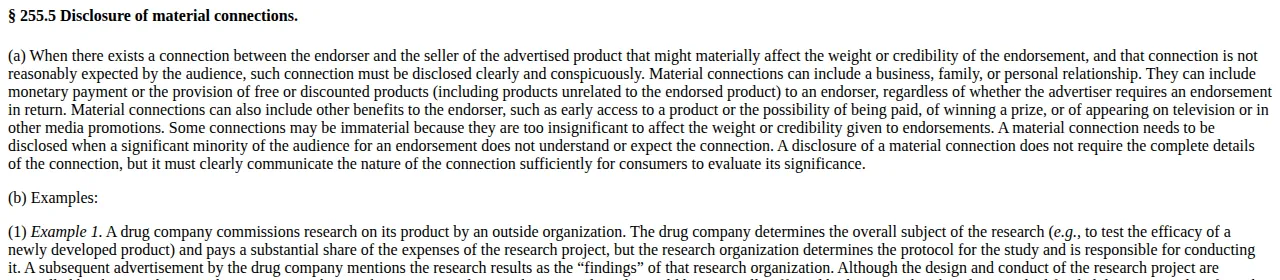
The operative rule is 16 CFR 255.5: "When there exists a connection between the endorser and the seller of the advertised product that might materially affect the weight or credibility of the endorsement, and that connection is not reasonably expected by the audience, such connection must be disclosed clearly and conspicuously." A material connection includes payment or free products, whether or not the advertiser required an endorsement in return. An affiliate commission is a material connection by definition.
Example 11 under section 255.5(k) decides the affiliate case: a blogger who reviews coffee makers independently but includes affiliate links, receiving "a portion of the sale" whenever a reader clicks and buys. The Guides conclude: "Because knowledge of this compensation could affect the weight or credibility site visitors give to the blogger's reviews, the reviews should clearly and conspicuously disclose the compensation."
Section 255.0(f) defines "clearly and conspicuously": a disclosure must be "difficult to miss (i.e., easily noticeable) and easily understandable by ordinary consumers," and in interactive electronic media it must be unavoidable. The suggested disclosure is: "I get commissions for purchases made through links in this post." The words "affiliate link" by themselves are not adequate, because consumers might not understand that the phrase means the poster is paid; a "buy now" button is not adequate either; "paid link" placed right next to the affiliate link should be adequate; "commissionable link" is probably not clear. Placement follows one rule: "The closer the disclosure is to your recommendation, the better."
> [!WARNING]
> The merchant carries the enforcement risk: when law enforcement becomes necessary, the FTC's focus "usually will be on advertisers or their ad agencies and public relations firms." A program agreement that tells partners to "comply with the FTC" without specifying the disclosure wording, the placement, and the monitoring is not a compliance control — it is a hope.
Fraud controls: the three leaks that eat a program
Coupon leakage. A partner publishes a coupon code the merchant issued for another channel, and every sale that uses it credits the partner. The control is code ownership: each partner gets unique codes, codes are single-use or capped, and coupon sites are monitored.
Trademark bidding. A partner buys the merchant's brand name as a search keyword, the customer clicks the ad instead of the organic result, and the merchant pays commission on a sale it would have made for free. The control is a written prohibition in the terms, enforced by search monitoring.
Self-referral and fake orders. A partner buys through their own link, or generates orders that refund after the commission is paid. The controls are a self-purchase ban, a holdback until the refund window closes, and a clawback clause for refunded orders.
Payouts, tax forms, and the cross-border paragraph
Paying partners is a payments operation, not a marketing afterthought. A US partner is onboarded with a Form W-9 and identified by an EIN or an SSN; a non-US partner with a Form W-8BEN and an ITIN or foreign tax identifier, and the merchant's withholding duty turns on that form. Payouts run by ACH domestically and by Wire internationally, with FX conversion and IBAN or SWIFT routing. The payout file should move as a CSV export from the platform into the accounting system through an API, not as a hand-typed spreadsheet — a mistyped digit loses a payout. Under GDPR, a partner's personal data is processed under a lawful basis the merchant documents. An LLC, an S-Corp, or a C-Corp merchant reports and withholds under its own structure; have the CPA review the payout setup before launch.
Under 26 U.S.C. section 6041(a), a payer must report payments for services — which is what affiliate commissions are — once they pass a dollar threshold: $600 for payments made in 2025 and earlier. The One Big Beautiful Bill Act, Public Law 119-21, section 70433(a), substituted $2,000 for $600, applicable to payments made after December 31, 2025. A merchant paying a partner $1,500 in 2026 has no 1099-NEC filing duty on that partner; the same payment in 2025 did. The threshold is per payee per calendar year. The IRS Form 1099-NEC contractor reporting playbook runs the filing mechanics line by line.
Two ratios discipline the program after launch. Customer acquisition cost (CAC) is the total program cost in a month divided by the new customers it produced — $1,669 divided by 100 orders is $16.69 per order, before refunds. Lifetime value (LTV) is what those customers are worth over their buying life, and the program is viable only while LTV clears CAC with margin to spare. Track both monthly, by partner tier. The profit calculator runs the same arithmetic on the merchant's own numbers.
Launch checklist
1. Set the rate from margin. Compute the effective rate at the merchant's own average order value, conversion rate, and margin.
2. Choose the platform by volume. Price all three tiers at your own attributed revenue.
3. Write the program terms before recruiting: rate, qualifying-sale definition, refund window, cookie window, attribution model, trademark-bidding ban, self-purchase ban, holdback, and clawback.
4. Put the FTC disclosure in the agreement: "I get commissions for purchases made through links in this post," adjacent to every recommendation and link.
5. Collect tax forms before the first payout: W-9 for US partners, W-8BEN for non-US partners. No form, no payout.
6. Issue unique coupon codes per partner.
7. Set the payout holdback: pay 30 days after the sale, after the refund window, and claw back commissions on refunded orders.
8. Audit partner content monthly: sample the long tail, review every top partner, and suspend partners who post without the disclosure.
9. Track acquisition cost against lifetime value by partner tier.
10. Re-price annually. Re-run the effective rate and break-even order value when any platform changes its card.
> [!TIP]
> Start on Awin Access or Impact Starter and move up only when the crossover math says so. The influencer marketing rate card playbook prices the flat-fee creator side of the same budget, and the social commerce fees playbook prices the storefront fees next to the affiliate cost.
An affiliate program is a contract, a price list, and a compliance control wearing a marketing costume. The merchants who make it work price it with the effective-rate formula, publish the attribution model, write the disclosure into the agreement, and audit the partners they pay. The rest pay for sales they already had, reward the partner who added the least, and hand the regulator a disclosure failure with the merchant's name on it.