Three vendors, three billing theories
Klaviyo, Mailchimp, and Kit all charge by list size, and that shared sentence hides three different bills. Klaviyo bills on active profiles and pairs the count with ecommerce data: segmentation, flows, and revenue attribution. Mailchimp bills on contacts and rations sends as a multiple of that count, with seats and automation depth gated by tier. Kit bills on subscribers, puts no cap on sends at any tier, and takes a cut of what creators sell through it.
This comparison prices all three on the same list sizes, from the vendors' own pricing pages read in November 2026, and names the ceiling that forces each switch. Prices are a November 2026 snapshot, not a quote: all three vendors reprice without notice, and their sliders render client-side, so the dollar ladders below were cross-checked across independent slider reads. Re-check the live page before signing.
> [!KEY TAKEAWAY]
> At 5,000 contacts the three vendors land within $25 a month of each other on comparable paid tiers, and Kit is free if you need broadcasts only. The decision is therefore not a price decision at small scale. It is a feature-ceiling decision: which vendor's free tier, automation cap, or send multiple breaks first under your actual sending pattern.
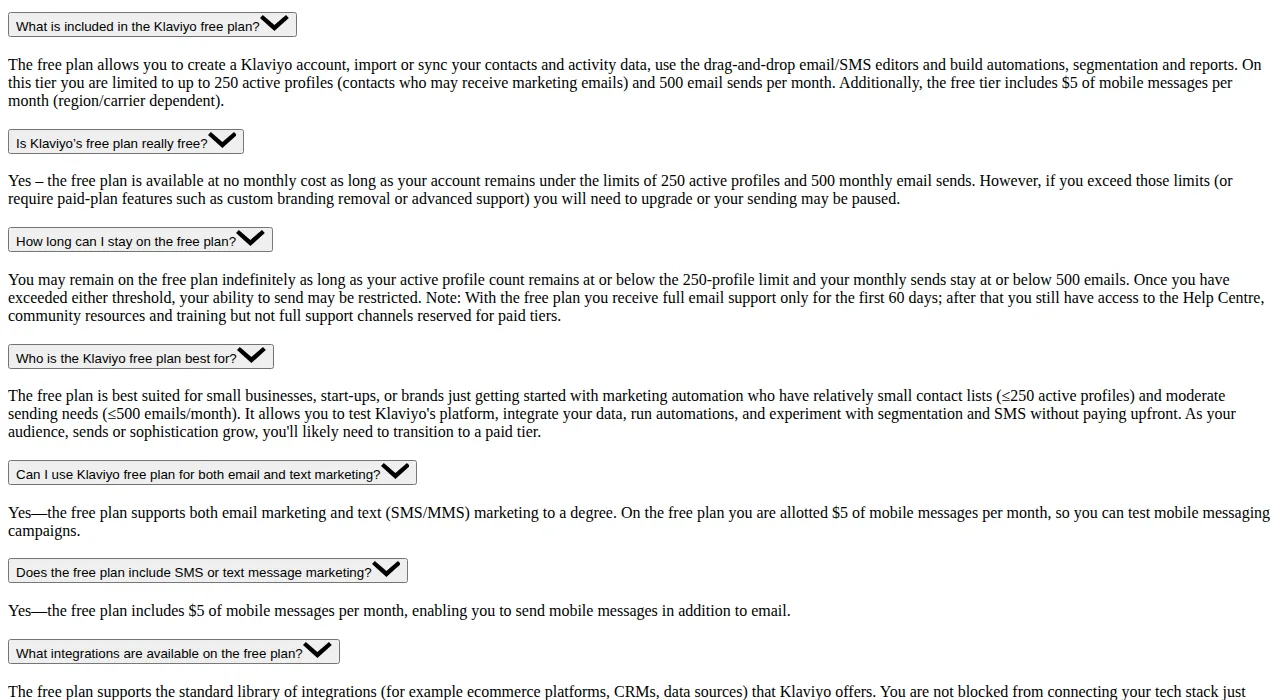
The pricing table, from the vendors' own pages
| Vendor | Free tier | First paid tier | Send allowance | Billing note from the page |
| :--- | :--- | :--- | :--- | :--- |
| Klaviyo | $0, up to 250 active profiles, 500 emails per month | Email plan from $20 per month at 251–500 profiles | About 10 times the profile count | Email plus mobile plans add SMS and MMS as metered credits |
| Mailchimp | $0, up to 250 contacts, 500 emails per month, 250 per day | Essentials from $13 per month at 500 contacts | 10 times contacts on Essentials, 12 times on Standard, 15 times on Premium | 15 percent off the first 12 months at 10,000 or more contacts |
| Kit | $0, up to 10,000 subscribers | Creator from $39 per month at up to 1,000 subscribers | No sending limit on any plan | Yearly billing is 10 months' price for 12 months; 3.5 percent plus 30 cents per commerce sale |
The ladder at the three list sizes this guide prices:
| Contacts or subscribers | Klaviyo Email | Mailchimp Essentials | Mailchimp Standard | Kit Creator |
| :--- | :--- | :--- | :--- | :--- |
| 1,000 | $30 per month | $26.50 per month | $45 per month | $39 per month |
| 5,000 | $100 per month | $75 per month | $100 per month | $89 per month |
| 10,000 | $150 per month | $110 per month | $135 per month | $139 per month |
The per-contact math at 1,000, 5,000, and 10,000
$
\text{Annual cost} = \text{Monthly price} \times 12
$
$
\text{Cost per contact per month} = \frac{\text{Monthly price}}{\text{Contacts}}
$
At 5,000 contacts on monthly billing:
$
\text{Klaviyo Email} = \$100 \times 12 = \$1{,}200 \text{ per year, or } \$0.020 \text{ per contact per month}
$
$
\text{Kit Creator} = \$89 \times 12 = \$1{,}068 \text{ per year, or } \$0.0178 \text{ per contact per month}
$
At 1,000 contacts the ranking is Mailchimp Essentials at $318 a year, Klaviyo Email at $360, Kit Creator at $468, and Mailchimp Standard at $540. At 10,000 it inverts at the top: Essentials at $1,320, Standard at $1,620, Kit Creator at $1,668, and Klaviyo Email dearest at $1,800. The crossover exposes what each vendor taxes. Klaviyo taxes profile count hardest at scale, which fits a store whose list grows with revenue, not a newsletter whose list grows faster than revenue. Mailchimp taxes the tier: Essentials stays cheapest at every size. Kit taxes subscribers linearly and then stops taxing sends entirely, so its per-contact cost falls fastest as sending frequency rises.
Worked example: the send-capacity test
A store with 5,000 contacts sending a weekly campaign plus two flows sends about 5,000 times 6, or 30,000 emails a month. Test that volume against each allowance. Klaviyo at 5,000 profiles includes roughly 50,000 sends, so the plan fits with room for a second weekly send. Mailchimp Essentials at 5,000 contacts allows 10 times the count, or 50,000 sends, and also fits. Mailchimp Standard allows 12 times, or 60,000. Kit allows unlimited sends, so it fits at any frequency. Double the frequency and Klaviyo and Essentials sit at their ceilings while Standard and Kit still fit.
$
\text{Monthly sends needed} = \text{Contacts} \times \text{Campaigns per month} + \text{Flow sends}
$
The free-tier ceilings that actually bind
Klaviyo's free tier is a genuine trial with a hard wall: 250 active profiles, 500 sends a month, $5 of mobile messages, and email support for the first 60 days only. Cross either count and sending pauses until the next cycle or an upgrade.
Mailchimp's free tier is the same shape with a sharper edge: 250 contacts, 500 sends a month, no more than 250 sends a day, one audience, one seat, and email support for the first 30 days. Sending pauses at the limit, and the plan excludes automations and A/B testing.
Kit's free tier is the outlier and the trap. Ten thousand subscribers, unlimited sends, landing pages, and forms, all free — but no automations and no sequences. A creator who builds an audience on Kit Free and then needs a welcome sequence discovers that the feature starts at $39 a month for up to 1,000 subscribers, and at $139 a month once the list built for free reaches 10,000. The mistake is budgeting $0 for a tool whose paid feature is the reason you chose it.
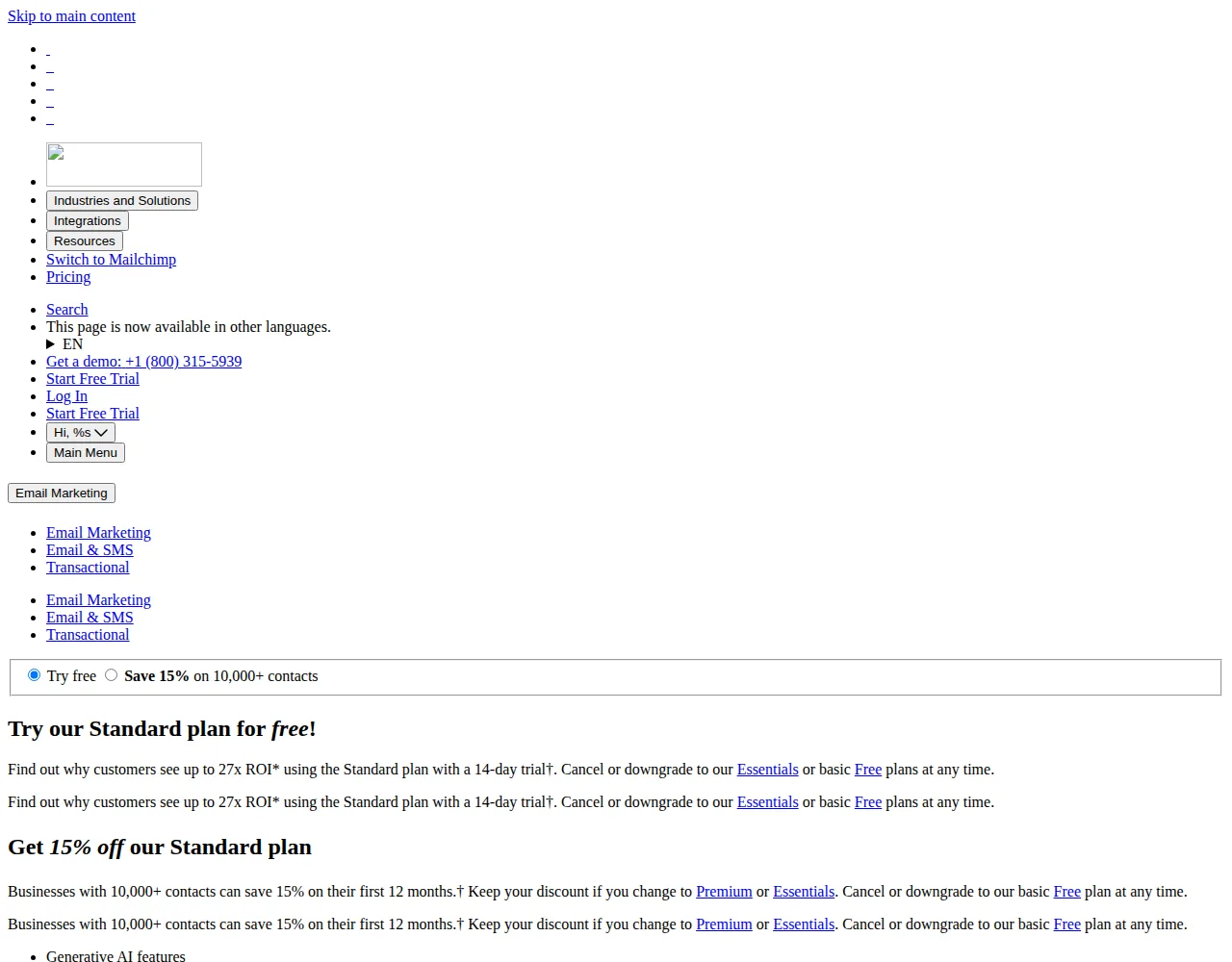
The automation ceilings: why teams actually switch
Mailchimp's tier gap is the most explicit in this comparison. Essentials caps automation flows at 4 steps. Standard expands to around 200 flows, adds dynamic content, send-time optimization, and custom reports. Premium, sold from 10,000 contacts at $350 a month, adds phone support and unlimited seats. A business that outgrows Essentials does not outgrow Mailchimp; it outgrows a 4-step ceiling, and the $25 monthly step to Standard at 5,000 contacts is the cheapest upgrade in this guide.
Klaviyo's ceiling is different: features do not change across paid tiers, because the Email plan carries the same flows, segmentation, and predictive analytics at every profile band. The ceiling is the profile count itself. A store at 5,000 profiles paying $100 that grows to 10,000 pays $150, a 50 percent increase for the same features. That is fair for a vendor whose value scales with store revenue, and punishing for a list that grows through giveaways: every dead profile is billed at the same rate as a buyer.
Kit's ceiling is the commerce cut. Creator adds unlimited visual automations, unlimited sequences, 100-plus integrations, subject-line A/B testing, and 24/7 support. Creator Pro adds the newsletter referral system, sponsor network access, advanced reporting, and subscriber scoring. But every plan, including Free, charges 3.5 percent plus 30 cents on digital product and subscription sales through Kit, and 23.5 percent on paid recommendations earnings. A creator selling a $50 course to 100 buyers a month pays $205 a month in Kit transaction fees on top of the subscription:
$
\text{Kit commerce fees} = 100 \times (\$50 \times 3.5\% + \$0.30) = 100 \times \$2.05 = \$205 \text{ per month}
$
That is $205 a month, or $2,460 a year — more than double the Creator subscription at 5,000 subscribers. A creator whose revenue runs through Kit should price the subscription and the transaction cut together; a creator who sells elsewhere should not count the cut at all.
Compliance: the law that rides along with the platform
Choosing a vendor does not transfer compliance. Under the CAN-SPAM Act, enforced by the FTC, every commercial message must carry accurate header information, a non-deceptive subject line, a clear identification as an advertisement, a valid physical postal address, and a working opt-out mechanism, and opt-out requests must be honored within 10 business days. The Act covers business-to-business mail with no exception, and the FTC's current guidance puts penalties at up to $53,088 per violating email. Hiring a vendor or an agency does not contract that responsibility away: both the company promoted and the company sending can be held responsible.
For readers with EU subscribers, GDPR adds a second regime: a lawful basis for processing under Article 6, freely given consent where consent is the basis under Article 7, and the right to object to direct marketing under Article 21. All three vendors support double opt-in, suppression lists, and data export, but none of them creates a lawful basis for you. The practical stack is the same regardless of vendor: SPF, DKIM, and DMARC on a dedicated sending domain, a confirmed opt-in record per subscriber, and a suppression workflow that removes opt-outs within the 10-business-day window. For the authentication setup, see the cold email deliverability guide and the cold email outbound infrastructure guide.
> [!WARNING]
> Mailchimp bills on total audience contacts, including unsubscribed and non-subscribed contacts, until you archive them. A 10,000-contact audience with 30 percent long-dead addresses bills at the 10,000 tier while delivering to 7,000. Archive or delete the dead weight before the billing date, on every vendor in this guide, and never buy a list: purchased contacts violate the vendors' terms, destroy deliverability, and put CAN-SPAM's per-email penalty within reach for no revenue.
Decision table
| Decision factor | Klaviyo | Mailchimp | Kit | Authority |
| :--- | :--- | :--- | :--- | :--- |
| Best for | Ecommerce stores whose list grows with revenue | Small businesses that need tiered automation depth | Creators building an audience and selling direct | Vendor pages, Nov 2026 |
| Free tier | 250 profiles, 500 sends, 60 days of email support | 250 contacts, 500 sends, 250 per day, 30 days of support | 10,000 subscribers, unlimited sends, no automations | Klaviyo, Mailchimp, Kit pricing pages |
| Paid entry | Email from $20 at 251–500 profiles | Essentials $13 at 500 contacts | Creator $39 at up to 1,000 subscribers | Vendor pages, Nov 2026 |
| At 5,000 contacts | $100 per month | Essentials $75, Standard $100 | Creator $89 | Slider ladders, cross-checked |
| At 10,000 contacts | $150 per month | Essentials $110, Standard $135, Premium $350 | Creator $139 | Slider ladders, cross-checked |
| Switch signal | Dead profiles inflating a revenue-blind bill | Hitting the 4-step flow ceiling on Essentials | Needing sequences on a list built for free | Editorial analysis of vendor terms |
The migration math nobody budgets
Switching email platforms is priced in the planning spreadsheet as a subscription delta and experienced as a migration project. The following model is illustrative, using the team's own rates, and exists so the subscription comparison is never read in isolation:
$
\text{Migration cost} = (\text{Hours for export, rebuild, and warmup} \times \text{Loaded rate}) + \text{Parallel-run cost}
$
$
\text{Illustrative migration} = (16 \times \$75) + \$500 = \$1{,}700
$
Sixteen hours of export, rebuild, and warmup at a $75 loaded rate, plus a $500 parallel-run allowance for the month both platforms send, costs $1,700 — more than a full year of the price spread between any two comparable tiers at 5,000 contacts. At small scale, switching to save $25 a month costs more than staying on the dearer platform. Switch for the ceiling — the automation, the send cap, or the commerce cut — not for the subscription delta. To test a switch against your own list size and rates, run the migration figure through the break-even calculator alongside the subscription totals.
Execution checklist
> [!FOUNDER]
> "Buy the email platform for the list you will have in eighteen months, not the list you have today. The subscription is the smallest line in the decision; the migration you do because you chose for today's list, and the deliverability you lose while warming up a new domain, are the largest."
> — Enow A. Jovial, Founder & Chief Executive Officer
Operator boundaries: who should not pick each tool
Do not pick Klaviyo if the list grows faster than revenue, because the profile-count bill will punish audience growth that does not convert, and do not pick it for a newsletter with no store attached, because its ecommerce depth becomes shelfware. Do not pick Mailchimp Essentials if any flow needs more than 4 steps, because the upgrade to Standard is the real price. Do not pick Kit Free as an automation platform, because it is not one: it is an audience builder with broadcasts, and the sequences that make it a platform start at the Creator price. Do not pick any of the three on the free tier alone if the business already sends daily, because all three free tiers pause sending at their ceilings.
> [!TIP]
> Run the free tier on real sends for two weeks before paying, but judge it on the ceiling you will hit, not the price you pay. On Klaviyo, watch the profile count. On Mailchimp, watch the flow-step count and the daily send cap. On Kit, check whether the welcome sequence you need exists on the plan you are testing — if it does not, you are testing the wrong plan.
Paid media feeds this list: the Google Ads vs Meta Ads ROAS playbook runs both auctions against the same $3,000 budget and the same $72.00 break-even CPA, so the traffic the email platform converts is priced before it is captured.