A U.S. company buys €500,000 of inventory from a German supplier. On the booking date the euro is $1.08, so the payable enters the books at $540,000. Thirty days later the company pays, and the euro is $1.15 — the payment costs $575,000. The extra $35,000 is not a cost of goods sold and not a capital loss. Under 26 U.S.C. § 988 it is an ordinary loss, recognized in the year of payment. The same rule runs in reverse on receivables, and it decides the tax treatment of every cross-border invoice, loan, and forward contract.
What section 988 actually says
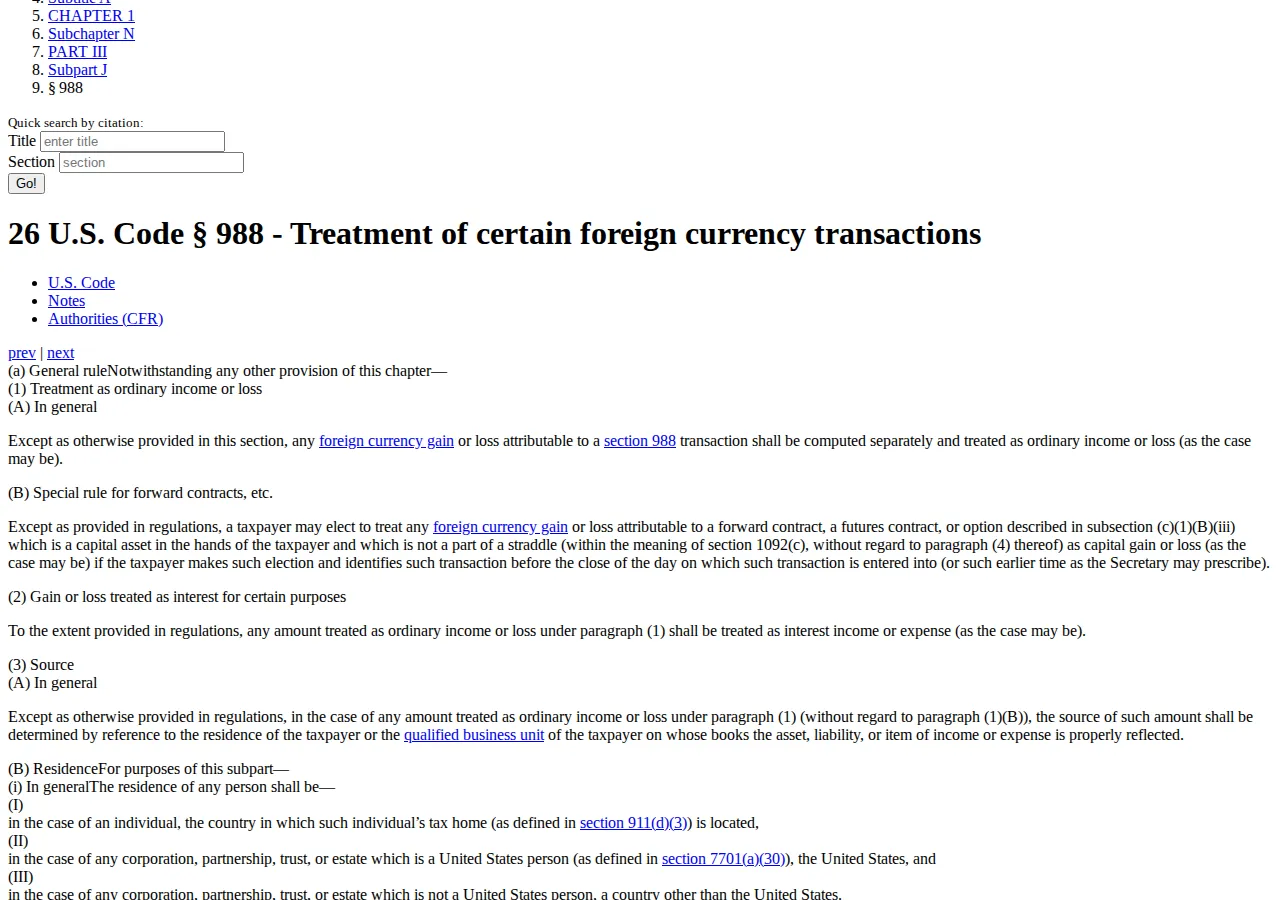
Section 988(a)(1)(A) states the general rule: except as otherwise provided in the section, any foreign currency gain or loss attributable to a section 988 transaction "shall be computed separately and treated as ordinary income or loss (as the case may be)." A section 988 transaction, under § 988(c)(1), is any of three things where the amount to be received or paid is denominated in a nonfunctional currency or determined by reference to one: acquiring a debt instrument or becoming the obligor under one; accruing an item of income or expense that will be paid or received later; or entering into a forward contract, futures contract, option, or similar financial instrument. Disposing of nonfunctional currency itself is also a section 988 transaction under § 988(c)(1)(C).
The measurement window is fixed by two defined dates. The booking date, § 988(c)(2), is the date of acquisition, the date the taxpayer becomes the obligor, or the date the item is accrued. The payment date, § 988(c)(3), is the date the payment is made or received. Foreign currency gain or loss, under § 988(b), is the gain or loss from the transaction to the extent it does not exceed the gain or loss realized by reason of exchange-rate changes between those two dates.
The functional-currency gate
Nothing in section 988 applies until the functional currency is settled, and 26 U.S.C. § 985 sets that gate. Section 985(a) requires all determinations to be made in the taxpayer's functional currency. Section 985(b)(1)(A) makes the dollar the functional currency for every taxpayer except a qualified business unit, for which § 985(b)(1)(B) uses the currency of the economic environment in which a significant part of the unit's activities are conducted. A QBU whose activities are primarily conducted in dollars still uses the dollar under § 985(b)(2), and § 985(b)(3) lets a taxpayer elect the dollar for a QBU that keeps its books in dollars. Changing functional currency is a change in method of accounting under § 985(b)(4).
The IRS states the same rule on its foreign-currency page: a taxpayer must express the amounts on a U.S. tax return in U.S. dollars, translating foreign-currency income and expenses at the exchange rate prevailing when the item is received, paid, or accrued. A QBU is the exception: a separate unit of a trade or business that maintains separate books and records. Treas. Reg. § 1.988-1 defines nonfunctional currency as any currency other than the taxpayer's or the QBU's functional currency.
Founder & CEO Insight — Enow A. Jovial
Worked math 1: the payable that cost $35,000
Example: U.S. Corp orders €500,000 of components on March 1, when the euro is $1.08. The payable is booked at $540,000. U.S. Corp pays on March 31, when the euro is $1.15, and the wire costs $575,000. The foreign currency loss is the exchange-rate movement applied to the principal:
The $35,000 is ordinary loss under § 988(a)(1)(A), deductible in the year of payment, sourced by the residence of the taxpayer under § 988(a)(3)(A) — for a U.S. corporation, U.S. source. The inventory itself still costs $540,000 for cost-of-goods purposes; the currency loss is computed separately. If the euro had fallen to $1.02 instead, the payment would have cost $510,000 and U.S. Corp would have recognized $30,000 of ordinary income.
The booking date is the trap most operators miss. A payable booked on March 1 and paid on March 31 has a 30-day window; one paid 90 days later has a 90-day window, and the rate movement over 90 days is usually larger. Suppliers who offer 90-day terms in euros are offering a currency position along with the goods.
Worked math 2: the receivable, the hedge, and the integrated $10,000
Example: the same company sells €500,000 of software licences on April 1, booking a receivable at $540,000, and collects on May 1 at $1.02, receiving $510,000 — a $30,000 ordinary foreign currency loss:
Now add the hedge: on April 1 the company enters a forward contract to sell €500,000 at $1.10 on May 1. Under § 988(d), a 988 hedging transaction — entered into primarily to manage currency-fluctuation risk and identified as a hedging transaction — is integrated with the hedged item and treated as a single transaction. The forward gains ($1.10 minus the $1.02 spot at settlement, times €500,000) $40,000; the receivable loses $30,000; the integrated result is a $10,000 gain:
The hedge did not eliminate the tax — it converted a $30,000 loss and a $40,000 forward gain into a single $10,000 ordinary gain. Sections 475, 1092, and 1256 do not apply to a transaction covered by § 988(d). The identification requirement is the operational point: a hedge never identified as a 988 hedging transaction is not integrated, and its gain or loss is measured separately.
Section 988 versus its neighbours
| Rule | What it measures | Character | Authority |
|---|---|---|---|
| § 988 transaction | Exchange-rate movement between booking date and payment date | Ordinary, computed separately | 26 U.S.C. § 988(a)(1)(A), (b), (c)(2)–(3) |
| § 987 QBU translation | Currency gain or loss of a foreign-currency QBU, recognized on remittance or election | Ordinary, sourced from the underlying income | 26 U.S.C. § 987; Treas. Reg. § 1.987-4 |
| § 1256 contracts | Regulated futures and nonequity options marked to market | 60% long-term / 40% short-term capital | 26 U.S.C. § 1256(a)(3); § 988(c)(1)(D) exception |
| § 988(d) hedging | Hedged item plus hedge, integrated as one transaction | Ordinary, measured at the locked rate | 26 U.S.C. § 988(d) |
The boundary that matters most is § 988 versus § 987. Section 988 is transaction-level: one payable, one receivable, one forward, measured from booking to payment. Section 987 is unit-level: a QBU keeping books in a foreign currency, with gain or loss sitting unrecognized until a remittance pulls a proportion of it into income. The § 987 foreign-currency QBU translation playbook covers the unit-level operation. A payable owed by a QBU is a section 988 transaction of the QBU under § 1.987-1(d); the same payable owed directly by the U.S. owner is a section 988 transaction of the owner. The entity holding the item decides which section applies.
The two elections that change character
Section 988(a)(1)(B) lets a taxpayer elect capital treatment for foreign currency gain or loss on a forward contract, futures contract, or option that is a capital asset in the taxpayer's hands and is not part of a straddle. The election must be made and the transaction identified before the close of the day on which the transaction is entered into. Miss the day, and the election is gone for that contract; there is no late-election relief in the statute. The election suits a taxpayer holding a forward as a capital investment, not as a hedge of a business payable — § 988(d) excludes (a)(1)(B) elections from hedging integration.
The second election runs the other way: § 988(c)(1)(D) excludes regulated futures and nonequity options that would be marked to market under § 1256, but a taxpayer may elect out on or before the first day of the taxable year. For a partnership the election is made by each partner separately; the same rule applies to an S corporation.
Individuals: the $200 cliff
Section 988(e)(1) provides that the preceding provisions do not apply to a personal transaction entered into by an individual. Under § 988(e)(3), a personal transaction is any transaction entered into by an individual — except to the extent expenses properly allocable to it meet § 162 (a trade or business) or § 212 (production of income). A business trip's currency exchange is not personal; a holiday's is.
For the disposition of nonfunctional currency itself, § 988(e)(2) excludes the gain — but only while the gain is $200 or less. The exclusion is a cliff, not a threshold. Example: an individual buys €10,000 for a holiday at $1.05 and converts the unspent euros back at $1.12. The gain is €10,000 × ($1.12 − $1.05) = $700, which exceeds $200, so the exclusion switches off entirely and the whole $700 is recognized. A smaller trip tells the other side: €2,000 converted at the same rates gains $140, so no gain is recognized at all.
Source, related-party loans, and the traps
Source follows residence. Under § 988(a)(3)(A), the source of an amount treated as ordinary income or loss under § 988(a)(1) is determined by the residence of the taxpayer or the QBU on whose books the item is properly reflected — for a U.S. corporation, the United States. A U.S. corporation's euro payable therefore produces U.S.-source ordinary loss, which matters for the foreign tax credit limitation under § 904.
The related-party loan rule in § 988(a)(3)(C) is the one operators stumble into without noticing. A loan by a U.S. person to a 10-percent owned foreign corporation, denominated in a currency other than the dollar and bearing interest at least 10 percentage points above the Federal mid-term rate under § 1274(d) when entered into, is marked to market annually for § 904 purposes, and its interest income is treated as U.S.-source to the extent of any mark-to-market loss. A high-yield euro loan to a foreign subsidiary can therefore shrink the foreign tax credit. The transfer-pricing intercompany services playbook covers the arm's-length pricing of the same loans, and the Form 5471 foreign corporation reporting playbook covers the reporting that makes the loan visible to the IRS.
The rule is entity-neutral; the paperwork is not. An LLC taxed as a partnership reports the currency loss on the partners' returns; an S-Corp passes it through to shareholders; a C-Corp absorbs it at the entity level. The EIN on the return, the CPA who signs it, and the GAAP books that produced the booking date all have to agree on the same two dates — and the FICA and SECA treatment of the underlying payment does not change just because the currency moved.
Execution checklist
- [x] Step 1 — Fix the functional currency first: confirm the dollar under § 985(b)(1)(A), or document the QBU's economic-environment currency under § 985(b)(1)(B).
- [x] Step 2 — Stamp the booking date on every foreign-currency payable and receivable: the two dates define the measurement window under § 988(c)(2)–(3).
- [x] Step 3 — Identify hedges in writing on the day they are entered: a § 988(d) hedge must be identified as such, and a § 988(a)(1)(B) election made before the close of the day.
- [x] Step 4 — Decide the § 1256 election before the tax year starts: the § 988(c)(1)(D) election-out is due on or before the first day of the taxable year.
- [x] Step 5 — Price the currency on the purchase order: book the payable at spot, note the forward rate and a 5% adverse move, so the exposure is visible before the goods ship.
- [x] Step 6 — Keep personal currency separate: a personal-transaction gain over $200 is fully recognized under § 988(e)(2); § 162 or § 212 expenses are not personal.
Who should not rely on this playbook
A taxpayer whose exposure sits inside a QBU should start with the § 987 playbook — the unit-level pool decides when that gain is recognized. A taxpayer trading regulated futures marked to market under § 1256 should check § 988(c)(1)(D) first. And anyone whose "hedge" is an undocumented phone call with a bank should assume it is not a § 988(d) hedging transaction: integration requires identification.