The one sentence that decides the exam
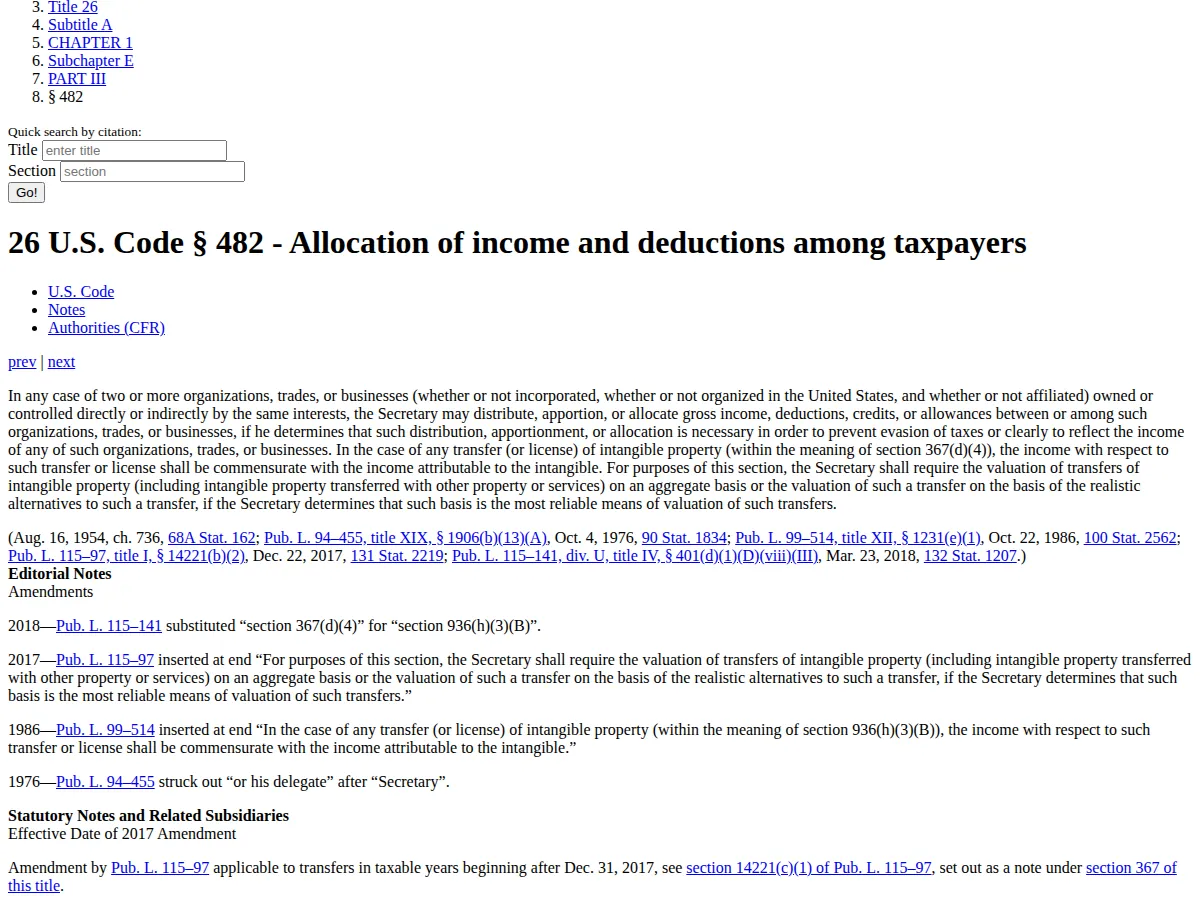
Section 482 of the Internal Revenue Code is a single sentence with no safe harbor in it. Where two or more organizations, trades, or businesses are owned or controlled directly or indirectly by the same interests, the Secretary may distribute, apportion, or allocate gross income, deductions, credits, or allowances between or among them if that allocation is necessary to prevent evasion of taxes or clearly to reflect the income of any of them. That is the whole statute. Everything else — the methods, the documentation, the penalties — answers one question: what would two unrelated parties have charged each other for the same thing.
Two more clauses matter here. Income from a transfer or license of intangible property must be commensurate with the income attributable to the intangible, and the Secretary must require valuation of intangible transfers on an aggregate basis, or on the basis of the realistic alternatives to the transfer, when that basis is the most reliable means of valuation.
> [!KEY TAKEAWAY]
> Transfer pricing is not a filing. It is a price, defended by a method, documented before the return is filed, and produced within 30 days on request. A group that sets the price first and looks for a method later has the sequence backwards.
Who this playbook is for, and who should stop here
This playbook is for a group with at least two entities under common control where one performs services for another across a border — a US parent providing payroll, IT, finance, or management services to a foreign subsidiary, or a foreign parent charging a US operating company for shared services. It assumes US returns, an EIN for each US entity, and costs that can be tied to a charge.
It is not for a single-entity business with no related parties. Section 482 cannot apply where there is no common control, and a sole proprietor or single-member LLC with no related entity has nothing to price. It is also not for a group whose intercompany flows are only dividends or capital contributions; those are not services, and calling them service charges invites recharacterization. If your only cross-border flow is a loan, the pricing question lives under § 482 too, but the method is the arm's-length interest rate under Treas. Reg. § 1.482-2, not the services cost method below.
The statute, in plain sequence
The exam follows a fixed sequence; build your file in the same order.
1. Control. Section 482 applies where the same interests own or control the organizations directly or indirectly. Control is broader than majority ownership — the regulation looks at actual control, including control through related persons. If you set the price on both sides, assume control exists and move on to pricing.
2. The arm's-length standard. Treas. Reg. § 1.482-1(b) states the standard: the result that would have been realized if uncontrolled taxpayers had engaged in the same transaction under the same circumstances. Your charge is arm's length when the best method was used and the result falls inside the arm's-length range, normally the interquartile range under § 1.482-1(e)(2)(iii)(C).
3. The best method rule. Treas. Reg. § 1.482-1(c) requires the method that provides the most reliable measure of an arm's-length result, judged on comparability and the quality of data and assumptions. There is no default method.
| Method | What it prices | When it is the best method | Authority |
| :--- | :--- | :--- | :--- |
| Comparable uncontrolled price (CUP) | A controlled sale of tangible property against an uncontrolled sale of the same property | Identical property with reliable uncontrolled prices | Treas. Reg. § 1.482-3(b) |
| Resale price | A controlled sale to a distributor against the distributor's resale price less a gross profit margin | Resale where the distributor adds little value | Treas. Reg. § 1.482-3 |
| Cost plus | A controlled sale of property or services against cost plus a comparable gross profit markup | Where comparable markups are observable | Treas. Reg. § 1.482-3 |
| Comparable profits method (CPM) | Operating profit against comparable companies' profit-level indicators | No transaction price exists, but comparable companies do | Treas. Reg. § 1.482-5 |
| Profit split | Combined profit of the controlled transaction, split by relative contributions | Both sides contribute unique intangibles | Treas. Reg. § 1.482-6 |
| Services cost method (SCM) | Covered services at total services costs, with no markup | Covered service passing the low-margin test | Treas. Reg. § 1.482-9(b) |
| Unspecified method | Any transaction where no specified method is reliable | Documented like a specified method, or the IRS substitutes its own | Treas. Reg. § 1.482-1(c) |
4. The adjustment. If the IRS determines your price was not arm's length, it adjusts the price and reallocates the income. The adjustment is a dollar figure on the return, and the penalty analysis starts from that figure.
Worked math: the services cost method on a real cost base
Take a concrete, labelled scenario. A Delaware C-Corp parent with an EIN provides shared back-office services — payroll, IT helpdesk, finance — to its UK subsidiary. The costs below are illustrative; replace them with your own ledger figures. Total services costs for the year, under Treas. Reg. § 1.482-9(j):
$
\text{Total Services Costs} = \text{Payroll} + \text{Systems} + \text{Allocated Overhead} = \$360{,}000 + \$72{,}000 + \$48{,}000 = \$480{,}000
$
The SCM charge. Where the service is a covered service, the services cost method tests the charge against total services costs with no markup. Eligibility has four legs, and all four must hold: the service is a covered service under § 1.482-9(b)(3); it is not an excluded activity under § 1.482-9(b)(4); it is not precluded by the business judgment rule under § 1.482-9(b)(5); and adequate books and records are maintained under § 1.482-9(b)(6). On those facts the arm's-length charge is:
$
\text{SCM Charge} = \text{Total Services Costs} \times (1 + 0\%) = \$480{,}000
$
The low-margin test. A low-margin covered service is one where the median comparable markup on total services costs is less than or equal to seven percent. In this scenario the comparable markup is 4 percent, so the service passes. At 9 percent it would fail, and the SCM would not be available on that ground.
The cost-plus alternative. Suppose the same $480,000 of costs were engineering services instead of back-office services. Engineering is an excluded activity under § 1.482-9(b)(4), so the SCM is unavailable. The group prices with the cost-plus method at a median comparable markup of 12 percent, again an illustrative input:
$
\text{Cost-Plus Charge} = \$480{,}000 \times 1.12 = \$537{,}600
$
The difference is $57,600 — what the IRS would reallocate if it rejected the SCM and applied cost plus. At the 21 percent corporate rate, the additional US tax is:
$
\text{Additional Tax} = \$57{,}600 \times 21\% = \$12{,}096
$
The exam does not stop at one year or one service. The same method error across five service lines over three open years turns $12,096 into a six-figure adjustment, and the penalty test below is computed on the net adjustment, not on the tax.
The penalty ladder: IRC § 6662(e)
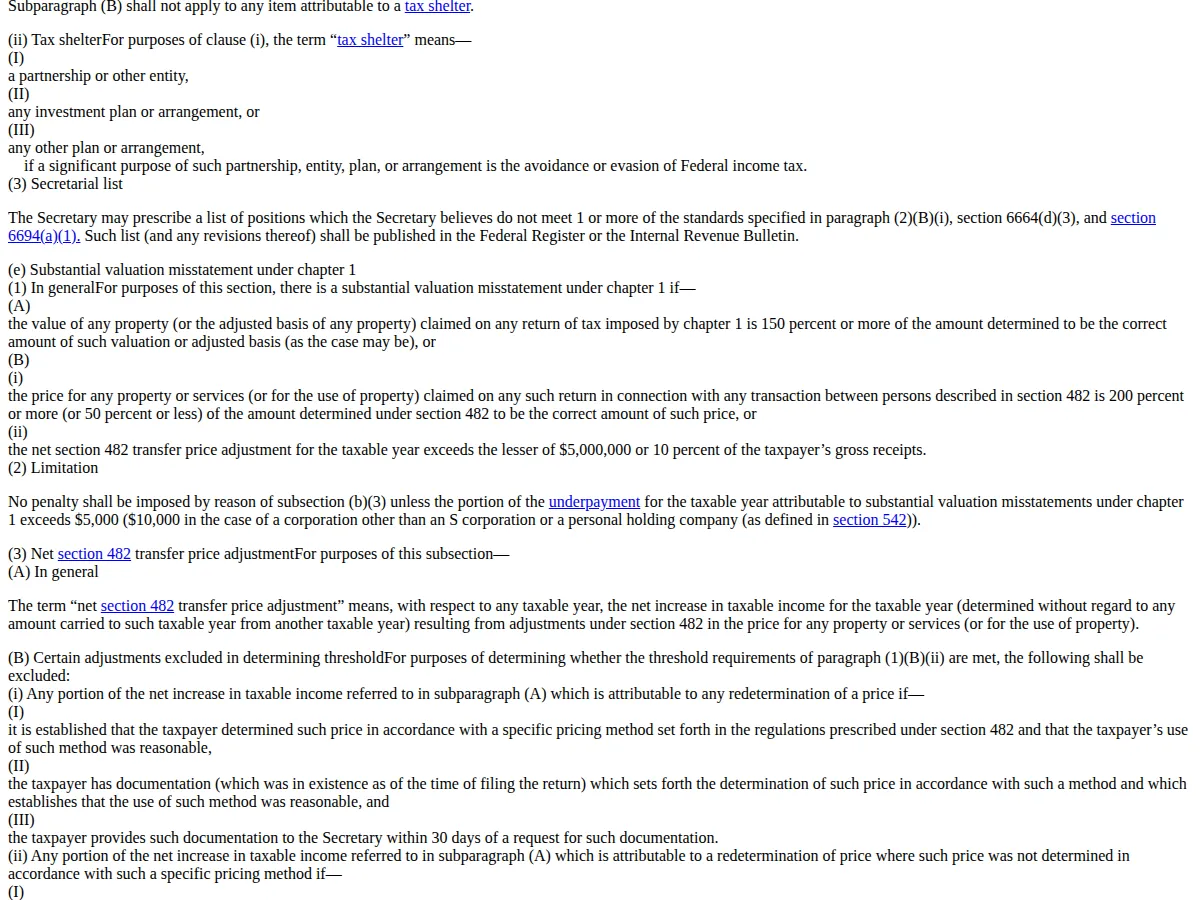
Section 6662(e) is where a pricing disagreement becomes a penalty: 20 percent of the portion of the underpayment attributable to a substantial valuation misstatement. A substantial valuation misstatement exists where either of two tests is met: the price claimed on the return for property or services in a § 482 transaction is 200 percent or more, or 50 percent or less, of the amount determined under § 482 to be the correct price; or the net § 482 transfer price adjustment for the year exceeds the lesser of $5,000,000 or 10 percent of the taxpayer's gross receipts. No penalty applies unless the underpayment portion exceeds $5,000 — $10,000 for a corporation other than an S corporation or a personal holding company.
The gross valuation misstatement rate is 40 percent: the price test becomes 400 percent or more, or 25 percent or less; the net adjustment test becomes the lesser of $20,000,000 or 20 percent of gross receipts.
Extend the scenario: gross receipts are $4,000,000, so 10 percent is $400,000. The IRS adjusts the service charge and a related royalty together, for a net § 482 adjustment of $500,000 — above $400,000, so the substantial valuation misstatement test is met. The underpayment is:
$
\text{Underpayment} = \$500{,}000 \times 21\% = \$105{,}000
$
$105,000 exceeds the $10,000 corporate threshold, so the penalty applies: $21,000 at the 20 percent rate. If the price test had been met at the gross level — the group charged $120,000 for services the IRS values at $480,000, which is 25 percent of the correct price — the 40 percent rate applies and the penalty is $42,000.
$
\text{Penalty}_{20\%} = \$105{,}000 \times 20\% = \$21{,}000 \qquad \text{Penalty}_{40\%} = \$105{,}000 \times 40\% = \$42{,}000
$
> [!WARNING]
> The 20 percent penalty is the default, not the worst case. The 40 percent gross rate triggers on the price test alone — charge a quarter of the correct price, or four times it, and the rate doubles. And the documentation defense in § 6662(e)(1)(B) is lost if the documentation did not exist when the return was filed; a study commissioned after the exam notice starts cannot cure a missing file.
The documentation defense: build the file before the return
Section 6662(e)(1)(B) excludes an adjustment from the penalty threshold where three conditions are met: the taxpayer determined the price in accordance with a specific pricing method set out in the regulations and that use was reasonable; the taxpayer has documentation that was in existence as of the time of filing the return, setting out the determination of the price under that method and establishing that its use was reasonable; and the taxpayer provides that documentation to the Secretary within 30 days of a request for it. Under § 6664(c), reasonable cause is not available for a net § 482 adjustment without them.
The filing sequence, in order:
1. Map every intercompany flow before year-end: services, licenses, loans, and goods, each tagged with the method that will price it.
2. Price each flow under its method and record the charge in the intercompany agreement while the year is still open.
3. Assemble the documentation file and date it before the return is filed, with the cost build tied to the ledger.
4. File the return with the related-party forms the group owes — Form 5471 for a controlled foreign corporation, Form 5472 for a 25-percent foreign-owned US corporation — and keep the pricing file with the workpapers. The filing operation behind that line — the five filer categories, the $10,000-per-year penalty ladder, and the GILTI math at the current 12.6 percent effective rate — is the IRS Form 5471 foreign corporation reporting playbook.
5. Calendar the 30-day response: if the IRS requests the documentation, the file goes out within 30 days, complete.
When the APA is cheaper than the exam
The IRS Advance Pricing and Mutual Agreement program gives taxpayers an alternative dispute resolution mechanism for complex international transfer pricing cases. An advance pricing agreement locks the method in advance with the IRS, and in a bilateral APA with the treaty partner as well, so the same price is accepted on both sides.
An APA is not cheap and it is not fast, and it is not the right move for a group whose only intercompany flow is a single back-office service priced at cost under the SCM — but it is when the flows are large, the methods are contested, or two tax authorities examine the same transaction. Compare the APA's professional cost against the penalty exposure in the worked math above, multiplied by the number of open years and service lines.
> [!FOUNDER]
> "Every group I have seen lose a transfer pricing exam lost it in the file, not in the law. The price was defensible and the method was reasonable. But the documentation did not exist when the return was filed, or it arrived on day 45 instead of day 30, and the penalty followed the paperwork, not the economics. Build the file first."
> — Enow A. Jovial, Founder & Chief Executive Officer
What this playbook does not cover
This playbook prices services. It does not price the transfer of intangibles, where the commensurate-with-income standard and the aggregate valuation rule apply. It does not address the global intangible low-taxed income rules under § 951A, which attribute a US shareholder's share of a controlled foreign corporation's income back to the United States. And it does not substitute for a transfer pricing study: the worked numbers are labelled illustrations, and your comparables and cost base are your own. A group with a controlled foreign corporation, a cost sharing arrangement, or a prior § 482 adjustment should have a CPA run the file, not a playbook.
> [!TIP]
> Price the service in the agreement before the year starts, not in the study after it ends. The IRS reads a charge set in advance as a business decision and a charge set after the fact as a tax position.
Related reading on this site: the Form 5472 guide for foreign-owned US LLCs for the filing that reports these related-party transactions; the FinCEN BOI interim final rule guide for what a foreign-owned US entity must file; and the Delaware statutory trust vs series LLC guide for the structure whose license must survive the same arm's-length test under Treas. Reg. § 1.482-4. Test the charge against your own cost base with the pricing calculator, markup zero for an SCM service and your comparable markup for a cost-plus service.