The BBA Centralized Partnership Audit Regime: The Operator's Playbook
A fund reports $2.4 million of income too low on its 2025 return. Under the old rules, the IRS chased each partner separately. Under the Bipartisan Budget Act, the IRS sends one notice to the partnership, computes one number — the imputed underpayment — and collects it from the partnership itself at the highest individual rate in the Code. The partnership has exactly two exits: modify the number within 270 days, or push it out to the reviewed-year partners within 45 days. Miss both and the partnership pays.
What the BBA replaced, and when it took over
Before the BBA, partnership audits ran under the Tax Equity and Fiscal Responsibility Act of 1982 (TEFRA). Adjustments were determined at the partnership level, but tax was assessed and collected partner by partner, and a tax matters partner spoke for the partnership while other partners could participate and challenge adjustments. The Bipartisan Budget Act of 2015 (Pub. L. 114-74), signed November 2, 2015, repealed TEFRA and wrote a new subchapter C of chapter 63, sections 6221 through 6241. The Tax Technical Corrections Act of 2018 amended it. The regime is generally effective for partnership taxable years beginning after December 31, 2017. The filing mechanics are covered in the IRS Form 1065 partnership tax return playbook.
Five terms that decide every outcome
The regime runs on defined terms. The Form 8985 instructions (Rev. December 2024) define them.
The reviewed year is the year being corrected. The adjustment year is the tax year containing the FPA mail date, when the partnership pays the IU. A partnership-related item is any item relevant to any person's tax liability. The first affected year is the partner's tax year containing the end of the reviewed year.
An audit of the 2025 return ending with an FPA mailed in 2027 produces a payment in 2027, by partners who may no longer be partners. That mismatch is the reason the push-out election exists.
The partnership representative: one person, total authority
Section 6223(a) requires every partnership to designate a partnership representative — a partner or another person with a substantial presence in the United States — who "shall have the sole authority to act on behalf of the partnership" under the regime. If no designation is in effect, the Secretary may select any person. Section 6223(b) makes the consequence explicit: the partnership and all partners are bound by the representative's actions and by any final decision in a proceeding. Partners have no right to participate in the examination or to challenge the adjustments themselves.
Name the representative in the partnership agreement, not just on the return: require written notice to the partners on receiving any IRS notice, and name a successor in the same clause.
Electing out under section 6221(b)
Not every partnership is in the regime. Section 6221(b) lets a partnership elect out entirely, returning it to partner-level assessment.
The election requires 100 or fewer partners, all of them eligible — individuals, C corporations, S corporations, estates of deceased partners, or certain foreign entities treated as C corporations — made annually on a timely filed return with Schedule B-2. Partnerships, trusts and disregarded entities are not eligible partners.
The count is the trap. A partnership with 90 direct partners looks safely under the limit until one of them is a disregarded single-member LLC or a trust, which kills the election outright. The election is annual: electing out for 2024 does nothing for 2025.
An LLC taxed as a partnership files the same Form 1065 and sits inside the regime; an LLC that elected corporate treatment files as a C-Corp and sits outside it, as does an S-Corp filing Form 1120-S. Your CPA reads the election off the entity's EIN record: a Delaware LLC with a C-Corp blocker, a family LLC holding rentals, and a two-member LLC running a SaaS business are all partnerships here, and their GAAP books carry the same income the IRS adjusts.
The imputed underpayment: the math, exposed
Section 6225(a) states the default: if the Secretary's adjustments result in an imputed underpayment, the partnership pays it in the adjustment year as provided in section 6232; if they do not, the adjustments are taken into account by the partnership in the adjustment year. Section 6225(b) states the formula: the Secretary nets all partnership adjustments for the reviewed year and applies the highest rate of tax in effect for the reviewed year under section 1 or 11.
Adjustments are placed into groupings and subgroupings — ordinary items together, capital items together, credits in their own grouping — netted within each grouping, and the IU is determined from the netted results.
Worked example. The IRS proposes a net adjustment of $2,400,000 to a partnership's 2025 reviewed year — income understated by $2,600,000, partly offset by a $200,000 deduction the partnership should have claimed. The highest individual rate in effect for the reviewed year is 37%:
Note what the formula ignores: which partners held interests in 2025, what rates they actually pay, and whether some partners are tax-exempt. The Schedule K-1 pass-through income playbook shows how the same income would have been allocated partner by partner on the return.
Section 6232 governs payment. The imputed underpayment is assessed and collected as if it were a tax imposed for the adjustment year, but no assessment may be made before the close of the 90th day after the FPA is mailed. Unpaid amounts expose the partners themselves to collection under section 6232(f) once 10 days have passed after notice and demand.
Modification under section 6225(c): the 270-day window
Modification is the first exit, and it is a request, not a right. Section 6225(c)(1) directs the Secretary to establish procedures under which the imputed underpayment may be modified, and section 6225(c)(8) provides that a modification is made only upon the Secretary's approval. Only the partnership representative may request modification.
The clock is section 6225(c)(7): everything required must reach the Secretary no later than the close of the 270-day period beginning on the date the notice of proposed partnership adjustment (NOPPA) is mailed, unless the period is extended with the Secretary's consent. The request is made on Form 8980, submitted electronically.
The five modification types are amended returns of partners (§ 6225(c)(2)), the alternative procedure (§ 6225(c)(2)(B)), tax-exempt partners (§ 6225(c)(3)), rate modification (§ 6225(c)(4)), and regrouping (§ 6225(c)(5)).
Return to the $2,400,000 example. Suppose $900,000 of the adjustment is allocable to a tax-exempt university endowment, certified on Form 8983, and $500,000 is allocable to a C corporation partner taxed at 21%.
That $413,000 is the value of the 270-day window. The amended-return modification is usually the largest lever.
Push-out under section 6226: the 45-day election
If modification is the first exit, push-out is the second, because it changes who pays rather than how much the partnership pays. Under section 6226(a), if the partnership elects not later than 45 days after the notice of final partnership adjustment is mailed, and furnishes each reviewed-year partner and the Secretary a statement of the partner's share, section 6225 does not apply to that underpayment.
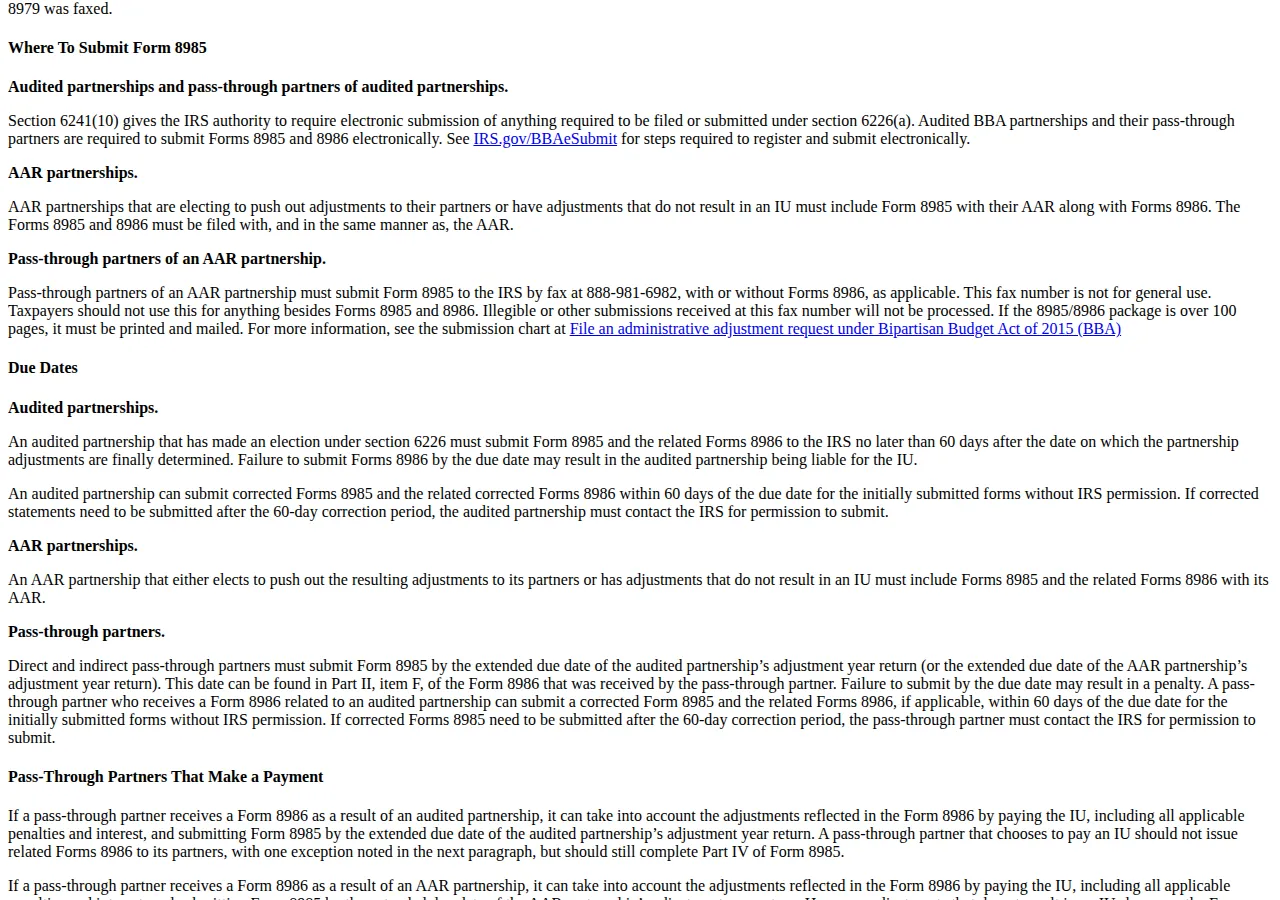
The mechanics run on three forms. First, the representative makes the election on Form 8988, submitted electronically, within the 45 days. Second, the partnership furnishes Form 8986 — Partner's Share of Adjustment(s) to Partnership-Related Item(s) — to every person who held an interest during the reviewed year. Third, the partnership submits Form 8985, the transmittal for the Forms 8986, to the IRS no later than 60 days after the date the partnership adjustments are finally determined.
Each reviewed-year partner then takes the adjustments into account as provided in section 6226(b), in the partner's reporting year — the partner's tax year that includes the date the Forms 8986 were furnished — not by amending the reviewed-year return. The partner pays tax at the partner's own rates, plus penalties and interest. No amended Schedules K-1 are issued for a push-out; the Form 8986 is the vehicle. A partner who receives a pushed-out adjustment should also check the excess business loss limitation playbook, because a pushed-out loss can run into the section 461(l) cap. Model the cost with the Self-Employed Tax Estimator.
A pass-through partner that receives a Form 8986 may either pay the imputed underpayment itself, reported on Form 8985 by the extended due date of the adjustment-year return, or push the adjustments further down with its own Forms 8986.
Pay or push out: the decision table
Paying is borne by whoever owns the partnership in the adjustment year; pushing out is borne by whoever owned it in the reviewed year.
| Factor | Pay (§ 6225) | Push out (§ 6226) | Authority |
|---|---|---|---|
| Who bears the tax | Current partners | Reviewed-year partners | IRC §§ 6225(a), 6226(b) |
| Rate applied | Highest rate under § 1 or § 11 | Each partner's own rate | IRC §§ 6225(b), 6226(b) |
| Deadline | On notice and demand, after 90 days | Elect within 45 days of the FPA | IRC §§ 6226(a), 6232(b) |
| Modification | Yes, within 270 days of the NOPPA | No, once the election is made | IRC § 6225(c) |
| Failure mode | Overpayment at the highest rate | Missed election locks in the full IU | IRC § 6226(a) |
| Best fit | Partners unchanged since the reviewed year | Partners turned over since the reviewed year | IRC §§ 6225, 6226 |
The decisive question is turnover. If the same partners still own the partnership, paying is usually cheaper. If the fund has turned over, paying means new partners fund a tax on income they never received.
The audit timeline, notice by notice
The regime runs as a sequence of IRS notices, and each notice starts a clock.
- The IRS mails a Notice of Administrative Proceeding (NAP) opening the examination of the reviewed year.
- The IRS issues a Notice of Proposed Partnership Adjustment (NOPPA) with the proposed adjustments and IU.
- The 270-day modification window opens. The representative files Form 8980.
- The FPA is not mailed earlier than 270 days after the NOPPA, giving modification room to run.
- The IRS mails the Notice of Final Partnership Adjustment (FPA) with the final IU.
- The 45-day push-out window opens. The representative elects on Form 8988.
- The partnership has 90 days from the FPA mail date to petition for readjustment under section 6234.
- If pushed out, the partnership furnishes Forms 8986 and submits Form 8985 within 60 days of final determination.
Two clocks overlap: the 270-day window runs from the NOPPA, the 45-day window from the FPA.
Correcting your own return: the administrative adjustment request
A partnership that discovers its own error does not wait for an audit. Section 6227 lets a BBA partnership file an administrative adjustment request (AAR) — an amended Form 1065 with Form 8082, or Form 1065-X on paper — within three years after the later of the date the return was filed or the last day for filing it. If the AAR produces an imputed underpayment the partnership takes into account itself, it is paid when the request is filed.
The filing calendar that keeps you out of the penalty stack
Form 1065 is due on the 15th day of the third month after the tax year ends — March 16, 2026 for the 2025 tax year, because March 15 is a Sunday — and Form 7004 buys a six-month extension to September 15, 2026. A late or incomplete return triggers section 6698: $255 per partner for each month or part of a month the failure continues, up to 12 months, for returns due in 2026.
A 12-partner fund three months late owes $9,180; at the 12-month cap the same fund owes $36,720.
Who should not rely on this playbook
This playbook is written for the operator of a partnership inside the regime — a fund, a real estate syndicate, a professional practice, a joint venture filing Form 1065. It is not written for a partnership that can elect out under section 6221(b) and has not: for that partnership, the correct move is the election.
Execution checklist
- [x] Election-out status confirmed
- [x] Representative named in the agreement, with successor
- [x] NOPPA date calendared; 270-day deadline computed
- [x] Form 8980 types identified with documents
- [x] FPA date calendared; 45-day deadline flagged
- [x] Pay-versus-push-out decision taken
- [x] Forms 8988, 8986, 8985 filed inside their windows
- [x] Form 1065 filed or extended with Form 7004
Founder & CEO Insight — Enow A. Jovial
The decision in advance
The BBA regime is not a trap for the careful partnership; it is a timetable. The imputed underpayment is the price of doing nothing, the modification is the price of keeping records, and the push-out is the price of keeping track of who owned what and when. Elect out where you can, and calendar the NOPPA and FPA dates the day they arrive.