A partner sells a one-third interest in an LLC for $210,000 and reports a $100,000 capital gain. The amount is right and the character is wrong by $80,000. The partnership holds $120,000 of unbilled receivables, inventory $60,000 above basis, and equipment with $60,000 of section 1245 recapture. Section 751 pulls the ordinary income out before section 741 can call anything capital gain.
What section 751 actually says
Section 751(a) states the sale rule: money or property received for an interest, to the extent attributable to unrealized receivables or inventory items, is an amount realized from the sale of property other than a capital asset. The rest is capital gain or loss under section 741, which grants capital treatment "except as otherwise provided in section 751".
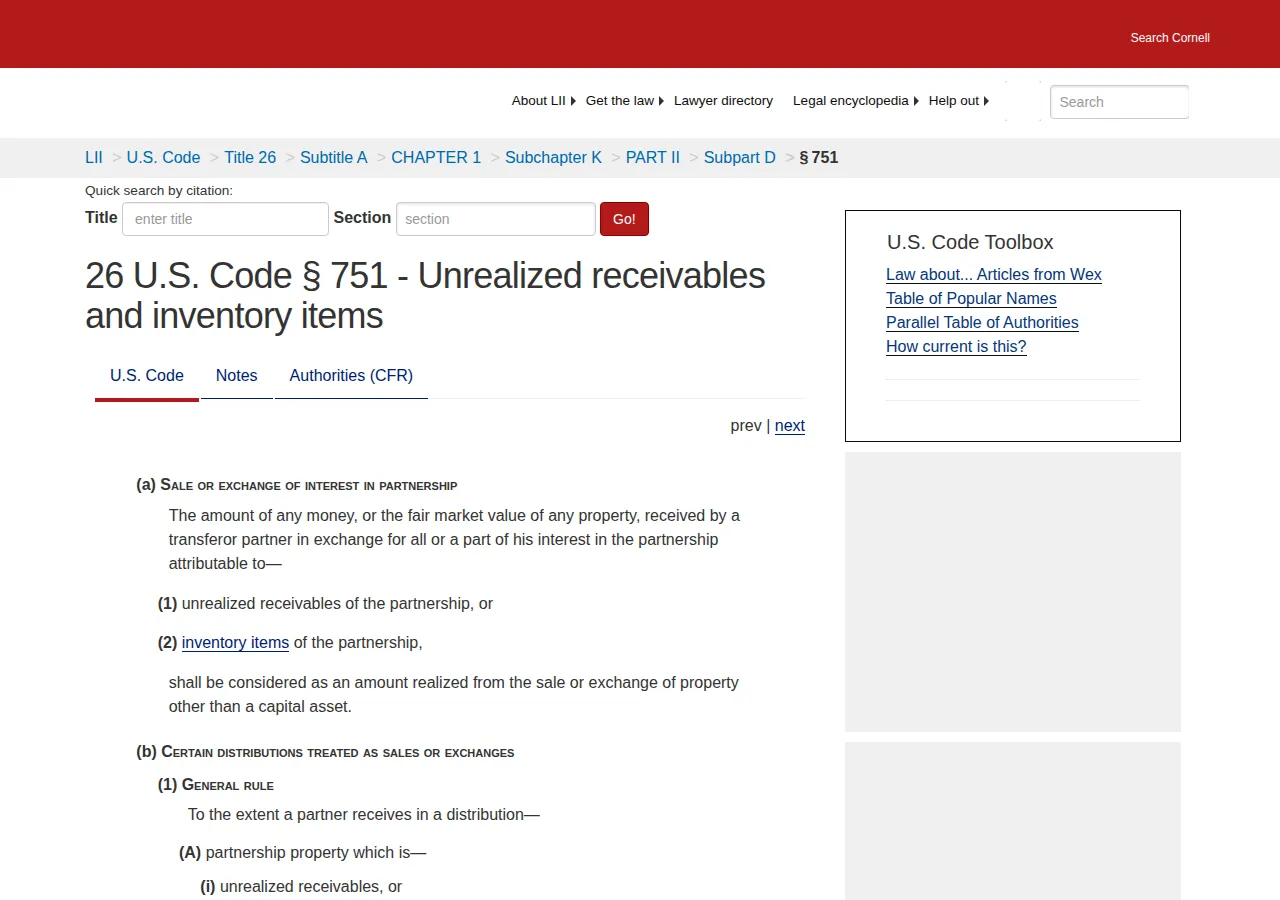
Section 751(b)(1) states the distribution rule: to the extent a partner receives section 751 property for part of the interest in other property, or other property for part of the interest in section 751 property, the transaction is a sale or exchange between the distributee and the partnership. Reg. § 1.751-1(b)(1)(iii) fixes the order: section 751(b) applies first, then sections 731 through 736.
Section 751(b)(3)(A) sets the substantial-appreciation test for distributions: inventory has appreciated substantially if its fair market value exceeds 120 percent of its adjusted basis, excluding inventory acquired to avoid the subsection. The Taxpayer Relief Act of 1997 rewrote section 751(a)(2) to "inventory items of the partnership", effective after 5 August 1997, so the test never applied to section 751(a) sales after that date.
Section 751(c) defines unrealized receivables as any right to payment for goods delivered or to be delivered, or services rendered or to be rendered, to the extent the income was not previously includible under the partnership method of accounting. A cash-method firm's unbilled fees and uncollected accounts are receivables, as is work begun but incomplete. The second sentence of subsection (c) is wider than the name suggests: the term also includes section 1245 and 1250 property, farm land, franchises and trade names, oil and gas property, market discount bonds, and short-term obligations — each capped at the ordinary income a sale at fair market value would produce. A machine with $60,000 of section 1245 recapture is a $60,000 unrealized receivable inside depreciable equipment.
Section 751(d) defines inventory items in three prongs: section 1221(a)(1) property, any other non-capital, non-section 1231 property on a sale by the partnership, and any property that would be inventory in the hands of the selling or distributee partner.
The decision table
| Situation | § 751 result | Character | Authority |
|---|---|---|---|
| Sale of an interest; partnership holds receivables or any inventory | Ordinary income equal to the seller share of hypothetical-sale gain | Ordinary to that extent; the rest is capital | § 751(a); Reg. § 1.751-1(a)(2); § 741 |
| Receivables in excess of the partner share | Deemed exchange; partnership ordinary income; distributee gain follows relinquished property | Mixed — ordinary to the partnership, capital to the distributee | § 751(b)(1)(A); Reg. § 1.751-1(b)(2) |
| Cash or other property in excess of the partner share, for section 751 property | Deemed exchange; distributee recognizes ordinary income | Ordinary to the distributee | § 751(b)(1)(B); Reg. § 1.751-1(b)(3) |
| Inventory at 120 percent of basis or less, distributed | Section 751(b) does not reach it | Sections 731 and 737 govern | § 751(b)(3)(A) |
| Inventory worth 120 percent of basis or less, interest sold | Section 751(a) still applies to all inventory | Ordinary to the seller share | § 751(a)(2), as amended 1997 |
The fact pattern for A1 through A5 and A7
Partnership ABC is an LLC, equal partners A, B, and C, cash-method, no liabilities, no section 754 election unless stated:
| Asset | Adjusted basis | Fair market value |
|---|---|---|
| Cash | $90,000 | $90,000 |
| Accounts receivable | $0 | $120,000 |
| Inventory | $90,000 | $150,000 |
| Equipment (§1245) | $60,000 | $120,000 |
| Land (§1231) | $90,000 | $150,000 |
| Total | $330,000 | $630,000 |
Each partner holds a one-third interest worth $210,000 with an outside basis of $110,000. A hypothetical sale of everything at fair market value would produce $300,000 of gain: $240,000 ordinary (receivables $120,000, inventory $60,000, section 1245 $60,000) and $60,000 of section 1231 gain on the land. The equipment recomputed basis is $140,000, so the potential section 1245 income is $120,000 minus $60,000, which is $60,000. Each partner share is $80,000 ordinary and $20,000 section 1231.
Worked examples: A1 to A7
— Example A1: the sale, ordinary first. A sells the entire one-third interest for $210,000 cash. Total gain is $210,000 minus the $110,000 outside basis, which is $100,000. Under Reg. § 1.751-1(a)(2), the ordinary income is one-third of the $240,000 hypothetical-sale ordinary gain, which is $80,000. Capital gain is $100,000 minus $80,000, which is $20,000. A attaches the statement required by Reg. § 1.751-1(a)(3); the buyer takes a $210,000 cost basis with no inside-basis share absent a section 754 election.
— Example A2: the partial sale. A sells one-half of the interest for $105,000. Basis allocable is $55,000, so total gain is $50,000: $40,000 ordinary (one-half of $80,000) and $10,000 capital.
— Example A3: receivables out, land in. A receives $90,000 of accounts receivable in a current distribution, and the partners agree the excess is received in exchange for land. A share of the receivables before the distribution is one-third of $120,000, which is $40,000. The partnership retains $30,000 of receivables, in which A keeps a one-third interest of $10,000. The share A receives is therefore $30,000, and the excess — $90,000 minus $30,000 — is $60,000, the section 751(b) exchange. The partnership recognizes ordinary income of $60,000 — the land interest relinquished minus the $0 basis of the receivables deemed sold — allocated $30,000 each to B and C under Reg. § 1.751-1(b)(2)(ii). A is treated as receiving $60,000 of land immediately before the exchange, with a section 732 basis of $36,000 ($90,000 over $150,000, times $60,000). A gain is $60,000 minus $36,000, which is $24,000, capital and section 1231 in character. A basis in the receivables is $60,000 for the purchased portion and $0 for the share portion; A outside basis after is $110,000 minus $36,000, which is $74,000; the partnership land basis becomes $90,000 minus $36,000 plus $60,000, which is $114,000.
— Example A4: cash out, inventory in. A receives $60,000 of cash, and the partners agree the excess is received in exchange for inventory. A share of the cash is one-third of $90,000, which is $30,000, so $30,000 of the cash is received in exchange for section 751 property. A is treated as receiving $30,000 of inventory immediately before the exchange, with a section 732 basis of $18,000 ($90,000 over $150,000, times $30,000). A ordinary income is $30,000 minus $18,000, which is $12,000, under Reg. § 1.751-1(b)(3)(iii). The partnership recognizes no gain on the deemed sale of $30,000 of cash, and its inventory basis becomes $90,000 minus $18,000 plus $30,000, which is $102,000. A outside basis after is $110,000 minus $18,000 minus $60,000, which is $32,000.
— Example A5: the 120 percent test, both directions. Inventory worth $150,000 against a $90,000 basis gives a ratio of 1.6667, or 166.7 percent — above the threshold, so section 751(b) applies to a distribution of it. At a $100,000 value the ratio is 1.1111, or 111.1 percent, below the threshold, so section 751(b) does not reach a distribution of that inventory. On a sale of the interest, though, section 751(a) still treats the inventory as section 751 property at either value — the 1997 amendment removed the test from subsection (a) only.
— Example A6: section 1245 recapture as a receivable. Partnership ABC distributes a machine to partner C in liquidation of a one-third interest. The machine is section 1245 property with a recomputed basis of $18,000, an adjusted basis of $9,000, and a fair market value of $15,000. The potential section 1245 income is $15,000 minus $9,000, which is $6,000 — an unrealized receivable under section 751(c). C share is $2,000; C receives $4,000 in excess, in exchange for $4,000 of land. C is treated as receiving land with a basis of $2,667 ($18,000 over $27,000, times $4,000) and realizes a gain of $4,000 minus $2,667, which is $1,333. The partnership recognizes $4,000 of ordinary income, and its land basis becomes $18,000 minus $2,667 plus $4,000, which is $19,333. C basis in the machine is $11,333. These figures are Reg. § 1.751-1(g), Example 6.
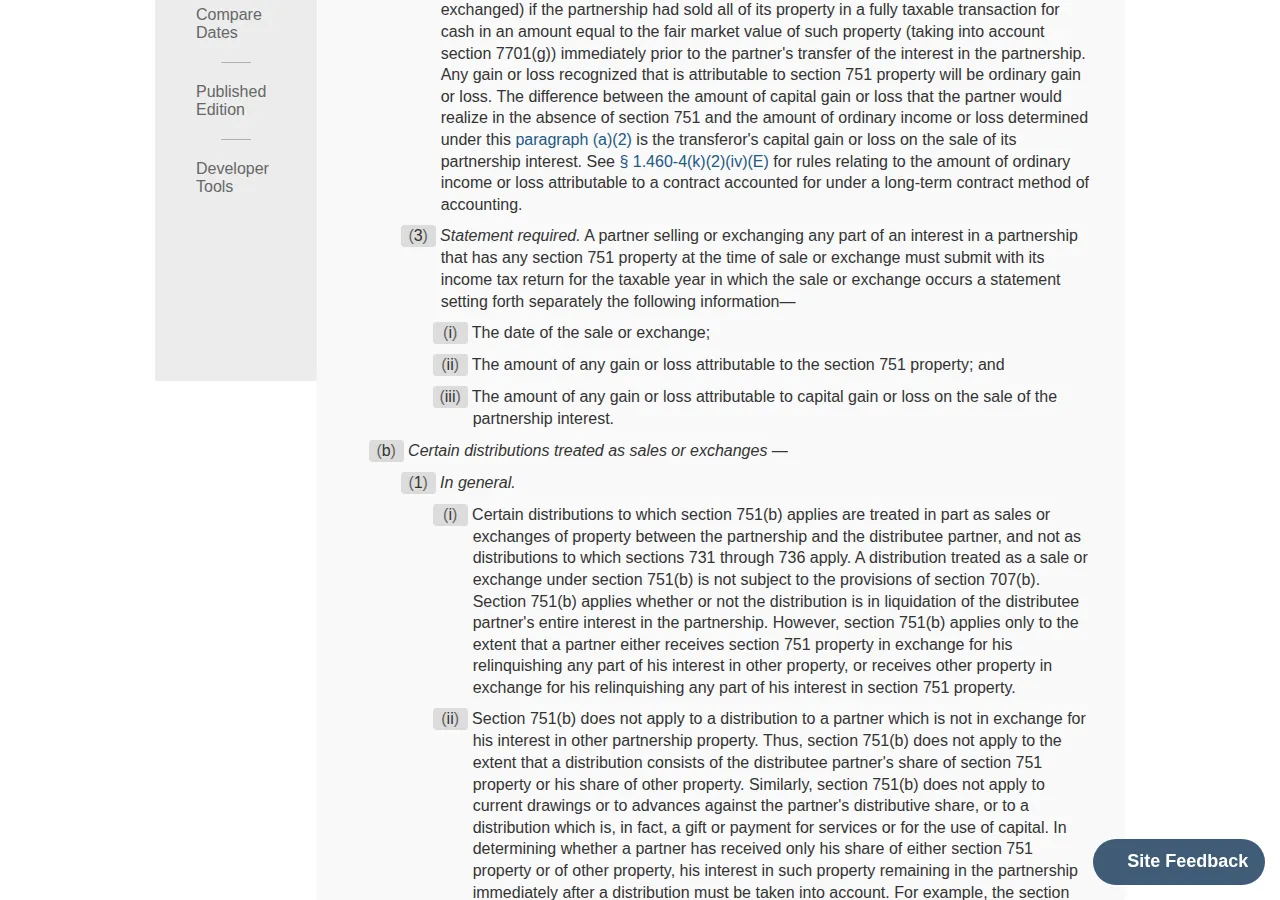
— Example A7: the section 755 aftermath. A buyer pays $210,000 for A one-third interest while a section 754 election is in effect. The section 743(b) adjustment is $210,000 minus the $110,000 share of inside basis, which is $100,000. Section 755 requires the adjustment to reduce the fair-market-value-to-basis gaps, keeping ordinary property with ordinary property. The gaps are $120,000 on receivables and $60,000 each on inventory, equipment, and land — $300,000 in total. A one-third share of the ordinary gap is $80,000 and of the capital gap is $20,000. The $80,000 is allocated in proportion to the gaps, 120 to 60 to 60: receivables $40,000, inventory $20,000, equipment $20,000. The remaining $20,000 goes to the land, for a total of $100,000. Without the election there is no adjustment, and the buyer inherits the $80,000 ordinary-income share A just paid tax on.
The section 751(b) ordering
The ordering is fixed by the regulation and by section 737(d)(2):
- Test section 751(b) first — measure each side against the partner share of section 751 property and of other property, and carve out the deemed exchange.
- Tax the deemed exchange — the partnership recognizes ordinary income or loss on the section 751 property it is treated as selling, allocated to the partners other than the distributee; the distributee recognizes gain, loss, or ordinary income on what was relinquished.
- Apply section 737 next — section 737(d)(2) excludes whatever section 751(b) already taxed.
- Apply section 731 to the remainder — money against outside basis; loss only in liquidation.
- Set bases under sections 732, 733, and 734 — purchased portion at purchase price, share portion at carryover basis.
The exceptions
Section 751(b)(2)(A) excludes a distribution of property the distributee contributed, governed instead by sections 731 through 736. Section 751(b)(2)(B) excludes section 736(a) payments to a retiring partner or a deceased partner successor, though section 736(b) payments are still tested for inventory exchanges.
Execution checklist
- [x] List every section 751 asset before any sale or distribution: receivables at fair market value, inventory with basis and value, and every recapture item.
- [x] Run the 120 percent test on the inventory before planning a distribution, and remember it does not apply to a sale of the interest.
- [x] Compute the section 751(a) ordinary amount by the hypothetical-sale method, not by allocating the sale price.
- [x] Measure the distribution against the partner share of each class first, and carve out the deemed exchange before sections 737 and 731.
- [x] Attach the section 751 statements: seller statement under Reg. § 1.751-1(a)(3); partnership and distributee statements under Reg. § 1.751-1(b)(5). Have your CPA check them.
- [x] After a sale, check the section 754 election and allocate any section 743(b) adjustment under section 755.
Who this playbook is not for
A partner in an accrual-method partnership with no receivables, no inventory, and no recapture property has no section 751 property, and a sale of the interest is entirely capital under section 741. A partner receiving exactly the partner share of each class is outside section 751(b). A retiring partner receiving only section 736(a) payments is outside section 751(b). S-Corp and C-Corp shareholders are outside this section entirely. A section 751 gain is not FICA wages.
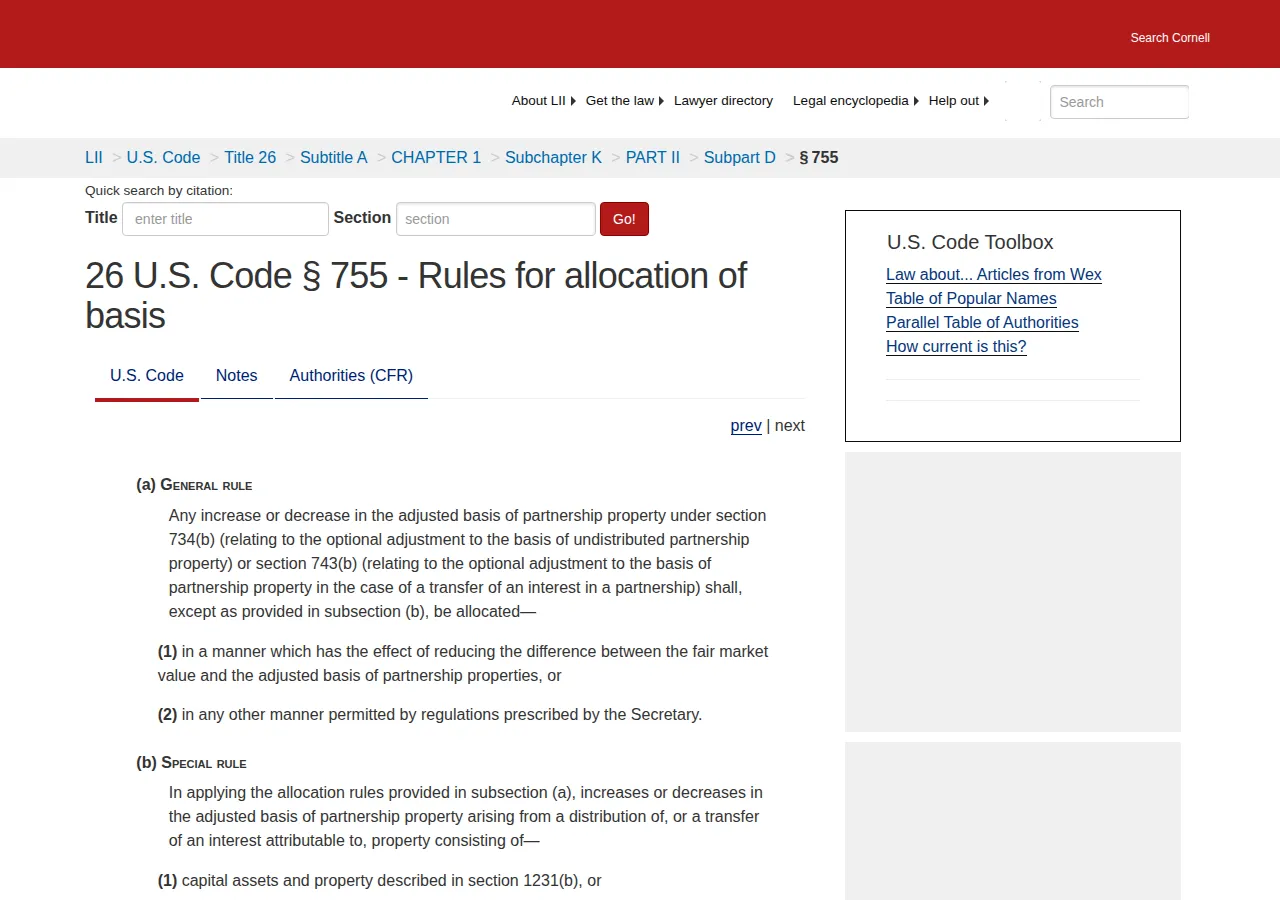
Related reading: Section 737 Partnership Excess Distribution Playbook, Section 731 Distributions Playbook, and Section 752 Debt Basis Playbook.
Founder & CEO Insight — Enow A. Jovial