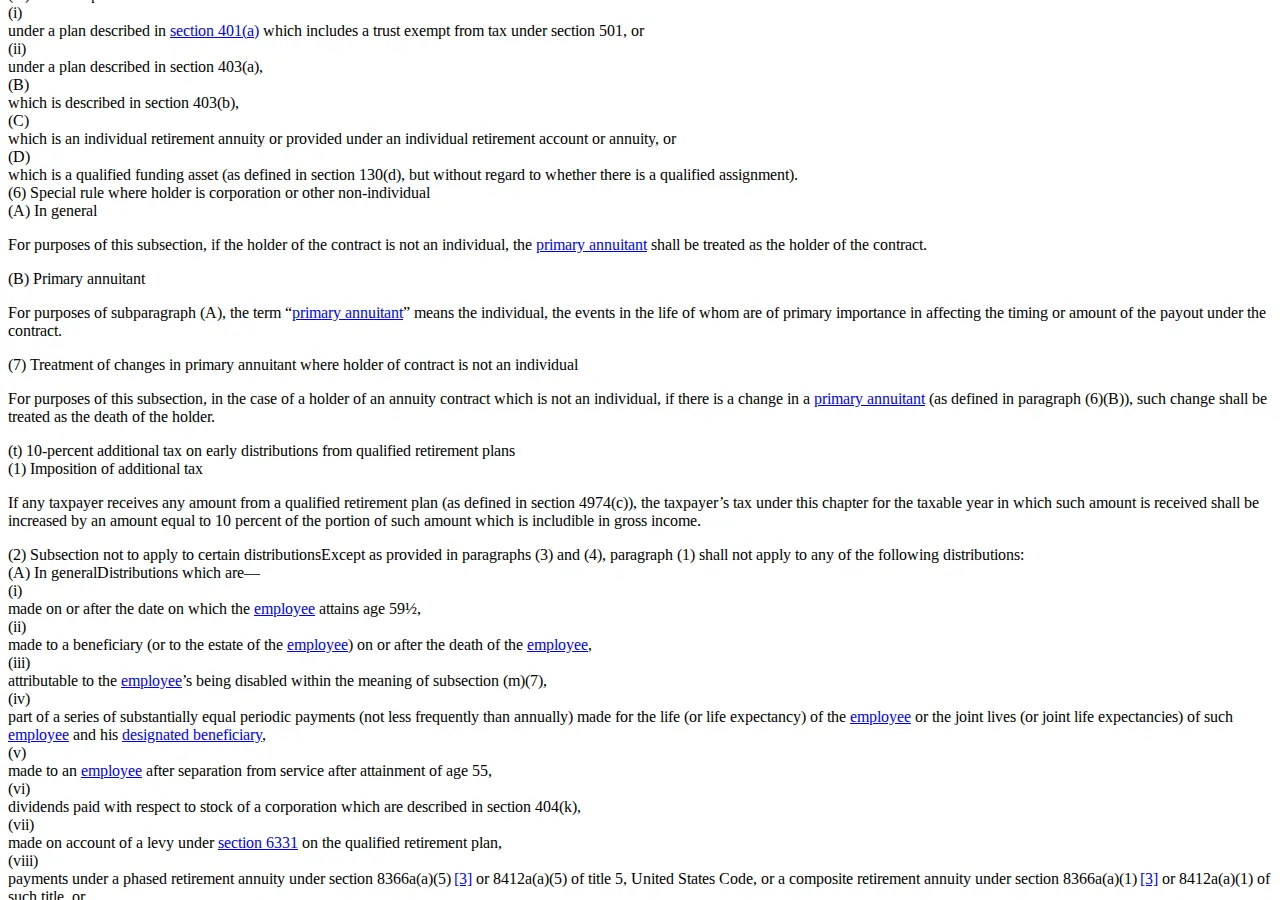
A 54-year-old takes $40,000 out of a 401(k) to cover a gap between jobs. At a 22 percent marginal rate the ordinary income tax is $8,800 — the number everyone expects. Then the return adds a second line: $4,000 more, 10 percent of the taxable distribution, under 26 U.S.C. § 72(t). The total cost is $12,800, and the extra $4,000 is the part nobody budgeted for. Section 72(t) is the toll on early access to retirement money, and its exceptions are the only way through without paying it.
What section 72(t)(1) actually says
Section 72(t)(1) states the rule in one sentence: if a taxpayer receives any amount from a qualified retirement plan, the tax for the year is increased by 10 percent of the portion includible in gross income. "Qualified retirement plan" is defined by reference to § 4974(c) — 401(a) plans, 403(a) annuity plans, 403(b) plans, IRAs, and governmental 457(b) plans, with the carve-outs below. And "includible in gross income" means the 10 percent applies only to the taxable slice: a distribution of after-tax basis, or a qualified Roth distribution, carries no additional tax.
The additional tax is not withholding and it is not a penalty the payer assesses. The payer reports the distribution on Form 1099-R with a code in box 7 — code 1 for an early distribution with no known exception, code 2 for one with an exception known to the payer — and the taxpayer claims the exception on their own return. IRS Topic 557, last reviewed November 17, 2026, states the mechanics: code 1 means the taxpayer enters the 10 percent directly on Schedule 2 of Form 1040; an exception the payer did not code must be claimed on Form 5329 and Schedule 2. The exception is the taxpayer's burden to prove, not the payer's to find.
Worked math 1: the $40,000 withdrawal at 22 percent
Example: a 54-year-old employee, still working, takes a $40,000 cash distribution from a 401(k). The full $40,000 is includible in gross income — no basis, no rollover, no exception. At a 22 percent marginal rate:
The total federal cost is $12,800, or 32 percent of the distribution, before state tax. The same $40,000 taken as a direct rollover to an IRA costs $0. The $4,000 is the price of taking the money as cash instead of moving it trustee to trustee — and the same mistake at $120,000 costs $12,000 in additional tax alone.
The exception map: every door in § 72(t)(2)
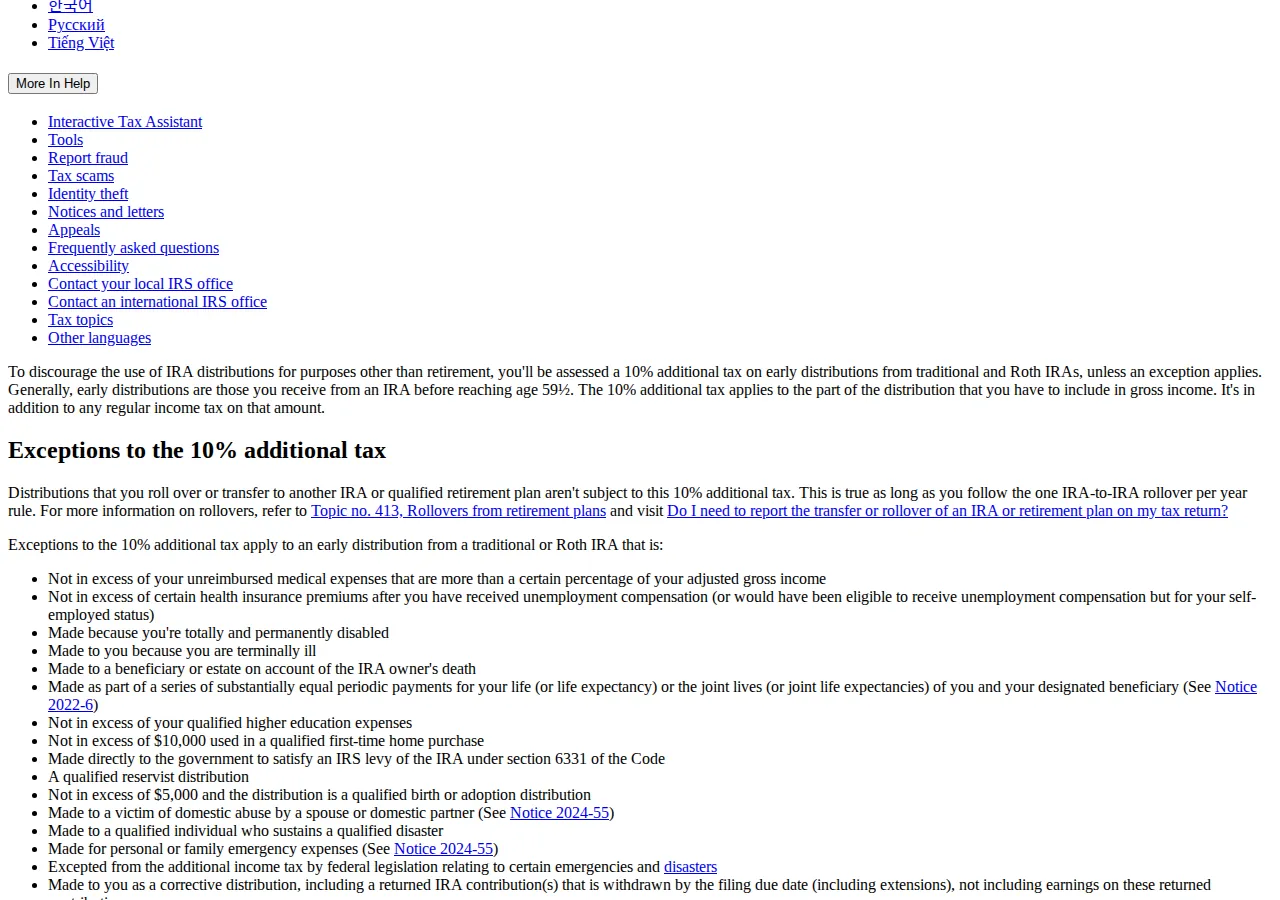
The exceptions fall into four groups: status-based with no cap (age 59½, death, disability, separation after 55, QDRO, IRS levy, reservist duty); expense-based and capped by the expense (medical, health premiums during unemployment, higher education); capped by statute ($10,000 lifetime first home, $5,000 per birth or adoption, $1,000 a year for emergencies, the lesser of $10,000 or 50 percent of the vested benefit for domestic abuse, $22,000 per disaster); and structural (substantially equal payments, terminal illness, pension-linked emergency savings).
| Exception | Cap or condition | Authority |
|---|---|---|
| Age 59½, death, disability | No cap; status-based | 26 U.S.C. § 72(t)(2)(A)(i)–(iii) |
| Separation from service at 55 | Separate after 55; does not apply to IRAs | § 72(t)(2)(A)(v); § 72(t)(3)(A) |
| Substantially equal periodic payments | Run to the later of age 59½ or 5 years; plan series must begin after separation | § 72(t)(2)(A)(iv); § 72(t)(3)(B); § 72(t)(4) |
| Medical expenses | Up to the § 213 deduction amount for the year | § 72(t)(2)(B) |
| Higher education expenses | Up to qualified expenses for the year | § 72(t)(2)(E); § 72(t)(7) |
| First-time homebuyer | $10,000 lifetime, used within 120 days | § 72(t)(2)(F); § 72(t)(8) |
| Birth or adoption | $5,000 per birth or adoption; repayable in 3 years | § 72(t)(2)(H) |
| Emergency personal expense | $1,000 a year, once a year, 3-year lockout | § 72(t)(2)(I) |
| Domestic abuse | Lesser of $10,000 or 50% of vested benefit | § 72(t)(2)(K) |
| Qualified disaster recovery | $22,000 aggregate per disaster | § 72(t)(2)(M); § 72(t)(11) |
| Terminal illness | Physician certification required | § 72(t)(2)(L) |
Substantially equal periodic payments: the SEPP operation
The SEPP exception is the only one that lets a taxpayer under 59½ take regular income from a retirement account indefinitely without the 10 percent. The series must be substantially equal periodic payments, not less frequently than annually, for the life or life expectancy of the employee or the joint lives of the employee and a designated beneficiary. IRS Notice 2022-6 lists the three approved methods: the required minimum distribution method, the fixed amortization method, and the fixed annuitization method. All three require a life-expectancy table from the notice; the second and third require an interest rate no greater than the greater of 5 percent or 120 percent of the federal mid-term rate for either of the two months before the first payment.
The RMD method recalculates every year. The IRS's own worked example in its SEPP guidance starts with an IRA balance of $810,250 and a single life expectancy of 31.6 at age 55, producing a first-year payment of $25,641:
The fixed amortization method locks the payment. Example: a 50-year-old with a $600,000 IRA balance, a single life expectancy of 36.2 years, and a 5 percent interest rate amortizes the balance over the expectancy:
The $36,187 stays fixed until the series ends; the RMD method's $25,641 moves every year as the balance and the expectancy change. A taxpayer who needs $36,000 a year cannot use the RMD method on an $810,250 balance — the method, not the need, sets the number.
Founder & CEO Insight — Enow A. Jovial
The modification bust: what breaking a SEPP costs
Section 72(t)(4) is the enforcement mechanism. If a series of payments that qualified under the SEPP exception is subsequently modified — other than by reason of death or disability — before the close of the 5-year period beginning with the first payment and after the employee attains age 59½, or before the employee attains age 59½, the tax for the first year of modification is increased by the tax that would have been imposed without the exception, plus interest for the deferral period. The series must run until the later of five years or age 59½; stopping at either milestone alone is a modification.
Example: the taxpayer above takes $25,641 a year for three years, then stops at 58 to take a lump sum instead. The recapture is 10 percent of everything already received:
The $7,692 lands in the year of modification, with interest running from the years the distributions would have been taxable. The statute allows one escape hatch: a rollover or transfer of the SEPP balance to another qualified plan is not a modification, provided the combined distributions would still satisfy the SEPP rules. Notice 2022-6 also permits a one-time change from the fixed methods to the RMD method — the only method change the guidance allows without busting the series.
The dollar-capped exceptions, worked
The first-time homebuyer exception is the most commonly misread. Section 72(t)(8) caps it at $10,000 over the taxpayer's lifetime, and the distribution must be used to pay qualified acquisition costs before the close of the 120th day after receipt. Example: a 45-year-old takes $40,000 from an IRA for a first home. Only $10,000 is excepted; the remaining $30,000 carries the additional tax:
The $10,000 is a lifetime cap per taxpayer, not per home, and it covers the taxpayer, a spouse, a child, a grandchild, or an ancestor.
The birth or adoption exception under § 72(t)(2)(H) allows up to $5,000 per birth or adoption, repayable to an eligible plan within 3 years. The emergency exception under § 72(t)(2)(I) is tighter: one distribution a year, no more than the lesser of $1,000 or the vested benefit over $1,000, and no further emergency distribution from the same plan for three calendar years unless the first is fully repaid or the taxpayer has since contributed at least as much. The domestic abuse exception under § 72(t)(2)(K) is capped at the lesser of $10,000 — indexed for inflation after 2024 — or 50 percent of the vested benefit, and must occur within one year of the abuse. The disaster exception under § 72(t)(2)(M) is capped at $22,000 per qualified disaster, for an individual whose home was in the disaster area and who sustained an economic loss.
The terminal-illness exception under § 72(t)(2)(L) requires a physician's certification under § 101(g)(4)(A), except that 84 months is substituted for 24 months, and like the birth, emergency, and domestic-abuse exceptions it may be repaid within three years.
Who this playbook is for — and who should not use it
This playbook is for the taxpayer under 59½ deciding whether a distribution is excepted, and for the adviser or CPA documenting that decision before the return is filed. It is not for the taxpayer over 59½ — the additional tax does not apply at all — and it is not a substitute for the plan document: a plan that does not permit a distribution the statute excepts still does not have to make it. Governmental 457(b) plans are the notable carve-out: a distribution from one is generally not subject to the 10 percent additional tax at all, unless the amount is attributable to a rollover from another eligible plan or IRA. The Form 1099-R playbook covers how the distribution is reported — including the code 1 versus code 2 decision that decides whether Form 5329 is needed — and the Roth IRA versus traditional IRA playbook covers the contribution side. An LLC owner funding retirement through a Solo 401(k) should read the Solo 401(k) versus SEP IRA playbook before touching the distribution rules: the plan type decides which exceptions are even available. The EIN on the return, the CPA who signs it, and the GAAP books behind the plan all have to agree on the same dates.
Execution checklist
- [x] Step 1 — Price the distribution before taking it: ordinary tax at your marginal rate plus 10 percent of the taxable portion, on the full amount, before any exception.
- [x] Step 2 — Match the reason to a § 72(t)(2) subparagraph: age, separation at 55, SEPP, medical, education, first home, birth or adoption, emergency, domestic abuse, disaster, or terminal illness.
- [x] Step 3 — Check the IRA restriction: separation-at-55 and QDRO exceptions do not apply to IRAs under § 72(t)(3)(A); a rollover into an IRA can forfeit the exception.
- [x] Step 4 — If using a SEPP, pick the method in writing: RMD, fixed amortization, or fixed annuitization under Notice 2022-6, with the rate at or below the greater of 5 percent or 120 percent of the federal mid-term rate.
- [x] Step 5 — Diary the SEPP end date: the later of five years from the first payment or age 59½; any modification before then triggers recapture plus interest under § 72(t)(4).
- [x] Step 6 — File Form 5329 when the 1099-R does not code the exception: code 1 means the payer does not know; the exception is claimed on the return.
- [x] Step 7 — Respect the caps and the clocks: $10,000 lifetime for a first home, $5,000 per birth or adoption, $1,000 a year for emergencies, $22,000 per disaster.
Who should not rely on this playbook
A governmental 457(b) distribution generally escapes the 10 percent entirely, and a taxpayer over 59½ does not need the exception list. But a plan document that forbids the distribution is not overridden by the statute: § 72(t) removes a tax, it does not create a right to the money.