Form 1099-R is the receipt for money leaving a retirement account. Every designated distribution of $10 or more from a pension, annuity, profit-sharing plan, IRA, or insurance contract produces one: the payer files it, the recipient gets a copy, and the IRS matches four numbers against the recipient's return — box 1, box 2a, box 4, and box 7a. Get any of the four wrong and the recipient's return gets a letter. Figures as read on November 16, 2026.
Reading the boxes: what each number is
Box 1 is the gross distribution — everything that left the account, before withholding and before any basis is subtracted. Box 2a is the taxable amount: box 1 minus the recipient's basis, which sits in box 5 (employee contributions, designated Roth contributions, or insurance premiums). Box 4 is the federal income tax withheld. Box 7a carries the distribution code; box 7b is checked for a traditional IRA, SEP, or SIMPLE IRA. The payer's EIN goes on the form; the recipient's SSN or ITIN identifies the account.
| Box | Contents | Our worked example |
|---|---|---|
| 1 | Gross distribution | $85,000 left the IRA |
| 2a | Taxable amount | $80,000 (box 1 minus $5,000 basis) |
| 4 | Federal income tax withheld | $0 on a direct rollover; 20% on cash |
| 5 | Employee contributions / designated Roth contributions / insurance premiums | $5,000 |
| 7a | Distribution code(s) — maximum two | 7 for a normal distribution; G for a direct rollover |
| 7b | IRA/SEP/SIMPLE checkbox | X for a traditional IRA distribution |
| 11 | First year of designated Roth contribution | Year starting the five-year Roth clock |
One reporting rule is easy to miss: a distribution from a designated Roth account to a Roth IRA is coded H, not G, and a trustee-to-trustee transfer between IRAs of the same type is not a distribution and is not reported. The recipient's TIN may be truncated on the payee statement — Copy B is a fillable PDF on IRS.gov — never on the IRS copy.
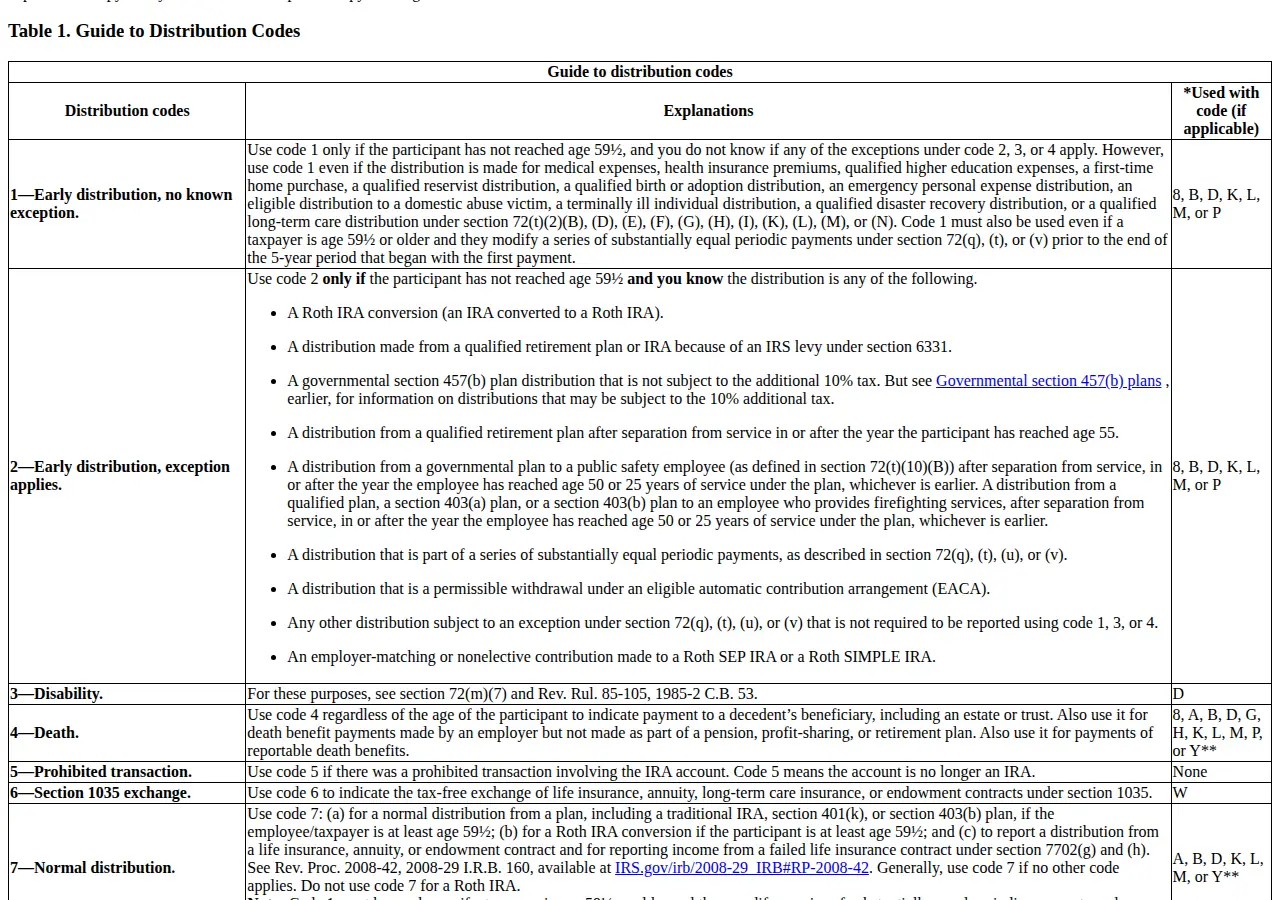
Table 1 of the 2026 instructions, above: the code guide the payer must follow.
The distribution codes: Table 1, and the two-code limit
Box 7a carries at most two alphanumeric codes, and only three numeric combinations are permitted on one form: codes 8 and 1, 8 and 2, or 8 and 4. If part of a distribution is premature (code 1) and part is not (code 7), the payer files two Forms 1099-R, one for each part. Use code 1 whenever the payer does not know whether an exception applies, even for distributions that turn out to be excepted.
| Code | Meaning | When the payer uses it |
|---|---|---|
| 1 | Early distribution, no known exception | Participant under 59½, no known exception — including medical, education, first-home, reservist, birth-or-adoption, emergency, domestic-abuse, terminal-illness, disaster, or long-term-care |
| 2 | Early distribution, exception applies | Roth conversion, IRS levy, governmental 457(b), separation at 55+, public safety at 50 or 25 years, substantially equal payments |
| 3 | Disability | Section 72(m)(7) disability |
| 4 | Death | Payment to a beneficiary, estate, or trust |
| 5 | Prohibited transaction | The IRA is no longer an IRA |
| 6 | Section 1035 exchange | Tax-free exchange of life insurance, annuity, long-term care, or endowment |
| 7 | Normal distribution | Participant 59½ or older; default when no other code applies (never for a Roth IRA) |
| 8 | Excess contributions plus earnings | Corrective distribution under section 408(d)(4) |
| G | Direct rollover and direct payment | Qualified plan, 403(b), or governmental 457(b) to an eligible plan |
| H | Direct rollover of a designated Roth account distribution to a Roth IRA | Roth to Roth only — never use G here |
| J | Early distribution from a Roth IRA, no known exception | Roth IRA or Roth SIMPLE IRA when Q or T do not apply |
| Q | Qualified distribution from a Roth IRA | Meets the five-year rule and a qualifying event |
| T | Roth IRA distribution, exception applies | Roth distribution where an exception to the 10% tax applies |
Code 1 carries a trap: it must be used even if the taxpayer is 59½ or older and modifies a series of substantially equal periodic payments within five years of the first payment. The instructions give Jordan, who began payments at 57 and modified them at 61 — the year of the modification is reported with code 1, even though Jordan is over 59½. A payer that codes it 7 has told the IRS the distribution is normal.
The 20 percent rule: eligible rollover distributions
IRC § 3405(c)(1) states the rule without ambiguity: for any designated distribution that is an eligible rollover distribution, the payor shall withhold 20 percent of the distribution. The only exception is section 3405(c)(2): no withholding where the distributee elects under section 401(a)(31)(A) a direct payment to an eligible retirement plan.
The 20 percent is withholding, not tax — it is credited against the recipient's tax for the year. But it is mandatory: the recipient cannot opt out on a cash distribution, and the payer cannot waive it. The section 402(f) notice the payer must give before the distribution must explain the rollover rules, the direct rollover option, the mandatory 20 percent withholding, and how the receiving plan's restrictions may differ. A payer that skips the notice has failed the distribution.
The 60-day rollover and the shortfall trap
Section 402(c)(3) gives the recipient 60 days from receipt to roll a distribution into another eligible retirement plan. Sixty calendar days, not business days, starting the day the money arrives. A direct rollover never touches the clock: trustee to trustee, no withholding, no deadline. An indirect rollover — the recipient takes the cash and deposits it themselves — is the trap.
Work the example through. The recipient takes $120,000 in cash, $24,000 is withheld, $96,000 lands in the bank. Deposit the full $120,000 into the new IRA within 60 days — $96,000 received plus $24,000 from their own funds — and the rollover is complete, nothing is taxable, and the $24,000 withheld is credited on their return. Deposit only the $96,000 received and the $24,000 shortfall is taxable income, plus a $2,400 additional tax if they are under 59½ with no exception. The withholding did not protect them: the credit arrives at filing time while the tax is due now.
The 10 percent additional tax
Section 72(t) imposes a 10 percent additional tax on early distributions from qualified plans and IRAs — on top of ordinary income tax, not instead of it. The exceptions are the same list that drives code 2: separation at 55, disability, death, substantially equal payments, IRS levy, medical expenses, first-time home purchase, higher education, reservist duty, birth or adoption, emergency expenses, domestic abuse, and terminal illness.
Governmental section 457(b) plans are the notable carve-out: a distribution from a governmental 457(b) plan is generally not subject to the 10 percent additional tax — unless the amount is attributable to a rollover from another eligible plan or IRA, in which case the rolled-over portion is treated as if it came from a 401(a) plan. A 457(b) distribution that is solely non-rollover money is coded 2; a distribution mixing both sources needs separate Forms 1099-R for each part.
Required minimum distributions: age 73 and the 26.5 factor
You generally must start taking withdrawals from a traditional IRA, SEP IRA, SIMPLE IRA, or workplace plan when you reach age 73. The first RMD is due by April 1 of the year after you turn 73, and every later RMD is due by December 31. The amount is the prior December 31 balance divided by the life expectancy factor in Table III (Uniform Lifetime) of Publication 590-B — 26.5 at age 73. Publication 590-B's own example: $34,800 ÷ 26.5 = $1,313.
Roth IRA owners have no RMD during their lifetime, but beneficiaries of Roth IRAs do — and the custodian must give the participant a statement by January 31 when an RMD is required. The RMD is reported on Form 1099-R like any other distribution, and the 10-year rule for most non-spouse beneficiaries is the deadline that now matters more than the old stretch. Our Solo 401(k) versus SEP IRA playbook covers the plans whose distributions these forms report — including the LLC owner whose Solo 401(k) sits on a DB-plan-free design — and our Roth IRA versus traditional IRA playbook covers the contribution side. Distributions are not wages, so no FICA is withheld from them.
Founder & CEO Insight — Enow A. Jovial
Qualified charitable distributions and the Roth edge
A qualified charitable distribution is a direct transfer from an IRA trustee to an eligible charity: nontaxable, excluded from income, and reported on Form 1099-R with code Y alongside code 7 for a normal distribution, code 4 for an inherited IRA, or code K for traditional IRA assets without a readily available fair market value. For tax year 2026, code Y is optional. The statute caps QCDs at $100,000 a year, indexed for inflation after 2023. A QCD reported as a normal distribution is still a QCD on the recipient's return. The HSA cousin of this rule sits in our Form 1099-SA playbook.
Deadlines and the penalty ladder
Furnish the recipient statement by January 31 of the year after the distribution. File by February 28 on paper, or March 31 e-filed. The penalty ladder under sections 6721 and 6722 is the same ladder that governs every information return:
$60 per return corrected within 30 days of the due date, $130 corrected more than 30 days after but by August 1, $340 after August 1 or not filed, and at least $680 per return for intentional disregard, with no maximum. Filing forty 1099-Rs in September instead of February costs $13,600. Have a CPA review the first filing batch — a systematic coding error repeats forty times.
Who should not use this playbook
A payer whose payments are all wages should not use Form 1099-R — wage withholding belongs on Form W-2 and Form 941. And a recipient over 59½ taking a normal distribution and reporting it correctly does not need the rollover or additional-tax sections — the form is a receipt, not a problem, and the only number that matters is box 2a.
The execution checklist
- [x] Step 1: Before any distribution, deliver the section 402(f) notice and record the direct-rollover election.
- [x] Step 2: Code box 7a from Table 1: code 1 when no exception is known, code G for a direct rollover, code H for a designated Roth account to a Roth IRA.
- [x] Step 3: For an indirect rollover, diary day 60 on the day the money arrives, and confirm the full distribution amount is deposited.
- [x] Step 4: Compute box 2a as box 1 minus box 5 basis, and check the Roth five-year clock in box 11 before coding Q or T.
- [x] Step 5: For a participant turning 73, compute the RMD from the prior December 31 balance divided by the Table III factor.
- [x] Step 6: For a QCD, make the transfer trustee to charity and enter code Y with code 7, 4, or K.
- [x] Step 7: Furnish by January 31, file by February 28 on paper or March 31 e-filed. Run the taxable amount and the withholding through the tax estimator.
Form 1099-R reports the money after it moves, but every expensive number on it — the 20 percent withheld, the 60-day shortfall, the 10 percent additional tax — is decided before the distribution is made. Choose the direct rollover, code from the table, and diary the clock, and the form is a receipt. Take the cash, miss the clock, and guess the code, and it is the first page of a letter.