Roth IRA vs Traditional IRA: 2026 Contribution Limits Playbook
Founder & CEO Insight — Enow A. Jovial
A Roth IRA and a traditional IRA share one contribution limit, one deadline, and one custodian form — and almost nothing else. The traditional taxes you at the exit; the Roth taxes you at the door. Which one leaves more in your hands depends on two numbers only: your bracket when you contribute and your bracket when you withdraw.
1. The 2026 Contribution Limit: One Ceiling for Both Accounts
The limit is combined, not per account. IRS Notice 2025-67 raised the amount under 26 U.S.C. § 219(b)(5)(A) from $7,000 to $7,500 for 2026, and the age-50 catch-up under § 219(b)(5)(B)(ii) from $1,000 to $1,100 — the first catch-up increase since the SECURE 2.0 Act tied it to inflation. For 2026, total contributions to all of your traditional and Roth IRAs cannot exceed $7,500 ($8,600 at 50 or older), or your taxable compensation if less. A $7,500 Roth plus a $7,500 traditional contribution is a $7,500 excess, taxed at 6% per year until removed.
| 2026 limit | Under 50 | Age 50 or older | Authority |
|---|---|---|---|
| Combined traditional + Roth IRA | $7,500 | $8,600 | § 219(b)(5) |
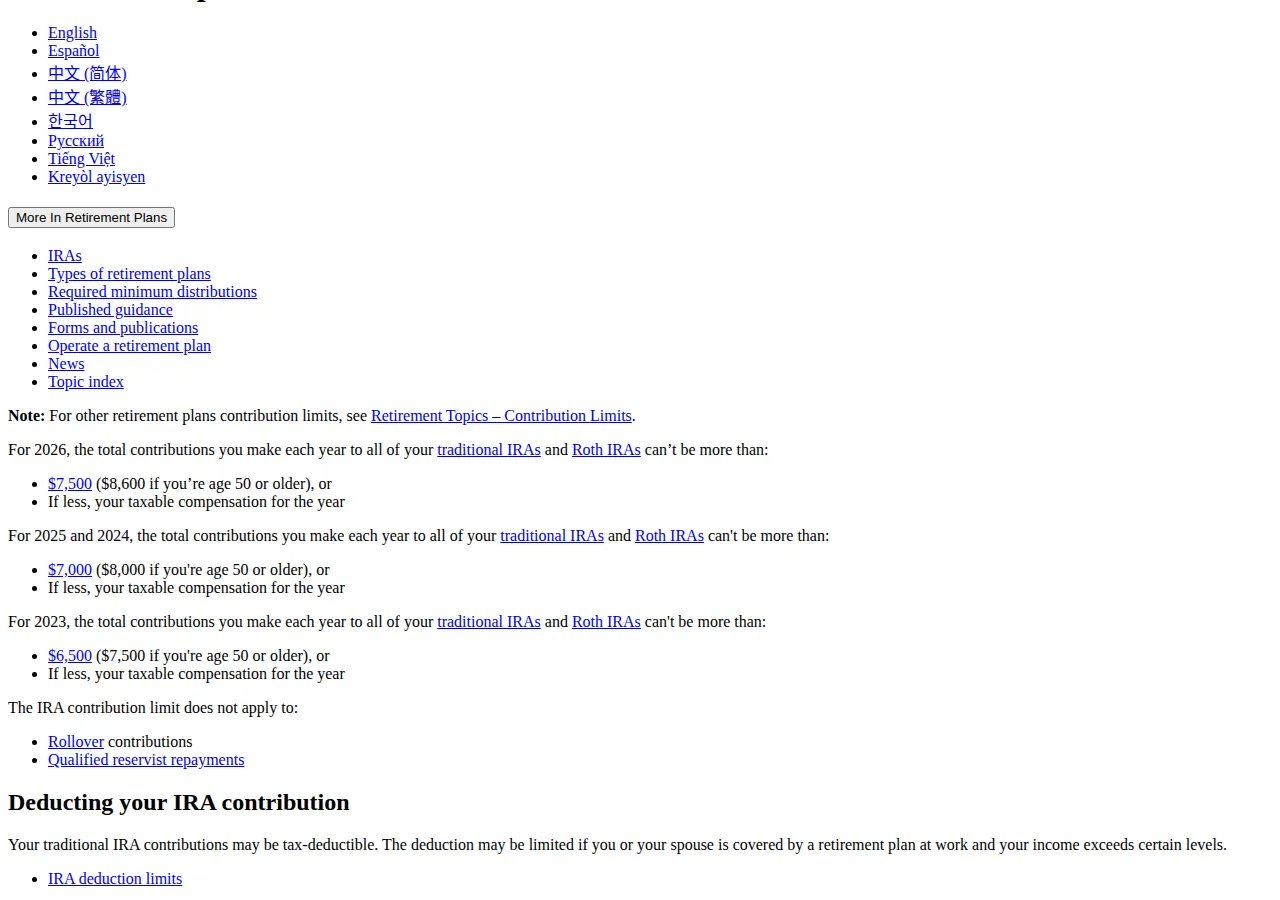
The limit is capped by taxable compensation: W-2 Box 1 wages — the wages FICA is withheld from — and net self-employment earnings under SECA count; a worker who earned $3,500 can contribute $3,500, not $7,500. An S-corp or LLC distribution is not Box 1 pay and does not count as compensation. There is no age limit on contributions for 2020 and later. The deadline is the return due date without extensions: 2026 contributions can be made until April 15, 2027, if designated for 2026.
2. Roth IRA Income Phase-Outs: The Gate That Closes First
A Roth contribution is an income-tested privilege under 26 U.S.C. § 408A(c)(3), and Notice 2025-67 moved every threshold up for 2026. Inside the range, your allowed contribution shrinks with how far your modified adjusted gross income (MAGI) sits into it. Above the upper bound, the direct route is closed. Married filers living apart face a $0–$10,000 range on both tables.
| Filing status, 2026 | Full Roth contribution | Partial (phase-out range) | None | Authority |
|---|---|---|---|---|
| Single / head of household | Below $153,000 | $153,000–$168,000 | Above $168,000 | § 408A(c)(3) |
| Married filing jointly | Below $242,000 | $242,000–$252,000 | Above $252,000 | § 408A(c)(3) |
IRS Publication 590-A, Worksheet 2-2, fixes the arithmetic: divide the MAGI excess over the lower bound by the range width ($15,000 single, $10,000 joint), multiply by your limit, subtract, and round up to the nearest $10 (floor $200).
Example: single filer, MAGI $160,500. The excess over $153,000 is $7,500; divided by the $15,000 range that is 0.500, so the reduction is 0.500 × $7,500 = $3,750 and the limit is $3,750.
Joint filers at MAGI $247,000 land in the same place: ($247,000 − $242,000) ÷ $10,000 = 0.500, so their Roth limit is also $3,750, with the other $3,750 able to go into a traditional IRA.
3. Traditional IRA Deductibility Phase-Outs: Two Gates, Not One
A traditional IRA contribution is always allowed. The deduction is what phases out — and only when you or your spouse is covered by a retirement plan at work. If neither spouse is covered, the full contribution is deductible at any income. If one of you is covered, Notice 2025-67 sets these 2026 ranges under 26 U.S.C. § 219(g):
| Situation, 2026 | Full deduction | Partial | None | Authority |
|---|---|---|---|---|
| Single / head of household, covered at work | Below $81,000 | $81,000–$91,000 | Above $91,000 | § 219(g) |
| Married filing jointly, contributor covered | Below $129,000 | $129,000–$149,000 | Above $149,000 | § 219(g) |
| Married filing jointly, contributor not covered, spouse covered | Below $242,000 | $242,000–$252,000 | Above $252,000 | § 219(g)(7) |
Example: single filer, covered at work, MAGI $86,000. The excess over $81,000 is $5,000; divided by the $10,000 range that is 0.500, so only $3,750 of the $7,500 contribution is deductible and $3,750 is nondeductible basis. Track that basis on Form 8606 every year — without it, you pay tax twice on the same dollars.
A single filer covered at work loses the traditional deduction at $91,000 but keeps full Roth access until $153,000. Above $168,000, neither door is open directly — which is where the backdoor in section 6 earns its place.
4. Tax Now vs Tax Later: The Math That Decides Everything
A Roth contribution costs after-tax dollars and grows tax-free; a traditional contribution costs pre-tax dollars and is taxed at withdrawal. At 7% a year over 30 years, $7,500 contributed annually grows to:
A Roth saver paying 22% today puts $7,500 after tax into the account; the pre-tax cost is $7,500 ÷ (1 − 0.22) = $9,615.38. A traditional saver contributing that same $9,615.38 pre-tax ends with $9,615.38 × 94.460786 = $908,277 before tax. At a 22% withdrawal bracket, $908,277 × (1 − 0.22) = $708,456 — identical to the Roth, to the dollar. The tie is exact.
Example: the bracket falls to 12% in retirement. The traditional account keeps $908,277 × 0.88 = $799,284, beating the Roth by $90,828.
Case Study: the bracket rises to 32% in retirement. The traditional account keeps $908,277 × 0.68 = $617,628, losing to the Roth by the same $90,828.
At 50 or older the scale changes, not the logic: $8,600 a year for 30 years at 7% grows to $8,600 × 94.460786 = $812,363. The catch-up is worth $103,907 of extra ending wealth at either bracket.
5. The 5-Year Rule and Qualified Distributions
Tax-free Roth withdrawals need two keys, not one. Under 26 U.S.C. § 408A(d)(2), a qualified distribution must be made on or after age 59½, after death, on account of disability within § 72(m)(7), or as a qualified special purpose distribution — and under § 408A(d)(2)(B) it must also fall outside the 5-taxable-year period beginning with the first taxable year of any Roth contribution. Pass age 59½ in year four and the earnings are still taxable, plus the 10% penalty under § 72(t).
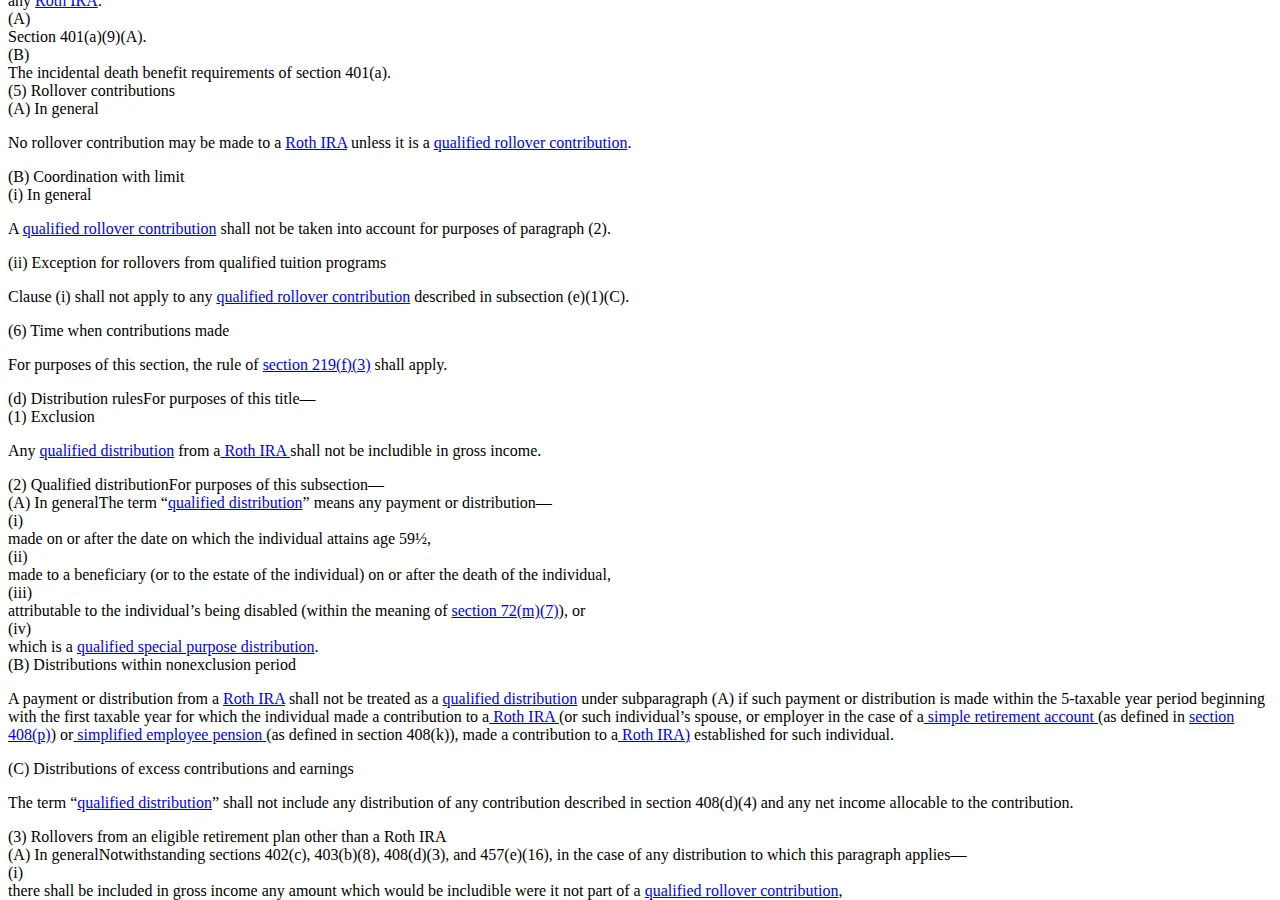
Contributions themselves are always available: a nonqualified distribution is treated as coming from contributions first, so withdrawing what you put in never triggers tax or penalty. Earnings are the gated part. Open your first Roth IRA early — the clock starts with the first tax year of any Roth contribution.
6. The Backdoor Roth and the Pro-Rata Trap
When MAGI closes the direct Roth door, the backdoor route stays open: make a nondeductible traditional IRA contribution, then convert it to a Roth IRA. Section 408A places no income limit on conversions, and § 408A(d)(3) treats the conversion as a rollover included in gross income to the extent it would otherwise be taxable. The trap is the pro-rata rule: the IRS aggregates all of your traditional, SEP, and SIMPLE IRAs and taxes each conversion in proportion to the pre-tax share.
Example: the $6,510 surprise. A saver holds $93,000 of pre-tax money in a traditional IRA, contributes $7,000 nondeductible, and converts $7,000. The pre-tax share is $93,000 ÷ $100,000 = 93%, so $7,000 × 0.93 = $6,510 of the conversion is taxable and only $490 escapes tax.
The clean way through is to empty the pre-tax bucket first: roll a traditional IRA balance into an employer 401(k), which the aggregation rule does not count, then run the backdoor on a zero pre-tax balance. Skip that step and the backdoor converts mostly pre-tax money at your marginal rate. File Form 8606 for both steps; the tax lands in the year of conversion.
7. Required Minimum Distributions: The Traditional IRA's Exit Tax
A traditional IRA cannot sit untouched forever. Under 26 U.S.C. § 401(a)(9)(C)(v), the applicable age is 73 for anyone who turns 72 after December 31, 2022 and 73 before January 1, 2033, and 75 for anyone who turns 74 after December 31, 2032 — in practice, 73 for those born 1951–1959, 75 for those born in 1960 or later. The first RMD is due by April 1 of the year after you reach the applicable age, every later RMD by December 31. The amount is the prior year-end balance divided by the IRS Uniform Lifetime Table period.
Example: $500,000 balance at age 73. The Uniform Lifetime Table factor at 73 is 26.5, so the RMD is $500,000 ÷ 26.5 = $18,868.
A Roth IRA has no RMD while the owner is alive: the balance compounds untouched. A missed traditional RMD draws a 25% excise tax on the shortfall, reduced to 10% if corrected within two years — turning an $18,868 oversight into a $4,717 bill. For the employer-plan counterpart, see our Solo 401(k) vs SEP IRA playbook.
8. Roth Conversion Ladders: Moving Money on Your Schedule
A conversion ladder moves pre-tax money into a Roth in annual slices sized to fill a low bracket without spilling into the next one. Each tranche is taxed in the year of conversion and becomes available tax-free once its own 5-year clock runs.
Example: five rungs of $40,000. Converting $40,000 a year for five years at 22% costs $8,800 of tax per rung — $44,000 in total — and moves $200,000 into the Roth. The first rung is available tax-free in year six, the second in year seven. Pay the tax from cash outside the IRA: paying it from the converted amount shrinks the Roth.
9. The Decision Table
| Decision factor | Roth IRA wins | Traditional IRA wins | Authority |
|---|---|---|---|
| Retirement bracket higher than today | Yes — pay 22% now, avoid 32% later | No | § 408A(d) |
| Retirement bracket lower than today | No | Yes — deduct at 22%, withdraw at 12% | § 219(g) |
| MAGI above $168,000 single / $252,000 joint | Backdoor only, pro-rata applies | Deductibility usually gone too | § 408A(c)(3) |
| RMD planning | No RMD while owner alive | RMDs from 73 / 75, 25% excise if missed | § 401(a)(9)(C)(v) |
10. Who Should Avoid Each Account
A Roth IRA is the wrong tool when your current bracket is the highest you will ever see and you need the deduction now — a founder in a peak-income year who will retire to a lower bracket pays 32% or 37% to fund a Roth and never recovers the premium. It is also the wrong tool when you cannot fund it without the tax saving: if the $1,650 deduction at 22% is what makes it affordable, choose the traditional account.
A traditional IRA is the wrong tool when you are already in a low bracket with a high bracket ahead — a medical resident, a junior engineer, a founder in a loss year — because the deduction is worth 12% today and the withdrawal will cost 24% or more later. It is also the wrong tool when you want the money to compound for heirs: forced RMDs at 73 drain the account on the IRS schedule, not yours. Above the Roth phase-out with a large pre-tax IRA balance, do not start a backdoor conversion until the pro-rata math is run. For HSA reporting, see our Form 1099-SA HSA distributions playbook; for the estate side, our estate tax exemption playbook.
11. Execution Checklist: Before April 15
- [x] Step 1: Confirm your 2026 MAGI and workplace coverage against both phase-out tables (§ 408A(c)(3) and § 219(g)).
- [x] Step 2: Run the bracket comparison using the $708,456 tie-point math in section 4.
- [x] Step 3: Run the pro-rata calculation before any backdoor conversion, and roll pre-tax IRA balances into an employer plan first if the taxable share is material.
- [x] Step 4: Open the Roth early and contribute by April 15, 2027 — a small first contribution starts the 5-taxable-year clock under § 408A(d)(2)(B). Fund it by ACH; custodians hold your SSN or ITIN from account opening.
- [x] Step 5: File Form 8606 for any nondeductible contribution or conversion, and reconcile the basis yearly — or have your CPA do it.
- [x] Step 6: Calendar the RMD — 73, or 75 if born in 1960 or later — and take the first distribution by December 31 of that year. Run the estimate on the tax calculator first.
Re-run the two tables every January, when the IRS publishes the new inflation adjustments. The account matters less than contributing the full $7,500 — or $8,600 at 50 or older — every year the law allows.