A partner contributes a warehouse to the partnership. The warehouse is worth $800,000 and the partner's adjusted basis is $200,000. Fourteen months later the partnership distributes $600,000 in cash. On paper, two separate events: a tax-free contribution under Section 721, a tax-free distribution under Section 731. In substance, one event: the partner sold three-quarters of a warehouse for $600,000. Section 707(a)(2)(B) collapses the two steps into the sale they are, and Regulation Section 1.707-3 supplies the test, the presumption, and the worked math.
The statute in one paragraph
Section 707(a)(1) states the default rule: when a partner transacts with the partnership other than as a member, the transaction is treated as occurring between the partnership and a non-partner. Section 707(a)(2) splits that rule into two prongs. Subparagraph (A) covers services and property transfers paired with a related allocation and distribution. Subparagraph (B) — the disguised-sale rule — covers a transfer of money or other property by a partner to the partnership, plus a related transfer of money or other property by the partnership to the partner, when the two transfers together are properly characterized as a sale or exchange of property. Section 707(b) adds the related-party rules for controlled partnerships, and Section 707(c) defines guaranteed payments.
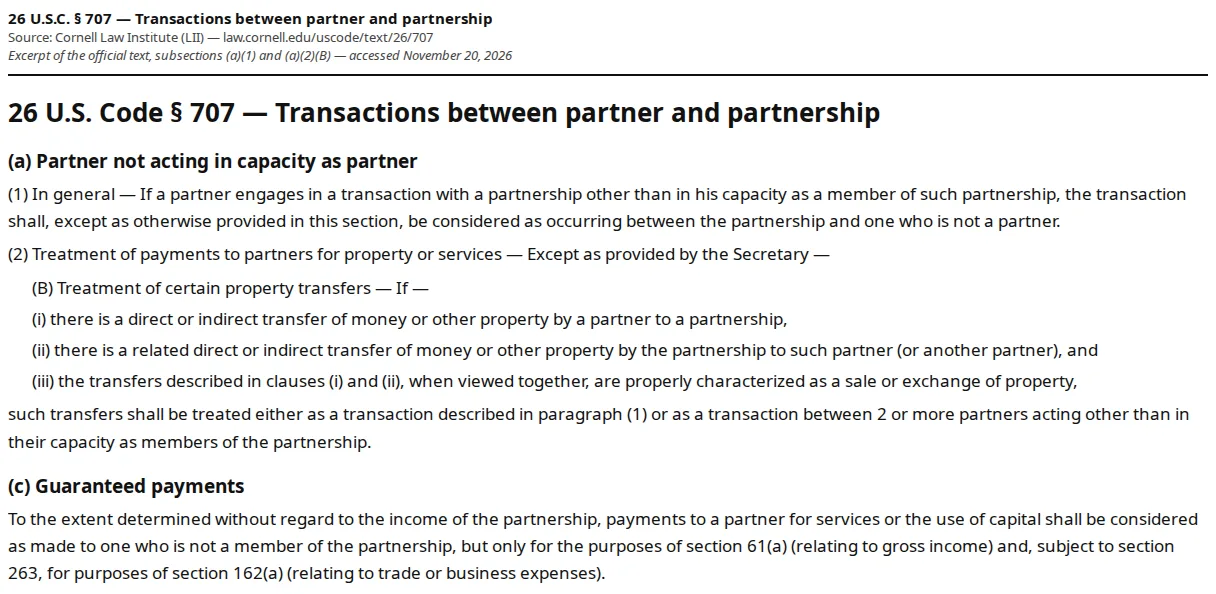
The prongs answer different questions. Subparagraph (A) asks whether a service or property transfer plus a related allocation is really a purchase of services or property. Subparagraph (B) asks whether a contribution plus a distribution is really a sale. A payment for the use of capital is tested under subsection (c). The same dollars can fail under one prong and pass under another, so the agreement must name the prong it satisfies.
Section 707 reaches every partnership-taxed vehicle. A multi-member LLC, an LP, or an LLP files Form 1065 under its EIN and lives under Section 707. It does not reach an S-Corp or a C-Corp — those entities answer to Section 267, not Section 707 — and a CPA who maps a client's structure must check the election first, because a single-member LLC that never elected partnership treatment has no partner to transact with. GAAP capital accounts and tax capital accounts diverge here too: a disguised sale changes tax basis, not book basis, and the NOL the partnership carries forward is computed on the tax numbers. Guaranteed payments for services also draw SECA tax, while a limited partner's distributive share is excluded under Section 1402(a)(13).
The 2025 rewrite: what Congress changed on July 4, 2025
The One Big Beautiful Bill Act, Public Law 119-21, amended Section 707(a)(2) on July 4, 2025. The change is a single phrase in paragraph (2): "Under regulations prescribed by the Secretary" became "Except as provided by the Secretary." The amendment applies to services performed and property transferred after July 4, 2025. Congress added a rule of construction: nothing in the amendment creates any inference about the treatment of payments for services performed, or property transferred, on or before enactment.
Before the amendment, the statute delegated the whole paragraph (2) mechanism to regulations the Secretary would prescribe; after it, the statute reads as a self-executing rule subject to exceptions the Secretary provides. The regulation that governs the analysis — Section 1.707-3 — was not rewritten, and its two-year presumption, ten-factor test, and examples still control the facts. What changed is the hierarchy: a taxpayer can no longer argue a transaction escapes paragraph (2) because no regulation squarely prescribes its treatment.
The two-part test and the ten factors
Regulation Section 1.707-3(b)(1) states the test in two parts. A contribution and a distribution constitute a sale, in whole or in part, only if, first, the transfer of money or other consideration would not have been made but for the transfer of property, and second, the subsequent transfer is not dependent on the entrepreneurial risks of partnership operations.
| Factor | What the IRS looks for | Authority |
|---|---|---|
| Timing and amount determinable | Later transfer fixed early | § 1.707-3(b)(2)(i) |
| Legally enforceable right | Partner holds an enforceable right to the transfer | § 1.707-3(b)(2)(ii) |
| Right secured | Right to receive the transfer is secured | § 1.707-3(b)(2)(iii) |
| Contributions arranged | Someone agreed to contribute to fund the transfer | § 1.707-3(b)(2)(iv) |
| Loan arranged | Someone loaned the money | § 1.707-3(b)(2)(v) |
| Partnership debt incurred | Partnership borrowed to fund the transfer | § 1.707-3(b)(2)(vi) |
| Liquid assets held | Partnership holds cash beyond business needs | § 1.707-3(b)(2)(vii) |
| Burdens and benefits shifted | Distributions or control exchange ownership | § 1.707-3(b)(2)(viii) |
| Disproportionate size | Transfer dwarfs the partner's continuing interest | § 1.707-3(b)(2)(ix) |
| No repayment obligation | No repayment obligation, or a distant one | § 1.707-3(b)(2)(x) |
The regulation weighs the factors on the facts at the earliest transfer date. No single factor decides. A contribution followed fourteen months later by a cash distribution promised in the agreement, secured by an escrow, and funded by a partnership loan scores on factors (i), (ii), (iii), (v) and (vi). A distribution made three years later, set by the year's profits, with no prior promise, scores on almost none of them.
The two-year presumption and the disclosure duty
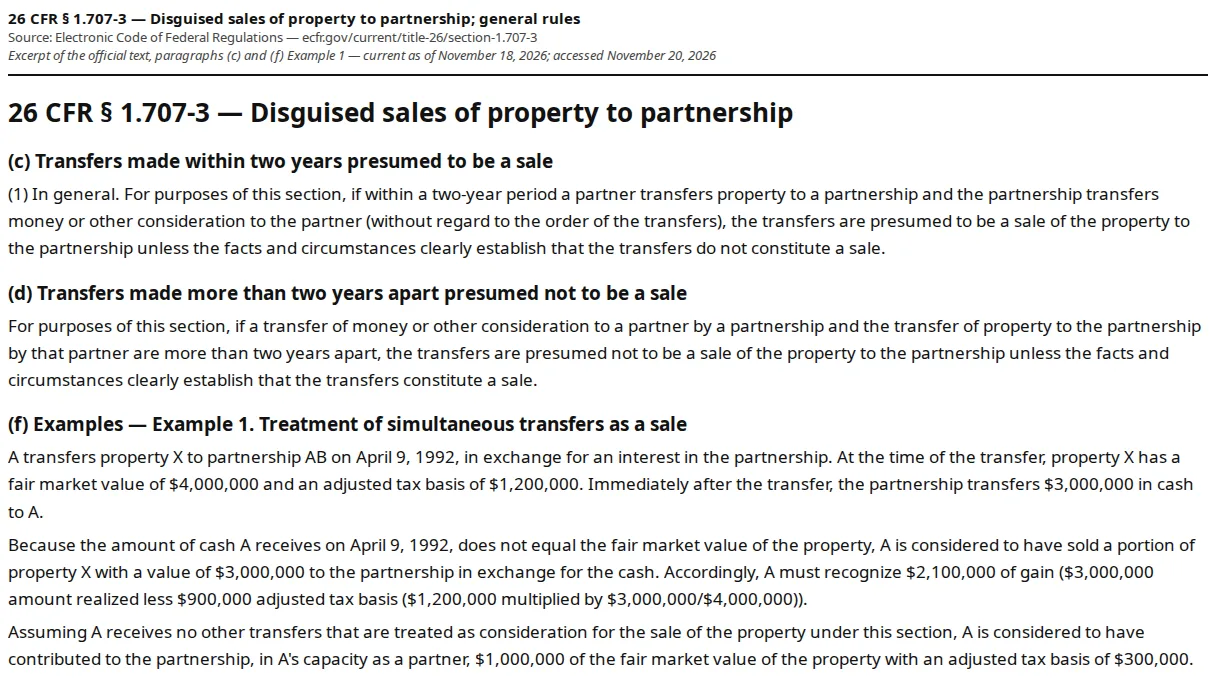
Regulation Section 1.707-3(c)(1) draws the bright line. If within a two-year period a partner transfers property to a partnership and the partnership transfers money or other consideration to the partner, the transfers are presumed to be a sale of the property to the partnership unless the facts and circumstances clearly establish that they do not constitute a sale. Paragraph (d) draws the mirror image: transfers more than two years apart are presumed not to be a sale unless the facts and circumstances clearly establish that they are. Inside two years the partner must clearly establish no sale; outside, the IRS must clearly establish a sale.
Disclosure rides on the presumption. Under Section 1.707-3(c)(2), when a partner transfers property and the partnership transfers money or other consideration within two years, the partner treats the transfers as other than a sale, and the transfer is not a guaranteed payment for capital, a reasonable preferred return, or an operating cash flow distribution, the partner must disclose the transfers to the IRS under Regulation Section 1.707-8 — filed on Form 8275. The disclosure does not concede the sale; it tells the IRS the position exists.
The worked math: the regulation's own example
Regulation Section 1.707-3(f), Example 1, does the arithmetic. Partner A transfers property X to partnership AB on April 9, 1992. Property X has a fair market value of $4,000,000 and an adjusted basis of $1,200,000. Immediately after the transfer, the partnership transfers $3,000,000 in cash to A. Because $3,000,000 is less than the $4,000,000 fair market value, A sold three-quarters of property X and contributed the remaining quarter.
A recognizes $2,100,000 of gain and is treated as having contributed $1,000,000 of fair market value — the unsold quarter — with an adjusted basis of $300,000. The sold portion takes three-quarters of the $1,200,000 basis; the contributed portion keeps one-quarter.
Apply the same formula to the warehouse above. Fair market value $800,000, adjusted basis $200,000, cash distribution $600,000 fourteen months after the contribution. The transfers fall inside two years, so the sale is presumed. Treated as a sale of three-quarters of the warehouse, the gain is $600,000 minus $200,000 times $600,000 over $800,000 — $450,000 recognized in the year of the distribution. The contributed remainder is $200,000 of fair market value with a $50,000 basis. Move the distribution to twenty-five months and the presumption reverses. Eleven months is the difference between a $450,000 gain the partner must disprove and one the IRS must prove.
The three safe harbors and the debt rule
Regulation Section 1.707-4 carves three categories out of the disguised-sale analysis. A guaranteed payment for capital is a payment determined without regard to partnership income, made for the use of the partner's capital — and it is not treated as part of a sale under Section 1.707-3. But a payment designed to liquidate all or part of the partner's interest in contributed property, rather than to provide a return on an investment, is not a payment for the use of capital at all. A reasonable guaranteed payment for capital is presumed to be a guaranteed payment, notwithstanding the two-year presumption, unless the facts and circumstances clearly establish that it is part of a sale. A reasonable preferred return — a preferential distribution of cash flow with respect to capital contributed, matched by an allocation of income or gain — carries the same presumption. An operating cash flow distribution is likewise not treated as part of a sale.
Regulation Section 1.707-5 governs the liability half. When a partnership assumes property subject to a qualified liability, the partnership is treated as transferring consideration only to the extent provided in paragraph (a)(5). When the liability is not a qualified liability, the partnership is treated as transferring consideration to the extent the liability exceeds the partner's share immediately after the assumption, determined under the Section 752 rules. A partner who contributes property encumbered by a $500,000 mortgage, and retains a 40 percent share of that liability, has received $300,000 of consideration — $500,000 minus the $200,000 share the partner still bears.
The related-party rules and guaranteed payments
Section 707(b) governs sales and exchanges with controlled partnerships. No deduction is allowed for losses from sales or exchanges of property, other than an interest in the partnership, between a partnership and a person owning directly or indirectly more than 50 percent of the capital or profits interest, or between two partnerships in which the same persons own more than 50 percent. If the transferee later sells the property, Section 267(d) applies as if the loss had been disallowed under Section 267(a)(1). Gains are ordinary income where the property in the transferee's hands is other than a capital asset under Section 1221, on the same test. Ownership is determined under the constructive-ownership rules of Section 267(c), other than paragraph (3). A 60-percent partner who sells the partnership a loss property gets no loss deduction; one who sells it inventory gets ordinary income instead of capital gain.
Section 707(c) treats guaranteed payments as made to a person who is not a member of the partnership, but only for Section 61(a) on gross income and, subject to Section 263, Section 162(a) on trade or business expenses. A $120,000 annual payment for services, determined without regard to partnership income, is ordinary income to the partner under Section 61(a) and deductible by the partnership under Section 162(a) — unlike a distributive share, which the partnership cannot deduct. The trap is the label: calling a distribution a guaranteed payment does not make it one.
The 30-day compliance sequence
- Map every contribution-and-distribution pair. List each contribution and distribution, with dates and amounts.
- Run the two-year test on each pair. Any pair inside two years is presumed a sale; any pair more than two years apart is presumed not.
- Score the ten factors. For each flagged pair, score the Section 1.707-3(b)(2) factors (i) through (x) at the earliest transfer date.
- Run the partial-sale math. For each presumed sale, compute the gain and the remainder's basis.
- Test the safe harbors. Ask whether each distribution is a guaranteed payment, a reasonable preferred return, or an operating cash flow distribution, and whether any liability is a qualified liability.
- Check the 50 percent line. Apply Section 707(b) and Section 267(c) to every sale or exchange with the partnership.
- File the disclosure. Where required, prepare the Form 8275 disclosure under Regulation Section 1.707-8 before filing.
- [x] Pairs mapped: contributions and distributions listed.
- [x] Two-year test run: each pair classified.
- [x] Ten factors scored.
- [x] Partial-sale math computed.
- [x] Safe harbors tested.
- [x] 50 percent line checked.
- [x] Disclosure filed: Form 8275 prepared.
Founder & CEO Insight — Enow A. Jovial
Related reading on this site: our Section 721 partnership contribution guide for the nonrecognition rule it overrides, our Section 731 partnership distributions guide for the distribution rules it recharacterizes, and our Section 752 partnership debt allocation guide for the liability-share math. Before signing, run the partial-sale gain through the break-even calculator at the distribution amounts the agreement promises.