Section 59A (BEAT): The Base Erosion Anti-Abuse Tax Playbook
Section 59A (BEAT): The Base Erosion Anti-Abuse Tax Playbook
Section 59A imposes a minimum tax on large US corporations that shrink their American tax base by paying deductible amounts to foreign related parties. The name on the statute is the base erosion and anti-abuse tax — BEAT. A corporation that is big enough and pays enough to foreign affiliates must recompute taxable income with those deductions added back, apply the BEAT rate, and pay the excess over regular tax liability — a tax "in addition to any other tax imposed by this subtitle." This playbook runs the operation on Meridian US Inc., a fictional C corporation with $600,000,000 of average gross receipts and $30,000,000 of base erosion tax benefits — and $1,050,000 of additional tax. The arm's-length rules behind the payments are worked in the transfer-pricing-intercompany-services-playbook; the companion deduction for foreign-derived income is priced in the section-250-fdii-gilti-deduction-playbook.
Step 1: Are you an applicable taxpayer? Two tests, both mandatory
Section 59A(e)(1) sets three conditions, and all three must hold. First, the taxpayer must be a corporation other than a regulated investment company, a real estate investment trust, or an S corporation. Second, the gross-receipts test: average annual gross receipts of at least $500,000,000 for the 3-taxable-year period ending with the preceding taxable year. Third, the base-erosion percentage test: base erosion tax benefits of at least 3 percent of total deductions — 2 percent if any member of the group is a bank or a registered securities dealer.
The tests are measured on the aggregate group, not on the single corporation. Treasury Regulation § 1.59A-2(c) provides that a taxpayer that is a member of an aggregate group determines its gross receipts and base erosion percentage on the basis of the whole group, and transactions between members of the group are not taken into account.
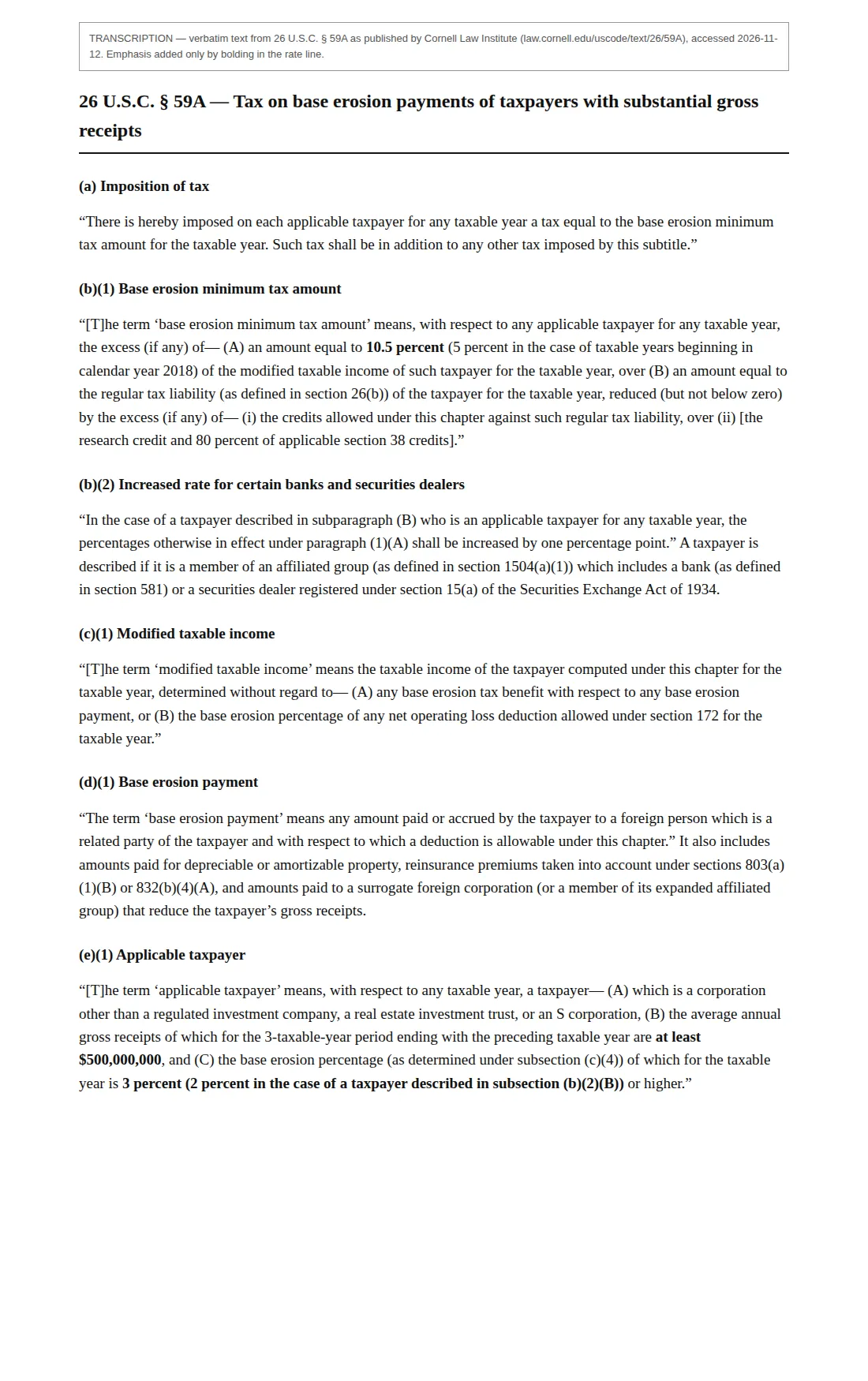
Meridian's numbers, stated as assumptions: gross receipts of $560,000,000 in 2023, $610,000,000 in 2024, and $630,000,000 in 2025 — a three-year average of $600,000,000, clearing the $500,000,000 test. Total deductions of $500,000,000, of which $30,000,000 are base erosion tax benefits — 6.0 percent, clearing the 3 percent test. Meridian is an applicable taxpayer.
Step 2: What counts as a base erosion payment
The definition in § 59A(d)(1) is broad: any amount paid or accrued by the taxpayer to a foreign person that is a related party of the taxpayer and with respect to which a deduction is allowable. Related party means, broadly, a person related under § 267(b) or § 707(b)(1), or a 25-percent owner — control, not mere dealing, is the trigger.
| Payment | Treatment | Authority |
|---|---|---|
| Deductible payment to a foreign related party (interest, royalty, service fee) | Base erosion payment | § 59A(d)(1) |
| Amount paid for depreciable or amortizable property from a foreign related party | Base erosion payment; the benefit is the depreciation allowed | § 59A(d)(2) |
| Reinsurance premiums to a foreign related party | Base erosion payment | § 59A(d)(3) |
| Payment to a surrogate foreign corporation (post-Nov. 9, 2017 inversion) reducing gross receipts | Base erosion payment | § 59A(d)(4) |
| Cost of goods sold | NOT a base erosion payment | § 59A(d)(5); Reg. § 1.59A-3(b)(3) |
| Services eligible for the services cost method under § 482, charged at cost with no markup | NOT a base erosion payment | § 59A(d)(5) |
| Qualified derivative payments, reported under § 6038A(b)(2) | NOT a base erosion payment | § 59A(h) |
Two exclusions carry most of the planning weight. Cost of goods sold is excluded outright, which is why buying finished goods from a foreign affiliate faces a different BEAT profile from paying the same affiliate a royalty to make them. And the services cost method exclusion means low-margin back-office services — accounting, HR, IT support — charged at cost with no markup can sit outside the base entirely, provided the services meet the § 482 requirements.
Step 3: The rate — and the 12.5 percent figure that no longer exists
The most common error in 2026 models is using a rate that was repealed before it took effect. The Tax Cuts and Jobs Act set the rate at 5 percent for 2018 and 10 percent for 2019 through 2025, and scheduled a rise to 12.5 percent for tax years beginning after 2025. The One Big Beautiful Bill Act, Pub. L. 119-21, § 70331, enacted July 4, 2025, struck out that scheduled rise and substituted 10.5 percent for 10 percent, effective for tax years beginning after December 31, 2025. The Instructions for Form 8991 (Rev. December 2025) state the operative table plainly.
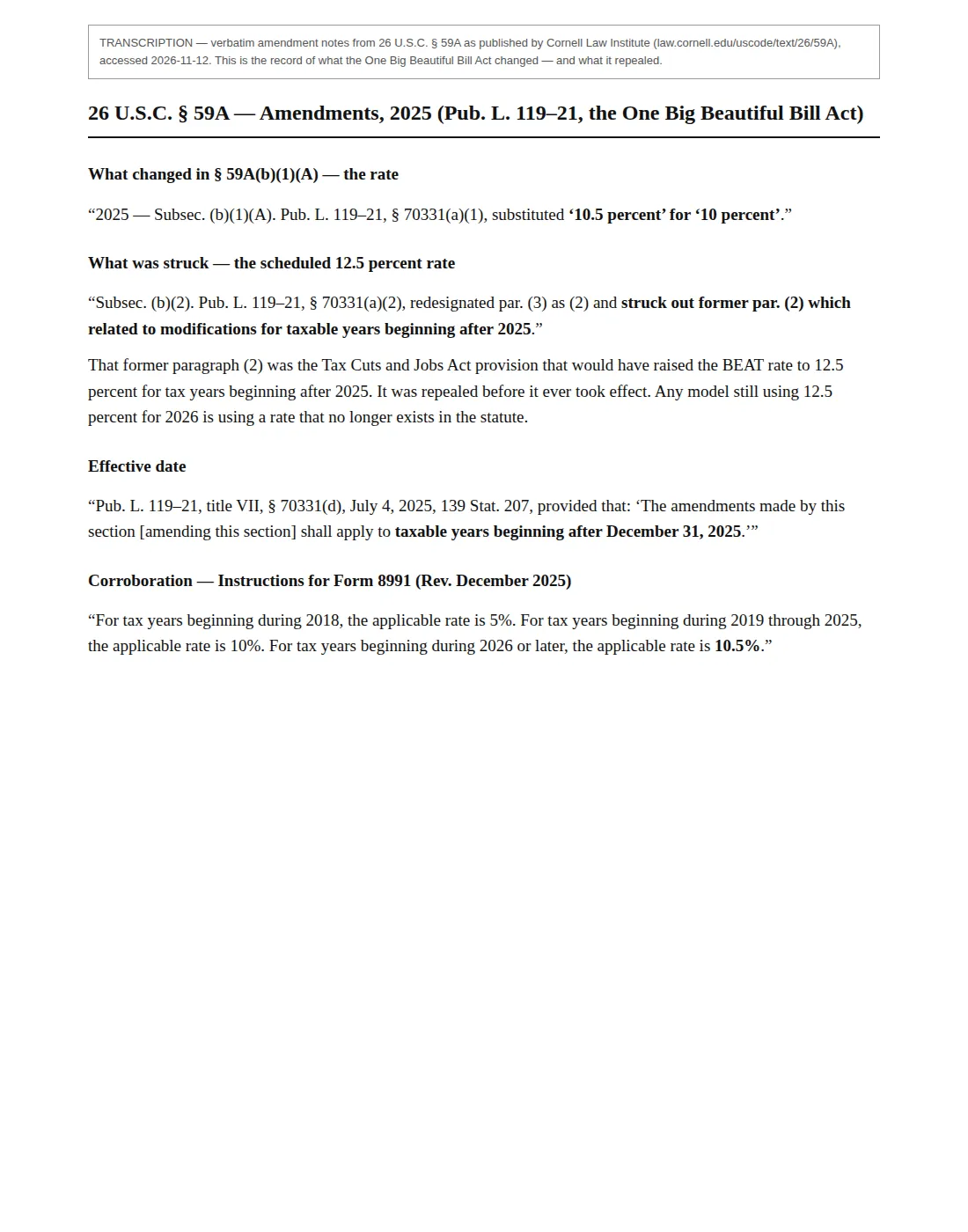
| Tax years beginning during | General rate | Bank / securities-dealer group |
|---|---|---|
| 2018 | 5% | 6% |
| 2019 through 2025 | 10% | 11% |
| 2026 or later | 10.5% | 11.5% |
Any spreadsheet still carrying 12.5 percent for 2026 is modelling a law that was never in force. On $50,000,000 of modified taxable income, the difference between the repealed 12.5 percent and the operative 10.5 percent is $1,000,000 of tentative BEAT.
Step 4: Worked example — Meridian US Inc., tax year 2026
All inputs here are stated assumptions for a fictional corporation, not sourced figures. Meridian is a calendar-year C corporation with $600,000,000 of average gross receipts and a 6.0 percent base erosion percentage, so it is an applicable taxpayer. Its regular taxable income for 2026 is $20,000,000, its base erosion tax benefits are $30,000,000, and it has no net operating loss deduction and no general business credits.
Modified taxable income is regular taxable income recomputed without the base erosion tax benefits:
The tentative BEAT is the 2026 rate applied to that income:
Regular tax liability at the 21 percent corporate rate:
With no credits, the adjusted regular tax liability is $4,200,000, so the base erosion minimum tax amount is the excess:
Meridian's total federal income tax for 2026 is $4,200,000 of regular tax plus $1,050,000 of BEAT — $5,250,000, which equals the tentative BEAT, as it must when BEAT binds. At the 2025 rate of 10 percent the additional tax would have been $800,000, so the OBBBA's half-point rise costs Meridian $250,000. In a group that includes a bank, the 11.5 percent rate would give additional tax of $1,550,000.
Step 5: The deduction waiver — a lever that can cost more than it saves
Schedule B lets a taxpayer elect to waive deductions, reducing both its base erosion tax benefits and its total deductions, and can push its base erosion percentage below 3 percent so it is no longer an applicable taxpayer. On Meridian's numbers, waiving $16,000,000 of base-erosion deductions would cut base erosion tax benefits to $14,000,000 and total deductions to $484,000,000:
At 2.89 percent, Meridian escapes applicable-taxpayer status. But waiving a deduction raises regular taxable income by the same $16,000,000, to $36,000,000, and regular tax at 21 percent becomes $7,560,000. The waiver trades $1,050,000 of BEAT for $3,360,000 of additional regular tax — a net cost of $2,310,000. A waiver only pays when the BEAT saved exceeds the regular tax created.
Step 6: Form 8991 — the filing operation
The Instructions for Form 8991 (Rev. December 2025) state its purpose directly: "Use Form 8991 to determine a taxpayer's base erosion minimum tax amount for the year." Schedule A reports every base erosion payment and base erosion tax benefit, and it is required for any corporation with average annual gross receipts of $500,000,000 or more — even one that turns out not to be an applicable taxpayer. Schedule B reports waived deductions. Schedule C determines the credits that reduce regular tax liability — the research credit under § 41 is fully allowed, and applicable § 38 credits are allowed only up to 80 percent of the lesser of the credits or the base erosion minimum tax amount.
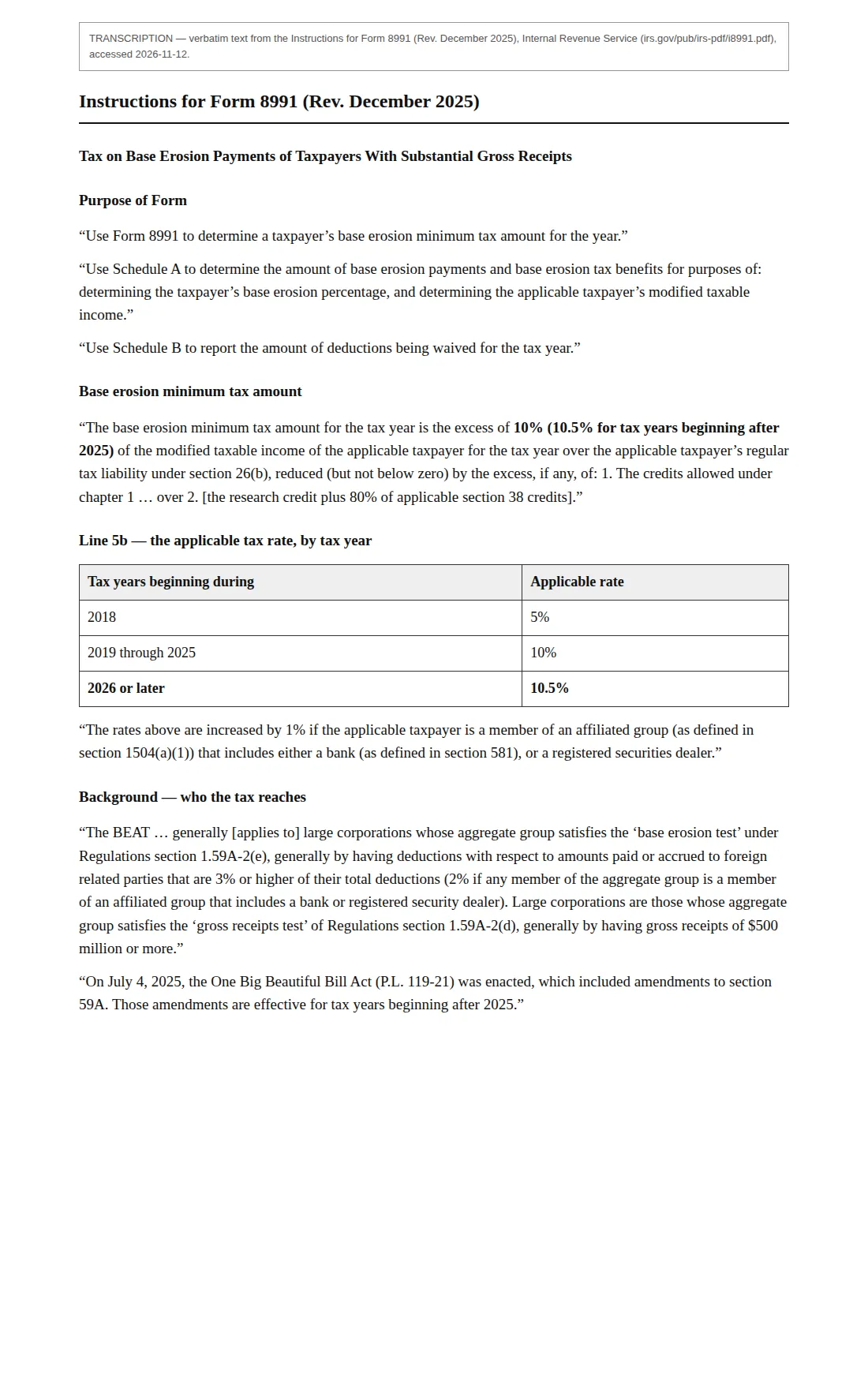
Part IV of the form is the computation itself: line 5b carries the applicable rate — 10.5 percent for tax years beginning in 2026 or later — line 5c is the tentative BEAT, line 5d is the adjusted regular tax liability, and line 5e is the base erosion minimum tax amount, entered on the corporation's return — for a Form 1120 filer, on Schedule J, line 1f.
The CPA who prepares the return files Form 8991 under the corporation's EIN, and the same EIN ties the form to the Form 1120 and the Form 5472 the group files for its foreign related parties. An LLC taxed as a partnership never files Form 8991, an S-Corp is excluded from applicable-taxpayer status by § 59A(e)(1)(A), and a C-Corp's GAAP books and its tax return can disagree on the same payment — the book expense and the base erosion payment are measured on different rules, so the CPA reconciles the GAAP carrying amount to the tax schedule, with the EIN noted beside it, before the form is signed.
Step 7: The risk and penalty layer
Information reporting comes first: § 6038A requires the reporting of transactions with foreign related parties, and the Tax Cuts and Jobs Act raised the penalty for failure to furnish information or maintain records under § 6038A(d)(1) and (2) from $10,000 to $25,000 per failure. QDP treatment also depends on this reporting — § 59A(h)(2)(B) denies it without the required § 6038A(b)(2) information. The anti-abuse rules in Reg. § 1.59A-2(c)(5)(iii) disregard transactions entered into with a principal purpose of changing the period taken into account to avoid applicable-taxpayer status. The irs-form-5472-foreign-corporation-reporting-playbook runs that § 6038A reporting, including the $25,000 penalty.
Cross-border context: BEAT does not act alone
The § 250 deduction — 33.34 percent of foreign-derived deduction eligible income and 40 percent of net CFC tested income from 2026 under the OBBBA — reduces regular taxable income, which can make BEAT bind more easily, because a smaller regular tax liability leaves a larger gap for the tentative BEAT to exceed. Treaties do not override BEAT, and the US has not adopted the OECD Pillar Two global minimum tax as a substitute. Before restructuring a payment to escape BEAT, run the ROI calculator on the restructuring cost against the tax saved; a reorganization that costs more than the BEAT it avoids is a loss dressed as planning.
The build operation, start to finish
- [x] Pull the aggregate group's gross receipts for the three preceding tax years; average them against $500,000,000.
- [x] Total all deductions, isolate base erosion tax benefits, and compute the base erosion percentage against 3 percent (or 2 percent).
- [x] Classify every payment to a foreign related party under § 59A(d); mark the exclusions.
- [x] Compute modified taxable income, apply the correct year's rate — 10.5 percent for 2026 — and compare against adjusted regular tax liability.
- [x] Model the Schedule B waiver both ways before electing it; never waive on the percentage alone.
- [x] Complete Schedule A, attach Form 8991, and enter the amount on Schedule J, line 1f of Form 1120.
- [x] Confirm § 6038A reporting covers every QDP and base erosion payment; a missing report costs $25,000.
- [x] Re-run the model whenever the group changes — an acquisition, a disposition, or a new foreign affiliate re-tests both thresholds.
Founder & CEO Insight — Enow A. Jovial